
Segnali stradali riflettenti serve one purpose regardless of where they are deployed: return vehicle headlight beams toward drivers so that signs remain legible at night and in poor weather. The retroreflective sheeting bonded to the aluminum face of every segnale stradale riflettente governs this performance — and the standards that define what ‘good enough’ means for that sheeting are, depending on the market, ASTM D4956 (U.S.A.), IN 12899-1 (EU and Middle East), BS One 12899-1 (Regno Unito), o AS/NZS 1906.1 (Australia). These frameworks use different grade names, different certification models, and different minimum retroreflectivity thresholds for the same physical product.
The practical consequence: a procurement manager ordering diamond grade signs for a US highway project specifies ASTM Type IX. The same manager supplying Segnali stradali riflessivi to a UK motorway project specifies RA3 under BS EN 12899-1. An Australian road authority calls the same performance tier Class 3. A Gulf region infrastructure tender calls for EN 12899-1 RA3 with CE marking. All four are describing functionally equivalent high intensity reflective signs — but with different certifications, different product markings, and different documentation requirements in each market.
This guide maps every major reflective sheeting grade across five regulatory frameworks so that buyers can align segnale stradale riflettente specifications across markets without reading each standard from scratch. Internal links throughout connect to detailed single-market guides — follow them when you need to go deeper on a specific framework or application.
How to use this guide: Specifying for a single market? Jump to Part 2 (grade equivalency) e parte 4 (work zone minimums). Sourcing Segnali stradali riflessivi for multiple markets simultaneously? Parte 3 (certification requirements) tells you what documentation each market requires. The procurement cheat-sheet in Part 5 is a ready-to-copy specification table for any retroreflective sign applicazione.
Parte 1: Why Reflective Traffic Sign Standards Diverge
The sheeting bonded to every segnale stradale riflettente — whether an aluminum work zone warning sign, a permanent highway guide sign, or a temporary roll-up — works the same way in every country: microprismatic or glass-bead structures return vehicle headlight beams toward the driver. But the standards that define how this performance is measured, what minimum values are required, and how segnale stradale riflettente products are certified developed independently in the United States, Europa, e Australia. They have never been formally harmonized.
1.1 Three Independent Standards Lineages for Reflective Road Signs
ASTM D4956 (USA — all reflective traffic signs on public roads). Referenced throughout the MUTCD, this standard classifies retroreflective sheeting used on Segnali stradali riflessivi into numbered Types (I through XI) based on minimum retroreflectivity values in candela per lux per square metre (CD/LX/M²). The MUTCD specifies which Type is required for each Segno stradale applicazione. Critically, ASTM D4956 uses a manufacturer self-declaration model — no mandatory third-party certification is required for US domestic supply of segnali stradali in alluminio o altro segnale stradale riflettente prodotti. For how ASTM sheeting types apply inside US work zones, see the Field Playbook: Extreme Weather Work Zone Signs guide, which covers retroreflectivity failure thresholds by weather condition.
IN 12899-1 (EU and Middle East — all reflective road signs). This CEN standard classifies retroreflective sign sheeting into RA grades (RA1, RA2, RA3). IN 12899-1 requires CE marking for all Segnali stradali riflessivi sold for road use in EU member states — mandatory third-party testing by a notified body. GCC countries have widely adopted EN 12899-1 as their segnale stradale riflettente procurement reference standard, though individual country specifications vary.
AS/NZS 1906.1 (Australia e Nuova Zelanda). This standard uses Class designations (Classe 1, Classe 2, Classe 3) per segnale stradale riflettente sheeting that closely parallel EN RA grades in performance tier. L'Australia è come 1742 series references AS/NZS 1906.1 for all temporary traffic control Segni stradali — the same sign category covered by MUTCD Part 6 Negli Stati Uniti. For sheeting class requirements across Australian states, see the overview at Reflective Traffic Signs Sheeting Standards in Australia.
1.2 The Measurement Unit All Reflective Sign Standards Share — and Where They Diverge
All three frameworks measure the retroreflectivity of Segnali stradali riflessivi in cd/lx/m², but apply different observation angles and entrance angles in their test methods. UN diamond grade sign sheeting product with 1,000 cd/lx/m² under ASTM measurement may not produce exactly 1,000 cd/lx/m² under EN measurement. In pratica, grade equivalency across standards is approximate but reliable for specification purposes: diamond grade signs meeting ASTM Type IX will generally satisfy EN RA3 minimum performance in real-world conditions, and vice versa. For formal compliance in regulated markets, each standard must be satisfied on its own terms with the appropriate test documentation.
For a detailed explanation of ASTM D4956 Types and retroreflectivity values for Segnali stradali riflessivi, see the ASTM D4956 Reflective Signage Material Guide.
Parte 2: Grade Equivalency — What Each Grade Means for Reflective Traffic Sign Procurement
The master cross-reference below maps all five markets across twelve specification dimensions. Use this as the starting point for any cross-market segnale stradale riflettente specification task — then go to Part 4 for the specific minimum grade required for your application.
| Dimension | U.S.A. | Unione Europea / Medio Oriente | Regno Unito | Australia / Nuova Zelanda | CCG / Medio Oriente |
| Standard | ASTM D4956 | IN 12899-1 | BS One 12899-1 | AS/NZS 1906.1 | IN 12899-1 (adopted) |
| Standard body | ASTM International | CEN (European Committee) | BSI | Standard Australia | GSO / local DOT |
| Low grade | Tipo I.(Grado ingegnere) | RA1 | RA1 | Classe 1 | RA1 or equivalent |
| Mid grade | Tipo III / IV(ANCA) | RA2 | RA2 | Classe 2 | RA2 or equivalent |
| High grade | Tipo IX(Grado di diamanti) | RA3 | RA3 | Classe 3 | RA3 or equivalent |
| Premium grade | Tipo XI(DG premium) | RA3 / R3B* | RA3 / R3B* | Classe 3 | RA3 |
| Work zone min (urban ≤35 mph) | Type III HIP | RA2 | RA2 | Classe 2 | RA2 |
| Work zone min (highway ≥45 mph) | Type IX DG | RA3 | RA3 | Classe 3 | RA3 |
| Night work min | Type IX DG | RA3 | RA3 | Classe 3 | RA3 |
| Certification model | Manufacturer self-decl (no mandatory 3rd party) | CE marking mandatory (notified body) | UKCA (Gen 2025+) or CE transition | Supplier declaration or SAI Global | CE or GSO mark (varies by country) |
| Test standard | ASTM E810 / E1709 | NELL'ISO 7591 | IN 12899-1 Annex A | COME 1906.1 / ASTM E810 | IN 12899-1 or ASTM |
| Garanzia (RA3/DG/Class 3) | 12 yr (3M benchmark) | 10–12 yr typical | 10–12 yr | 10–12 yr | 10–12 yr (if EN-compliant) |
2.1 Three Product Tiers: Grado ingegnere, Alta intensità, and Diamond Grade Signs
From a product procurement standpoint, the grade tiers across all five frameworks map onto three product types that buyers encounter when sourcing Segnali stradali riflessivi:
- Engineer grade reflective signs (Tipo I. / RA1 / Classe 1) provide basic retroreflectivity suitable for parking signs, private road signs, and non-critical wayfinding. Service life is typically 7 anni. Not suitable for highway or work zone applications.
- High intensity reflective signs (Type III–IV / RA2 / Classe 2) provide significantly brighter retroreflectivity for city streets, Strade residenziali, and urban work zone signs. Service life is typically 10 anni. The minimum grade for most US urban Segni stradali and EU-market Segnali stradali riflessivi on classified roads.
- Diamond grade signs (Type IX–XI / RA3 / Classe 3) provide maximum retroreflectivity for highway work zone signs, segnaletica autostradale, and night-deployment Segnali stradali riflessivi. Service life is typically 12 anni. The minimum grade for all highway-speed Segni stradali in all five markets.
For a detailed buyer’s guide to selecting between engineer grade, alta intensità, and diamond grade reflective signs, Vedere Come selezionare i migliori materiali riflettenti per i segnali stradali.
2.2 Grade Tiers with Retroreflectivity Performance Values
The table below maps each grade tier to approximate minimum retroreflectivity values and the types of reflective traffic signs where each applies.
| Application Tier | Tipo ASTM (U.S.A.) | Min. cd/lx/m² White @ 0.2° | EN Grade (Unione Europea / CCG) | AS Class (Australia) | Typical Sign Types |
| Basso / Non-critical | Tipo I. (PER ESEMPIO) | ≥ 70 | RA1 | Classe 1 | Segni di parcheggio, private road signs, indoor wayfinding |
| Standard / Urbano | Tipo III / IV (ANCA) | ≥ 250 | RA2 | Classe 2 | Segnali stradali della città, Segni di limite di velocità, low-speed work zone signs |
| Prestazione / Autostrada | Tipo IX (Dg) | ≥ 1,000 | RA3 | Classe 3 | Segnali autostradali, work zone warning signs, night-deployment signs |
| Premium / Critico | Tipo XI (DG premium) | ≥ 2,500 | RA3 / R3B | Classe 3 | High-speed motorway signs, critical corridor signs |
Key procurement insight: Diamond grade signs (ASTM Tipo IX) e RA3 Segnali stradali riflessivi are functionally interchangeable in real-world performance. They carry different certifications and product markings. Specify both ASTM Type IX and EN RA3 if supplying segnaletica stradale riflettente to markets with both regulatory frameworks.
OPTRAFFIC aluminum reflective traffic signs are available with ASTM Type III, Tipo IX, and Type XI retroreflective sheeting — CE marking, Rohs, e iso 9001 certificato. Browse Safety Signage →
Parte 3: Certification Requirements — What Each Market Requires Before Selling Reflective Traffic Signs
Grade equivalency tells you which tier of segnale stradale riflettente to specify. Certification requirements tell you what documentation, marcatura, and testing your segnaletica stradale riflettente must carry to be legally sold and installed in each market. These are different questions.
| Mercato | Required Cert | Testing Body | Product Marking | Key Standard | Note |
| U.S.A. | ASTM D4956 Type declaration | Manufacturer self-cert | ASTM Type label on sheeting roll | ASTM D4956 | None mandatory |
| Unione Europea | CE marking mandatory | EU Notified Body | Questo segno + Direttore della produzione | IN 12899-1 | 3rd-party test required |
| Regno Unito | UKCA (post Jan 2025) or CE transition | UK-approved body | UKCA or CE mark | BS One 12899-1 | See Brexit note |
| Australia / Nuova Zelanda | Supplier declaration or SAI Global | Manufacturer or SAI Global | AS/NZS 1906.1 statement | AS/NZS 1906.1 | Voluntary 3rd party |
| CCG / Medio Oriente | CE or GSO mark | CE notified body or GSO body | Ce / GSO mark | IN 12899-1 or SASO | SASO adds national layer in SA |
3.1 Self-Declaration vs Third-Party Certification for Reflective Road Signs
The most operationally significant difference between ASTM and EN certification is third-party testing. For US-market Segnali stradali riflessivi, ASTM D4956 compliance is a manufacturer self-declaration — no independent testing body is required. For EU-market segnaletica stradale riflettente, IN 12899-1 compliance requires CE marking, which mandates testing by a notified body. A manufacturer supplying both US and EU markets must maintain two separate certification tracks.
For manufacturers already holding CE marking under EN 12899-1, supply of Segnali stradali riflessivi to GCC markets is typically straightforward — most Gulf country procurement specifications accept CE-marked Segni stradali as EN 12899-1 compiacente.
3.2 Australia: Certification for Reflective Traffic Signs
Australia has no mandatory third-party certification requirement equivalent to CE marking for Segnali stradali riflessivi. Conformità con AS/NZS 1906.1 is demonstrated through supplier declaration and test reports. Major infrastructure projects increasingly specify segnaletica stradale riflettente tested and certified by SAI Global or holding 3M product certification. In pratica, segnali stradali in alluminio holding both ASTM Type IX and EN RA3 certifications satisfy Australian Class 3 requirements for all major projects. For state-by-state sign size and sheeting requirements, Vedere Traffic Sign Size Requirements Across Australian States.
Parte 4: Work Zone Reflective Traffic Sign Minimums by Market
Work zone Segnali stradali riflessivi — temporary road signs deployed during construction and maintenance — face the most demanding retroreflectivity requirements in all five markets. The table below shows minimum sheeting grades for work zone Segno stradale applications by road type and operating condition.
| Work Zone Scenario | U.S.A. (MUTCD) | Unione Europea (IN 12899-1) | Regno Unito (TSRGD Ch.8) | Australia (COME 1742) | CCG (typical spec) |
| Urban work zone signs ≤35 mph / 55 km/h, giorno | Tipo III (ANCA) | RA2 | RA2 | Classe 2 | RA2 |
| Urban work zone signs ≤35 mph / 55 km/h, night | Tipo IX (Dg) | RA3 | RA3 | Classe 3 | RA3 |
| Highway work zone signs ≥45 mph / 70 km/h, any time | Tipo IX (Dg) | RA3 | RA3 | Classe 3 | RA3 |
| Segnali autostradali, night / wet season | Tipo XI (DG+) | RA3 | RA3 / R3B | Classe 3 | RA3 |
| Temporary roll-up road signs (any speed) | Type III min | RA2 min | RA2 min | Classe 2 min | RA2 min |
These are minimum requirements. Higher grades are always permitted. Diamond grade signs / RA3 / Classe 3 on temporary work zone reflective traffic signs is increasingly the practical baseline for highway-speed operations in all five markets.
For detailed US work zone sign deployment protocols — including night sign requirements and retroreflectivity failure thresholds — see the Field Playbook Series:
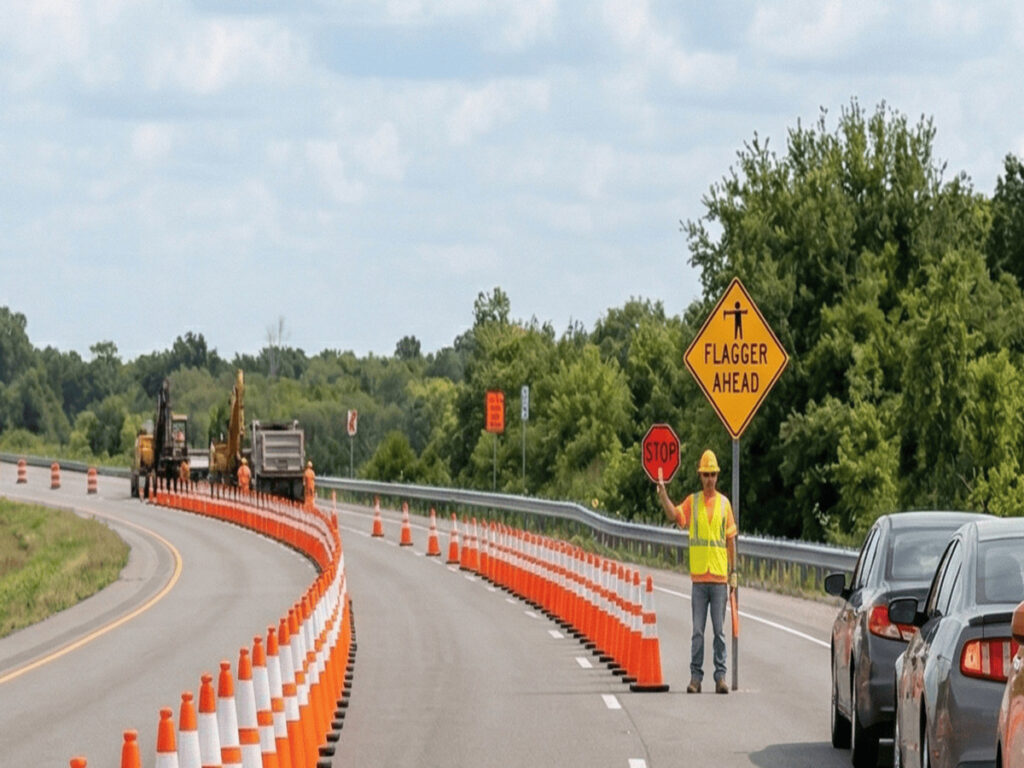
- Highway One-Lane Two-Way Flagging Guide
- Urban Intersection Short-Term Work Zone Guide
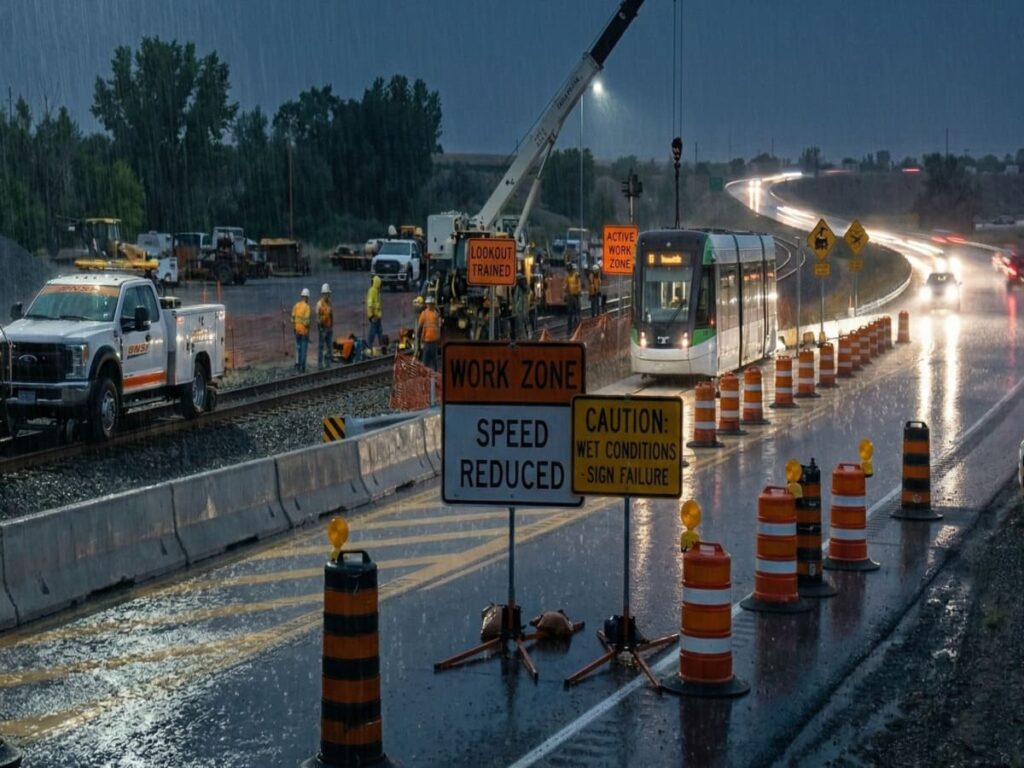
- Extreme Weather Work Zone Signs Guide
4.1 UK Work Zone Road Signs: Giove giallo fluorescente, Not Orange
One characteristic of UK temporary Segni stradali that does not appear in retroreflectivity tables — but that has major procurement implications — is background color. Under TSRGD and Chapter 8 of the UK Traffic Signs Manual, temporaneo Segnali stradali riflessivi utilizzo fluorescent yellow-green backgrounds, not orange. This is the opposite of the US, where orange is the mandatory MUTCD work zone Segno stradale colore. A contractor supplying standard MUTCD-compliant orange segnaletica della zona di lavoro to a UK project delivers non-compliant Segnali stradali riflessivi regardless of sheeting grade. Both background color and RA grade must be specified correctly for UK supply.
4.2 Medio Oriente: Heat Stability for Reflective Road Signs
GCC countries regularly experience sustained temperatures above 50°C (122° f). Standard EN 12899-1 sheeting performance characterization does not test Segnali stradali riflessivi at these conditions. When specifying segnali stradali in alluminio for Middle East projects, request high-temperature stability data from sheeting manufacturers in addition to standard EN RA3 certification. Segnali stradali riflettenti certified to EN 12899-1 RA3 that also demonstrate stable performance at 60°C+ are the correct specification for Gulf region supply.
Parte 5: Reflective Traffic Sign Procurement Specification Cheat-Sheet
The table below consolidates the recommended sheeting specification for each segnale stradale riflettente type and market. Copy the relevant row into your project procurement document.
| Cartello / Tipo di dispositivo | Specify for USA | Specify for UK | Specify for Australia | Specify for GCC | Min cd/lx/m² |
| Urban work zone signs (giorno, bassa velocità) | Type III HIP | RA2 | RA2 | Classe 2 | 250 |
| Highway work zone signs (any time) | Type IX DG | RA3 | RA3 | Classe 3 | 1,000 |
| Night work zone signs (all speeds) | Type IX DG | RA3 | RA3 | Classe 3 | 1,000 |
| Autostrada / freeway road signs (permanente) | Tipo IX / Xi | RA3 / R3B | RA3 / R3B | Classe 3 | 1,000–2,500 |
| Temporary roll-up road signs | Type III HIP | RA2 | RA2 | Classe 2 | 250 |
| Traffic cone reflective collars | ASTM E810 Type I min | IN 13422 spec | IN 13422 spec | COME 1742.3 spec | 70 (collar) |
5.1 Multi-Market Procurement: How to Specify Reflective Signs That Serve All Five Markets
If a single segnale stradale riflettente product must serve multiple markets, specify the most demanding requirement across all target markets and verify that the product meets it under each market’s testing standard. For US + Regno Unito + Australia supply of segnaletica stradale riflettente: specify ASTM Type IX / EN RA3 / Classe 3 with both ASTM test documentation and CE marking. Quality-tier diamond grade signs from major sheeting manufacturers will carry this combination as standard.
The key scenario requiring careful handling is US + Middle East supply without EU/UK: a US-only-certified product (ASTM Type IX self-declaration only) needs an additional EN 12899-1 RA3 certification with CE marking before it can be installed on GCC projects. Obtaining CE marking alongside ASTM self-declaration is the most efficient path to multi-market segnale stradale riflettente eligibility.
OPTRAFFIC reflective traffic signs: aluminum road signs with ASTM Type III, Tipo IX, and Type XI retroreflective sheeting — CE marking, Rohs, Iso 9001 certified manufacturer — Browse reflective road signs → | For multi-market supply documentation, contact the OPTRAFFIC team.
Parte 6: Five Specification Errors When Sourcing Reflective Traffic Signs Internationally
Error 1: Specifying ASTM Type Without Requesting EN RA Certification for EU / GCC Delivery
ASTM Type IX and EN RA3 describe comparable performance for diamond grade signs, but a product with ASTM Type IX self-declaration only does not carry CE marking. It cannot be legally placed on the EU market or on GCC projects where EN 12899-1 with CE marking is the specified standard for Segnali stradali riflessivi. Always request CE marking documentation separately from ASTM compliance when supplying segnaletica stradale riflettente to EU or GCC markets.
Error 2: Using Orange Work Zone Signs for UK Supply
Standard MUTCD orange Segnali stradali riflessivi do not comply with UK TSRGD Chapter 8. UK temporary Segni stradali use fluorescent yellow-green backgrounds. Specifying the correct segno riflettente sheeting grade (RA3) without correcting the background color produces a non-compliant sign regardless of retroreflectivity performance.
Error 3: Assuming Australian Class 3 Reflective Signs Are Also CE Marked
AS/NZS 1906.1 Classe 3 is an Australian performance specification for Segnali stradali riflessivi. UN diamond grade sign product can meet Class 3 retroreflective performance without holding CE marking. For projects requiring supply to both Australia and EU/GCC markets, CE marking must be obtained separately — Class 3 compliance alone does not satisfy EN 12899-1 certification requirements.
Error 4: Not Requesting Heat Stability Data for Middle East Reflective Sign Supply
Standard EN RA3 certification does not include high-temperature performance testing at GCC ambient conditions. UN segnale stradale riflettente sheeting that passes EN 12899-1 at standard test temperatures may experience accelerated degradation at 50–60°C sustained ambient. Request high-temperature stability data as a supplemental requirement for all Middle East segnale stradale riflettente fornitura.
Error 5: Confusing R3B with RA3 for UK Motorway Reflective Traffic Signs
R3B is a UK-specific designation for premium segnale stradale riflettente performance that exceeds RA3 minimums. UN retroreflective sign meeting EN RA3 does not automatically meet R3B. For UK motorway segnale stradale riflettente projects calling for R3B, request R3B performance data in addition to RA3 certification. For a detailed comparison of RA1, RA2, RA3, and R3B with UK applications, Vedere Rivestimento riflettente R3B: Gold Standard for High-Visibility Traffic Signs.
Riepilogo: Buying Reflective Traffic Signs for Multiple Markets
Segnali stradali riflettenti perform the same function in every country: return vehicle headlight beams toward drivers at a defined minimum intensity. The practical equivalency between diamond grade signs (ASTM Tipo IX) / RA3 segnaletica stradale riflettente (IN 12899-1) / Classe 3 high intensity reflective signs (AS/NZS 1906.1) is reliable enough for specification purposes across all four frameworks.
The certification requirements, product markings, and supplemental performance demands differ significantly by market. The procurement cheat-sheet in Part 5 and the certification requirements in Part 3 provide the framework for multi-market segnale stradale riflettente supply alignment. For application-specific questions on work zone signs, segnaletica autostradale, or extreme-climate Segno stradale fornitura, consult the relevant standard or contact OPTRAFFIC.
Next in this series: Traffic Cone Standards Compared: MUTCD, BS One 13422, e come 1742.3 — height, collar, and certification requirements across five markets for cones used alongside Segnali stradali riflessivi in work zone deployments.
Related Guides
From the OPTRAFFIC International Standards Series:
From the OPTRAFFIC Field Playbook Series:
- Segni di zona di lavoro: Highway One-Lane Two-Way Flagging Guide
- Segnali stradali chiusi: Urban Intersection Short-Term Work Zone Guide
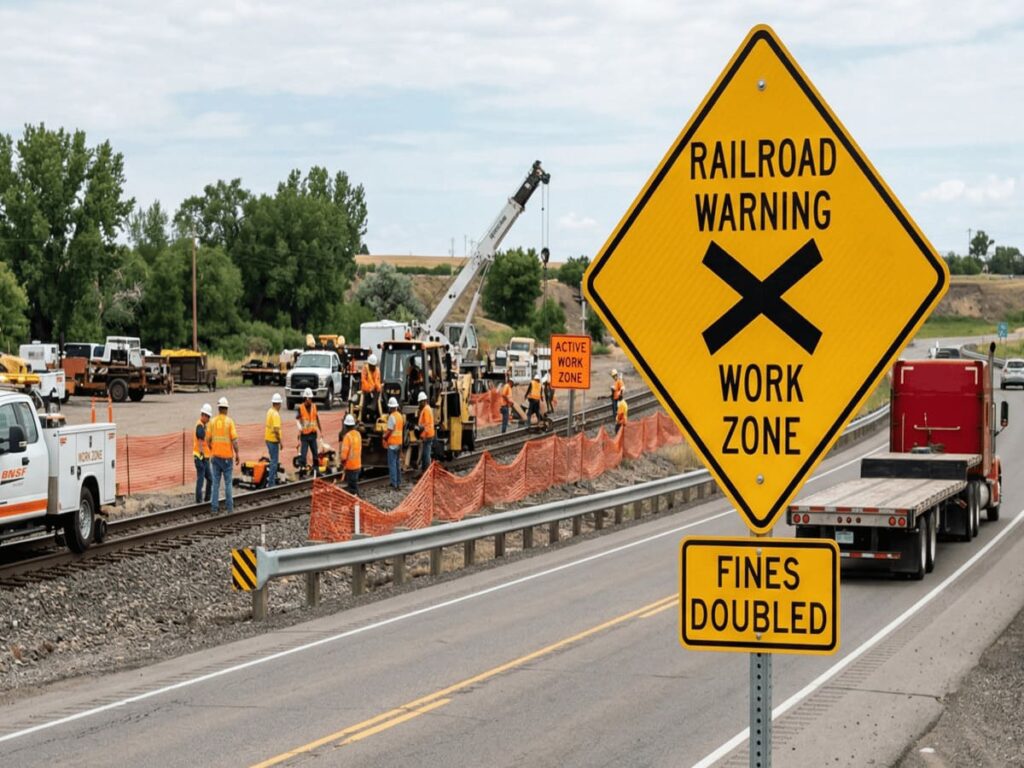
- Railroad Warning Signs: Rail-Adjacent Work Zone TTC Guide
- Segnaletica di sicurezza della zona di lavoro: Extreme Weather Failure Guide
OPTRAFFIC Reflective Sign Library:
- Come selezionare i migliori materiali riflettenti per i segnali stradali
- ASTM D4956 Reflective Signage Material Guide
- RA1 vs RA2 Reflective Sheeting for Traffic Signs
- Rivestimento riflettente R3B: Gold Standard for High-Visibility Traffic Signs
- Reflective Traffic Signs Sheeting Standards in Australia
- Classe 3 Segni stradali riflettenti: Value for Australian Road Authorities
- Traffic Sign Size Requirements Across Australian States