Primary reference — MUTCD 11th Edition
All sign codes in this guide reference MUTCD 11th Edition (effective January 18, 2024), Part 6 — Temporary Traffic Control, Chapters 6F and 6H.
Spacing distances reference Table 6C-1. Size requirements reference Table 6F-1.
Full text available at: mutcd.fhwa.dot.gov
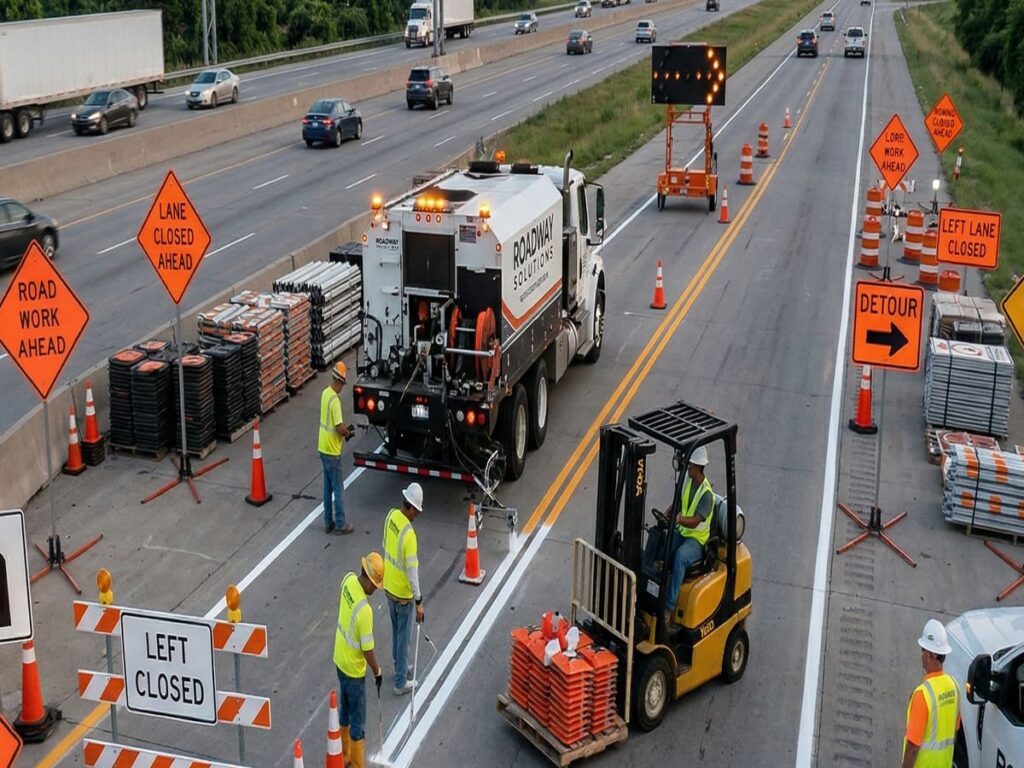
Work zone signs are not a single product. They are a system. The right work zone sign package for a lane closure on a 55 mph arterial differs from what a utility crew needs for a two-hour pothole repair. It also differs from what a long-duration paving project requires on a divided highway. For rental companies, getting these configurations right matters on two levels: compliance and efficiency.
Compliance because MUTCD 11th Edition Part 6 prescribes specific sign sequences, placement distances, and minimum sizes by job type and speed zone. Efficiency because pre-packaged kits — assembled to the correct configuration before a truck leaves the yard — reduce setup errors, speed deployment, and give contractors a defensible compliance record.
This guide builds a work zone sign package for each of the five most common job types. Each package lists MUTCD codes, standard sizes, typical quantities, and mandatory vs. optional status. Use it as a direct reference for kit assembly.
For a broader overview of how sign types relate to each other on a job site, see our comprehensive construction signage overview. OPTRAFFIC’s MUTCD-compliant work zone signage covers all sign codes referenced in this guide.
Work Zone Signs: The Four-Zone Structure Every Package Must Cover
Before building job-specific work zone sign packages, it helps to understand the structural framework that MUTCD Part 6 applies to every temporary traffic control zone. All work zones — regardless of job type — consist of four sequential zones. Every sign package must address each one.
| Zone | Function | Typical Signs |
| Advance Warning | Alerts drivers to the work zone ahead; gives reaction time | ROAD WORK AHEAD (W20-1), distance signs, speed reduction signs |
| Transition | Guides traffic from normal path into modified configuration | LANE CLOSED (W20-5), MERGE signs, taper devices |
| Activity | The work space itself; signs protect workers | Worker symbol signs, speed limit signs, FLAGGER AHEAD (W20-7) |
| Termination | Returns traffic to normal conditions | END ROAD WORK (G20-2), lane re-open indicators |
A common compliance gap is covering only the advance warning zone and skipping the termination zone. Every kit you deliver must include the END ROAD WORK sign and any transition-back signage the specific job configuration requires.
With that framework in place, here are the five standard job-type packages.
Lane Closure Signs: Multi-Lane Roadway Package
When to Use This Package
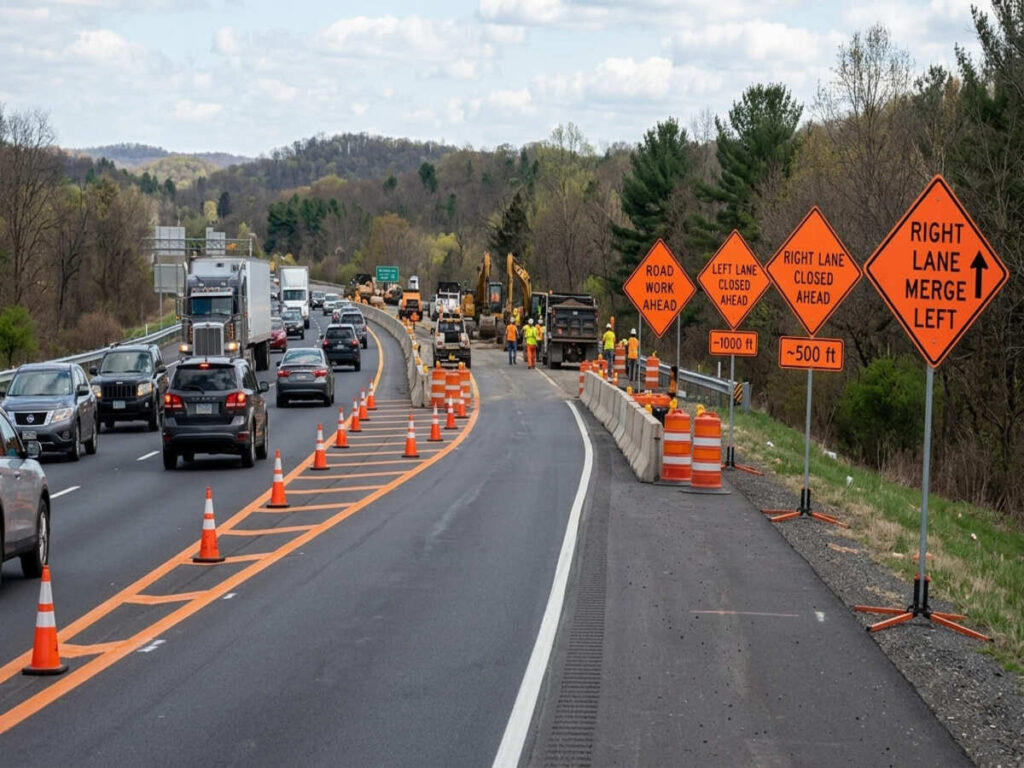
Lane closure packages apply to any job where one or more lanes of a multi-lane roadway close to traffic. Common applications include paving, striping, bridge deck work, and utility crossings on divided arterials and highways. The package below covers a standard single right-lane closure on a road posted 35–55 mph.
| MUTCD Code | Sign Legend | Size (standard) | Qty (typical) | Status |
| W20-1 | ROAD WORK AHEAD | 48″×48″ | 1–2 | ✅ Mandatory |
| W20-5 | RIGHT LANE CLOSED AHEAD | 48″×48″ | 1 | ✅ Mandatory |
| W4-2 | LANE ENDS — MERGE LEFT | 48″×48″ | 1 | ✅ Mandatory |
| W3-4 | BE PREPARED TO STOP | 48″×48″ | 1 | ⚠️ If flagging used |
| W20-7 | FLAGGER AHEAD | 48″×48″ | 1 | ⚠️ If flagging used |
| R4-7 | KEEP RIGHT | 30″×36″ | 1–2 | ⚠️ If needed |
| G20-2 | END ROAD WORK | 48″×48″ | 1 | ✅ Mandatory |
Key Compliance Notes
Posted speed determines advance warning sign placement distances — not the other way around. Place the LANE CLOSED sign (W20-5) in advance of the taper, not at the taper itself. Per MUTCD 11th Edition Part 6, Table 6C-1: allow approximately 350 ft at 35 mph, 500 ft at 45 mph, and 700 ft at 55 mph from the first sign to the taper start.
For two-lane closures specifically, substitute W20-5a (TWO LANES CLOSED) and add W4-7 (THRU TRAFFIC MERGE LEFT) per MUTCD Section 6F.23.
Pre-packaged lane closure kits built to 2009 Edition spacing tables may no longer meet 11th Edition thresholds. Confirm your spacing sheets against the current Part 6 tables. For a detailed MUTCD compliance review, see our MUTCD traffic signs 11th Edition compliance guide.
Road Work Ahead Sign and Flagger Ahead Sign: Two-Lane Flagging Package
When to Use This Package
The two-lane flagging package applies to work on two-lane, two-way roads where one lane closes temporarily and a flagger controls alternating traffic flow. Common applications include resurfacing on rural two-lane roads, bridge repairs, and utility work on undivided streets. This is one of the most frequently rented package types.
| MUTCD Code | Sign Legend | Size (standard) | Qty (typical) | Status |
| W20-1 | ROAD WORK AHEAD | 48″×48″ / 36″×36″ (local) | 2 (one per direction) | ✅ Mandatory |
| W20-4 | ONE LANE ROAD AHEAD | 48″×48″ | 2 (one per direction) | ✅ Mandatory |
| W20-7 | FLAGGER AHEAD (symbol) | 48″×48″ | 2 (one per direction) | ✅ Mandatory |
| W3-4 | BE PREPARED TO STOP | 48″×48″ | 2 (one per direction) | ✅ Mandatory |
| W20-7a | FLAGGER (word message) | 48″×48″ | Optional alt. to W20-7 | ⚠️ Optional |
| W6-3 | TWO-WAY TRAFFIC | 36″×36″ | 2 | ⚠️ If converting from divided |
| G20-2 | END ROAD WORK | 48″×48″ | 2 (one per direction) | ✅ Mandatory |
Key Compliance Notes
Importantly, place the FLAGGER sign (W20-7) in advance of the flagger station — not immediately next to the flagger. Per MUTCD Part 6, Section 6F.29, use Table 6C-1 distances based on posted speed for this placement.
Furthermore, orient all signs in this package to face their respective directions of approaching traffic. That means the package requires two of most sign types — one per approach.
Turn the FLAGGER sign away from traffic when the flagger is not present. Pair it with the BE PREPARED TO STOP sign (W3-4) in all one-lane two-way flagging operations. For sign installation and placement standards including mounting heights and orientation, see our construction sign installation and placement guide.
Utility Work Ahead Sign: Short-Duration Utility Package
When to Use This Package
The utility work ahead package covers short-duration jobs — typically under three days — where a utility crew works on or adjacent to a road. Applications include pothole repairs, manhole cover replacements, water main cuts, and fiber installation. These are high-frequency rental jobs. Consequently, they benefit most from a standardized pre-packaged kit.
| MUTCD Code | Sign Legend | Size (standard) | Qty (typical) | Status |
| W21-7 | UTILITY WORK AHEAD | 36″×36″ (local) / 48″×48″ (arterial) | 1 | ✅ Mandatory (or W20-1) |
| W20-1 | ROAD WORK AHEAD | 36″×36″ or 48″×48″ | 1 | ✅ Alt. to W21-7 |
| W21-1 | WORKERS (symbol) | 36″×36″ | 1–2 | ⚠️ Recommended |
| W3-4 | BE PREPARED TO STOP | 36″×36″ or 48″×48″ | 1 | ⚠️ If stopping required |
| W20-7 | FLAGGER AHEAD | 36″×36″ or 48″×48″ | 1 | ⚠️ If flagging used |
| R4-7 | KEEP RIGHT / KEEP LEFT | 30″×36″ | 1–2 | ⚠️ If needed |
| G20-2 | END ROAD WORK | 36″×36″ or 48″×48″ | 1 | ✅ Mandatory |
Key Compliance Notes
MUTCD explicitly permits the UTILITY WORK AHEAD sign (W21-7) as a direct substitute for ROAD WORK AHEAD (W20-1) in utility operations on or adjacent to a highway. Many rental customers default to ROAD WORK AHEAD regardless of job type. Both options are compliant. However, UTILITY WORK AHEAD communicates the hazard more precisely.
For short-duration work under one hour on low-volume local streets, MUTCD allows a reduced sign package — confirm with your customer’s traffic control plan. For work lasting more than three days, post-mounted advance warning signs replace portable supports. Build both duration configurations into your kit options.
Construction Work Zone Signs: Long-Duration Project Package
When to Use This Package
Long-duration work zone signs for construction projects apply to jobs lasting more than three days in one location. Applications include paving contracts, bridge rehabilitation, major utility replacements, and similar extended operations. These packages are typically the largest kits your rental operation delivers. They are also the most likely to face contractor compliance documentation requirements on federally funded projects.
| MUTCD Code | Sign Legend | Size (standard) | Qty (typical) | Status |
| W20-1 | ROAD WORK AHEAD | 48″×48″ | 2+ | ✅ Mandatory |
| W20-5 | RIGHT/LEFT LANE CLOSED | 48″×48″ | 1–2 | ✅ If lane closed |
| W4-2 | LANE ENDS — MERGE | 48″×48″ | 1–2 | ✅ If lane closed |
| W3-5 | REDUCED SPEED LIMIT AHEAD | 48″×48″ | 1 | ✅ If speed reduction >10 mph |
| R2-1 | SPEED LIMIT (construction zone) | 24″×30″ or 30″×36″ | Multiple | ✅ Mandatory in work zone |
| W20-7 | FLAGGER AHEAD | 48″×48″ | As needed | ⚠️ Where flaggers present |
| W21-1 | WORKERS (symbol) | 48″×48″ | Multiple | ⚠️ Recommended |
| W20-1 | ROAD WORK NEXT X MILES | 48″×48″ | 1 | ⚠️ For long projects |
| G20-2 | END ROAD WORK | 48″×48″ | 1 | ✅ Mandatory |
Key Compliance Notes
Unlike portable kits, long-duration packages require post-mounted advance warning signs rather than portable supports. Per MUTCD Part 6, Section 6G.02, post mounting applies to work lasting more than three consecutive days. Confirm with your customer whether the project specification requires post mounting before delivering a portable-stand kit.
In addition, construction speed limit signs (R2-1) must appear throughout the work zone at intervals the traffic control plan specifies. These are regulatory signs — not advisory signs. Per MUTCD Section 6F.57, they must meet the same dimensional and retroreflectivity standards as permanent regulatory signs.
For construction site signage compliance under MUTCD and OSHA together, see our construction site signage compliance guide.
Detour Signs: Road Closure and Rerouting Package
When to Use This Package
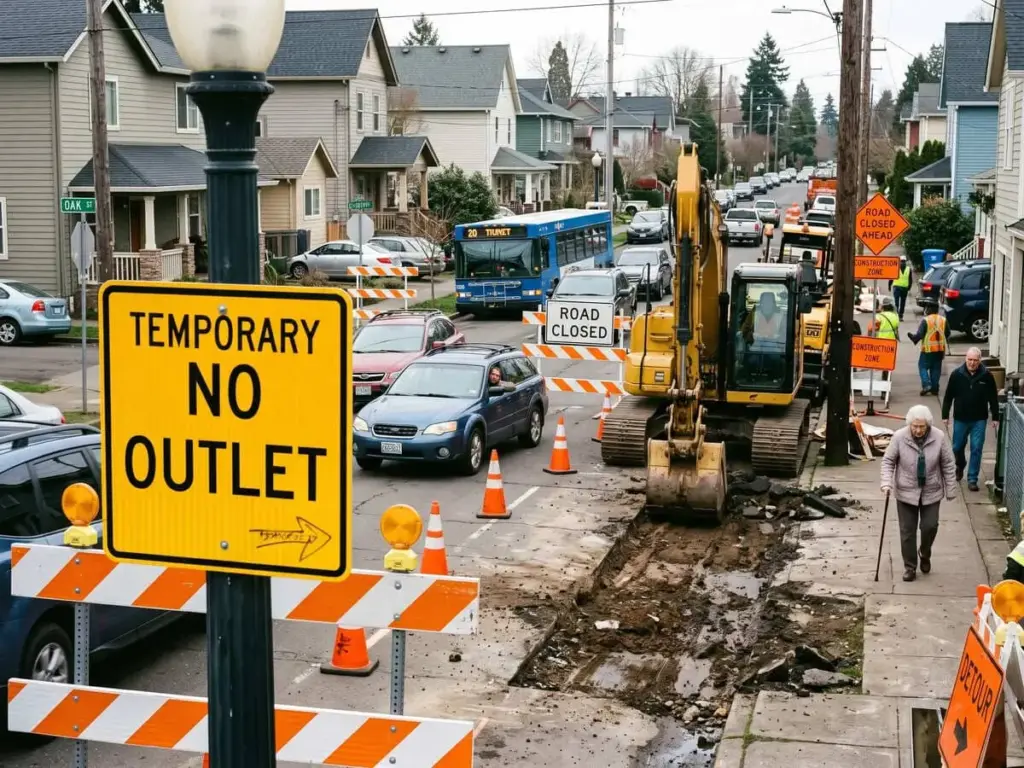
Detour packages apply when a road or lane closes completely and traffic must reroute to an alternate path. Common rental scenarios include bridge closures, major utility excavations blocking a travel lane, event-related road closures, and emergency closures. Detour kits are among the most variable packages. The specific signs depend heavily on the geometry of the alternate route.
| MUTCD Code | Sign Legend | Size (standard) | Qty (typical) | Status |
| W20-1 | ROAD WORK AHEAD | 48″×48″ | 1+ | ✅ Mandatory |
| R11-3 | ROAD CLOSED | 48″×30″ | 1 | ✅ Mandatory at closure point |
| W20-2 | DETOUR (with arrow) | 48″×48″ | Multiple | ✅ Mandatory at each decision point |
| M4-9 | DETOUR (arrow panels) | Varies | Multiple | ✅ At each turn |
| R11-3a | ROAD CLOSED — LOCAL TRAFFIC ONLY | 48″×30″ | 1 | ⚠️ If partial access maintained |
| W20-1 | ROAD WORK AHEAD (on detour route) | 48″×48″ | 1 | ⚠️ If work affects detour route |
| G20-2 | END ROAD WORK / RESUME NORMAL | 48″×48″ | 1 | ✅ At detour end |
Key Compliance Notes
Per MUTCD Section 6F.14, DETOUR signs (W20-2) must appear at every decision point along the alternate route — not just at the closure point itself. A detour kit covering only the closure creates a compliance failure. It also exposes both the contractor and the rental company to liability if drivers miss a turn.
Detour arrow panel direction must match the actual turn geometry. As a result, rental companies that deliver standardized left-turn or right-turn detour panels should confirm the direction matches the customer’s specific detour route before the kit ships. Building direction-specific detour kits — or including both left and right variants — is the safer operational approach.
End Road Work Sign and Fleet Inventory Configuration
The Universal Sign: END ROAD WORK (G20-2)
Every job type in this guide requires the END ROAD WORK sign (G20-2) at the downstream end of the termination zone. Despite this, it is one of the most commonly missing signs from rental kits. Kits often focus on the advance warning sequence and treat the termination zone as secondary.
Therefore, build END ROAD WORK signs into every pre-packaged kit as a mandatory line item. Use 48″×48″ for highway and arterial deployments. Use 36″×36″ for local street applications. Treat it the same way as ROAD WORK AHEAD — required for every job, every time.
Core Inventory Quantities by Package Type
The table below summarizes recommended stock quantities for a rental fleet serving a mixed customer base across all five work zone sign job types. Quantities assume 10 simultaneous active deployments of each kit type.
| Sign | MUTCD Code | Lane Closure | Flagging | Utility | Construction | Detour |
| ROAD WORK AHEAD | W20-1 | 20 | 20 | 10 | 20+ | 10 |
| RIGHT/LEFT LANE CLOSED | W20-5 | 10 | — | — | 10 | — |
| ONE LANE ROAD AHEAD | W20-4 | — | 20 | — | — | — |
| FLAGGER AHEAD | W20-7 | 10 | 20 | 10 | 10+ | — |
| BE PREPARED TO STOP | W3-4 | 10 | 20 | 10 | — | — |
| UTILITY WORK AHEAD | W21-7 | — | — | 10 | — | — |
| ROAD CLOSED | R11-3 | — | — | — | — | 10 |
| DETOUR (arrow) | W20-2 | — | — | — | — | 30 |
| END ROAD WORK | G20-2 | 10 | 20 | 10 | 10 | 10 |
All signs in these configurations should meet ASTM D4956 Type III fluorescent orange sheeting minimum. OPTRAFFIC’s MUTCD-compliant work zone signage covers all MUTCD codes referenced in this guide. Bulk fleet orders are available with specification documentation on request.
Keeping Kits Field-Ready: Condition Grading and Replacement Cycles for Rental Fleets
Assembling the right work zone sign kit is only half the operational challenge. The other half is knowing when a sign in that kit has degraded past the point of compliance — before it leaves your facility, not after a contractor calls with a problem.
A Four-Level Condition Grading System
Rental fleets benefit from a simple, consistent grading framework applied at every pre-rental inspection. The following four levels map directly to the compliance thresholds that matter under MUTCD Section 2A.22 and OSHA 29 CFR 1926.200:
Grade A — Rental Ready: Sign face is clean, legend fully legible, sheeting shows no delamination or significant fading. Retroreflectivity is within expected service life for the sheeting grade. No physical damage to substrate or edges. Release for rental without restriction.
Grade B — Monitor: Minor surface contamination, light edge oxidation on aluminum, or minor abrasion to sheeting that does not affect retroreflectivity. Clean and re-inspect before next rental cycle. Do not release without cleaning.
Grade C — Repair or Restrict: Visible delamination, legend partially obscured, significant substrate deformation, or sheeting that has exceeded its expected service life by acquisition date. Do not release for arterial or highway deployments. Flag for replacement within 30 days.
Grade D — Retire: Bent substrate that cannot be straightened to flat, legend illegible under normal viewing conditions, sheeting visibly degraded or missing, or any physical damage that creates a sharp edge or detachment risk. Remove from inventory immediately. Do not release under any circumstances.
Apply this grading at two points: pre-rental inspection when the kit ships, and post-return inspection when it comes back. Document the grade assigned, the inspector’s name, and the date on your batch record. This creates the compliance record chain that satisfies both MUTCD Section 2A.22 and OSHA 29 CFR 1926.200 simultaneously.
Replacement Intervals by Sign Type
Replacement timing depends on sheeting grade and handling intensity. Rental signs face significantly more physical stress than permanently installed signs — repeated setup and takedown, transport in truck beds, exposure to equipment contact. Plan replacement cycles accordingly:
| Sign Type | Sheeting Grade | Expected Service Life (permanent install) | Recommended Rental Replacement Interval |
|---|---|---|---|
| Aluminum TTC warning signs | ASTM D4956 Type III | 7–10 years | 5–7 years |
| Aluminum TTC warning signs | ASTM D4956 Type IX/XI | 10–12 years | 7–9 years |
| Roll-up fabric TTC signs | Type III equivalent | 3–5 years | 2–3 years (or earlier if fabric tears) |
| Regulatory signs (R-series) | Type III or IV | 7–10 years | 5–7 years |
| ROAD CLOSED / detour signs | Type III | 7–10 years | 5–7 years |
Blanket replacement by acquisition date — retiring all signs of a given SKU batch at the interval above — is the most operationally efficient method for rental fleets. It eliminates the need for individual retroreflectivity measurement and satisfies MUTCD Section 2A.22’s expected-sign-life management method.
Track acquisition date per batch, not per individual sign unit. When a batch reaches its retirement date, pull the entire batch regardless of apparent condition. Document the retirement in your batch record.
The Rental-Specific Risk: Post-Deployment Damage
Rental companies carry a liability exposure that permanent sign owners do not: signs return from the field in unknown condition. A contractor who improperly stores, transports, or deploys your signs can return them with damage that is not immediately visible — bent substrate straightened in the field, sheeting contaminated with road materials, mounting hole damage from non-standard frames.
Three practices protect your operation from this exposure:
Pre-rental photographic documentation. Photograph each kit before it ships — a simple photo of the sign faces and backs creates a condition baseline that is timestamped and defensible. If a sign returns damaged beyond the pre-rental condition, the photo establishes that the damage occurred during the rental period.
Rental contract condition clauses. Your rental agreement should specify that the customer accepts the equipment in the condition documented at the time of delivery, and that the customer is responsible for damage beyond normal wear and tear. Define “normal wear and tear” explicitly — surface dirt is normal; bent substrate and sheeting tears are not.
Post-return inspection before re-stocking. Never return a sign from a rental cycle directly to active inventory without inspection. Signs that pass post-return inspection are re-graded and re-stocked. Signs that fail are flagged for repair or retirement. This prevents a damaged sign from entering the next rental cycle undiscovered.
These three practices together create a closed-loop condition management system. Combined with the grading framework above, they give your rental operation a defensible compliance record from purchase through retirement — which is exactly what MUTCD Section 2A.22 requires and what OSHA 29 CFR 1926.200 documentation standards support.
Frequently Asked Questions: Work Zone Signs for Rental Fleets
Q1: What is the first sign in any work zone sign sequence?
ROAD WORK AHEAD (W20-1) should be the first sign drivers encounter in any work zone. MUTCD Part 6 specifies this as the standard opening sign for all TTC zones. Place it at the advance warning distance from Table 6C-1 for the posted speed — not at the taper or the activity area.
Q2: How far in advance should work zone signs be placed?
Posted speed determines advance warning placement distances per MUTCD 11th Edition Part 6, Table 6C-1. General reference: approximately 100–350 ft at 25–35 mph; 350–500 ft at 40–45 mph; 500–700 ft at 50–55 mph. These are minimums. Field conditions — curves, hills, restricted sight distance — may require longer spacing. The 11th Edition updated several distances from the 2009 Edition. Verify all kit spacing sheets against current tables.
Q3: Can the UTILITY WORK AHEAD sign replace ROAD WORK AHEAD?
Yes. MUTCD explicitly permits UTILITY WORK AHEAD (W21-7) as a substitute for ROAD WORK AHEAD (W20-1) for utility operations on or adjacent to a highway. Both are compliant. UTILITY WORK AHEAD communicates the hazard more precisely for utility-specific deployments and some state DOT specs may require it.
Q4: Is the END ROAD WORK sign mandatory?
Yes. Place END ROAD WORK (G20-2) at the downstream end of the termination zone for all TTC zones. It is one of the most frequently omitted signs in pre-packaged rental kits. Include it as a mandatory line item in every kit regardless of job type.
Q5: What size work zone signs should a rental fleet stock?
Stock 48″×48″ as the primary size for warning signs on arterials and highways — roads posted 35 mph and above. Stock 36″×36″ as the secondary size for low-speed local street applications. MUTCD Part 6, Table 6F-1 specifies these thresholds. When in doubt, the larger size is always compliant and provides better driver recognition distance.
Q6: How do I update pre-packaged kits from the 2009 Edition to the 11th Edition?
Review each kit configuration against MUTCD 11th Edition Part 6, Table 6C-1 for spacing and Table 6F-1 for dimensions. Document the review date and update date for each kit design. Label updated kits with the 11th Edition compliance date so customers and inspectors can verify currency. Focus first on lane closure kits — they carry the most spacing changes between editions.
Building Work Zone Sign Kits That Hold Up in the Field
The five work zone sign packages in this guide cover the job types that account for the majority of traffic sign rental deployments. Each package follows the MUTCD Part 6 four-zone structure — advance warning, transition, activity, termination — and includes the mandatory signs that make each zone compliant.
More importantly, the most operationally valuable step a rental company can take is to standardize these packages. Assign each kit a documented configuration. Review it against the 11th Edition tables. Update it on a scheduled basis. A contractor who rents from you should be able to hand your kit documentation to an OSHA inspector or DOT compliance officer and have a defensible record. That is what separates a professional rental operation from a commodity sign supplier.
Related articles in this series