Why Custom Specifications Matter for Municipal and Facility Sign Programs
Municipal procurement teams face a sourcing reality that off-the-shelf inventory rarely solves. Stock blanks miss MUTCD post spacing, ADA mounting clearances, and facility-specific schedules. Custom aluminum sign blanks close those gaps with documented compliance and field-ready dimensions. For a complete framework on alloys, gauges, and supplier qualification, agencies should review the full B2B guide to aluminum sign blank specifications before drafting any RFP.
The 11th Edition of the MUTCD, published December 2023, sets a state adoption deadline of January 18, 2026. New sign installations after January 18, 2024, must already comply. Procurement teams that rely on legacy inventory now risk denied federal-aid funding and contract liability. Custom aluminum sign blanks engineered to current specifications protect both budgets and audit trails.
The Real Cost of Modifying Stock Blanks in the Field
Field-drilling and trimming stock inventory drive unbudgeted labor costs. The Bureau of Labor Statistics reports a May 2024 median wage of $48,620 for general maintenance and repair workers (Source: https://www.bls.gov/ooh/Installation-Maintenance-and-Repair/General-maintenance-and-repair-workers.htm). Loaded with benefits, that translates to roughly $35–$55 per hour in many municipalities. A two-person crew burning four minutes per sign on field drilling adds $4–$7 per unit before fasteners. Pre-drilled aluminum sign blanks eliminate this step entirely.
Compliance Drivers: MUTCD, Buy America, and ADA
Three regulatory frameworks govern modern sign procurement. The MUTCD 11th Edition controls dimension and color. The ADA 2010 Standards §703 govern facility wayfinding. And 23 CFR 635.410, amended by FHWA’s January 2025 Final Rule on Buy America for Manufactured Products, applies Buy America requirements to aluminum products on federal-aid projects. For projects obligated on or after October 1, 2026, manufactured products must be U.S.-made with greater than 55% domestic component cost.
When Custom Outperforms Stock Inventory
Custom aluminum sign blanks pay back fastest when:
- Volumes exceed roughly 100 units per spec
- Dimensions fall outside the standard MUTCD R-series matrix
- Mounting hardware deviates from common 3/8″ or 7/16″ patterns
- Radius corners must exceed the 3/8″ stock value
Custom Aluminum Blank Size Specifications and Tolerances
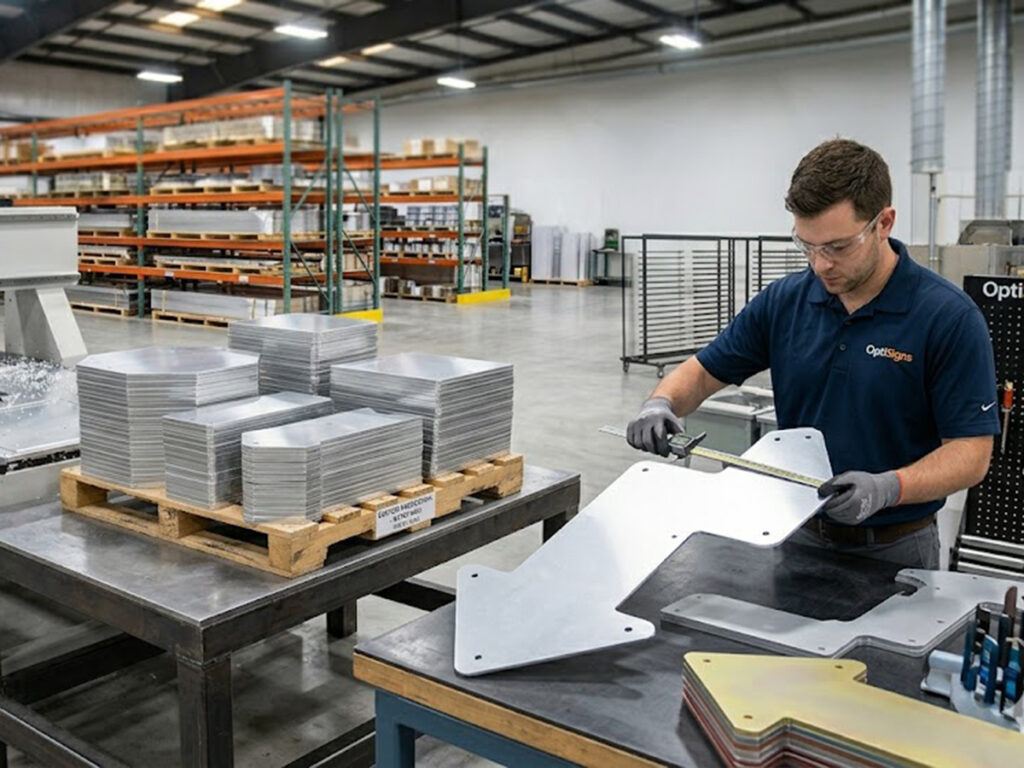
Sizing is where most RFP failures begin. Custom aluminum blank size selection should map directly to MUTCD tables and the agency’s mounting hardware schedule. Custom aluminum sign blanks dimensioned outside MUTCD ranges still carry the agency’s compliance burden.
Standard and Custom Size Ranges
Custom aluminum sign blanks ship from a 6″×6″ facility, plaques up to 48″×96″ guide-sign sheets. The most-ordered municipal sizes follow MUTCD codes:
| Sign Type | MUTCD Code | Standard Sizes (inches) |
| STOP | R1-1 | 30, 36, 48 |
| YIELD | R1-2 | 30, 36, 48 |
| Speed Limit | R2-1 | 24×30, 30×36, 36×48 |
| Warning Diamond | W-series | 30, 36, 48 |
| Facility Plaque | — | 6×9, 8×12, 12×18 |
Gauge, Thickness, and Sheet Tolerance
ASTM B209 governs flat-rolled aluminum sheet supplied to U.S. sign manufacturers. The standard sets thickness tolerance of approximately ±0.004″ for sheets under 0.080″ and tighter values above. Four gauges dominate municipal procurement:
| Gauge (in) | Metric (mm) | Typical Use |
| 0.04 | 1 | Indoor or temporary signs |
| 0.063 | 1.6 | Standard regulatory under 30″ |
| 0.08 | 2 | Highway permanent installations |
| 0.125 | 3.2 | Large guide signs over 48″ |
Custom Shapes for Sign Blanks Beyond Rectangles
Custom shapes for sign blanks include octagons (STOP), equilateral triangles (YIELD), pentagons (school zone), shields (route markers), and bespoke logos. CNC routing holds ±0.030″ cut tolerance. Shear-cut shapes fall closer to ±0.060″. MUTCD Section 2A.11 fixes shape and color for every regulated sign type. Custom logos remain open for facility, university, and parks departments ordering custom aluminum sign blanks at scale.
Radius Corners: Standards, Tooling, and Specification Language
Radius corners cut both injury risk and field damage. They also signal manufacturing quality. Procurement teams should specify them every time.
Standard Corner Radii by Sign Application
The MUTCD does not mandate a single radius. Industry convention pairs the corner radius to the sign size:
- 3/8″ radius for signs up to 24″
- 1/2″ radius for 24″–36″
- 3/4″ radius for 36″–48″
- 1-1/2″ radius for signs above 48″
For facility signage, OSHA 29 CFR 1910.145 requires that signs remain free of sharp edges and burrs. A minimum 1/4″ radius satisfies this standard.
Custom Radius Options
Beyond aesthetics, radius corners are a safety requirement in high-traffic pedestrian zones to mitigate injury risks. Utilizing CNC routing, we produce custom radii from 1/8″ to 3″ with a precision tolerance of ±0.015″.
- Standard Safety Radius: 1.5″ or 2″ radii are typical for MUTCD-compliant street signs.
- Specialty Profiles: Stadium-shaped (full-radius) blanks are ideal for valet stations, parking structures, and ADA-compliant directional signage where a softer, modern profile improves both legibility and tactile safety.
Specification Language for Procurement & Purchase Orders
To ensure consistency across municipal districts and prevent vendor disputes, utilize the following standardized PO clause:
- Sample PO Clause: “All four corners shall be radiused to 1/2″ (12.7mm) ±1/16″, deburred to meet ASTM B209 standards, and finished free of tool marks or sharp edges.”
- Quality Inspection Tip: Facility Managers should perform a visual inspection upon delivery. Signs should have smooth, uniform edges that allow for safe handling without gloves and ensure seamless reflective sheeting application (bubbling often occurs at poorly deburred corners).
Pre-Drilled Aluminum Sign Blanks: Hole Patterns and Hardware Compatibility
Pre-drilled aluminum sign blanks deliver the largest installation savings of any custom feature. Holes punched at the factory eliminate field measurement and reduce coating breach.
Standard Hole Diameters
Three hole sizes cover most municipal hardware:
- 3/8″ (0.375″) for 5/16″ bolts with washers
- 7/16″ (0.4375″) for 3/8″ U-channel bolts
- 1/2″ (0.500″) for square-tube bracket assemblies
Position tolerance should run ±0.030″ from the datum edge. A 1″ edge offset is the highway standard.
Multi-Hole Patterns by Post Type
U-channel posts use a 2-hole vertical centerline at 7/16″ diameter on 1″ centers. Square tube (2″–2-1/2″) uses a 4-hole pattern matched to factory post drilling. Breakaway systems certified to AASHTO MASH-16 require specific hole placement to preserve crash-test certification.
Deburring and Hole Finishing
Class 2 deburring permits no burr above 0.005″. Buyers ordering powder-coated aluminum blanks must require deburring before painting. Burrs hold powder unevenly and crack under bolt torque. An 82° countersink suits flush-mount fasteners on architectural signs.
Pre-Treatment and Powder Coated Aluminum Blanks: Surface Preparation
Pre-treatment chemistry determines coating life. The right pretreatment buys decades; the wrong one peels in two winters. Custom aluminum sign blanks ordered without a documented pretreatment standard expose agencies to premature failure claims.
Chromate vs. Non-Chrome Conversion Coatings
MIL-DTL-5541 covers chromate conversion coatings in two relevant classes. Class 1A delivers maximum corrosion protection. Class 3 trades some protection for lower electrical resistance. Hexavalent chromium is restricted in many states. Trivalent chromium (TCP) per MIL-DTL-81706 and zirconium-based non-chrome systems per ASTM B921 now serve as compliant alternatives.
Powder Coating Performance Standards
The AAMA family of standards ranks coating durability:
| Standard | Salt Spray (ASTM B117) | Florida Exposure | Typical Application |
| AAMA 2603 | 1,500 hours | 1 year | Indoor or short-term |
| AAMA 2604 | 3,000 hours | 5 years | Standard exterior signs |
| AAMA 2605 | 4,000 hours (G85) | 10 years | Coastal and high-UV sites |
Source: https://www.pfonline.com/articles/understanding-aama-specifications
Standard polyester powder runs 2.0–4.0 mil dry film thickness. Specifying AAMA 2604 protects buyers in coastal counties and freeze-thaw belts.
Sheeting-Ready Surfaces for Reflective Vinyl
Powder-coated aluminum blanks rarely receive retroreflective sheeting on the same face. Sheeting requires a conversion-coated bare-aluminum surface for adhesion under ASTM D4956. Procurement teams should specify “powder coat” or “sheeting-ready” as separate line items, never both on the same face.
ASTM B209 Compliant Material and Traffic Grade Aluminum Alloy Selection
The phrase “ASTM B209 compliant” carries weight only when buyers verify it. Specifying traffic-grade aluminum alloy with documentation forces vendors to back the claim. Custom aluminum sign blanks without mill certification cannot be considered compliant, regardless of vendor marketing.
5052-H38 vs. 6061-T6 Mechanical Properties
| Property | 5052-H38 | 6061-T6 |
| Tensile strength | 41 ksi (285 MPa) | 45 ksi (310 MPa) |
| Yield strength | 37 ksi (255 MPa) | 40 ksi (275 MPa) |
| Elongation (% in 2″) | 4 | 12 |
| Marine corrosion | Excellent | Good |
Source: https://store.astm.org/standards/b209
5052-H38 is the standard traffic-grade aluminum alloy for signs. Its magnesium content (2.2–2.8%) drives marine and roadside corrosion resistance. 6061-T6 takes over where structural strength matters, such as on overhead guide signs.
Read more: 5052-H38 vs 6061-T6: Choosing the Right Aluminum Alloy for Sign Blanks
Mill Certification and Documentation
A defensible RFP should require Mill Test Reports per EN 10204 Type 3.1 with heat and lot traceability. Each pallet should carry a label cross-referenced to a certificate. Chemistry verification protects against substitution: Mg 2.2–2.8% confirms 5052; Mg 0.8–1.2% with Si 0.4–0.8% confirms 6061.
Receiving Inspection Checklist
Procurement should validate three items per pallet at a minimum:
- Thickness with calibrated micrometer at three points per sheet
- Flatness on a granite surface plate within 0.5% of the long dimension
- Visual inspection per ASTM B209 Section 9 for surface defects
Bulk Custom Sign Blanks and Wholesale Custom Aluminum Signs Procurement
Bulk custom sign blanks unlock both pricing and lead-time leverage. Wholesale custom aluminum signs at quantity make multi-year sign maintenance programs feasible on tight municipal budgets.
Volume Pricing Tiers
Most fabricators structure breaks at 50, 100, 250, 500, and 1,000 units. Tier-to-tier reductions typically run 8–22%. MOQs differ by complexity:
- 25–50 units for stock sizes with custom drilling
- 100–250 units for custom-shape powder-coated blanks
- 500+ units for unique alloy or gauge combinations
Lead Times in 2026
Current 2026 lead time bands reflect tariff and supply chain realities:
- 5–7 business days: pre-drilled stock-size blanks
- 10–15 business days: custom-shape powder-coated blanks
- 15–25 business days: full custom orders with mill-direct alloy
Multi-Year Contracts and Buy America Documentation
Annual blanket POs with quarterly releases let agencies hedge price and lead time. Every contract advertised on or after October 1, 2026, should require a Manufactured Product Certificate of Materials Origin documenting U.S. final assembly and >55% domestic component cost (23 CFR 635.410). Vendors unable to produce this documentation will fail bid review on federal-aid projects.
Specifying Custom Aluminum Sign Blanks for Long-Term Program Success
Sizing, drilling, and pre-treatment form the specification triad that drives 10–15 year service life. Each pillar protects the others. Correct gauge fails when poor pretreatment lets edges corrode. Perfect drilling fails when uncoated holes wick moisture into the substrate.
Custom aluminum sign blanks specified to ASTM B209, MUTCD 11th Edition, AAMA 2604, and MIL-DTL-5541 Class 1A deliver predictable field performance and audit-ready documentation. The result: fewer field failures, cleaner audits, and full Buy America defensibility through the 2026 transition.
Frequently Asked Questions About Custom Aluminum Sign Blanks
What gauge is required for permanent traffic signs?
Most state DOTs specify 0.080″ for highway-permanent installations. The 0.063″ gauge is acceptable for signs under 30″. Guide signs over 48″ generally require 0.125″ to control flutter and edge damage.
Are pre-drilled aluminum sign blanks more expensive than stock blanks?
Pre-drilling adds roughly $0.40–$1.20 per hole at volume. Each hole, however, saves $3–$6 in field labor at typical municipal loaded rates. Net installation savings run 60–80% on hole-heavy signs.
What’s the difference between MIL-DTL-5541 Class 1A and Class 3?
Class 1A delivers maximum corrosion protection for unpainted or sheeted aluminum. Class 3 lowers electrical resistance for grounding and conductivity applications. Most sign blanks specify Class 1A.
Can custom aluminum sign blanks ship to ASTM B209 with non-standard alloys?
Yes. 3003-H14, 5083-H116, and marine-grade 5086 are available on custom orders. Lead times typically run 4–6 weeks with 500-unit minimums.
Do powder-coated aluminum blanks meet retroreflective sheeting requirements?
No. Powder coatings prevent the chemical adhesion that ASTM D4956 sheeting requires. Buyers should specify either “powder coat” or “conversion coat for sheeting” — never both on the same face.
How do the October 2026 Buy America rules affect aluminum sign procurement?
Federal-aid projects obligated on or after October 1, 2026, must source manufactured products with >55% U.S. component cost and U.S. final assembly. Agencies should require certification of compliance in every solicitation.
References
- Federal Highway Administration, Manual on Uniform Traffic Control Devices, 11th Edition
- ASTM International, B209-21a Standard Specification for Aluminum and Aluminum-Alloy Sheet and Plate.
- eCFR, 23 CFR 635.410 Buy America Requirements
- Products Finishing, Understanding AAMA Specifications.
- OSHA, 29 CFR 1910.145 Specifications for Accident Prevention Signs and Tags.