Why Visual Communication Is a Frontline Safety Control
Every workplace runs on signals. A red circle, a yellow triangle, a glowing exit marker — each one carries a message that workers must read in a fraction of a second. Strong safety sign design makes that message land. Weak design lets it slip past. This guide treats safety sign design as a complete discipline, not a catalogue order.
The stakes are measurable. The U.S. Bureau of Labor Statistics recorded 5,070 fatal work injuries in 2024 (Source: https://www.bls.gov/news.release/cfoi.nr0.htm). On average, a worker dies every 104 minutes. Private employers also reported 2.5 million nonfatal injuries and illnesses that year (Source: https://www.bls.gov/news.release/osh.nr0.htm). Signage does not explain those numbers alone. But it sits on the critical path between a hazard and a human decision.
The Cost of Ambiguous or Poorly Designed Signage
Poor safety sign design fails quietly. A faded pictogram, a cluttered message, or an inconsistent palette creates hesitation. Hesitation costs time. Near a moving forklift or an energised panel, time is the margin between safe and severe.
Over-signage carries its own risk. When every surface screams “Danger,” workers stop reading. Safety professionals call this warning fatigue. Disciplined safety sign design fights it by reserving the strongest visual coding for the highest-consequence hazards.
Where Signage Sits in the Hierarchy of Controls
Occupational safety follows a hierarchy of controls. Elimination ranks first. Substitution and engineering controls follow. Signage belongs to the administrative tier — near the bottom, just above personal protective equipment.
That placement matters. Signage does not remove a hazard. It informs a decision. So, safety sign design must work hard to compensate for a weak control tier. Many managers build the foundation by mastering the meanings behind each workplace sign colour.
The Regulatory and Standards Framework Behind Safety Signage
Sound safety sign design rests on published standards. These documents remove guesswork and give safety managers a defensible basis for every choice.
International Standards — ISO 7010 and ISO 3864
ISO 7010:2019 is the international standard for registered safety sign pictograms. It defines a library of tested symbols and assigns each one a reference code. ISO 3864-1 sets the design principles — safety colours, geometric shapes, and layout rules. ISO 3864-4 specifies the colorimetric and photometric properties of sign materials.
Together, these standards form one system. ISO 7010 draws its shapes and colours directly from ISO 3864-1. Neither works alone.
National Regulations and Their Crossover
In the United States, OSHA regulation 29 CFR 1910.145 governs accident prevention signs and tags. It defines sign categories, design rules, and placement duties. The standard requires rounded or blunt corners, legible wording, and signs placed as close as safely possible to the hazard.
OSHA also directs employers toward the ANSI Z535 series, which expands on safety colours, alert symbols, and pictograms. ANSI Z535.3 explicitly permits ISO-style symbols inside the ANSI format. That crossover lets one facility satisfy both frameworks at once.
How the Standards Interlock Into a System
Colour, shape, and pictogram are not independent choices. Each standard cross-references the others. A compliant sign is a coordinated object — not a loose collection of parts. Treating safety sign design as a system is the first mark of real expertise.
The Safety Sign Colour System: Meanings, Contrast, and Common Errors
Colour is the fastest channel in safety sign design. Workers process it before they read a single word. A clear grasp of safety sign colours and meanings anchors the whole system.
| Safety Colour | Meaning | Geometric Shape | Example Use |
| Red | Prohibition; fire equipment | Circle with diagonal bar; square for fire equipment | No smoking; fire extinguisher location |
| Yellow | Warning | Equilateral triangle | Risk of electric shock; forklift traffic |
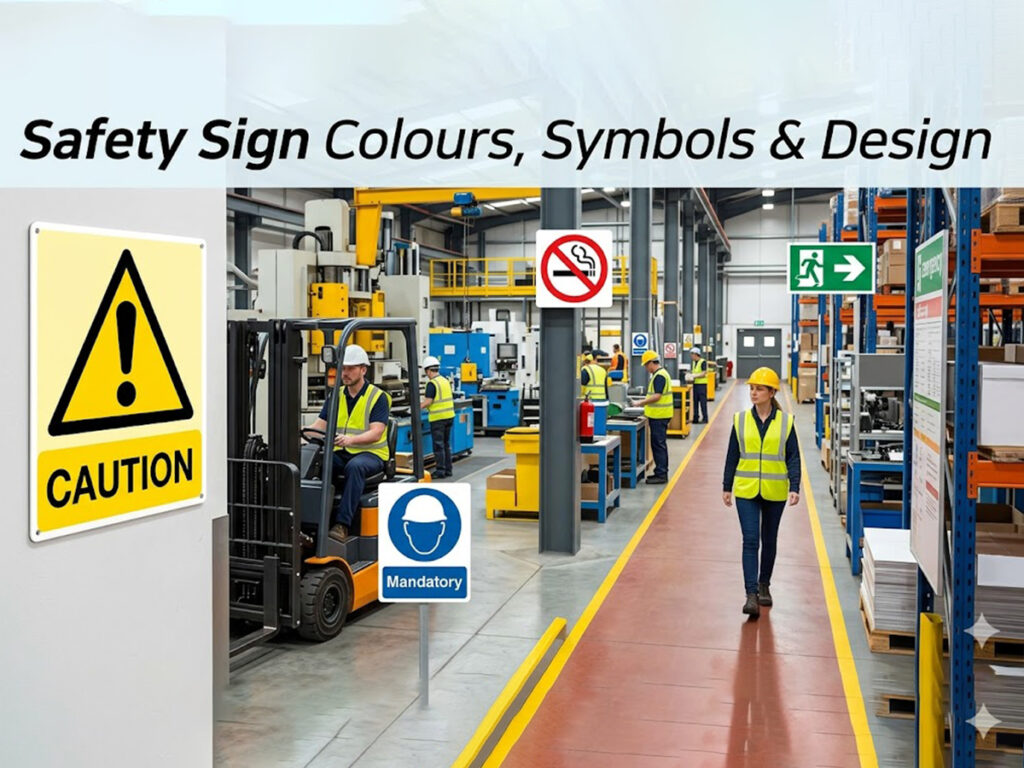
| Blue | Mandatory action | Circle | Wear eye protection; wear a hard hat |
| Green | Safe condition; escape | Square or rectangle | Emergency exit; first aid station |
Source: https://www.iso.org/standard/72424.html
Black and white serve as contrast colours. ISO 3864-4 ties each colour to specific CIE chromaticity coordinates. A green sign in one plant then matches a green sign in another.
Colour Specification in Practice
A specified colour means nothing until it reaches a substrate. Manufacturers translate ISO chromaticity values into RAL and Pantone references for production. Colour fidelity matters. A sign that drifts toward orange under UV exposure breaks the code it was meant to carry.
Common Colour Mistakes That Undermine Compliance
Three errors recur across audits:
- Managers misuse red for non-prohibition messages.
- They pair colours with weak chromatic contrast.
- They specify pigments that fade fast. Each mistake erodes the colour system.
Teams that want to avoid these traps should study the colour pairings that send the wrong message.
Symbols, Pictograms and Geometric Shape Coding
Symbols carry meaning across language barriers. Well-built safety sign symbols and pictograms make a sign readable to anyone on the floor.
The Geometric Shape Code
Shape encodes meaning before colour is even processed. A circle signals prohibition or mandatory action. An equilateral triangle signals a warning. A square or rectangle signals a safe condition or information. A worker who sees a triangle already expects a hazard. The shape primes the response.
What Makes a Pictogram Effective
ISO 7010 builds its pictograms on tested principles. Each symbol uses a clean silhouette, minimal internal detail, and a high measured recognition rate. Simplicity drives comprehension. A cluttered pictogram slows the reader and weakens the sign.
Symbol-First vs Text-Supported Signs
Symbol-led safety sign design reduces dependence on words. That choice pays off in any multilingual workforce. Text panels still help when a hazard needs a specific instruction. The balance between the two drives the debate over graphics versus written text on a sign.
Reflectivity, Photoluminescence, and High-Visibility Sign Design
A sign only works when a worker can see it. High-visibility sign design extends safety messaging into darkness, glare, and distance.
Retroreflective Materials and How They Are Measured
Retroreflective sheeting bounces light back toward its source. Engineers measure performance as the coefficient of retroreflection, expressed in candelas per lux per square metre. Performance shifts with entrance and observation angles. Vehicle headlights make retroreflective signs essential in traffic zones.
Photoluminescent Signs
Photoluminescent — “glow-in-the-dark” — signs absorb light and release it slowly. Designers measure luminance in millicandelas per square metre and track the decay curve over time. These signs guide escape routes when power fails. They need no wiring and no external source at the moment of crisis.
Matching Material Technology to the Environment
Material choice follows the environment. Low-light spaces, no-light escape routes, and vehicle zones each demand a different technology. Managers working through poor lighting benefit from dedicated strategies for keeping signs legible in low light.
Behavioural Influence and Human Factors in Sign Design
The best safety sign design changes behaviour. It does not just inform — it prompts the right action at the right moment.
How Colour and Graphics Drive Decision-Making
Colour and shape act as pre-attentive cues. The brain processes them before conscious reading begins. Smart safety sign design uses that head start to shorten reaction time.
Warning Fatigue and Habituation
Habituation is the enemy of any sign system. Workers tune out repeated, low-stakes warnings. Designers fight back by ranking hazards and matching visual urgency to real consequences.
Designing for Comprehension, Not Just Compliance
Compliance is the floor, not the ceiling. The strongest signs combine colour, shape, and pictogram into redundant coding — three signals that all point the same way. Teams should test comprehension with their actual workforce. The link between colour, graphics, and behaviour rewards a closer look.
Designing Safety Signs for a Multilingual, Multicultural Workforce
Modern work sites speak many languages. Sound safety sign design plans for that reality from the start.
Why Symbol-Led Design Reduces Language Risk
A pictogram needs no translation. Symbol-led design sets a baseline of comprehension that survives literacy gaps and language differences. This baseline is the core of multilingual safety sign best practices.
Consistent Colour Interpretation Across Cultures
Colour associations vary across cultures. Standardisation overrides that variation. When a site follows ISO colour coding, red means prohibition for everyone. Manufacturers carry part of that load, and consistent colour interpretation across a diverse site depends on disciplined production.
When and How to Add Multiple Languages
While symbols bridge many gaps, specific technical instructions or legal warnings often require supplementary text.
- The “When”: Deploy multilingual text when dealing with high-risk hazards that cannot be fully captured by a pictogram alone (e.g., specific chemical handling or electrical isolation procedures), or when local regulations specifically mandate secondary languages.
- The “How”: To maintain legibility without creating visual clutter, follow a strict design hierarchy:
- Prioritize the ISO Symbol: Keep the graphic as the primary anchor for split-second recognition.
- Text Hierarchy: Use bold, larger fonts for the primary language and a lighter weight or distinct color for the secondary translation.
- Logical Grouping: Avoid “sandwiching” text; group translations clearly below or to the side of the symbol to prevent cognitive overload.
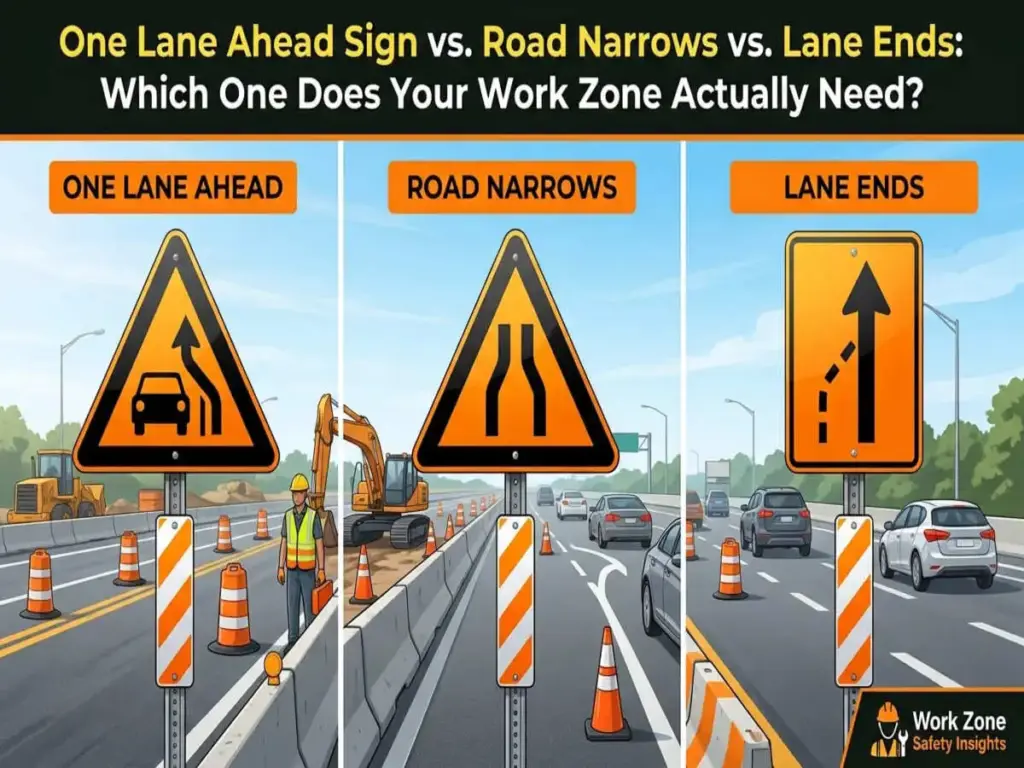
Extending the System: Traffic and Wayfinding Safety Signs
The logic of visual communication doesn’t stop at the factory door; it must extend to the tarmac to ensure site-wide safety.
Shared Logic Between Workplace and Traffic Signage
Unified coding reduces cognitive friction. By maintaining consistent shape and colour logic between indoor safety signs and outdoor traffic routes, site managers ensure that drivers and pedestrians respond instinctively, regardless of their location. This continuity is essential for multi-modal sites where heavy machinery and personnel frequently intersect.
Engineering for Speed: Design Principles for Traffic Environments
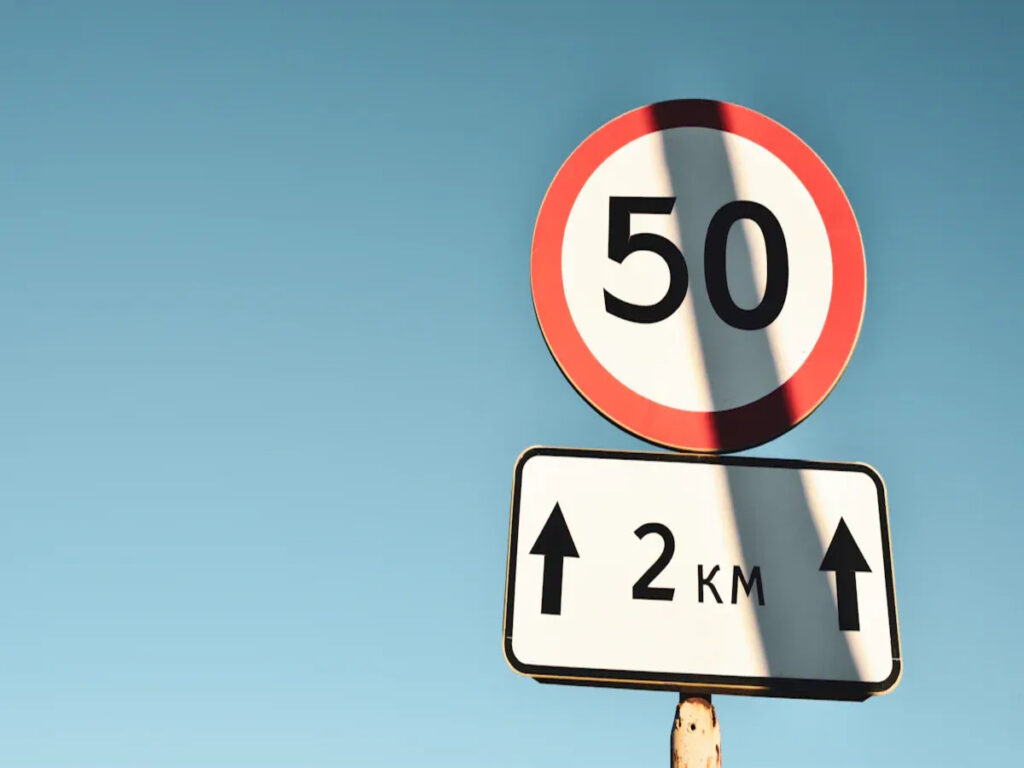
Traffic environments introduce a critical variable: velocity. Unlike static workplace signs, traffic signage must account for “Legibility Distance.”
- Reflectivity Scales: As vehicle speed increases, the required Grade of reflective sheeting (e.g., Class 1 vs. Class 2) must rise to provide adequate reaction time.
- Geometric Scaling: Text heights and symbol dimensions are calculated based on approach speeds to ensure the message is decoded before the braking point.
- Visual Adaptability: The design principles behind road sign colours are engineered to remain distinct against complex outdoor backgrounds and under varying weather conditions.
Building a Coherent Safety Sign System That Works
Strong safety sign design ends where it began — as a system. Every colour, shape, symbol, and material choice serves one goal: a message a worker understands without effort.
The Design Checklist — Colour, Shape, Pictogram, Material
A practical safety sign design review runs through four questions:
- Colour: Does the safety colour match the hazard category under ISO 3864-1?
- Shape: Does the geometric shape reinforce the message before the words are read?
- Pictogram: Is the symbol a registered ISO 7010 pictogram with a clean silhouette?
- Material: Does the substrate suit the lighting — retroreflective, photoluminescent, or standard?
Auditing and Maintaining Sign Integrity Over Time
Signs age. They fade, crack, and fall behind revised standards. A scheduled audit catches damage, removes redundant signs, and keeps the system aligned with current ISO 7010 amendments. OSHA enforcement adds a financial reason to keep that schedule.
| Violation Type | Maximum Penalty (2026) |
| Serious | $16,550 per violation |
| Other-than-serious | $16,550 per violation |
| Willful | $165,514 per violation (minimum $11,524) |
| Repeat | $165,514 per violation |
| Failure to abate | $16,550 per day beyond the abatement date |
Source: https://www.osha.gov/penalties
Frequently Asked Questions About Safety Sign Design
What are the four main safety sign colours and what do they mean?
ISO 3864-1 defines red for prohibition and fire equipment, yellow for warning, blue for mandatory action, and green for safe conditions and escape routes. Black and white act as contrast colours.
Are safety signs a legal requirement in U.S. workplaces?
Yes. OSHA 29 CFR 1910.145 requires accident prevention signs and tags wherever hazards are not readily apparent. It also sets design and placement rules.
What is the difference between ISO 7010 and older standards?
ISO 7010:2019 provides a single library of registered, tested pictograms. Older national standards used varied symbols. ISO 7010 harmonises them under one referenced system.
What is the difference between retroreflective and photoluminescent signs?
Retroreflective signs bounce headlight or torchlight back to the viewer. Photoluminescent signs store light and glow on their own when the area goes dark. Good safety sign design matches each type to its environment.
Do safety signs have to use symbols instead of text?
No, but symbol-led design is best practice. Pictograms cross language barriers. Text panels add specific instructions where a symbol alone cannot carry the full message.
How often should a workplace audit its safety signs?
Most safety managers run a documented review at least once a year. They also re-check after layout changes, incidents, or updates to ISO 7010 or OSHA guidance.
References
- OSHA — 29 CFR 1910.145, Specifications for accident prevention signs and tags.
- Cornell Legal Information Institute — 29 CFR 1910.145.
- ISO — ISO 7010:2019, Graphical symbols, Safety colours and safety signs, Registered safety signs.
- ISO — ISO 3864-4:2011, Colorimetric and photometric properties of safety sign materials.