Traffic cone standards diverge more sharply between markets than any other category of traffic safety equipment. A US highway project requires 28-inch cones with dual reflective collars and NCHRP-350 crash-test certification. A UK motorway project requires 750 mm cones meeting BS EN 13422 with CE marking. An Australian council specification references AS 1742.3. A Middle East infrastructure tender calls for EN 13422 CE-marked cones with 750 mm minimum height. These specifications describe the same functional product — a large, arancia, retroreflective channelizing cone for highway use — but require different product certifications, different height units, different collar width standards, and in some cases different minimum base weights.
This guide maps traffic cone standards across five regulatory frameworks — MUTCD (U.S.A.), IN 13422 (EU and Middle East), BS One 13422 (Regno Unito), COME 1742.3 (Australia), and GCC country-level specifications — for procurement managers, project engineers, and manufacturers sourcing or supplying cones internationally. Internal links throughout connect to detailed guides on specific topics.
How to use this guide: If you are specifying for a single market, go directly to Part 2 (height quick-reference) e parte 5 (procurement cheat-sheet) for that market. If you need a product that serves multiple markets simultaneously, Parte 4 (certification paths) tells you what documentation each market requires. Parte 3 (reflective collar standards) covers the specification detail that causes the most cross-market procurement errors for cones.
Parte 1: Why Traffic Cone Standards Differ Across Markets
Traffic cone compliance across global markets relies on two independent regulatory layers: product standards (material specifications) E deployment standards (site placement). While these requirements often overlap, each region manages them through distinct legislative structures:
- Australia (AS/NZS): Standards Australia separates sheeting performance from field use. COME 1742.3 manages deployment protocols, which then references AS/NZS 1906.1 to ensure the reflective sheeting meets high-visibility benchmarks.
- Stati Uniti (MUTCD): IL Manuale sui dispositivi di controllo del traffico uniforme (MUTCD) consolidates both layers into a single document. It defines physical attributes like minimum cone height and reflective collar specs alongside precise deployment rules.
- Regno Unito (Dual-Standard): British regulations split these responsibilities. BS One 13422 dictates the product’s physical performance, Mentre Capitolo 8 del Manuale della Segnaletica Stradale governs legal deployment on public roads.
The result is that a cone can be fully product-compliant (CE marked to BS EN 13422) but non-compliant in deployment (wrong height for the road speed), or vice versa. This guide covers the product specification layer — height, collar, materiale, and certification — because that is where procurement decisions are made. For deployment placement rules by market, see the Field Playbook Series guides linked throughout this article.
1.1 The Three Core Specification Parameters
Across all five markets, three parameters govern what a highway-grade traffic cone must be: altezza (the primary visibility driver), reflective collar (the primary nighttime visibility driver), E crash test certification (the safety-of-device requirement for high-speed impact). Each market measures and mandates these parameters differently, using different units, different test methods, and different certification models. Base weight — the fourth commonly discussed parameter — has no universal minimum mandate in any of the five frameworks, but is often specified in project-level procurement documents.
1.2 The NCHRP-350 vs CE Marking Divide
The most fundamental difference between US and international cone procurement lies in the crash test certification system. Specificamente, the US requires traffic cones on Federal Highway Administration (FHWA) projects to meet NCHRP-350 or the newer MASH (Manuale per la valutazione dell'hardware di sicurezza) standard. These protocols simulate high-speed vehicle strikes to measure critical breakaway performance. Tuttavia, crash-test certification remains optional for commercial sales outside FHWA projects, although many state DOTs still mandate NCHRP-350 compliance in their standard drawings.
Al contrario, Unione Europea, Regno Unito, CCG, and Australian markets embed crash-test requirements directly into the CE marking framework under EN 13422. This CE marking is mandatory for any traffic cone sold for road use within EU member states and serves as the de facto procurement benchmark for the GCC region. Crucially, NCHRP-350 and EN 13422 evaluate different impact scenarios with distinct speed variables and pass/fail criteria. Di conseguenza, an NCHRP-350 certification does not automatically satisfy EN 13422 Requisiti, or vice versa. Perciò, manufacturers targeting both global regions must maintain dual certifications to ensure full regulatory compliance.
For a detailed guide on CE certification requirements for traffic safety cones, Vedere CE Certification for Traffic Safety Cones: Standard di sicurezza europei. For a full overview of OSHA and MUTCD cone regulations in the US, Vedere Guida completa ai regolamenti del cono del traffico OSHA.
Parte 2: Height Requirements by Market — the Master Cross-Reference
The table below maps all five markets across twelve specification dimensions. The height measurement discrepancy between the US (pollici) and all other major markets (millimetres) is the single most common source of cone specification error in international procurement.
| Dimension | U.S.A. | Unione Europea | Regno Unito | Australia / Nuova Zelanda | CCG / Medio Oriente |
| Governing standard | MUTCD (Parte 6) + NCHRP-350 / MASH | IN 13422 + Ce | BS One 13422 (Capitolo 8 for deployment) | COME 1742.3 + AS/NZS 1906.1 | IN 13422 (adopted) or local DOT spec |
| Standard body | FHWA (MUTCD) ATSSA / TRB (Test) | CEN | BSI | Standard Australia | GSO / country DOT |
| Urban min. altezza | 18 In (457 mm) | 500 mm (≈ 20 In) | 500 mm | 500 mm | 500 mm |
| Highway min. altezza | 28 In (711 mm) (≥45 mph / 70 km/h) | 750 mm (≈ 30 In) | 750 mm | 750 mm | 750 mm |
| Notte / high-speed height | 28 in min, 36 in preferred | 750 mm min | 750 mm min | 750 mm min | 750 mm min |
| Reflective collar — upper | 6 In (152 mm) Largo | ≥ 100 mm largo (IN 13422) | ≥ 100 mm largo | ≥ 100 mm largo | ≥ 100 mm largo |
| Reflective collar — lower | 4 In (102 mm) Largo (dual-band required >45 mph) | ≥ 50 mm largo | ≥ 50 mm largo | ≥ 50 mm largo | ≥ 50 mm largo |
| Reflective sheeting grade (collar, min) | ASTM Type I (PER ESEMPIO) — night use | IN 13422 RA1 compliant | IN 13422 RA1 compliant | COME 1742.3 compiacente | IN 13422 compiacente |
| Cone color | Arancio fluorescente (ASTM E709) | Orange — EN 13422 spec | Orange or red (both permitted Ch.8) | Arancio fluorescente | Arancia |
| Min. peso base (28 In / 750 mm) | No MUTCD mandate state DOTs vary: 3–7 lb typ. | No EN min. mandate but ballast required | No BS EN min. (site-specific wind risk) | No AS min. mandate (state specs vary) | No EN min. (project spec governs) |
| Crash test certification | NCHRP-350 or MASH (required for FHWA projects) | IN 13422 Marcatura CE | Marcatura CE (BS One 13422) | COME 1742.3 conformità | Marcatura CE (for GCC supply) |
| Third-party cert required? | NO (for commercial sale) SÌ (FHWA/DOT projects) | Yes — CE marking | Yes — CE / UKCA | NO (voluntary SAI Global) | Yes — CE (in genere) |
2.1 Height Quick-Reference by Application
| Applicazione | U.S.A. (MUTCD) | Unione Europea (IN 13422) | Regno Unito (Ch.8 / BS One) | Australia (COME 1742.3) | CCG (EN-based) |
| Interno / private site | 12–18 pollici (305–457 mm) | 300–500 mm | 300–500 mm | 300–500 mm | 300–500 mm |
| Urban road, low speed ≤35 mph / 55 km/h | 18 In (457 mm) | 500 mm | 500 mm | 500 mm | 500 mm |
| Arterial / collector road | 18–28 in | 500–750 mm | 500–750 mm | 500–750 mm | 500–750 mm |
| Autostrada / freeway ≥45 mph / 70 km/h | 28 In (711 mm) | 750 mm | 750 mm | 750 mm | 750 mm |
| Notte / high-speed preferred | 36 In (914 mm) | 750 mm+ | 750 mm+ | 750 mm+ | 750 mm+ |
For US-specific guidance on when to use 18-inch vs 28-inch cones in roadwork settings, including the MUTCD application thresholds, Vedere 18-inch vs 28-inch Traffic Cones for Roadwork and Event Management.
Key procurement insight: 28 pollici (711 mm) E 750 mm are not the same height. A US-specification 28-inch cone is 39 mm shorter than a European or Australian 750 mm cone. For projects where the specification calls for ‘750 mm minimum height,’ a US-spec 28-inch cone does not comply. For multi-market procurement, specify 750 mm / 28 in and verify the actual product height against both values before ordering.
Parte 3: Reflective Collar Standards — the Detail That Causes Errors
Reflective collars are the primary nighttime visibility component of a traffic cone. The collar requirements are the specification detail where the most cross-market procurement errors occur — not because the requirements differ dramatically in performance, but because the measurement conventions and testing references differ enough to create confusion.
| Collar Detail | U.S.A. (Parte MUTCD 6) | Unione Europea (IN 13422) | Regno Unito (Ch.8 / BS One) | Australia (COME 1742.3) | CCG (EN-based) |
| Number of bands (autostrada) | 2 (required >45 mph) | 2 (specified) | 2 (specified) | 2 (specified) | 2 (specified) |
| Upper collar width | 6 In (152 mm) | ≥ 100 mm | ≥ 100 mm | ≥ 100 mm | ≥ 100 mm |
| Lower collar width | 4 In (102 mm) | ≥ 50 mm | ≥ 50 mm | ≥ 50 mm | ≥ 50 mm |
| Upper collar position (from top of cone) | 3–4 in from top | ≤ 200 mm from top (EN spec) | ≤ 200 mm from top | ≤ 200 mm from top | ≤ 200 mm from top |
| Sheeting grade (collar) | ASTM Type I min (PER ESEMPIO) | IN 13422 RA compliant | IN 13422 RA compliant | COME 1742.3 compiacente | IN 13422 compiacente |
| Day vs night collar requirement | Notte: obbligatorio; Giorno: optional on low-speed | Required for all road-use cones | Required for all road-use | Required for road-use | Required for road-use |
The reflective sheeting on cone collars is assessed against the same underlying retroreflectivity frameworks as sign sheeting — ASTM D4956 in the US and EN 12899-1 / IN 13422 in international markets. For a detailed comparison of reflective sheeting grades and their equivalency across ASTM, IN, and AS frameworks — including how collar sheeting grades map to road sign sheeting grades — see the companion guide Standard di foglio riflettente: ASTM D4956 vs EN 12899 vs AS/NZS 1906.
3.1 The Single-Band vs Dual-Band Threshold
Both the MUTCD and EN 13422 require two reflective collars on traffic cones used on high-speed roads. The MUTCD specifies the dual-band requirement explicitly for cones used on roads with posted speeds above 45 mph. IN 13422 requires two bands on cones used for road traffic management on all classified roads. The practical difference: a single-band cone that is compliant for low-speed US urban deployment (≤35 mph) may not be compliant for any EN-market road deployment where the cone is used for traffic management.
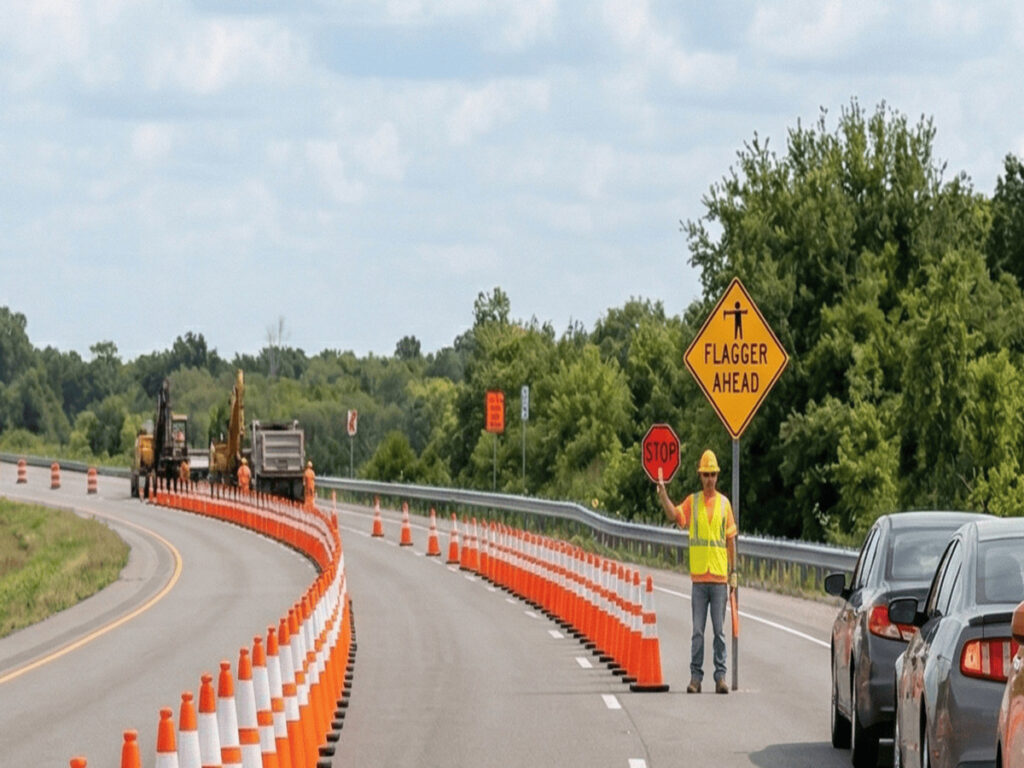
For US highway work zone operations and how reflective collar requirements apply in specific deployment scenarios including night operations, see the Field Playbook: Highway One-Lane Two-Way Flagging Guide e il Guida definitiva al controllo temporaneo del traffico MUTCD.
3.2 Collar Width Measurement: Inches vs Millimetres in Practice
The MUTCD specifies a 6-inch (152 mm) upper collar and a 4-inch (102 mm) lower collar. IN 13422 specifies a minimum 100 mm upper collar and minimum 50 mm lower collar. A cone with a 100 mm upper collar meets EN 13422 but does not meet the MUTCD 6-inch (152 mm) requirement. For multi-market procurement, the MUTCD collar widths are the more demanding specification — a cone with 6-inch + 4-inch collars satisfies both MUTCD and EN 13422 Requisiti.
Parte 4: Certification Paths — What Each Market Actually Requires
| Mercato | Required Cert | Testing Body | Product Marking | Key Standard | Note |
| U.S.A. (FHWA projects) | NCHRP-350 or MASH certification | FHWA-approved test lab | NCHRP-350 / MASH cert mark (project bid docs) | NCHRP-350 or ASTM standards | Commercial sale needs no cert; DOT projects require crash-test cert |
| U.S.A. (commerciale) | None mandatory | Manufacturer self-cert | MUTCD-compliant label | Parte MUTCD 6 | State DOTs may add requirements |
| Unione Europea | CE marking mandatory | EU Notified Body | CE mark on cone body | BS One 13422 | Applies to all cones sold for road use |
| Regno Unito | UKCA (post Jan 2025) or CE in transition | UK-approved body | UKCA or CE mark | BS One 13422 | Capitolo 8 governs deployment; BS EN governs product |
| Australia / Nuova Zelanda | COME 1742.3 conformità (supplier declaration) | Manufacturer or SAI Global | AS/NZS compliance statement | COME 1742.3 + AS/NZS 1906.1 | Voluntary SAI Global cert strengthens procurement position |
| CCG / Medio Oriente | Marcatura CE (tipico) or GSO mark | CE notified body or GSO body | Ce / GSO mark | IN 13422 or local DOT spec | Saudi SASO may add national registration layer |
4.1 NCHRP-350 vs MASH: Which US Certification Do You Need?
NCHRP-350 was the primary US crash-test standard for roadside safety hardware from 1993 until the introduction of MASH (Manuale per la valutazione dell'hardware di sicurezza) In 2009. FHWA set a deadline requiring that new traffic safety devices on FHWA-funded projects receive MASH certification rather than NCHRP-350 certification. Per coni di traffico, MASH TL-3 (test level 3, 100 km/h / 62 mph) is the relevant test level for highway applications.
In pratica: for DOT contract work on US highways, specify MASH TL-3 certification as the current standard. For commercial supply outside FHWA-funded projects, NCHRP-350 certification remains widely accepted and the requirement varies by state DOT and project specification. Products that were NCHRP-350 certified before MASH became the FHWA requirement may continue to be used where already deployed — but for new procurement on federal projects, MASH is the standard to specify.
4.2 Australia: When Does Third-Party Certification Matter?
Australia has no mandatory CE-style third-party certification requirement for traffic cones. Conformità all'AS 1742.3 (deployment) e AS/NZS 1906.1 (fogli riflettenti) is demonstrated through supplier declaration. Tuttavia, major state road authority contracts — particularly with Transport for NSW, Vicroads, and the Department of Transport Queensland — increasingly require SAI Global certification or third-party test reports. For export to Australia, a product holding both EN 13422 CE marking and ASTM MASH certification, with test reports translated to AS 1742.3 parameters, will satisfy procurement requirements for virtually all Australian infrastructure projects.
Parte 5: Procurement Specification Cheat-Sheet
The table below consolidates the recommended cone specification for each application and market combination. Copy the relevant row into your project procurement document and verify against local supplemental requirements.
| Applicazione / Scenario | USA Height | UK Height | AU Height | GCC Height | Collar (all markets) | Crash Cert (USA DOT) |
| Urbano, ≤35 mph / 55 km/h Daytime only | 18 In | 500 mm | 500 mm | 500 mm | 1-band min (50 mm) | Not required |
| Urbano, ≤35 mph / 55 km/h Night included | 18 In (reflective required) | 500 mm | 500 mm | 500 mm | 2-band RA compliant | Not required |
| Arterial / collector road | 18–28 in | 500–750 mm | 500–750 mm | 500–750 mm | 2-band RA compliant | Not required |
| Highway ≥45 mph / 70 km/h | 28 In | 750 mm | 750 mm | 750 mm | 2-band: 6 In + 4 In (152+102 mm) | NCHRP-350 or MASH |
| Autostrada, night preferred | 36 In | 750 mm+ | 750 mm+ | 750 mm+ | 2-band: 6 In + 4 In | NCHRP-350 or MASH |
| High-wind zone (≥55 mph / 90 km/h) | 28–36 in (ballasted base) | 750 mm (ballasted) | 750 mm (ballasted) | 750 mm (ballasted) | 2-band RA compliant | MASH preferred |
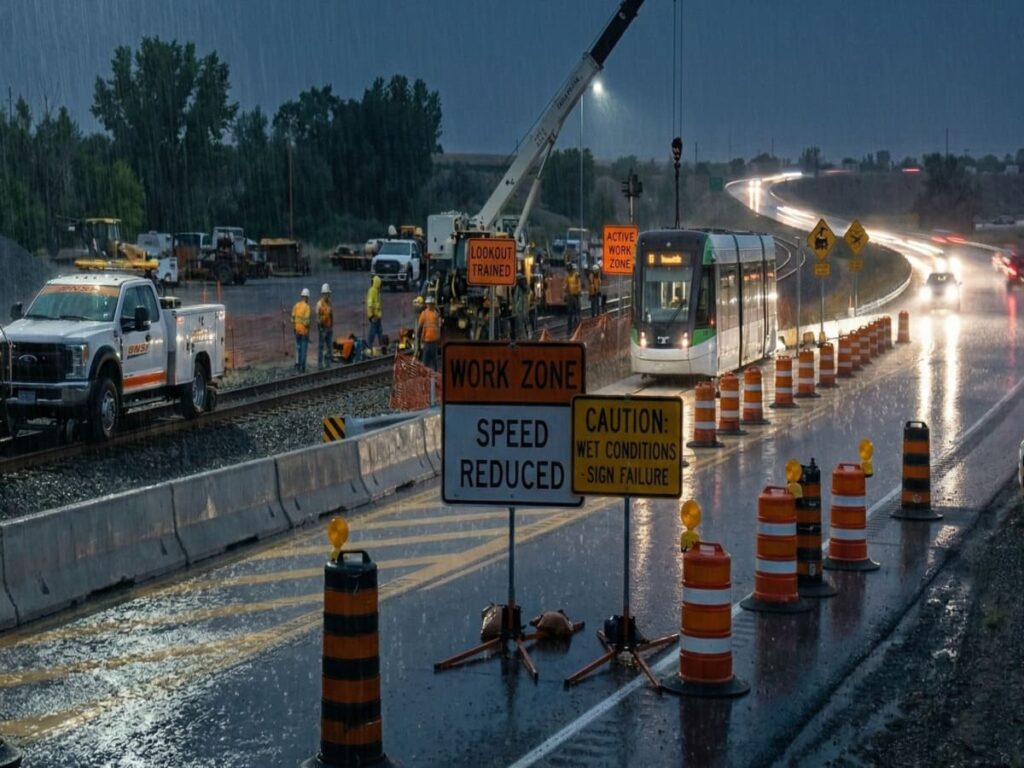
High-wind zone note: No standard specifies a universal minimum cone base weight for wind resistance. For sites with sustained winds above 55 mph (90 km/h) — including Gulf Coast US hurricane zones, tornado risk areas, and GCC desert sites — specify ballasted bases with a project-level minimum weight based on the site wind risk assessment rather than relying on a standard minimum. For wind-related cone performance failures in US work zones, see the Extreme Weather Work Zone Signs Guide, which covers cone base performance in high-wind and hurricane-season conditions.
5.1 Multi-Market Procurement Strategy for Cones
The most efficient path to cones that satisfy all five markets simultaneously is a 750 mm cone (meeting both the EN/AU/GCC 750 mm requirement and exceeding the US 28-inch / 711 mm requirement) with 6-inch + 4-inch reflective collars (meeting both MUTCD collar widths and EN 13422 collar minimums), CE marking under EN 13422, and MASH TL-3 crash-test certification. This combination covers US DOT projects, EU/UK road use, Australian infrastructure contracts, and GCC tenders without product modification or separate SKUs.
The one specification that cannot be fully combined is color for UK deployment: Capitolo 8 of the UK Traffic Signs Manual permits both orange and red cones for temporary traffic management, but orange is the dominant specification in practice and is EN 13422 compiacente. Fluorescent orange cones are appropriate for all five markets.
OPTRAFFIC traffic cones are manufactured with MUTCD, Ce (IN 13422), and AS/NZS compliance. MASH and NCHRP-350 certified models available for US DOT projects. Browse Traffic Cones → | For multi-market procurement documentation, contact the OPTRAFFIC team.
Parte 6: Five Common Specification Errors in Cross-Market Cone Procurement
Error 1: Treating 28 Inches and 750 mm as Equivalent
28 inches is 711 mm. 750 mm is the EN/UK/AU/GCC minimum for highway cones. A 28-inch cone is 39 mm shorter than required. For projects specifying 750 mm as the minimum height, order cones with an actual height of 750 mm (circa 29.5 pollici) or specify height in both units and verify the product data sheet against both values.
Error 2: Ordering NCHRP-350-Certified Cones for EU or GCC Projects
NCHRP-350 certification does not satisfy EN 13422 CE marking requirements. A cone crash-tested and certified under NCHRP-350 may perform similarly in real-world conditions to a CE-marked EN 13422 cono, but it does not carry the legal product marking required for road use in EU member states or on CE-specified GCC projects. Order CE marking and NCHRP-350 as separate certifications for multi-market supply.
Error 3: Supplying Single-Band Cones to EN-Market Road Projects
IN 13422 requires two reflective collar bands on cones used for road traffic management on classified roads. A single-band cone that is MUTCD-compliant for US low-speed urban deployment does not satisfy EN 13422 requirements for EU, Regno Unito, or GCC road use regardless of the cone’s height. For all EN-market road supply, specify dual-band collars as a baseline.
Error 4: Specifying Base Weight Without Reference to Wind Risk Assessment
None of the five standard frameworks specifies a universal minimum cone base weight. Specifying a fixed base weight (Per esempio, ‘7 lb minimum’) without reference to the site wind risk assessment may result in either over-specification (adding cost on low-wind urban sites) or under-specification (inadequate on exposed highway or GCC desert sites). For any site with sustained wind risk, specify base weight by referencing the site wind assessment rather than a fixed value.
Error 5: Using MASH Certification Language for Pre-2009 Projects Still Using NCHRP-350 Products
Many deployed traffic cones on US state highway networks are NCHRP-350 certified but not MASH certified. For new procurement on FHWA-funded projects, specify MASH TL-3. For supply to replace existing NCHRP-350 certified devices on ongoing projects, verify whether the project specification requires MASH or still accepts NCHRP-350. Mixing MASH and NCHRP-350 certified devices in the same deployment is permitted but should be documented in the traffic control plan.
Riepilogo
Traffic cone standards across the five major procurement markets converge on the same core purpose — a highly visible, retroreflect, channelizing device that can be safely struck by an errant vehicle — but diverge significantly in the measurement units, collar specifications, crash-test frameworks, and certification models used to enforce that purpose. The 28-inch / 750 mm height discrepancy, the NCHRP-350 vs CE marking certification divide, and the single-band vs dual-band collar threshold are the three specification differences that cause most cross-market procurement errors.
The procurement cheat-sheet in Part 5 consolidates the specification for each application and market combination. For manufacturers and importers building a multi-market cone product line, UN 750 mm cone with 6-inch + 4-inch dual reflective collars, MASH TL-3 certification, e e 13422 CE marking is the product specification that covers all five markets without modification.
Next in this series: Work Zone Sign Colors: MUTCD Orange vs UK Yellow-Green vs GCC Specifications — a guide to background color, retroreflectivity class, and legend requirements for temporary traffic control signs across five markets.
Related Guides
From the OPTRAFFIC International Standards Series:
From the OPTRAFFIC Field Playbook Series:
- Segni di zona di lavoro: Highway One-Lane Two-Way Flagging Guide (includes 28″ vs 36″ cone deployment protocols)
- Segnali stradali chiusi: Urban Intersection Short-Term Work Zone Guide (includes 18″ cone deployment protocols)
- Segnaletica di sicurezza della zona di lavoro: Extreme Weather Failure Guide (includes cone base performance in wind and hurricane conditions)
- Guida definitiva al controllo temporaneo del traffico MUTCD
OPTRAFFIC Traffic Cone Library:
- 18-inch vs 28-inch Traffic Cones for Roadwork and Event Management
- Guida completa ai regolamenti del cono del traffico OSHA
- CE Certification for Traffic Safety Cones: Standard di sicurezza europei
- Requisiti del cono stradale in diversi scenari
- Heavy Duty Cones vs Standard Cones: Che è meglio per il tuo progetto?