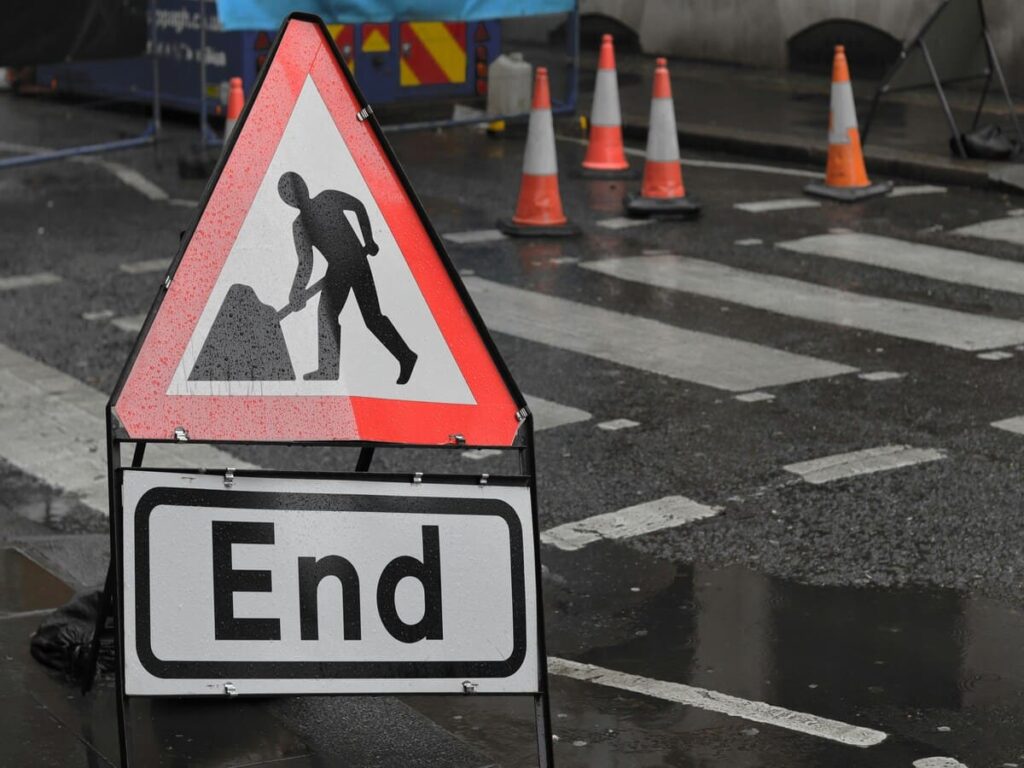
What Does the Highways Act 1980 Say About Traffic Cones?
El Acto de carreteras 1980 is the primary legislation governing the use of public roads in England and Wales. For anyone placing conos de trafico on a public highway — whether as a member of the public, a business owner, or a licensed contractor — Section 137 is the most important provision to understand.
Sección 137 states that if a person, without lawful authority or excuse, wilfully obstructs the free passage along a highway, they commit a criminal offence. As amended by the Police, Crime, Sentencing and Courts Act 2022 (which came into force on 12 Puede 2022), the penalty now includes imprisonment for up to 51 semanas, a fine, o ambos. Before that amendment, only a fine applied.
Placing road cones on a public street without a permit falls squarely within this definition. The obstruction does not need to block the entire width of the road to constitute an offence — any interference with free passage is sufficient. Además, it does not matter whether the highway has already been temporarily restricted by a constable or traffic authority; Sección 137(1B) makes clear that unauthorised obstruction remains an offence regardless.
What Counts as “Lawful Authority” Under Section 137?
The key phrase in Section 137 es “without lawful authority or excuse.” Para conos de trafico on a public road, lawful authority means one of the following:
- A permit issued by the local highway authority (typically under the New Roads and Street Works Act 1991)
- A Traffic Regulation Order (TRO) or Temporary Traffic Regulation Order (TTRO) made under the Road Traffic Regulation Act 1984
- A direction from a police officer or traffic authority acting under statutory powers
- Authorisation granted under another specific statutory provision (Por ejemplo, for emergency services responding to an incident)
Without one of these, any road cone on a public highway creates an offence under Section 137 — regardless of the reason behind it. Wanting to reserve a parking space, protect a dropped kerb, or mark a pothole does not constitute a lawful excuse. Councils consistently prosecute such cases, and courts treat them as straightforward obstruction offences.
Sección 137 and Traffic Cones: The Most Common Scenarios
Putting Cones Outside Your House
This is by far the most frequent Section 137 issue involving conos de trafico. Residents who place safety cones on a public road outside their property — to reserve parking or protect their driveway — have no lawful authority to do so. The road is a public highway, and the resident has no greater right to obstruct it than anyone else.
Councils treat this as obstruction under Section 137. Enforcement officers can remove the cones and issue a fine. In persistent cases, local authorities have also sought court orders requiring the person to stop placing cones, with further penalties for non-compliance under Section 137ZA of the same Act.
Using Cones for Informal Roadworks or Repairs
Property owners and small businesses sometimes place orange cones around a pothole, a damaged kerb, or a leaking pipe while waiting for repairs. Without a street works permit, this constitutes obstruction under Section 137, even though the intention is to protect others. The correct route is to report the hazard to the council or highway authority, who have the statutory duty under Section 130 of the Acto de carreteras 1980 to protect public access and remove hazards.
Contractors Without a Valid Permit
Even licensed contractors commit an offence under Section 137 if they deploy road cones before a permit is in place. The permit — typically a Section 50 licence under the New Roads and Street Works Act 1991 — is what provides the “lawful authority” that Section 137 requiere. Como consecuencia, contractors must ensure the permit precedes any cone placement, not vice versa.
Moving Official Cones
Removing or repositioning road cones placed by police, consejos, or licensed contractors is a separate but related offence. Under Section 89 of the Police Act 1996, interfering with a police officer in the execution of their duty — which includes moving police cones at an incident scene — carries an unlimited fine and up to one month’s imprisonment. Moving highway authority cones also engages Section 137, since doing so restores an obstruction that the authority had lawfully managed.
Penalties and Fines Under the Highways Act 1980
The penalty structure for Section 137 offences involving conos de trafico breaks down as follows:
| Offence | Legislación | Pena |
|---|---|---|
| Placing cones on public road without permit | Acto de carreteras 1980, S.137 | Fine and/or up to 51 weeks imprisonment |
| Failing to remove cones after court order | Acto de carreteras 1980, S.137ZA | Further fines per day of continued offence |
| Moving official highway cones | Acto de carreteras 1980, S.137 | Fine and/or up to 51 weeks imprisonment |
| Moving police cones at incident scene | Police Act 1996, S.89 | Unlimited fine and/or up to 1 month imprisonment |
| Contractor deploying cones without permit | Nuevas actos de carreteras y obras callejeras 1991 | Up to £5,000 |
Beyond these direct penalties, anyone whose unauthorised conos de trafico cause or contribute to an accident faces civil liability. If a driver swerves to avoid illegally placed road cones and causes a collision, the person who placed the cones can be sued for damages. Courts have consistently held that creating an obstruction on a public highway transfers a significant portion of liability to the person responsible for that obstruction.
How Section 137 Relates to the Road Traffic Regulation Act 1984
El Acto de carreteras 1980 and the Road Traffic Regulation Act 1984 work together to regulate the use of conos de trafico on public roads, but they serve different functions.
El Acto de carreteras 1980, Sección 137, addresses the criminal offence of obstruction — it is the enforcement mechanism that allows councils and police to prosecute anyone who places cones without authority.
The Road Traffic Regulation Act 1984, en contraste, is the enabling legislation. It gives councils the power to make Traffic Regulation Orders and Temporary Traffic Regulation Orders — the legal instruments that provide the “lawful authority” Sección 137 requiere. En otras palabras, el 1984 Act creates the permit framework; el Acto de carreteras 1980 enforces it.
For contractors and traffic management companies, both Acts are therefore relevant. El 1984 Act determines what permits are needed and how to obtain them; el Acto de carreteras 1980 determines the consequences of operating without them.
Other Relevant Provisions of the Highways Act 1980
Beyond Section 137, several other provisions of the Acto de carreteras 1980 are directly relevant to cono de trafico usar:
- Sección 130 — places a statutory duty on highway authorities to assert and protect the rights of the public to use and enjoy any highway. Under this section, councils have both the power and the obligation to remove unauthorised road cones and prosecute those responsible.
- Sección 149 — gives highway authorities the power to remove things deposited on highways that constitute a nuisance, including unlawfully placed safety cones. The authority can recover the costs of removal from the person who placed the obstruction.
- Sección 174 — places the duty to properly guard, luz, and sign any works on the road on the person carrying out those works. This section is the basis for Chapter 8 of the Traffic Signs Manual compliance obligations — it makes the contractor personally responsible for any failure to deploy road cones correctly during legitimate works.
- Sección 143 — gives highway authorities the power to remove structures from highways. En algunos casos, councils have used this provision to remove semi-permanent cone arrangements that property owners have left in place over extended periods.
Aplicación: Who Acts on Section 137 Violations?
En la práctica, enforcement of Section 137 obstruction offences involving conos de trafico falls to three bodies:
Local councils and civil enforcement officers (CEOs) handle the majority of cases involving residents placing cones on residential streets. CEOs can remove the cones and issue a fixed penalty notice. For persistent offenders, councils escalate to the magistrates’ court under Section 137ZA, which allows courts to order removal and impose daily fines for continued non-compliance.
Highway authorities act on obstructions affecting trunk roads and strategic routes. They use Section 149 to remove cones and recover costs, y Sección 137 to prosecute where the obstruction was deliberate or persistent.
Policía deal with obstructions that create an immediate safety risk or involve interference with official cones at incident scenes. Police also have the power to direct contractors to remove cones that are creating hazards, and to prosecute under Section 137 where the situation warrants it.
Además, the Health and Safety Executive (HSE) can investigate cases where incorrectly deployed road cones at a works site contributed to a workplace accident, applying the Health and Safety at Work Act 1974 in parallel with the Acto de carreteras 1980.
What Contractors Must Do to Avoid Section 137 Responsabilidad
For procurement managers and site operatives, the practical implications of Section 137 are straightforward. Before any conos de trafico go on a public road, the following must be in place:
A valid permit. On streets covered by the New Roads and Street Works Act 1991, this is a Section 50 licence or equivalent. On trunk roads, contractors need a permit under the relevant highway authority’s permit scheme. The permit provides the “lawful authority” that Section 137 requiere.
A Traffic Management Plan (TMP). Capítulo 8 of the Traffic Signs Manual requires a TMP for all works on public roads. The TMP must be prepared and approved before deployment begins — not after road cones are already in position.
Compliant equipment. Road cones must meet the specifications set out in the TMP and comply with BS EN 13422. Using undersized or non-reflective cones does not affect the Section 137 analysis directly, but it does engage liability under Section 174 if those cones fail to adequately guard the works.
Notification to the highway authority. The authority must receive advance notice of the works, and the TMP must satisfy Chapter 8 requirements before the permit is granted. Contractors who notify after placing cones — rather than before — have already committed an offence.
For a detailed breakdown of Chapter 8’s operational requirements for cono de trafico despliegue, including cone height by speed limit, taper spacing, and lighting obligations, ver nuestro Capítulo 8 Traffic Signs Manual guide.
Preguntas frecuentes
What does Section 137 de la Ley de Carreteras 1980 decir?
Sección 137 makes it a criminal offence to wilfully obstruct the free passage along a highway without lawful authority or excuse. As amended in May 2022, the penalty includes a fine, imprisonment for up to 51 semanas, o ambos. Colocación conos de trafico on a public road without a permit falls within this definition.
What is the fine for placing traffic cones illegally in the UK?
The fine is unlimited under the current version of Section 137 (following the 2022 amendment). En la práctica, councils typically issue fixed penalty notices in the range of £100 to £1,000 for residential obstruction cases. Contractors operating without a permit on roads covered by the New Roads and Street Works Act 1991 face fines of up to £5,000.
Can I put traffic cones outside my house under the Highways Act 1980?
No. Placing road cones on a public road — including the street outside your house — without a permit from the local highway authority constitutes obstruction under Section 137. The fact that the road is outside your property does not give you any right to obstruct it. Councils can remove the cones and prosecute you for the offence.
Is it illegal to move traffic cones placed by the council or police?
Sí. Moving official road cones is an offence under Section 137 of the Acto de carreteras 1980. Moving police cones at an incident scene is additionally an offence under Section 89 of the Police Act 1996, which carries an unlimited fine and up to one month in prison.
What is the difference between the Highways Act 1980 and the Road Traffic Regulation Act 1984?
El Acto de carreteras 1980, Sección 137, is the enforcement mechanism — it creates the criminal offence of obstruction. The Road Traffic Regulation Act 1984 is the enabling legislation that allows councils to issue the permits and Traffic Regulation Orders that provide the “lawful authority” Sección 137 requiere. Both Acts apply to cono de trafico use on public roads.
Who enforces Section 137 for traffic cone offences?
Local councils and civil enforcement officers handle residential cases. Highway authorities manage obstructions on strategic routes. Police deal with safety-critical situations and interference with official cones. The HSE may also investigate where incorrectly deployed safety cones at a works site contribute to an accident.
Can a contractor be prosecuted under Section 137?
Sí. A contractor who places road cones on a public highway before a permit is in place commits an offence under Section 137, regardless of whether the works themselves are legitimate. The permit must precede the cone deployment — not follow it.
Does Section 137 apply to private roads?
No. Sección 137 applies only to public highways. On private roads and private land, landowner permission is sufficient to place conos de trafico. Sin embargo, if any part of the cone layout extends onto a public pavement or carriageway, that portion immediately engages Section 137.
What should I do if someone has placed illegal cones on the road?
Report it to your local council’s highways department or call the police on 101 if the obstruction is creating a safety hazard. Do not move the cones yourself — if they were placed by a third party, moving them could expose you to liability. The council or police will remove them and deal with the person responsible.
Conclusión
El Acto de carreteras 1980, Sección 137, draws a clear line: conos de trafico on a public road require lawful authority, and without it, their placement is a criminal offence — regardless of intent, duración, or whether anyone is actually inconvenienced. Since the 2022 amendment, that offence now carries the possibility of a custodial sentence, not just a fine.
For members of the public, the practical rule is simple: if the road is public, you need a permit. For contractors and site managers, Sección 137 makes the sequencing non-negotiable — the permit and the approved Traffic Management Plan must be in place before a single road cone touches the highway.
OPTRAFICO supplies Chapter 8-compliant traffic cones across the full size range, all with BS EN 13422 retroreflective sleeves and sand-weighted bases built for high-speed road environments. Whether you are equipping a single site or procuring for a fleet, our road cone range meets the legal and technical specifications this article describes.
Browse our full traffic cone range →
Guías relacionadas: UK Traffic Cone Regulations
- Can I Put Traffic Cones on the Road in the UK? Laws, Multas & Normas — Legal framework: who can place cones on UK roads, penalties for unauthorised use, and private vs public road rules.
- Capítulo 8 Manual de señales de tráfico: Requisitos de los conos de tráfico explicados — Operational standards: cone height by speed limit, taper spacing, zonas de seguridad, and TMP requirements.
- UK Traffic Cones EN 13422 Compliance Guide — Product standards: sleeve classes, weight requirements, especificaciones de materiales, and bulk order verification.
| Referencias: Acto de carreteras 1980, Secciones 130, 137, 137PARA, 143, 149, 174 (legislation.gov.uk); Policía, Crime, Sentencing and Courts Act 2022, Sección 80 (legislation.gov.uk); Ley de Regulación de Tráfico Vial 1984 (legislation.gov.uk); Nuevas actos de carreteras y obras callejeras 1991 (legislation.gov.uk); Police Act 1996, Sección 89; Health and Safety at Work Act 1974; Traffic Signs Manual Chapter 8 (Departamento de transporte, gov.uk). |