Un letrero con forma de galón se erige como uno de los dispositivos mecánicamente más simples pero operativamente críticos en todo el inventario de control de tráfico.. Con forma de negrita, flecha apuntando, Delinea la dirección de curvatura en curvas horizontales., rampas de intercambio, e intersecciones donde la geometría de la carretera por sí sola no logra comunicar el camino correcto. Administración Federal de Carreteras (FHWA) Los datos sobre accidentes muestran que los accidentes por salida de la carretera (eventos en los que un vehículo abandona su carril previsto en una curva) representan aproximadamente 32% de todos los accidentes fatales en las carreteras anualmente en los Estados Unidos (FHWA, 2023).
despliegue adecuado de signos de galón corta directamente ese riesgo. Sin embargo, la mala aplicación, subespecificación, y los fallos de mantenimiento siguen siendo generalizados. Esta guía consolida todos los requisitos de cumplimiento., fórmula de ingeniería, y especificaciones de adquisiciones que los profesionales del tráfico necesitan en una referencia autorizada.
¿Qué es un signo de Chevron??
Un letrero de galón es un dispositivo de delimitación que muestra un solo galón. (punta de flecha) símbolo que apunta en la dirección de una próxima curva o giro. El manual de dispositivos de control de tráfico uniformes (Muescato), 11décima edición (2023), lo define formalmente como el Signo de Alineación Chevron y le asigna la designación W1-8. Los ingenieros colocan estas señales en el exterior de una curva para complementar (y a veces reemplazar) las señales de advertencia de curvas estándar donde la delineación de la alineación es insuficiente..
A diferencia de una señal de tráfico estándar en forma de chevrón utilizada en la canalización urbana, el W1-8 para autopista aborda específicamente la curvatura horizontal. Para obtener un desglose detallado de los significados específicos de la alineación y la investigación sobre prevención de accidentes, ver el recurso existente en señales de alineación de chevron y cómo previenen accidentes.
Signo de Chevron vs.. Señal de advertencia de curva
Los ingenieros de tráfico se enfrentan con frecuencia a la decisión entre una señal de alineación en forma de galón (W1-8) y una señal de advertencia de curva estándar (W1-1 o W1-2). El MUTCD no los trata como intercambiables. Las señales de advertencia de curvas notifican a los conductores que existe una curva más adelante; signos de galón guiar a los conductores a través de la curva en tiempo real. En la práctica, ambos dispositivos suelen aparecer juntos en el mismo enfoque. Una comparación específica, que incluye cuándo se permite la sustitución según los suplementos estatales del DOT- referirse a galón vs. señales de advertencia de curva.
MUTCD Sección 2C.12: Requisitos de cumplimiento federales
La sección 2C.12 del MUTCD rige todos los MUTCD. signos de galón en la vía pública de Estados Unidos. La norma establece condiciones de uso obligatorio, umbrales de retrorreflectividad, y criterios de colocación que todo plano de firma debe cumplir. El incumplimiento expone a las agencias a riesgos de elegibilidad para recibir ayuda federal y a exposición de responsabilidad civil según la doctrina de defectos en las carreteras..
Las disposiciones obligatorias clave bajo la Sección 2C.12 incluyen:
- signos de chevrón DEBE usarse en curvas donde la velocidad recomendada es 15 mph o más por debajo del límite de velocidad indicado.
- El espaciado DEBE seguir la fórmula S = C × R (consulte la sección Espaciado a continuación).
- Las láminas retrorreflectantes DEBEN cumplir con ASTM D4956 Tipo III (Prismático de alta intensidad) mínimo en carreteras con límites de velocidad ≥ 45 mph.
- La altura del poste DEBE colocar la parte inferior del letrero al menos 4 pies sobre la superficie de la carretera en carreteras rurales.
Para obtener un análisis completo cláusula por cláusula de la Sección 2C.12, incluidos los suplementos estatales del DOT y el precedente de responsabilidad, consulte el MUTCD Sección 2C.12 Requisitos sobre señales de alineación de chevron.
Estándares de retroreflectividad: Grados de láminas ASTM D4956
La regla de retrorreflectividad de la FHWA (23 Parte CFR 655) requiere que las agencias administren la retrorreflectividad de las señales a un nivel mínimo mantenido. Para reflectante signos de galón en caminos rurales de alta velocidad, el mínimo práctico son láminas tipo III. Tipo IV (Prismático de intensidad ultraalta) y tipo XI (Grado de diamante) extender la vida útil más allá 12 años y mantener una retrorreflectividad adecuada en condiciones climáticas extremas.
| Grado de lámina ASTM | Designación de tipo | mín.. Coeficiente (REAL ACADEMIA DE BELLAS ARTES) | Vida útil típica | Aplicación recomendada |
| Grado de ingeniero | Tipo I | 70 CD/LX/m² | 7 años | De baja velocidad, carreteras de bajo volumen |
| Prismático de alta intensidad | Tipo III | 250 CD/LX/m² | 10 años | Carreteras MUTCD mínimas ≥45 mph |
| Intensidad ultraalta | Tipo IV | 380 CD/LX/m² | 12 años | Carreteras rurales de alta velocidad |
| Grado de diamante | Tipo XI | 700+ CD/LX/m² | 12+ años | Interestatal / curvas críticas |
Fuente: Norma ASTM D4956-23
Tipos de letreros Chevron por color y jurisdicción
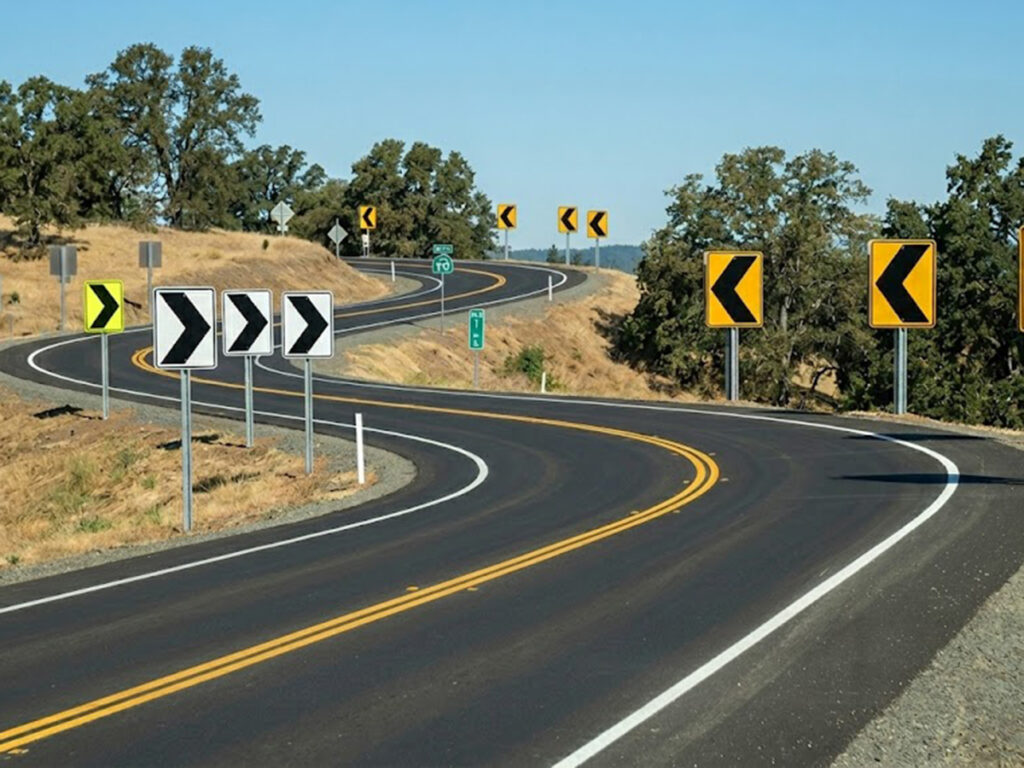
La codificación de colores en las señales de tráfico en forma de galón no es arbitraria: comunica jurisdicción, clase de carretera, y contexto regulatorio. Los errores de adquisición ocurren con frecuencia cuando los compradores especifican una combinación incorrecta de fondo y símbolo para su aplicación..
| Combinación de colores | Jurisdicción / Estándar | Aplicación típica | Muescato / Referencia regulatoria. |
| Símbolo negro sobre amarillo | Estados Unidos (Muescato) | Advertencia: delimitación de curvas en la vía pública | W1-8, Sección 2C.12 |
| Símbolo negro sobre blanco | Reino Unido (Tsrgd) / Autopista | Dirección obligatoria en salidas/curvas de autopista | Diagrama TSRGD 610 |
| Símbolo blanco sobre rojo | Marcas viales prescritas en el Reino Unido | Ceda el paso / Zonas de aproximación de prohibición de entrada | Diagrama TSRGD 614 |
| Símbolo blanco sobre azul | Informativo / Consultivo (A NOSOTROS) | Carreteras privadas, aparcamiento, solo asesoramiento | Sin mandato federal |
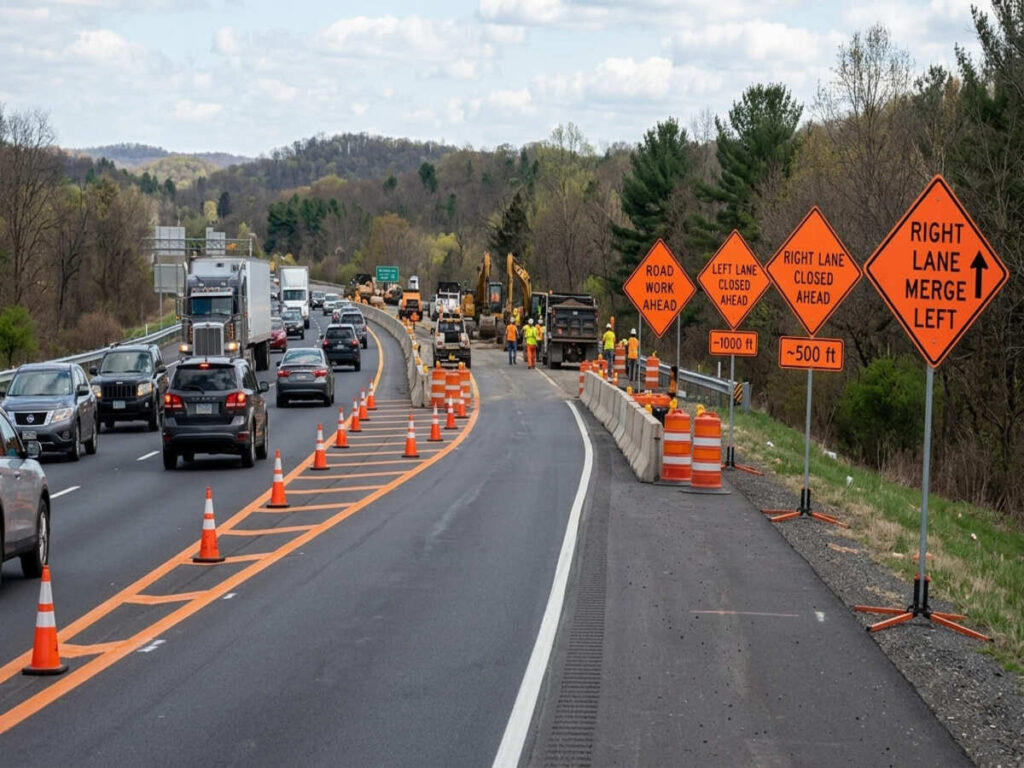
| Símbolo naranja sobre negro | Control de tráfico temporal (A NOSOTROS) | Zonas de trabajo, Cambios de carril | Parte MUTCD 6 |
Para obtener una referencia completa de colores jurisdicción por jurisdicción, consulte nuestra guía sobre lo que significa cada color de signo de chevron.
Dimensiones del letrero Chevron, Tallas & Especificaciones de material
Para seleccionar el tamaño correcto de la señal de chevron es necesario hacer coincidir el límite de velocidad publicado y la gravedad de la curva con la Tabla 2C-4 de MUTCD.. Las señales de tamaño insuficiente en accesos de alta velocidad crean un efecto de falsa seguridad documentado; Los conductores registran la presencia de una señal pero no pueden resolver su mensaje direccional a tiempo..
| Tamaño de signo (Ancho × Alto) | Límite de velocidad publicado | Láminas mínimas | Opciones de sustrato | Referencia de la tabla MUTCD. |
| 18″ × 24″ | ≤ 35 mph | Tipo I (ASTM D4956) | Aluminio .080 / CLORURO DE POLIVINILO | Tabla 2C-4, Fila A |
| 24″ × 30″ | 36–45 mph | Tipo III (ASTM D4956) | Aluminio .100 / Aluminio .080 | Tabla 2C-4, Fila B |
| 30″ × 36″ | 46–55 mph | Tipo III (ASTM D4956) | Aluminio .100 | Tabla 2C-4, Fila C |
| 36″ × 48″ | 56–65 mph | Tipo IV (ASTM D4956) | Aluminio .125 | Tabla 2C-4, Fila D |
| 48″ × 60″ | ≥ 66 mph / Interestatal | Tipo XI / Grado de diamante | Aluminio .125 | Tabla 2C-4, Fila E |
Fuente: MUTCD 11ª edición, Tabla 2C-4
Selección de sustrato y hardware
Aleación de aluminio 5052-H38 a 0,080″ a 0,125″ El calibre sigue siendo el sustrato estándar de la industria para carreteras. signos de galón debido a su resistencia a la corrosión y estabilidad dimensional. Polietileno de alta densidad (HDPE) y los sustratos de policarbonato se adaptan a aplicaciones de carreteras privadas de baja velocidad donde los requisitos de carga de viento y altura de los postes son menos exigentes.. Todo el hardware de montaje debe cumplir con los requisitos de postes separables según AASHTO MASH. 2016 Normas de pruebas de choque en cualquier vía abierta al tráfico público..
Fórmula de ubicación y espaciado de letreros de Chevron
El espaciado correcto de los letreros en forma de V es la variable de instalación más importante. El MUTCD proporciona una fórmula determinista que los ingenieros deben aplicar (y documentar) para cada enfoque de curva.. El espaciamiento que excede los máximos de MUTCD ha aparecido en litigios luego de accidentes de salida de la carretera., con los tribunales examinando el plan de firma en comparación con el estándar de atención.
La fórmula de espaciado MUTCD: S = C × R
MUTCD La sección 2C.12 define el espaciado máximo (S) entre consecutivos signos de galón como:
S (pies) = C×R
donde C = 3.0 (rural), 2.0 (urbano); R = radio de curva en pies
Ejemplo resuelto: Una curva de un camino rural con un radio de 400 pies requiere señales que no estén más separadas que 3.0 × 400 = 1,200 pies. Los ingenieros a menudo reducen a la mitad este espacio al acercarse al punto de curvatura. (ordenador personal) Construir progresivamente el modelo mental del conductor..
| Velocidad de diseño (mph) | Radio típico (pie) | máx.. Espaciado S (pie) - Rural | máx.. Espaciado S (pie) - Urbano | mín.. Señales en curva |
| 25 | 150 | 450 | 300 | 2 |
| 35 | 300 | 900 | 600 | 3 |
| 45 | 500 | 1500 | 1000 | 3–4 |
| 55 | 800 | 2400 | 1600 | 4–5 |
| 65 | 1200 | 3600 | - | 5+ |
Fuente: MUTCD 11ª edición, Sección 2C.12
Sumérgete profundamente en espaciado de signos de chevron & fórmula de colocación, un tutorial de instalación paso a paso, que incluye técnicas de medición de campo y una tabla de referencia de espaciado imprimible.
Escenarios de instalación especiales: Rotondas, Uniones en T & Autopista
Las reglas estándar de espaciamiento de curvas rurales no se transfieren directamente a la geometría de la intersección. Islas divisorias de rotondas, Finaliza el acceso al cruce en T, y las salidas de autopistas requieren configuraciones de señales de chevron específicas de geometría. Seleccionar la dirección de flecha incorrecta: izquierda vs.. a la derecha: en una isla rotonda es una causa citada de entradas en sentido contrario en el informe NCHRP 672 (2010).
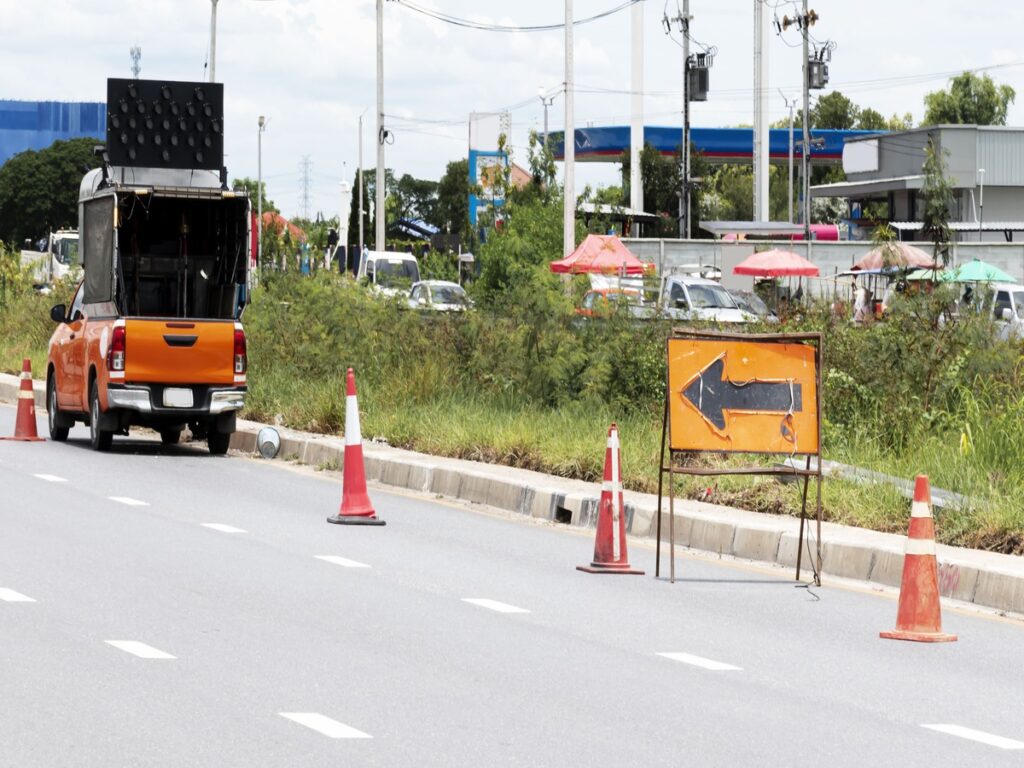
- Islas divisorias de rotondas: Una o dos señales de cara al tráfico que se aproxima, dimensionado para igualar la velocidad de aproximación. La flecha apunta en la dirección del recorrido alrededor de la isla..
- Finaliza el acceso al cruce en T: Señal de galón única colocada al final del tramo de la carretera. La flecha apunta hacia la dirección de giro predominante..
- Narices de salida de autopista (Reino Unido): negro sobre blanco signos de galón colocado en incrementos de 45° en la nariz de salida, regido por el diagrama TSRGD 610 en lugar de MUTCD.
Para ver esquemas de instalación completos para aplicaciones MUTCD y TSRGD, consulte nuestra guía sobre rotonda & Instalación de letreros de chevron en cruce en T.
Señales de Chevron más allá de las vías públicas: Industrial, Depósito & Aplicaciones privadas
Gerentes de instalaciones, operadores portuarios, y los desarrolladores de logística frecuentemente necesitan signos de galón en infraestructura privada donde el cumplimiento de MUTCD no es legalmente obligatorio pero sigue siendo el estándar de atención reconocido. OSHA 29 CFR 1910.144 requiere señales de seguridad codificadas por colores en entornos industriales, y muchos gestores de riesgos eligen materiales de calidad MUTCD para alinearse con las aseguradoras’ requisitos de control de pérdidas.
Consideraciones clave para la contratación industrial y de carreteras privadas:
- Material: 0.080″ el aluminio con láminas de Tipo I es suficiente para caminos de patio de ≤15 mph; caminos de acceso externos al almacén en 25 Orden mínima de mph Tipo III.
- Alternativas de sustrato: Los paneles corrugados de HDPE reducen el peso para la delineación temporal de pasillos, pero tienen una vida útil de 3 a 5 años en comparación con los paneles corrugados de HDPE.. 10+ años para el aluminio.
- Colores personalizados: Las combinaciones de chevrones rojo/blanco o azul/blanco de OSHA están permitidas en propiedades privadas donde los códigos de color MUTCD no son aplicables..
- Precios al por mayor: Órdenes de 25+ Los carteles suelen desbloquear descuentos por volumen del 15 al 25%.; 100+ los letreros califican para programas de sustratos troquelados personalizados.
Acceda a nuestro recurso de adquisiciones completo, que incluye matrices de especificaciones técnicas, tablas de comparación de sustratos, y niveles de precios por volumen, dentro de la guía especializada: Señales Chevron para carreteras privadas, Almacenes & Sitios industriales.
2026 Contexto de seguridad: Por qué el cumplimiento de las señales de Chevron nunca ha sido tan importante
La inversión en infraestructura ha intensificado el escrutinio de la firma de estándares en todos 50 estados. La Ley de Inversión y Empleos de Infraestructura (Ija, 2021) asignado $350 mil millones a mejoras de seguridad en las carreteras a través de 2026, con la FHWA condicionando una parte de los fondos a las agencias que demuestren el cumplimiento actual de MUTCD en sus planes de seguridad vial (TSP). Las agencias que no pueden documentar el cumplimiento del despliegue de letreros en forma de chevron corren el riesgo de recibir reembolsos en proyectos financiados por HSIP.
El Programa de seguridad en las salidas de carreteras de la FHWA, actualizado en 2024, identifica específicamente la delineación inadecuada en las curvas horizontales como un factor sistémico que contribuye a las muertes por salidas de carreteras.. El 2023 Se registra el informe de datos de seguridad vial de la NHTSA 11,700+ muertes por salida de carretera, de las cuales las desviaciones relacionadas con las curvas representaron la subcategoría geométrica más grande (NHTSA, 2023).
DOT estatales en Georgia, Texas, y California han emitido directrices de señalización actualizadas en 2024-2025 que exigen láminas de tipo III o superior en todos los dispositivos de delimitación de curvas de rutas estatales., ampliar directamente la base de cumplimiento para las señales de tráfico con forma de galón en esas redes.
Lista de verificación de cumplimiento de adquisiciones
Antes de realizar cualquier pedido de letreros en forma de galón para un proyecto de vía pública, Verifique lo siguiente con el plan de firma del proyecto.:
- Confirme que la designación W1-8 coincida con la edición MUTCD adoptada por el DOT estatal.
- Especifique el tipo de lámina ASTM D4956 en la orden de compra; nunca confíe en el "reflectante" genérico del proveedor.’ descripción.
- Confirmar el calibre del sustrato: 0.080″ mínimo de aluminio para carteles montados; 0.100″ para señales en caminos rurales de alta velocidad.
- Verificar el radio de la esquina: Los letreros que cumplen con MUTCD usan un 3/8″ radio de esquina; Las esquinas no conformes pueden provocar el rechazo del plano de taller..
- Consultar certificaciones: Los proyectos de ayuda federal requieren el cumplimiento de Buy America (productos de acero/hierro) y puede requerir el cumplimiento de TAA para materiales de láminas.
- Solicite un Certificado de conformidad del proveedor que documente la trazabilidad del lote y el grado ASTM D4956.
Preguntas frecuentes
¿Cuál es la diferencia exacta entre un “Deber” y “Debería” Condición según la Sección 2C.12 de MUTCD para instalar letreros en forma de V?
Según la Sección 2C.12 de MUTCD, a “Deber” condición denota una orden legal obligatoria. Se requiere estrictamente una señal de galón en curvas horizontales donde la velocidad recomendada es 15 mph o más por debajo del límite de velocidad reglamentario publicado.
En cambio, a “Debería” La condición es una fuerte recomendación de ingeniería.. Se aplica cuando la velocidad recomendada es 10 mph por debajo del límite de velocidad indicado, o donde los estudios de ingeniería indican una alta frecuencia de choques nocturnos por salida de la carretera a pesar de las señales de advertencia de curvas estándar (W1-1 o W1-2) estando presente.
¿Puede un signo de chevron de una sola flecha? (W1-8) ser sustituido por un doble (W1-8a) o señal de triple chevrón en la vía pública?
No. Bajo los estándares federales MUTCD, El W1-8 de grado estándar presenta una punta de flecha única en forma de V y es el único dispositivo aprobado para la delineación progresiva de la alineación horizontal..
Patrones de chevron dobles o triples (a menudo se clasifican bajo suplementos DOT específicos de cada estado o marcos internacionales como los marcadores de desviación marcada TSRGD del Reino Unido.) generalmente se limitan a puntos focales de alto impacto, como el extremo directo de un cruce en T o la punta de concreto de una salida de carretera. No se pueden utilizar como una serie rodante a lo largo de una curva horizontal estándar..
¿La fórmula de espaciado MUTCD (S = C x R) Aplicar a toda la longitud de la curva horizontal.?
La fórmula de espaciado estándar dicta la distancia máxima entre reflectores consecutivos. signos de galón dentro del cuerpo principal de la curva. Sin embargo, Las mejores prácticas de ingeniería de tráfico requieren un espaciado ajustado en la aproximación..
Ayudar a los conductores a construir un modelo mental de la curva de forma incremental., El primer letrero normalmente se coloca en el punto de curvatura. (ordenador personal), con letreros posteriores instalados a la mitad del espacio calculado (0.5S) durante los dos primeros intervalos antes de realizar la transición a la distancia calculada completa (S) a través del ápice.
¿Las láminas retrorreflectantes de grado de ingeniería tipo I cumplen legalmente con las señales de tráfico en forma de galón en vías públicas??
En 2026, Las láminas tipo I están prácticamente obsoletas para aplicaciones en vías públicas. Si bien la FHWA permite el Tipo I para baja velocidad, calles urbanas de bajo volumen (velocidades 35 mph), reglas federales de mantenimiento de retrorreflectividad (23 Parte CFR 655) y las especificaciones estatales del DOT generalmente exigen un mínimo de Tipo III (Prismático de alta intensidad) o láminas Tipo IV para todos los dispositivos de alineación horizontal en carreteras con límites de velocidad de 45 mph o más para garantizar una visibilidad nocturna y una longevidad adecuadas.
¿Cuándo están legalmente exentas las señales de chevron de una curva que cumple con el diferencial de velocidad??
Se puede conceder una excepción de ingeniería según la Sección 2C.12 si una barrera continua de hormigón o una barandilla de acero corre a lo largo de todo el exterior de la curva horizontal., y la barrera en sí está completamente equipada con continuo, sistemas de delineación lineal de alta visibilidad (SUD). Además, Los galones pueden omitirse en áreas residenciales o urbanas densas donde las velocidades de diseño bajas, restricciones estructurales al derecho de vía, o un amplio alumbrado público mitiga los riesgos de salida de la carretera.
Hacer sitios industriales privados., puertos, y los almacenes logísticos tienen que utilizar espesores de 0,100″ sustratos de aluminio para instalación de chevron?
Los administradores de instalaciones privadas no están legalmente obligados por las reglas de sustratos de MUTCD., es decir, más claro 0.080″ aluminio o polietileno de alta densidad (HDPE) Los paneles están permitidos para caminos de patio de baja velocidad. (15 mph).
Sin embargo, si los caminos de propiedad privada se conectan directamente con la infraestructura pública o admiten el tráfico pesado de camiones comerciales a velocidades superiores 25 mph, Los gestores de riesgos recomiendan encarecidamente utilizar el estándar 0,100.″ Aleación de aluminio 5052-H38 para mitigar fallas por carga de viento y garantizar el cumplimiento de las auditorías de seguridad de control de pérdidas de la aseguradora..
Referencias
- Administración Federal de Carreteras. (2023). Seguridad de salida de la carretera.
- FHWA. (2023). Manual en dispositivos de control de tráfico uniformes (Muescato), 11décima edición, Sección 2C.12.
- NHTSA. (2023). Datos de seguridad vial 2023: Una recopilación de datos sobre accidentes automovilísticos.
- ASTM International. (2023). Norma ASTM D4956-23: Especificación estándar para láminas retrorreflectantes para control de tráfico.
- Aashto. (2016). MEZCLA 2016: Manual para evaluar el hardware de seguridad.
- NCHRP. (2010). Informe NCHRP 672: Rotondas: Una guía informativa, 2Segunda edición.
- Ley de Inversión y Empleos de Infraestructura (Ija). (2021). Pub. L. 117-58.