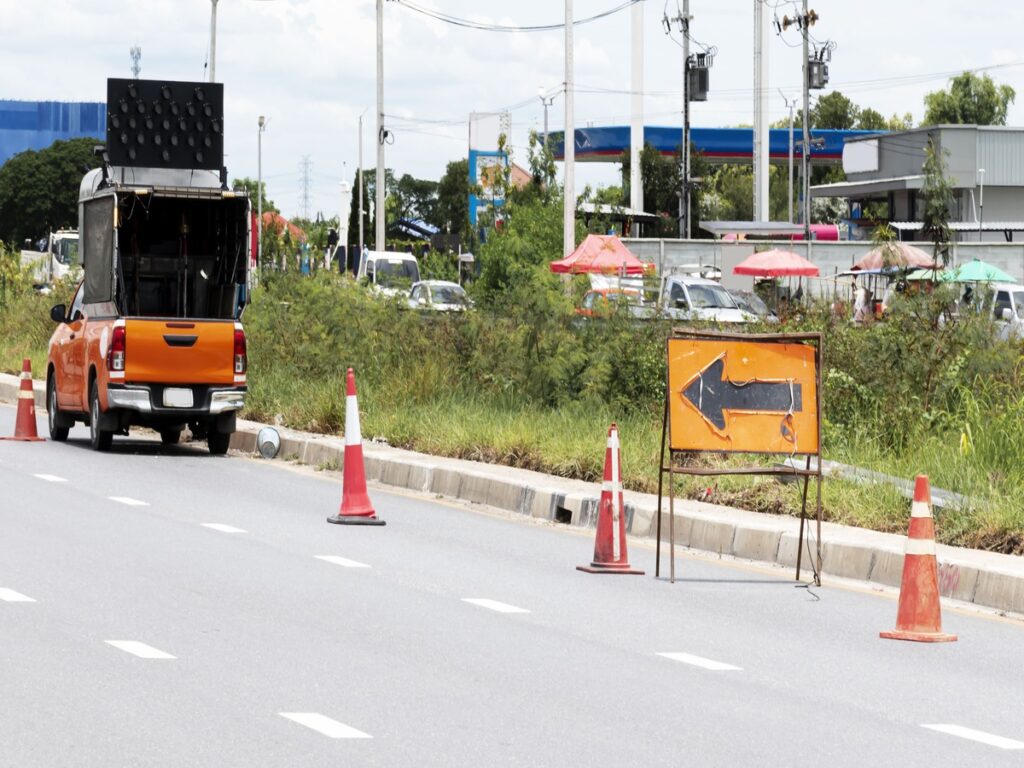
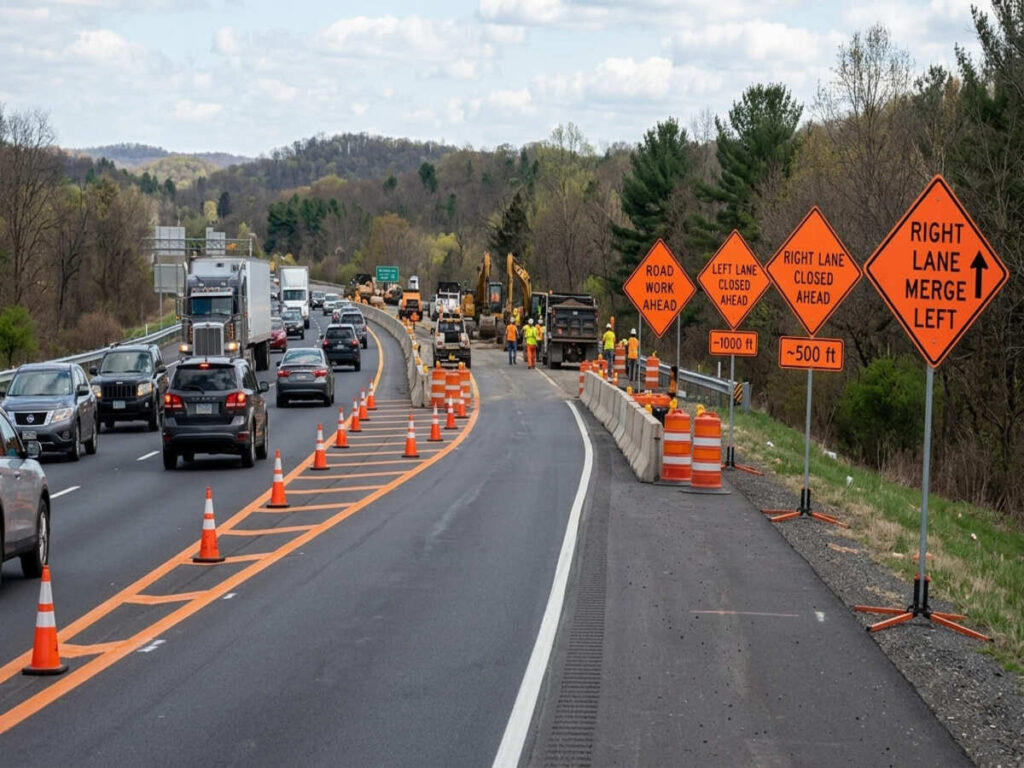
A chevron sign stands as one of the most mechanically simple yet operationally critical devices in the entire traffic control inventory. Shaped as a bold, pointing arrow, it delineates the direction of curvature at horizontal bends, interchange ramps, and intersections where the roadway geometry alone fails to communicate the correct path. Federal Highway Administration (FHWA) crash data show that roadway departure crashes—events where a vehicle leaves its intended lane on a curve—account for approximately 32% of all fatal highway crashes annually in the United States (FHWA, 2023).
Proper deployment of chevron signs directly cuts that risk. Yet misapplication, under-specification, and maintenance lapses remain widespread. This guide consolidates every compliance requirement, engineering formula, and procurement specification traffic professionals need in one authoritative reference.
What Is a Chevron Sign?
A chevron sign is a delineation device displaying a single chevron (arrowhead) symbol that points in the direction of an upcoming curve or turn. The Manual on Uniform Traffic Control Devices (MUTCD), 11th Edition (2023), formally defines it as the Chevron Alignment Sign and assigns it the designation W1-8. Engineers place these signs on the outside of a curve to supplement—and sometimes replace—standard curve warning signs where alignment delineation is insufficient.
Unlike a standard chevron road sign used in urban channelization, the highway-grade W1-8 specifically addresses horizontal curvature. For a detailed breakdown of alignment-specific meanings and accident-prevention research, see the existing resource on chevron alignment signs and how they prevent accidents.
Chevron Sign vs. Curve Warning Sign
Traffic engineers frequently face the decision between a chevron alignment sign (W1-8) and a standard Curve Warning Sign (W1-1 or W1-2). The MUTCD does not treat them as interchangeable. Curve Warning Signs notify drivers that a curve exists ahead; chevron signs guide drivers through the curve in real time. In practice, both devices often appear together on the same approach. A dedicated comparison—including when substitution is permitted under state DOT supplements- refer to chevron vs. curve warning signs.
MUTCD Section 2C.12: Federal Compliance Requirements
Section 2C.12 of the MUTCD governs all MUTCD chevron signs on public roads in the United States. The standard establishes mandatory-use conditions, retroreflectivity thresholds, and placement criteria that every signing plan must satisfy. Non-compliance exposes agencies to federal-aid eligibility risks and civil liability exposure under the highway defect doctrine.
Key mandatory provisions under Section 2C.12 include:
- Chevron signs SHALL be used on curves where the advisory speed is 15 mph or more below the posted speed limit.
- Spacing SHALL follow the formula S = C × R (see Spacing section below).
- Retroreflective sheeting SHALL meet ASTM D4956 Type III (High-Intensity Prismatic) minimum on roads with speed limits ≥ 45 mph.
- Post height SHALL position the bottom of the sign at least 4 feet above the road surface on rural highways.
For a full clause-by-clause analysis of Section 2C.12—including state DOT supplements and liability precedent—consult the MUTCD Section 2C.12 Requirements about chevron alignment signs.
Retroreflectivity Standards: ASTM D4956 Sheeting Grades
The FHWA’s retroreflectivity rule (23 CFR Part 655) requires agencies to manage sign retroreflectivity to a minimum maintained level. For reflective chevron signs on high-speed rural roads, the practical minimum is Type III sheeting. Type IV (Ultrahigh Intensity Prismatic) and Type XI (Diamond Grade) extend service life beyond 12 years and maintain adequate retroreflectivity in extreme weather conditions.
| ASTM Sheeting Grade | Type Designation | Min. Coefficient (RA) | Typical Service Life | Recommended Application |
| Engineer Grade | Type I | 70 cd/lx/m² | 7 years | Low-speed, low-volume roads |
| High-Intensity Prismatic | Type III | 250 cd/lx/m² | 10 years | MUTCD minimum ≥45 mph roads |
| Ultrahigh Intensity | Type IV | 380 cd/lx/m² | 12 years | High-speed rural highways |
| Diamond Grade | Type XI | 700+ cd/lx/m² | 12+ years | Interstate / critical curves |
Source: ASTM D4956-23
Types of Chevron Signs by Color and Jurisdiction

Color coding in chevron traffic signs is not arbitrary—it communicates jurisdiction, road class, and regulatory context. Procurement errors frequently occur when buyers specify the wrong background/symbol combination for their application.
| Color Combination | Jurisdiction / Standard | Typical Application | MUTCD / Regulatory Ref. |
| Black symbol on yellow | United States (MUTCD) | Warning — curve delineation on public roads | W1-8, Section 2C.12 |
| Black symbol on white | UK (TSRGD) / Motorway | Mandatory direction at motorway exits/curves | TSRGD Diagram 610 |
| White symbol on red | UK prescribed road markings | Give-way / No-entry approach zones | TSRGD Diagram 614 |
| White symbol on blue | Informational / Advisory (US) | Private roads, parking, advisory only | No federal mandate |
| Orange symbol on black | Temporary Traffic Control (US) | Work zones, lane shifts | MUTCD Part 6 |
For a complete jurisdiction-by-jurisdiction color reference, refer to our guide on what every chevron sign color means.
Chevron Sign Dimensions, Sizes & Material Specifications
Selecting the correct chevron sign size requires matching the posted speed limit and curve severity to MUTCD Table 2C-4. Under-sized signs on high-speed approaches create a documented false-security effect; drivers register a sign’s presence but cannot resolve its directional message in time.
| Sign Size (W × H) | Posted Speed Limit | Minimum Sheeting | Substrate Options | MUTCD Table Ref. |
| 18″ × 24″ | ≤ 35 mph | Type I (ASTM D4956) | Aluminum .080 / PVC | Table 2C-4, Row A |
| 24″ × 30″ | 36–45 mph | Type III (ASTM D4956) | Aluminum .100 / Aluminum .080 | Table 2C-4, Row B |
| 30″ × 36″ | 46–55 mph | Type III (ASTM D4956) | Aluminum .100 | Table 2C-4, Row C |
| 36″ × 48″ | 56–65 mph | Type IV (ASTM D4956) | Aluminum .125 | Table 2C-4, Row D |
| 48″ × 60″ | ≥ 66 mph / Interstate | Type XI / Diamond Grade | Aluminum .125 | Table 2C-4, Row E |
Source: MUTCD 11th Edition, Table 2C-4
Substrate and Hardware Selection
Aluminum alloy 5052-H38 at 0.080″ to 0.125″ gauge remains the industry-standard substrate for highway-grade chevron signs due to its corrosion resistance and dimensional stability. High-density polyethylene (HDPE) and polycarbonate substrates suit lower-speed private-road applications where wind load and post-height requirements are less demanding. All mounting hardware must comply with breakaway post requirements under AASHTO MASH 2016 crash-test standards on any road open to public traffic.
Chevron Sign Spacing and Placement Formula
Correct chevron sign spacing is the single most consequential installation variable. The MUTCD provides a deterministic formula that engineers must apply—and document—for every curve approach. Spacing that exceeds MUTCD maximums has featured in litigation following run-off-road crashes, with courts examining the signing plan against the standard of care.
The MUTCD Spacing Formula: S = C × R
MUTCD Section 2C.12 defines the maximum spacing (S) between consecutive chevron signs as:
S (feet) = C × R
where C = 3.0 (rural), 2.0 (urban); R = curve radius in feet
Worked example: A rural road curve with a 400-foot radius requires signs no farther apart than 3.0 × 400 = 1,200 feet. Engineers often halve this spacing on the approach to the Point of Curvature (PC) to build the driver’s mental model incrementally.
| Design Speed (mph) | Typical Radius (ft) | Max. Spacing S (ft) — Rural | Max. Spacing S (ft) — Urban | Min. Signs on Curve |
| 25 | 150 | 450 | 300 | 2 |
| 35 | 300 | 900 | 600 | 3 |
| 45 | 500 | 1500 | 1000 | 3–4 |
| 55 | 800 | 2400 | 1600 | 4–5 |
| 65 | 1200 | 3600 | — | 5+ |
Source: MUTCD 11th Edition, Section 2C.12
Dive deep into chevron sign spacing & placement formula, a step-by-step installation walkthrough—including field-measurement techniques and a printable spacing reference table.
Special Installation Scenarios: Roundabouts, T-Junctions & Motorways
Standard rural-curve spacing rules do not transfer directly to intersection geometry. Roundabout splitter islands, T-junction approach ends, and motorway exit noses each require geometry-specific chevron sign configurations. Selecting the wrong arrow direction—left vs. right—at a roundabout island is a cited cause of wrong-way entries in NCHRP Report 672 (2010).
- Roundabout splitter islands: One or two signs facing approaching traffic, sized to match approach speed. The arrow points in the direction of travel around the island.
- T-junction approach ends: Single chevron sign placed at the terminus of the through-road stub. The arrow points toward the predominant turning direction.
- Motorway exit noses (UK): Black-on-white chevron signs placed at 45° increments on the exit nose gore, governed by TSRGD Diagram 610 rather than MUTCD.
For full installation schematics for both MUTCD and TSRGD applications, refer to our guide on roundabout & T-junction chevron sign installation.
Chevron Signs Beyond Public Roads: Industrial, Warehouse & Private Applications
Facility managers, port operators, and logistics developers frequently need chevron signs on private infrastructure where MUTCD compliance is not legally mandatory but remains the recognized standard of care. OSHA 29 CFR 1910.144 requires color-coded safety signs in industrial environments, and many risk managers elect MUTCD-grade materials to align with insurers’ loss-control requirements.
Key considerations for private-road and industrial procurement:
- Material: 0.080″ aluminum with Type I sheeting suffices for ≤15 mph yard roads; external warehouse access roads at 25 mph warrant Type III minimum.
- Substrate alternatives: HDPE corrugated panels reduce weight for temporary aisle delineation but carry a 3–5 year service life vs. 10+ years for aluminum.
- Custom colors: OSHA red/white or blue/white chevron combinations are permissible on private property where MUTCD color codes are inapplicable.
- Bulk pricing: Orders of 25+ signs typically unlock 15–25% volume discounts; 100+ signs qualify for custom die-cut substrate programs.
Access our complete procurement resource—featuring technical specification matrices, substrate comparison tables, and volume pricing tiers—within the specialized guide: Chevron Signs for Private Roads, Warehouses & Industrial Sites.
2026 Safety Context: Why Chevron Sign Compliance Has Never Mattered More
Infrastructure investment has intensified scrutiny of signing standards across all 50 states. The Infrastructure Investment and Jobs Act (IIJA, 2021) allocated $350 billion to highway safety improvements through 2026, with FHWA conditioning a portion of funds on agencies demonstrating current MUTCD compliance in their Traffic Safety Plans (TSPs). Agencies that cannot document compliant chevron sign deployment risk reimbursement clawbacks on HSIP-funded projects.
The FHWA’s Roadway Departure Safety Program—updated in 2024—specifically identifies inadequate delineation on horizontal curves as a systemic contributing factor to roadway departure fatalities. The 2023 NHTSA Traffic Safety Facts report recorded 11,700+ roadway departure fatalities, of which curve-related departures represented the largest geometric subcategory (NHTSA, 2023).
State DOTs in Georgia, Texas, and California have each issued updated signing guidelines in 2024–2025 requiring Type III or higher sheeting on all state-route curve delineation devices, directly expanding the compliance baseline for chevron traffic signs on those networks.
Procurement Compliance Checklist
Before placing any chevron sign order for a public-road project, verify the following against the project’s signing plan:
- Confirm W1-8 designation matches the MUTCD edition adopted by the state DOT.
- Specify ASTM D4956 sheeting type in the purchase order—never rely on a vendor’s generic ‘reflective’ description.
- Confirm substrate gauge: 0.080″ aluminum minimum for mounted signs; 0.100″ for signs on high-speed rural roads.
- Verify corner radius: MUTCD-compliant signs use a 3/8″ corner radius; non-conforming corners may trigger shop-drawing rejection.
- Check certifications: Federal-aid projects require Buy America compliance (steel/iron products) and may require TAA compliance for sheeting materials.
- Request a Certificate of Conformance from the supplier documenting ASTM D4956 grade and lot traceability.
Frequently Asked Questions
What is the exact difference between a “Shall” and “Should” condition under MUTCD Section 2C.12 for installing chevron signs?
Under MUTCD Section 2C.12, a “Shall” condition denotes a mandatory legal warrant. A chevron sign is strictly required on horizontal curves where the advisory speed is 15 mph or more below the posted regulatory speed limit.
Conversely, a “Should” condition is a strong engineering recommendation. It applies when the advisory speed is 10 mph below the posted speed limit, or where engineering studies indicate a high frequency of night-time roadway departure crashes despite standard curve warning signs (W1-1 or W1-2) being present.
Can a single-arrow chevron sign (W1-8) be substituted with a double (W1-8a) or triple chevron sign on public highways?
No. Under federal MUTCD standards, the standard-grade W1-8 features a single chevron arrowhead and is the only approved device for progressive horizontal alignment delineation.
Double or triple chevron patterns (often classified under state-specific DOT supplements or international frameworks like the UK’s TSRGD sharp deviation markers) are generally restricted to high-impact focal points, such as the direct terminus of a T-junction or the concrete nose of a highway exit gore. They cannot be used as a rolling series along a standard horizontal curve.
Does the MUTCD spacing formula (S = C x R) apply to the entire length of the horizontal curve?
The standard spacing formula dictates the maximum distance between consecutive reflective chevron signs within the main body of the curve. However, traffic engineering best practices require adjusted spacing on the approach.
To help drivers build a mental model of the curve incrementally, the first sign is typically placed at the Point of Curvature (PC), with subsequent signs installed at half the calculated spacing (0.5S) for the first two intervals before transitioning to the full calculated distance (S) through the apex.
Are Type I Engineer Grade retroreflective sheets legally compliant for chevron traffic signs on public roads?
In 2026, Type I sheeting is practically obsolete for public highway applications. While the FHWA allows Type I for low-speed, low-volume urban streets (speeds 35 mph), federal retroreflectivity maintenance rules (23 CFR Part 655) and State DOT specifications generally mandate a minimum of Type III (High-Intensity Prismatic) or Type IV sheeting for all horizontal alignment devices on roads with speed limits of 45 mph or higher to ensure adequate nighttime visibility and longevity.
When are chevron signs legally exempt from a curve that meets the speed differential warrants?
An engineering exception may be granted under Section 2C.12 if a continuous roadside concrete barrier or steel guardrail runs along the entire outside of the horizontal curve, and the barrier itself is fully equipped with continuous, high-visibility linear delineation systems (LDS). Additionally, chevrons may be omitted in dense residential or urban areas where low design speeds, structural right-of-way restrictions, or extensive street lighting mitigate roadway departure risks.
Do private industrial sites, ports, and logistics warehouses have to use heavy-gauge 0.100″ aluminum substrates for chevron installation?
Private facility managers are not legally bound by MUTCD substrate rules, meaning lighter 0.080″ aluminum or high-density polyethylene (HDPE) panels are permissible for low-speed yard roads (15 mph).
However, if private property roads link directly to public infrastructure or accommodate heavy commercial truck traffic at speeds exceeding 25 mph, risk managers strongly recommend using standard 0.100″ aluminum alloy 5052-H38 to mitigate wind-load failures and ensure compliance with insurer loss-control safety audits.
References
- Federal Highway Administration. (2023). Roadway Departure Safety.
- FHWA. (2023). Manual on Uniform Traffic Control Devices (MUTCD), 11th Edition, Section 2C.12.
- NHTSA. (2023). Traffic Safety Facts 2023: A Compilation of Motor Vehicle Crash Data.
- ASTM International. (2023). ASTM D4956-23: Standard Specification for Retroreflective Sheeting for Traffic Control.
- AASHTO. (2016). MASH 2016: Manual for Assessing Safety Hardware.
- NCHRP. (2010). NCHRP Report 672: Roundabouts: An Informational Guide, 2nd Edition.
- Infrastructure Investment and Jobs Act (IIJA). (2021). Pub. L. 117-58.