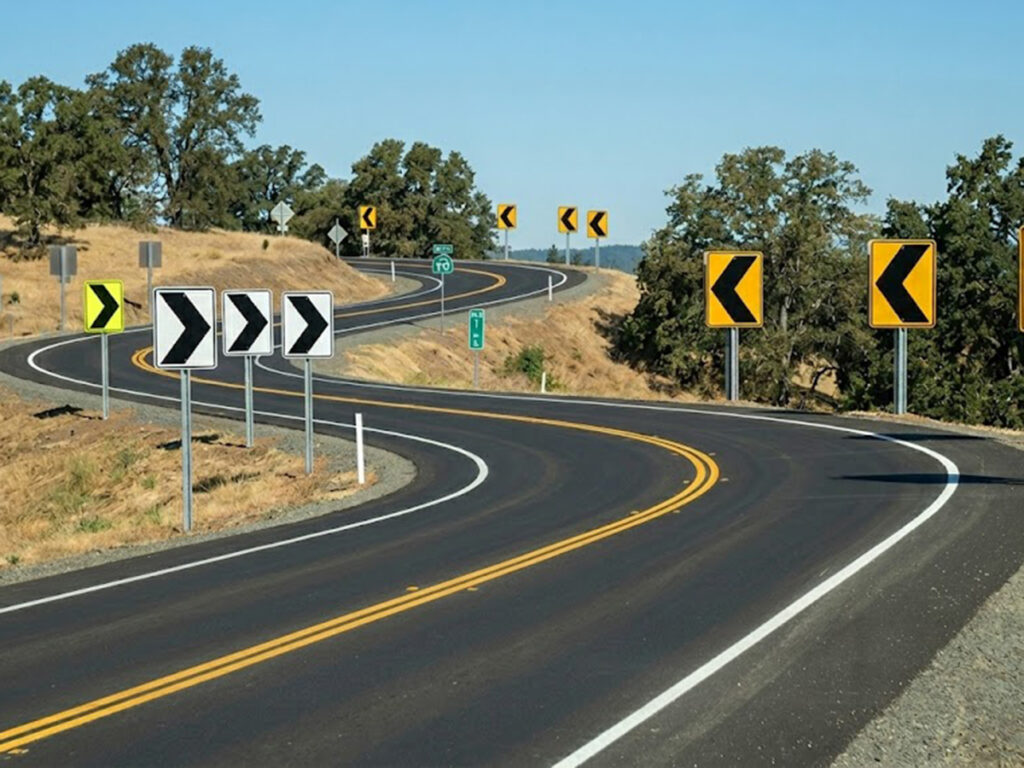
Ein Chevron-Schild gilt als eines der mechanisch einfachsten, aber betriebskritischsten Geräte im gesamten Verkehrskontrollinventar. Geformt als Fettdruck, zeigender Pfeil, Es beschreibt die Krümmungsrichtung bei horizontalen Biegungen, Umsteigerampen, und Kreuzungen, bei denen die Fahrbahngeometrie allein nicht in der Lage ist, den richtigen Weg zu ermitteln. Bundesstraßenverwaltung (Fhwa) Unfalldaten zeigen, dass Verkehrsunfälle, also Ereignisse, bei denen ein Fahrzeug in einer Kurve die vorgesehene Fahrspur verlässt, etwa 100 Prozent ausmachen 32% aller tödlichen Autobahnunfälle pro Jahr in den Vereinigten Staaten (Fhwa, 2023).
Richtiger Einsatz von Chevron-Zeichen reduziert dieses Risiko direkt. Doch eine Fehlanwendung, Unterspezifikation, und Wartungsfehler sind nach wie vor weit verbreitet. Dieser Leitfaden fasst alle Compliance-Anforderungen zusammen, technische Formel, und Beschaffungsspezifikationen, die Verkehrsfachleute in einer einzigen maßgeblichen Referenz benötigen.
Was ist ein Chevron-Zeichen??
Ein Chevron-Schild ist ein Abgrenzungselement, das einen einzelnen Chevron anzeigt (Pfeilspitze) Symbol, das in die Richtung einer bevorstehenden Kurve oder Wendung zeigt. Das Handbuch auf einheitlichen Verkehrssteuerungsvorrichtungen (MUTCD), 11Auflage (2023), definiert es offiziell als Chevron Alignment Sign und weist ihm die Bezeichnung W1-8 zu. Ingenieure platzieren diese Schilder an der Außenseite einer Kurve, um die Standard-Kurvenwarnschilder zu ergänzen und manchmal zu ersetzen, wenn die Ausrichtungsabgrenzung unzureichend ist.
Im Gegensatz zu einem herkömmlichen Chevron-Verkehrsschild, das bei der städtischen Kanalisierung verwendet wird, Die Autobahnklasse W1-8 berücksichtigt speziell die horizontale Krümmung. Für eine detaillierte Aufschlüsselung der ausrichtungsspezifischen Bedeutungen und der Forschung zur Unfallverhütung, Sehen Sie sich die vorhandene Ressource an Chevron-Schilder und wie sie Unfälle verhindern.
Chevron-Zeichen vs. Kurvenwarnzeichen
Verkehrsingenieure stehen häufig vor der Entscheidung zwischen einem Chevron-Ausrichtungsschild (W1-8) und ein Standard-Kurvenwarnschild (W1-1 oder W1-2). Die MUTCD behandelt sie nicht als austauschbar. Kurvenwarnschilder weisen Autofahrer darauf hin, dass vor ihnen eine Kurve liegt; Chevron-Zeichen Führen Sie den Fahrer in Echtzeit durch die Kurve. In der Praxis, Beide Geräte erscheinen oft zusammen beim gleichen Ansatz. Ein spezieller Vergleich – auch wenn eine Substitution gemäß den staatlichen DOT-Ergänzungen zulässig ist- beziehen sich auf Chevron vs. Kurvenwarnschilder.
MUTCD Abschnitt 2C.12: Bundeskonformitätsanforderungen
Abschnitt 2C.12 der MUTCD regelt alle MUTCD Chevron-Zeichen auf öffentlichen Straßen in den Vereinigten Staaten. Die Norm legt verbindliche Nutzungsbedingungen fest, Retroreflexionsschwellen, und Platzierungskriterien, die jeder Unterzeichnungsplan erfüllen muss. Die Nichteinhaltung setzt die Behörden Risiken hinsichtlich der Berechtigung von Bundesbeihilfen und der zivilrechtlichen Haftung im Rahmen der Doktrin von Straßenmängeln aus.
Zu den wichtigsten zwingenden Bestimmungen gemäß Abschnitt 2C.12 gehören::
- Chevron-Schilder MUSS in Kurven verwendet werden, in denen die empfohlene Geschwindigkeit erreicht ist 15 mph oder mehr unter der angegebenen Geschwindigkeitsbegrenzung liegen.
- Der Abstand MUSS der Formel S = C × R folgen (siehe Abschnitt „Abstände“ weiter unten).
- Retroreflektierende Folien MÜSSEN ASTM D4956 Typ III erfüllen (Hochintensive Prismatik) Minimum auf Straßen mit Geschwindigkeitsbegrenzungen ≥ 45 Meilen pro Stunde.
- Die Pfostenhöhe MUSS mindestens der Unterseite des Schildes entsprechen 4 Fuß über der Fahrbahnoberfläche auf Landstraßen.
Für eine vollständige Klausel-für-Satz-Analyse von Abschnitt 2C.12 – einschließlich staatlicher DOT-Ergänzungen und Haftungspräzedenzfällen – konsultieren Sie die MUTCD Abschnitt 2C.12 Anforderungen an Chevron-Ausrichtungszeichen.
Retrorefektivitätsstandards: ASTM D4956 Blechqualitäten
Die Retroreflexionsregel der FHWA (23 CFR Teil 655) verlangt von den Behörden, die Retroreflexion von Schildern auf ein Mindestmaß zu beschränken. Zum Nachdenken Chevron-Zeichen auf Landstraßen mit hoher Geschwindigkeit, Das praktische Minimum ist eine Folie vom Typ III. Typ IV (Ultrahochintensives Prisma) und Typ XI (Diamantqualität) verlängern die Lebensdauer darüber hinaus 12 Jahre halten und auch bei extremen Wetterbedingungen ein ausreichendes Retroreflexionsvermögen aufrechterhalten.
| ASTM-Folienqualität | Typenbezeichnung | Min. Koeffizient (RA) | Typische Lebensdauer | Empfohlene Anwendung |
| Ingenieurqualität | Typ I | 70 CD/LX/m² | 7 Jahre | Niedrige Geschwindigkeit, Straßen mit geringem Verkehrsaufkommen |
| Hochintensive Prismatik | Typ III | 250 CD/LX/m² | 10 Jahre | MUTCD-Straßen mit mindestens 45 Meilen pro Stunde |
| Ultrahohe Intensität | Typ IV | 380 CD/LX/m² | 12 Jahre | Hochgeschwindigkeits-Landstraßen |
| Diamantqualität | Typ XI | 700+ CD/LX/m² | 12+ Jahre | Interstate / kritische Kurven |
Quelle: ASTM D4956-23
Arten von Chevron-Zeichen nach Farbe und Gerichtsbarkeit
Die Farbcodierung in Chevron-Verkehrszeichen ist nicht willkürlich – sie kommuniziert die Zuständigkeit, Straßenklasse, und regulatorischen Kontext. Beschaffungsfehler treten häufig auf, wenn Käufer für ihre Bewerbung die falsche Hintergrund-/Symbolkombination angeben.
| Farbkombination | Zuständigkeit / Standard | Typische Anwendung | MUTCD / Regulatorische Ref. |
| Schwarzes Symbol auf Gelb | Vereinigte Staaten (MUTCD) | Achtung – Kurvendarstellung auf öffentlichen Straßen | W1-8, Abschnitt 2C.12 |
| Schwarzes Symbol auf Weiß | Vereinigtes Königreich (Tsrgd) / Autobahn | Richtungspflicht an Autobahnausfahrten/Kurven | TSRGD-Diagramm 610 |
| Weißes Symbol auf Rot | Im Vereinigten Königreich vorgeschriebene Straßenmarkierungen | Vorfahrt beachten / Zufahrtsverbotszonen | TSRGD-Diagramm 614 |
| Weißes Symbol auf Blau | Information / Beratung (UNS) | Privatstraßen, Parken, Nur beratend | Kein Bundesauftrag |
| Orangefarbenes Symbol auf Schwarz | Temporäre Verkehrskontrolle (UNS) | Arbeitszonen, Spurwechsel | MUTCD Teil 6 |
Für eine vollständige Farbreferenz der einzelnen Gerichtsbarkeiten, Weitere Informationen finden Sie in unserem Leitfaden unter was jede Chevron-Zeichenfarbe bedeutet.
Abmessungen des Chevron-Schildes, Größen & Materialspezifikationen
Um die richtige Größe des Chevron-Schildes auszuwählen, müssen die angegebene Geschwindigkeitsbegrenzung und der Kurvengrad mit der MUTCD-Tabelle 2C-4 übereinstimmen. Zu kleine Schilder an Hochgeschwindigkeitszufahrten führen nachweislich zu einer falschen Sicherheitswirkung; Autofahrer registrieren das Vorhandensein eines Schildes, können dessen Richtungsmeldung jedoch nicht rechtzeitig erkennen.
| Zeichengröße (B × H) | Ausgehängte Geschwindigkeitsbegrenzung | Mindestbeplankung | Substratoptionen | MUTCD-Tabellen-Ref. |
| 18″ × 24″ | ≤ 35 Meilen pro Stunde | Typ I (ASTM D4956) | Aluminium .080 / PVC | Tabelle 2C-4, Reihe A |
| 24″ × 30″ | 36–45 Meilen pro Stunde | Typ III (ASTM D4956) | Aluminium .100 / Aluminium .080 | Tabelle 2C-4, Reihe B |
| 30″ × 36″ | 46–55 Meilen pro Stunde | Typ III (ASTM D4956) | Aluminium .100 | Tabelle 2C-4, Zeile C |
| 36″ × 48″ | 56–65 Meilen pro Stunde | Typ IV (ASTM D4956) | Aluminium .125 | Tabelle 2C-4, Reihe D |
| 48″ × 60″ | ≥ 66 Meilen pro Stunde / Interstate | Typ XI / Diamantqualität | Aluminium .125 | Tabelle 2C-4, Reihe E |
Quelle: MUTCD 11. Auflage, Tabelle 2C-4
Auswahl des Substrats und der Hardware
Aluminiumlegierung 5052-H38 bei 0,080″ bis 0,125″ Die Stärke bleibt der Branchenstandard für den Straßenbau Chevron-Zeichen aufgrund seiner Korrosionsbeständigkeit und Dimensionsstabilität. Hochdichte Polyethylen (HDPE) und Polycarbonat-Substrate eignen sich für Anwendungen auf Privatstraßen mit geringerer Geschwindigkeit, bei denen Windlast und Pfostenhöhenanforderungen weniger anspruchsvoll sind. Sämtliche Montageteile müssen den Anforderungen für Abreißpfosten gemäß AASHTO MASH entsprechen 2016 Crashtest-Standards auf allen für den öffentlichen Verkehr geöffneten Straßen.
Formel für den Abstand und die Platzierung von Chevron-Zeichen
Der richtige Abstand der Chevron-Schilder ist die wichtigste Installationsvariable. Die MUTCD stellt eine deterministische Formel bereit, die Ingenieure für jeden Kurvenansatz anwenden und dokumentieren müssen. In Rechtsstreitigkeiten nach Unfällen im Gelände kam es zu Abständen, die die MUTCD-Maximalwerte überschreiten, wobei Gerichte den Unterzeichnungsplan anhand des Pflegestandards prüfen.
Die MUTCD-Abstandsformel: S = C × R
MUTCD Abschnitt 2C.12 definiert den maximalen Abstand (S) zwischen aufeinanderfolgenden Chevron-Zeichen als:
S (Füße) = C × R
wobei C = 3.0 (ländlich), 2.0 (urban); R = Kurvenradius in Fuß
Ausgearbeitetes Beispiel: Eine Landstraßenkurve mit einem Radius von 400 Fuß erfordert Schilder, die nicht weiter voneinander entfernt sein dürfen 3.0 × 400 = 1,200 Füße. Ingenieure halbieren diesen Abstand häufig bei der Annäherung an den Krümmungspunkt (PC) das mentale Modell des Fahrers schrittweise aufzubauen.
| Designgeschwindigkeit (Meilen pro Stunde) | Typischer Radius (ft) | Max. Abstand S (ft) - Ländlich | Max. Abstand S (ft) - Urban | Min. Schilder auf der Kurve |
| 25 | 150 | 450 | 300 | 2 |
| 35 | 300 | 900 | 600 | 3 |
| 45 | 500 | 1500 | 1000 | 3–4 |
| 55 | 800 | 2400 | 1600 | 4–5 |
| 65 | 1200 | 3600 | - | 5+ |
Quelle: MUTCD 11. Auflage, Abschnitt 2C.12
Tauchen Sie tief ein Chevron-Zeichenabstand & Platzierungsformel, eine Schritt-für-Schritt-Anleitung zur Installation – einschließlich Feldmesstechniken und einer druckbaren Abstandsreferenztabelle.
Spezielle Installationsszenarien: Kreisverkehr, T-Kreuzungen & Autobahnen
Standardmäßige Abstandsregeln für ländliche Kurven lassen sich nicht direkt auf die Kreuzungsgeometrie übertragen. Kreisverkehr-Splitterinseln, Der Ansatz der T-Kreuzung endet, und Autobahnausfahrten erfordern jeweils geometriespezifische Chevron-Schilderkonfigurationen. Auswahl der falschen Pfeilrichtung – links vs. richtig – an einer Kreisverkehrinsel ist eine im NCHRP-Bericht genannte Ursache für Falschfahrten 672 (2010).
- Kreisverkehr-Splitterinseln: Ein oder zwei Schilder mit Blick auf den herannahenden Verkehr, Größe entsprechend der Annäherungsgeschwindigkeit. Der Pfeil zeigt in Fahrtrichtung um die Insel.
- Der Ansatz der T-Kreuzung endet: Einzelnes Chevron-Schild am Ende des Durchgangsstraßenstummels. Der Pfeil zeigt auf die vorherrschende Drehrichtung.
- Autobahnausfahrtsnasen (Vereinigtes Königreich): Schwarz auf Weiß Chevron-Zeichen in 45°-Schritten auf dem Austrittsnase platziert, geregelt durch das TSRGD-Diagramm 610 statt MUTCD.
Für vollständige Installationspläne für MUTCD- und TSRGD-Anwendungen, Weitere Informationen finden Sie in unserem Leitfaden unter Kreisel & Installation des Chevron-Schildes mit T-Kreuzung.
Chevron-Schilder jenseits öffentlicher Straßen: Industriell, Lager & Private Bewerbungen
Facility Manager, Hafenbetreiber, und Logistikentwickler häufig benötigen Chevron-Zeichen auf privater Infrastruktur, wo die MUTCD-Konformität nicht gesetzlich vorgeschrieben ist, aber weiterhin der anerkannte Pflegestandard bleibt. OSHA 29 CFR 1910.144 erfordert farbcodierte Sicherheitsschilder in industriellen Umgebungen, und viele Risikomanager entscheiden sich für Materialien der MUTCD-Qualität, um mit den Versicherern übereinzustimmen’ Anforderungen an die Verlustkontrolle.
Wichtige Überlegungen zur Beschaffung im Privatstraßen- und Industriesektor:
- Material: 0.080″ Aluminium mit Blech vom Typ I reicht für Hofstraßen mit einer Geschwindigkeit von ≤24 km/h aus; externe Lagerzufahrtsstraßen bei 25 mph-Gewährleistung mindestens Typ III.
- Substratalternativen: HDPE-Wellplatten reduzieren das Gewicht für die vorübergehende Gangbegrenzung, haben aber eine Lebensdauer von 3 bis 5 Jahren im Vergleich zu herkömmlichen Platten. 10+ Jahre für Aluminium.
- Benutzerdefinierte Farben: OSHA-Kombinationen aus Rot/Weiß oder Blau/Weiß im Chevron-Muster sind auf Privatgrundstücken zulässig, auf denen die MUTCD-Farbcodes nicht anwendbar sind.
- Staffelpreise: Befehle von 25+ Schilder gewähren in der Regel Mengenrabatte von 15–25 %; 100+ Schilder qualifizieren sich für maßgeschneiderte Stanzsubstratprogramme.
Greifen Sie auf unsere komplette Beschaffungsressource zu – mit technischen Spezifikationsmatrizen, Substratvergleichstabellen, und Volumenpreisstufen – im Fachleitfaden: Chevron-Schilder für Privatstraßen, Lagerhäuser & Industriestandorte.
2026 Sicherheitskontext: Warum die Einhaltung von Chevron-Schildern noch nie so wichtig war
Infrastrukturinvestitionen haben die Prüfung von Unterzeichnungsstandards überall verschärft 50 Staaten. Das Gesetz über Infrastrukturinvestitionen und Jobs (IIJA, 2021) zugeteilt $350 Milliarden für Verbesserungen der Straßenverkehrssicherheit 2026, Die FHWA konditioniert einen Teil der Mittel an Agenturen, die in ihren Verkehrssicherheitsplänen die aktuelle MUTCD-Konformität nachweisen (TSPs). Agenturen, die den konformen Chevron-Sign-Einsatz nicht dokumentieren können, riskieren Rückerstattungsrückforderungen für HSIP-finanzierte Projekte.
Das im Jahr 2024 aktualisierte Roadway Departure Safety Program der FHWA identifiziert insbesondere eine unzureichende Abgrenzung in horizontalen Kurven als einen systemischen Faktor, der zu Todesfällen beim Verlassen der Straße beiträgt. Der 2023 Bericht der NHTSA Traffic Safety Facts aufgezeichnet 11,700+ Todesopfer beim Verlassen der Straße, wobei kurvenbedingte Abweichungen die größte geometrische Unterkategorie darstellten (NHTSA, 2023).
Staatliche DOTs in Georgia, Texas, und Kalifornien haben im Zeitraum 2024–2025 jeweils aktualisierte Beschilderungsrichtlinien herausgegeben, die eine Beplankung des Typs III oder höher auf allen Kurvenmarkierungsgeräten für Staatsrouten vorschreiben, direkte Erweiterung der Compliance-Grundlinie für Chevron-Verkehrszeichen in diesen Netzwerken.
Checkliste zur Einhaltung der Beschaffungsvorschriften
Bevor Sie eine Chevron-Schilderbestellung für ein öffentliches Straßenprojekt aufgeben, Überprüfen Sie Folgendes anhand des Unterzeichnungsplans des Projekts:
- Bestätigen Sie, dass die W1-8-Bezeichnung mit der MUTCD-Ausgabe des staatlichen DOT übereinstimmt.
- Geben Sie in der Bestellung den Folientyp ASTM D4956 an – verlassen Sie sich niemals auf die generische „Reflexfolie“ eines Anbieters’ Beschreibung.
- Bestätigen Sie die Substratdicke: 0.080″ Mindestens Aluminium für montierte Schilder; 0.100″ für Schilder auf Hochgeschwindigkeits-Landstraßen.
- Eckenradius überprüfen: MUTCD-konforme Schilder verwenden ein 3/8″ Eckradius; Nicht konforme Ecken können zur Ablehnung der Werkstattzeichnung führen.
- Überprüfen Sie die Zertifizierungen: Bundeshilfsprojekte erfordern die Einhaltung der Buy America-Konformität (Stahl-/Eisenprodukte) und erfordert möglicherweise die TAA-Konformität für Folienmaterialien.
- Fordern Sie vom Lieferanten ein Konformitätszertifikat an, das die ASTM D4956-Qualität und die Rückverfolgbarkeit der Charge dokumentiert.
Häufig gestellte Fragen
Was ist der genaue Unterschied zwischen a “Soll” Und “Sollen” Bedingung gemäß MUTCD Abschnitt 2C.12 für die Installation von Chevron-Schildern?
Gemäß MUTCD Abschnitt 2C.12, A “Soll” Bedingung bezeichnet eine zwingende gesetzliche Gewährleistung. In horizontalen Kurven, in denen die empfohlene Geschwindigkeit gilt, ist ein Chevron-Schild unbedingt erforderlich 15 mph oder mehr unter der angegebenen Geschwindigkeitsbegrenzung liegen.
Umgekehrt, A “Sollen” Zustand ist eine starke technische Empfehlung. Es gilt, wenn die Beratungsgeschwindigkeit beträgt 10 mph unter der angegebenen Geschwindigkeitsbegrenzung liegt, oder wenn technische Studien auf eine hohe Häufigkeit von nächtlichen Verkehrsunfällen trotz standardmäßiger Kurvenwarnschilder hinweisen (W1-1 oder W1-2) anwesend sein.
Kann ein Chevron-Zeichen mit einem einzelnen Pfeil sein? (W1-8) durch ein Double ersetzt werden (W1-8a) oder Dreifach-Chevron-Schild auf öffentlichen Straßen?
NEIN. Gemäß bundesstaatlicher MUTCD-Standards, Der W1-8 in Standardqualität verfügt über eine einzelne Chevron-Pfeilspitze und ist das einzige zugelassene Gerät für die progressive horizontale Ausrichtungsabgrenzung.
Doppelte oder dreifache Chevron-Muster (werden oft nach landesspezifischen DOT-Ergänzungen oder internationalen Rahmenwerken wie den britischen TSRGD-Markern für scharfe Abweichungen klassifiziert) sind in der Regel auf Schwerpunkte mit hoher Wirkung beschränkt, B. der direkte Endpunkt einer T-Kreuzung oder die Betonnase einer Autobahnausfahrt. Sie können nicht als fortlaufende Serie entlang einer horizontalen Standardkurve verwendet werden.
Funktioniert mit der MUTCD-Abstandsformel (S = C x R) gelten für die gesamte Länge der horizontalen Kurve?
Die Standardabstandsformel gibt den maximalen Abstand zwischen aufeinanderfolgenden Reflexionen vor Chevron-Zeichen innerhalb des Hauptkörpers der Kurve. Jedoch, Best Practices für die Verkehrstechnik erfordern angepasste Abstände auf der Zufahrt.
Um Fahrern dabei zu helfen, schrittweise ein mentales Modell der Kurve aufzubauen, Das erste Zeichen wird normalerweise am Krümmungspunkt platziert (PC), mit anschließender Anbringung der Schilder im halben berechneten Abstand (0.5S) für die ersten beiden Intervalle, bevor zur vollen berechneten Distanz übergegangen wird (S) durch die Spitze.
Sind retroreflektierende Folien vom Typ I in Ingenieurqualität gesetzeskonform für Chevron-Verkehrszeichen auf öffentlichen Straßen??
In 2026, Typ-I-Planen sind für öffentliche Straßenanwendungen praktisch veraltet. Während die FHWA Typ I für niedrige Geschwindigkeit zulässt, Stadtstraßen mit geringem Verkehrsaufkommen (Geschwindigkeiten 35 Meilen pro Stunde), Bundesvorschriften zur Aufrechterhaltung des Retroreflexionsvermögens (23 CFR Teil 655) und staatliche DOT-Spezifikationen schreiben im Allgemeinen mindestens Typ III vor (Hochintensive Prismatik) oder Typ IV-Planen für alle horizontalen Ausrichtungsgeräte auf Straßen mit Geschwindigkeitsbegrenzungen von 45 mph oder höher, um eine ausreichende Sichtbarkeit und Langlebigkeit bei Nacht zu gewährleisten.
Wann sind Chevron-Schilder gesetzlich von einer Kurve ausgenommen, die den Geschwindigkeitsdifferenzanforderungen entspricht??
Gemäß Abschnitt 2C.12 kann eine technische Ausnahme gewährt werden, wenn entlang der gesamten Außenseite der horizontalen Kurve eine durchgehende Betonschutzwand am Straßenrand oder eine Stahlleitplanke verläuft, und die Barriere selbst ist komplett mit durchgehendem ausgestattet, hochsichtbare lineare Abgrenzungssysteme (HLT). Zusätzlich, In dicht besiedelten Wohn- oder Stadtgebieten mit niedrigen Baugeschwindigkeiten kann auf Chevrons verzichtet werden, bauliche Vorfahrtsbeschränkungen, oder eine umfassende Straßenbeleuchtung mindern das Risiko, von der Fahrbahn abzuweichen.
Machen Sie private Industriestandorte, Ports, und Logistiklager müssen schwere 0,100er-Spur verwenden″ Aluminiumsubstrate für die Chevron-Installation?
Private Facility Manager sind rechtlich nicht an die MUTCD-Substratregeln gebunden, bedeutet leichter 0,080″ Aluminium oder Polyethylen hoher Dichte (HDPE) Für langsam fahrende Hofstraßen sind Paneele zulässig (15 Meilen pro Stunde).
Jedoch, wenn Privatstraßen direkt an die öffentliche Infrastruktur angeschlossen sind oder schweren Lkw-Verkehr mit Geschwindigkeiten über 100 m aufnehmen können 25 Meilen pro Stunde, Risikomanager empfehlen dringend die Verwendung des Standards 0,100″ Aluminiumlegierung 5052-H38, um Windlastausfälle zu mindern und die Einhaltung der Sicherheitsaudits der Versicherer zur Verlustkontrolle sicherzustellen.
Referenzen
- Bundesstraßenverwaltung. (2023). Sicherheit beim Verlassen der Straße.
- Fhwa. (2023). Handbuch zu einheitlichen Verkehrskontrollgeräten (MUTCD), 11Auflage, Abschnitt 2C.12.
- NHTSA. (2023). Fakten zur Verkehrssicherheit 2023: Eine Zusammenstellung von Kfz-Unfalldaten.
- ASTM International. (2023). ASTM D4956-23: Standardspezifikation für retroreflektierende Folie zur Verkehrskontrolle.
- Aashto. (2016). MAISCHE 2016: Handbuch zur Bewertung von Sicherheitshardware.
- Nchrp. (2010). NCHRP-Bericht 672: Kreisverkehr: Ein informativer Leitfaden, 22. Auflage.
- Gesetz über Infrastrukturinvestitionen und Arbeitsplätze (IIJA). (2021). Kneipe. L. 117-58.