Why Detour Sign Color Is a Federal Compliance Decision, Not a Field Choice
Most procurement officers treat detour signage as a commodity line item. That assumption costs agencies dearly — wrong detour sign color triggers FHWA Work Zone Safety Assessment non-conformances, state DOT bid rejections, and exposure to civil liability when secondary crashes occur in improperly signed incident zones.
Every detour sign color carries a federally assigned meaning under MUTCD Part 6 and 23 CFR Part 655. Orange signals planned temporary traffic control. Fluorescent pink signals unplanned emergency incidents. Blue, red, and green encode directional routing in multi-corridor emergency grids. Yellow warns of hazards upstream — but never guides drivers along a detour route. Conflating these colors in a procurement package is a Category 1 MUTCD non-conformance.
This guide decodes each detour sign color in terms that procurement officers, civil contractors, and Incident Management Teams (IMTs) can act on directly — with the MUTCD section codes, ASTM sheeting specifications, and state DOT protocols required to build a fully compliant sign package.
Orange Detour Signs: The Standard for Planned Temporary Traffic Control
Orange remains the primary detour sign color for all planned work zone and construction detour deployments under MUTCD Table 6F-1. Sections 6F.57 and 6F.58 govern DETOUR and DETOUR ARROW sign specifications, mandating an orange background with black legend in Series E Modified font.
Standard sign sizes scale by road class: 36″×18″ for local roads, 48″×24″ for arterials, and 60″×30″ for high-speed highways per MUTCD Figure 6F-6. Retroreflective sheeting must meet ASTM D4956 Type III at minimum. Type IX or Type XI fluorescent orange sheeting applies to corridors exceeding 45 mph for enhanced daytime conspicuity.
Orange in the Emergency Directional Grid: Westbound Routing
Beyond standard work zones, orange carries a second identity in multi-state emergency routing systems. In the color-coded Emergency Grid deployed by Pennsylvania DOT, Ohio DOT, and Virginia DOT during major interstate closures, orange designates the Westbound alternate route. Procurement officers building emergency response contracts for these states must stock orange DETOUR kits with Westbound-specific arrow configurations — separate from standard work zone orange inventory.
Failing to maintain directionally coded orange kits alongside blue, red, and green counterparts leaves an IMT unable to activate the grid on short notice, which FHWA’s Traffic Incident Management Handbook (FHWA-SA-09-01) identifies as a primary cause of evacuation route confusion.
Fluorescent Pink Detour Signs: The MUTCD Chapter 6I Incident Management Standard
Fluorescent pink is the officially designated detour sign color for unplanned incident management under MUTCD Chapter 6I. Section 6I.01 establishes the Traffic Incident Management Area (TIMA) framework. Section 6I.02 defines the four deployment zones — Advance Warning, Transition, Activity, and Termination — in which pink signing operates.
The FHWA selected fluorescent pink precisely because it carries no pre-existing meaning in the driver lexicon. Unlike orange (associated with roadwork) or yellow (associated with caution), pink forces novel cognitive processing. Drivers slow, read the sign, and comply — a measurable behavioral response that secondary-crash data supports.
According to data from the U.S. Federal Highway Administration (FHWA), secondary crashes account for approximately 20% of all traffic incidents. Furthermore, for every additional minute a primary incident remains at the scene, the risk of a secondary crash increases by 2.8% (Source: https://ops.fhwa.dot.gov/publications/fhwahop10009/tim_fsi.htm). Rapid, properly color-coded TIMA deployment directly reduces that number by accelerating driver response in the Advance Warning Zone.
Pink Detour Sign Deployment Triggers
Procurement officers must understand exactly which incident types legally require pink TTC under Chapter 6I protocols:
- Fatal crashes or multi-vehicle injury incidents requiring lane closure exceeding 30 minutes
- Hazardous materials spills requiring HAZMAT corridor isolation
- Severe weather events triggering mandatory highway closures (wildfire, flood, ice)
- Active threat events requiring law enforcement-directed traffic diversions
Fluorescent Pink Sign Specifications: ASTM Type XI Sheeting Is Non-Negotiable
ASTM D4956 Type XI fluorescent prismatic sheeting is the only compliant substrate for pink incident signs. Types III, IV, and VII lack the fluorescent performance required for TIMA visibility under both daylight and headlight conditions. FHWA Interim Approval IA-11 governs fluorescent pink sheeting in jurisdictions not yet updated to the 11th Edition MUTCD.
Standard TIMA sign sizes: 48″×48″ (DETOUR), 36″×36″ (DETOUR ARROW), 60″×30″ (ROAD CLOSED). Roll-up portable signs must deploy in under 90 seconds per IMT best-practice protocols. Caltrans Standard Specifications Section 12-3.06 requires fluorescent pink detour routing for Sig-Alert level closures. Michigan DOT mandates pink staging within 15 minutes of a Tier 1 incident declaration.
Blue, Red, and Green Detour Signs: The Emergency Directional Color Grid
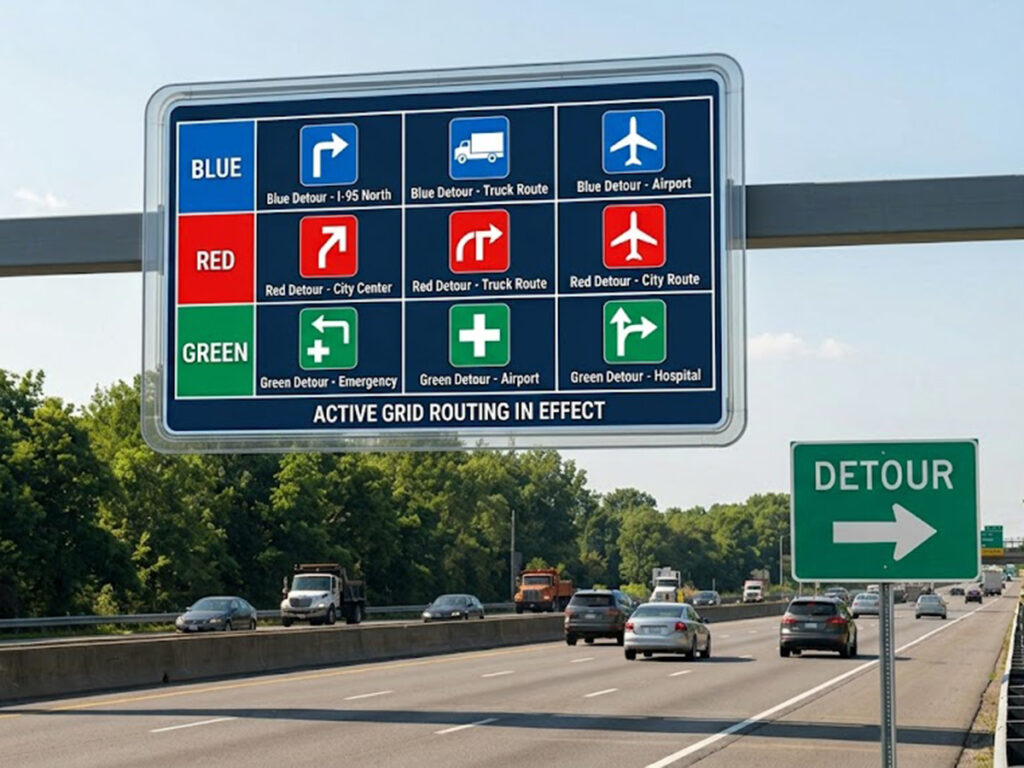
Blue, red, and green detour signs are not standalone MUTCD standard categories. They function as directional designators within state DOT-level Emergency Color Grid systems activated during major interstate closures — natural disasters, bridge failures, or multi-day traffic incidents.
The standard four-color matrix assigns: Blue = Northbound, Red = Southbound, Green = Eastbound, Orange = Westbound. Pennsylvania DOT, Ohio DOT, North Carolina DOT, and Virginia DOT operate formal versions of this grid. Procurement officers managing multi-state DOT contracts must maintain state-specific kit variants because directional assignments can differ.
| Sign Color | Grid Direction | Primary DOT Deployment | Sheeting Grade |
| Blue | Northbound | NCDOT, VDOT (evacuation routes) | ASTM Type III min / Type IX preferred |
| Red | Southbound | PennDOT (I-81, I-78 corridor) | ASTM Type III min / Type IX preferred |
| Green | Eastbound | Ohio DOT (SR-315, I-270) | ASTM Type III min / Type IX preferred |
| Orange | Westbound | PennDOT, Ohio DOT | ASTM Type III min / Type XI fluorescent preferred |
| Fluorescent Pink | Incident TTC (all directions) | Caltrans, MDOT, FDOT | ASTM Type XI required |
Source: FHWA Managing Traffic During Incidents and Emergencies
Blue Detour Sign Compliance: Avoiding Confusion with Standard Service Signs
The blue detour sign color creates a specific procurement compliance risk. MUTCD Section 2A.05 assigns blue as the standard background for motorist services guidance signs (hospitals, rest areas, fuel — the D-series). Emergency grid blue detour signs use a different legend format and must never substitute for or resemble standard blue service signs.
Procurement officers must maintain separate inventory classifications for blue emergency grid detour signs and blue service signs. North Carolina DOT deploys blue-coded detour signs for Northbound US-74 emergency alternate routing during coastal storm evacuations — all carry explicit ‘EMERGENCY DETOUR’ sub-legends to differentiate them in the field.
Red Detour Sign Compliance: The Critical Field Misuse Risk
Red detour sign color carries the highest misuse risk of any grid color. MUTCD assigns red exclusively to STOP, DO NOT ENTER, and WRONG WAY signs in standard operations. Field crews unfamiliar with emergency grid protocols may misinterpret red detour signs — or deploy them outside an authorized grid activation — creating dangerous driver confusion.
Procurement officers must: segregate red detour signs in clearly labeled emergency-only storage, include ‘EMERGENCY ROUTING ONLY’ sub-legends on all red grid signs, and implement written deployment authorization procedures. Pennsylvania DOT specifies red for Southbound emergency routing on I-81 and I-78 — these activations require a formal district emergency declaration before sign deployment.
Yellow Detour Signs: The Compliance Trap That Triggers FHWA Non-Conformances
Yellow is the single most misused detour sign color in B2B procurement. Field teams commonly substitute yellow for orange when orange inventory runs short, believing the colors carry equivalent meaning. They do not. MUTCD Section 2C.01 reserves yellow exclusively for the W-series permanent warning signs — geometric hazards, speed reductions, environmental conditions.
MUTCD Table 6F-1 and Section 6F.01 explicitly require an orange background for all TTC detour signs in work zones and TIMAs. FHWA Work Zone Safety Assessments classify yellow-for-orange substitution as a Category 1 non-conformance, the highest-severity finding in a federal work zone audit.
Yellow’s Legitimate Role: Advance Warning, Not Detour Routing
Yellow W-series signs play a required and legitimate role in detour staging — but only in the Advance Warning Zone, before the detour route begins. The correct deployment sequence is:
Yellow W20-1 (“Road Work Ahead”) and W4-2 (“Detour Ahead”) signs at the upstream end of the Advance Warning Zone
- Orange channelizing devices and DETOUR signs marking the actual route
- Fluorescent pink signs if the closure is incident-driven (Chapter 6I applies)
- “END DETOUR” orange sign at the return point to normal routing
MUTCD Table 6C-1 governs advance warning sign placement distances by posted speed limit. Procurement teams must order both yellow W-series (advance warning) and orange TTC (route marking) as separate line items. Combining them creates field ambiguity and audit exposure.
Fluorescent Yellow-Green: The School Zone Exception That Does Not Apply to Detours
Fluorescent yellow-green (FYG) sheeting achieves the highest daytime conspicuity of any MUTCD-approved color per FHWA Visibility Studies. MUTCD Section 2A.05 authorizes FYG exclusively for pedestrian, bicycle, and school warning signs. FYG signs in a TTC detour kit fail DOT inspection immediately.
Procurement officers must specify ‘orange fluorescent (ASTM Type XI)’ for high-visibility TTC applications — never FYG. The visual similarity between FYG and standard yellow creates dangerous confusion in sign kits when storage labels are missing.
Building a Multi-Color Emergency Detour Sign Kit: Procurement Specifications
A full four-color emergency detour grid kit plus a fluorescent pink TIMA kit represents the minimum pre-positioned inventory FHWA’s Traffic Incident Management Handbook recommends for each DOT maintenance district. Reactive ordering during an active incident is not a compliant practice — lead times for custom-color sign kits range from 10 to 21 business days versus 3 to 5 days for standard orange TTC signs.
Component Specifications for a Compliant Emergency Sign Kit
Per direction, per color tier, a compliant emergency kit requires:
- 4× DETOUR signs (48″×24″), 4× DETOUR ARROW signs (48″×24″), 2× BEGIN DETOUR, 2× END DETOUR
- Portable sign stands: minimum 40 lb. ballast per MUTCD Section 6F.63
- U-channel posts: minimum 2 lb./ft for temporary deployments; 12-gauge for deployments exceeding 30 days
- NCHRP Report 350 / MASH TL-3 certified breakaway bases for clear-zone mounting
- Weatherproof storage containers (minimum IP54 rating) labeled by color and direction
For detailed dimensional tolerances and wind-load structural requirements across sign sizes, procurement teams should reference specifications for detour sign dimensions, shapes, and structural wind-load requirements for heavy-duty work zones.
Vendor Qualification: What a Compliant Supplier Must Provide
Procurement officers must require the following documentation from any sign supplier before award:
- Per-lot ASTM D4956 sheeting certification by color (not just pre-qualification documentation)
- FHWA Interim Approval IA-11 documentation for fluorescent pink Type XI sheeting
- NCHRP 350 or MASH TL-3 hardware certification for all portable sign stands
- State DOT Approved Products List (APL) listings for each target deployment state
- Buy America certification per 23 CFR 635.410 for all federally funded projects
- ISO 9001 quality management certification
Suppliers unable to provide per-lot sheeting certifications are a red flag — this gap indicates possible off-specification material.
Incident Management Best Practices: Sign Sequencing, Rubbernecking, and State DOT Alignment
Proper detour sign color sequencing does more than satisfy FHWA audits. Correct sequencing at the right spacing intervals reduces driver hesitation at decision points — the primary cause of hard-braking secondary crashes in TIMAs.
FHWA data link secondary crashes to 20% of incident-related fatalities. Deploying color-coded signs in the correct sequence and spacing per MUTCD Table 6C-1 measurably reduces this exposure. Screen panels (MUTCD Section 6F.63) on the incident side of the roadway, combined with pink detour routing signs, pull driver focus forward rather than toward the incident scene — the most effective rubbernecking mitigation available in field TTC.
State DOT alignment requires procurement officers to verify active emergency detour routing protocols before stocking sign kits. Caltrans, MDOT, and FDOT publish updated TIM protocols annually. Virginia DOT’s Hurricane Evacuation Route system and PennDOT’s lettered alternate route system each carry specific color assignments that supersede generic grid defaults for those corridors.
Compliance Starts With the Right Detour Sign Color Specification
Detour sign color is not an aesthetic preference or a field-level discretionary call. Every color choice — orange for planned TTC, fluorescent pink for incident management, blue and red for emergency grid routing, yellow for advance warning — carries specific federal authority under the MUTCD, ASTM material standards, and state DOT procurement requirements. Getting a color wrong does not just mean a failed inspection. It means drivers receive incorrect routing signals during the highest-stress road conditions they will encounter.
Procurement officers who treat detour sign color as a technical specification — not a commodity — build compliant, deployable, legally defensible sign inventories. Those who do not inherit the liability when secondary crashes occur in poorly signed TIMAs.
For the complete technical reference on panel sizing, post hardware, retroreflective material grades, and structural specifications that underpin compliant detour sign procurement, review the complete detour sign specifications covering materials, dimensions, color standards, and structural requirements.
Frequently Asked Questions: Detour Sign Color Compliance for B2B Procurement
What does a pink detour sign mean, and when is it legally required?
Fluorescent pink is the MUTCD Chapter 6I-designated detour sign color for unplanned incident management. It is legally required when a fatal crash, hazmat incident, severe weather closure, or Tier 1 incident triggers a TIMA under state DOT protocols. Caltrans, FDOT, and MDOT have formally adopted Chapter 6I, making pink deployment mandatory for qualifying incidents. Procurement officers managing emergency response contracts must maintain standing pink sign inventory on a pre-positioned basis.
Can a red detour sign be used in a standard work zone?
No. Red detour sign color is not a standard MUTCD sign category. Red belongs exclusively to STOP, DO NOT ENTER, and WRONG WAY signs in standard operations. Red detour signs are solely emergency directional grid designators (Southbound routing) activated by formal state DOT emergency declarations. Deploying a red detour sign outside an authorized grid activation constitutes a MUTCD violation and creates dangerous driver confusion given red’s regulatory stop connotation.
Is yellow an acceptable substitute for orange in an active work zone?
No. MUTCD Table 6F-1 and Section 6F.01 require an orange background for all TTC detour signs. Yellow is a W-series permanent warning color — it belongs in the Advance Warning Zone upstream of the detour route, not on the route path itself. FHWA Work Zone Safety Assessments classify yellow-for-orange substitution as a Category 1 non-conformance, the highest severity finding. Procurement teams must maintain separate purchase orders for yellow W-series and orange TTC signs to prevent field substitution.
What ASTM sheeting grade applies to fluorescent pink incident signs?
ASTM D4956 Type XI fluorescent prismatic sheeting is the only compliant grade for pink incident sign backgrounds. Types III, IV, and VII lack the fluorescent performance required under TIMA deployment conditions. Sheeting must carry manufacturer compliance certification to ASTM D4956 and FHWA Interim Approval IA-11, where applicable. Fluorescent sheeting carries a typical 7-year warranty — procurement records must track manufacture dates for FHWA retroreflectivity management compliance under 23 CFR 655.603.
How do procurement officers build a compliant multi-state emergency detour sign contract?
Start with each target state’s DOT Approved Products List to confirm compliant manufacturers. Build a master specification matrix covering all grid colors, sign types, sizes, sheeting grades, and hardware. Require Buy America certification per 23 CFR 635.410 for federally funded work. Structure the contract as an IDIQ with a 48-hour emergency replenishment delivery clause. Require per-lot ASTM D4956 sheeting certifications as a contract deliverable — not a one-time pre-qualification document.
References
- Federal Highway Administration. MUTCD Part 6 — Temporary Traffic Control.
- Federal Highway Administration. Traffic Incident Management Handbook
- FHWA Office of Operations – Traffic Incident Management (TIM) Performance Measurement
- ASTM International. ASTM D4956 Standard Specification for Retroreflective Sheeting for Traffic Control.
- Code of Federal Regulations. 23 CFR Part 655 — Traffic Operations.
- Code of Federal Regulations. 23 CFR 635.410 — Buy America Requirements.
- NCHRP Report 350 / AASHTO MASH — Roadside Safety Hardware Criteria.
- Caltrans. Standard Specifications Division 12 — Construction Area Traffic Control Devices