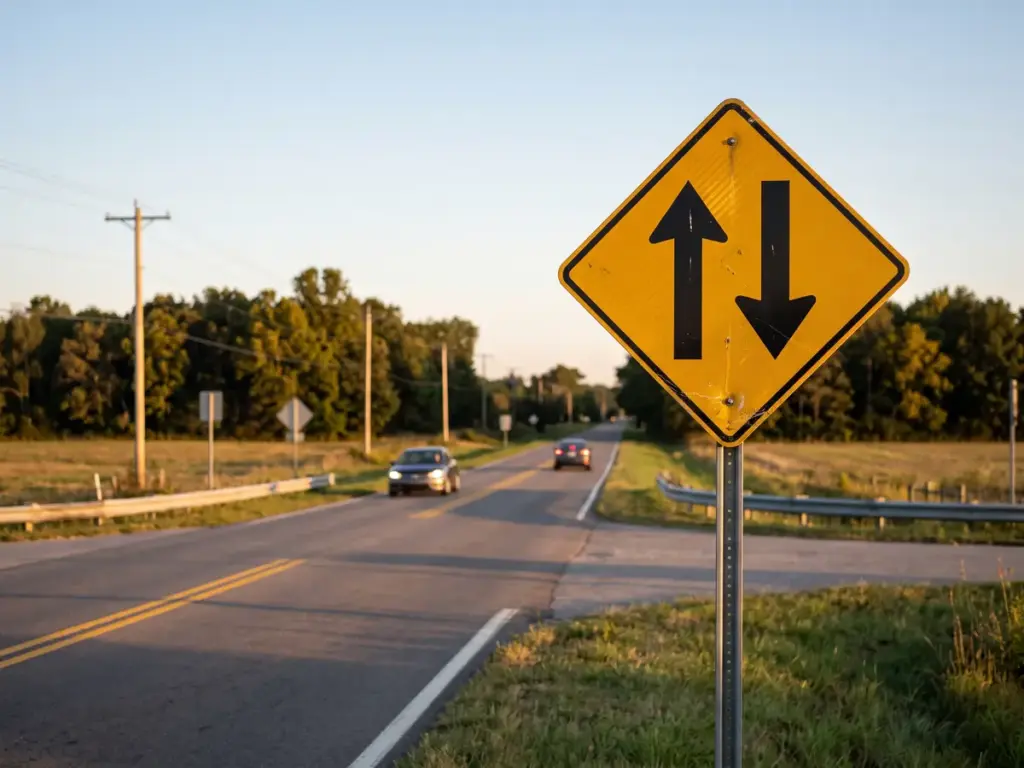
A driver leaves a divided highway. The median disappears. Oncoming cars now share the same pavement. Nothing about the road looks wrong until the last moment. That is the job of the two way traffic sign. It warns drivers that opposing traffic is about to appear.
The sign looks simple. Jedoch, crews and agencies still misuse it. Our team has reviewed sign plans where a Divided Highway Ends sign went up with no Two-Way Traffic sign behind it. Drivers got the warning that the median ended. They never got the warning that oncoming traffic was next. That gap matters most at night and at highway speed.
Dieser Leitfaden behandelt drei Dinge. Erste, what the two way traffic sign meaning is under the MUTCD. Zweite, how it differs from One Way, Wrong Way and Divided Highway signs. Dritte, how to use it in permanent roads and work zones.
Key Takeaways
- Two-Way Traffic (S6-3): Warns of a change to two-lane, two-way traffic, so drivers expect oncoming vehicles.
- AHEAD Plaque (W16-9P): Pair it with W6-3 after a one-way street, so drivers see the change early.
- Variable Nachrichtenzeichen: Show “Gegenverkehr” on temporary shifts, so crews update the warning as the layout changes.
- Pfeilbretter: Direct lane shifts into a crossover, so traffic enters the two-way section in the right lane.
- Sign Sets: Order W6-3, W6-2 and plaques together, so no transition ends with a missing warning.
What the Two Way Traffic Sign Means
The W6-3 sign is a yellow, diamond-shaped warning sign. Its symbol shows two opposing arrows. It does not give an order. It warns drivers that the roadway ahead carries traffic in both directions.
The MUTCD 11th Edition covers the sign in Section 2C.51. It sets three uses:
| Verwenden | What the MUTCD Says | Stärke |
|---|---|---|
| Divided road to two-lane, Einbahnstraße | Use W6-3 to warn of the transition | Anleitung (“sollen”) |
| One-way street to two-lane, Einbahnstraße | Use W6-3 with an AHEAD (W16-9P) Plakette | Anleitung (“sollen”) |
| Along a two-lane, Einbahnstraße | May be used at intervals as a reminder | Option (“Mai”) |
The sign may also supplement the Divided Highway Ends (W6-2) Zeichen. You can read the full text in the FHWA MUTCD 11. Auflage, Chapter 2C.
Two Way Traffic Sign vs. Similar Signs
Drivers often mix up signs that mention direction. Each sign does a different job. The table below separates them.
| Zeichen | Typ | What It Tells Drivers | Where It Goes |
|---|---|---|---|
| Two-Way Traffic (S6-3) | Warnung | Oncoming traffic is ahead | Before a two-way transition |
| Divided Highway Ends (W6-2) | Warnung | The median or barrier ends ahead | In advance of the end of a divided section |
| Geteilte Autobahn (W6-1) | Warnung | A median separates opposing traffic ahead | Approaches to a divided section |
| Ein Weg (R6-1, R6-2) | Regulatorisch | Traffic moves in one direction only | At one-way streets |
| Falscher Weg (R5-1a) | Regulatorisch | You are heading against traffic | Exit ramps and one-way roads |
The key difference is the sign family. W6-3 is a warning. One Way and Wrong Way are regulatory. A warning prepares drivers for what is coming. A regulatory sign sets a rule. The Related Reading guides on Ahead Only vs. One-Way and Wrong Way signs cover the regulatory side in more detail.
Where Agencies Get the Transition Wrong
Three mistakes show up again and again:
- Warning one sign short. The agency posts Divided Highway Ends. It skips W6-3. Drivers learn the median ends, not that traffic is coming at them.
- No AHEAD plaque after a one-way street. The sign appears at the transition point itself. Drivers have no time to adjust.
- Missing reminders. On a long two-lane road after a divided section, some drivers still behave as if the road is one-way. Repeating W6-3 at intervals helps.
The MUTCD also says Divided Highway (W6-1) must not replace a Keep Right sign at the end of a median island. Warning signs support the layout. They do not replace regulatory signs.
Using the Sign in Work Zones
Work zones create two-way sections that drivers do not expect. A crew may shift traffic onto one side of a divided road. Both directions then share one carriageway for weeks. The permanent sign map no longer fits the road.
Check the MUTCD Part 6 typical application for your layout. Then post the transition warnings before the shift begins.
Digital signs help when the layout changes often. The Optraffic team builds portable variable message signs for two-way traffic transitions. Crews can display “Gegenverkehr” before a crossover and change the message when the layout moves. That avoids the common problem of a static sign pointing at a layout that no longer exists.
Lane shifts also need a clear direction cue. Solar-powered electronic arrow boards show drivers which way to move into the crossover. That keeps traffic in the right lane when it enters the two-way section.
A Quick Transition Checklist
Use this list when signing a change to two-way traffic:
- Identify the transition type. Is it divided-to-two-way or one-way-to-two-way?
- Choose the signs. Use W6-3 for both. Add the AHEAD plaque for one-way streets.
- Check for W6-2. Post Divided Highway Ends in advance of the end of the divided section.
- Plan reminders. Repeat W6-3 at intervals along long two-way sections.
- Review in the field. Drive the approach at night and confirm every sign is visible.
Verwandte Lektüre
- Ahead Only vs. One-Way Traffic Signs: What Is the Difference?
- Von Standards bis zum Üben: Wie Transportabteilungen die richtigen Falschschilder auswählen
- Arbeitszonenschilder für einspurige Autobahnen, Zweiseitige Operationen: Nachlassend & Pilot Car Guide
- Einbahnstraßenkontrolle in Arbeitsbereichen: So melden Sie einen Spurwechsel an, ohne dass es zu Unfällen in die entgegengesetzte Richtung kommt
FAQ
What does a two way traffic sign mean?
It warns drivers that the road ahead carries traffic in both directions. Drivers should expect oncoming vehicles and stay in their lane.
What is the difference between a two way traffic sign and a one way sign?
The Two-Way Traffic sign (S6-3) is a warning sign. A One Way sign is a regulatory sign. The first prepares drivers for oncoming traffic. The second tells them traffic moves in one direction only.
When does the MUTCD say to use the Two-Way Traffic sign?
Section 2C.51 says to use it when a multi-lane divided road becomes two-way. It also applies when a one-way street becomes two-way, with an AHEAD plaque.
Does a Divided Highway Ends sign replace the two way traffic sign?
NEIN. They serve different warnings. Divided Highway Ends warns that the median ends. The Two-Way Traffic sign warns that oncoming traffic follows.
Can the two way traffic sign be used in a work zone?
Ja. Work zones often create temporary two-way sections. Check the MUTCD Part 6 typical application for the specific layout.
Abschluss
Der two way traffic sign closes a gap that other signs leave open. It tells drivers what to expect after the median ends or the one-way street turns. Agencies that post it with the right plaque and reminders cut the chance of a driver misjudging the road. That is why the Optraffic team supplies W6-3, W6-2 and AHEAD plaques as matched sets, so every two way traffic sign arrives with the signs that complete the transition.