Why Chevron Sign Colour Selection Matters for Liability and Safety
Chevron sign colour is not a design preference. It is a compliance decision that carries real legal weight. Private property managers who select the wrong colour face premises liability exposure, failed safety audits, and — in the worst cases — preventable injuries on their sites. Property managers overseeing multi-use sites, warehouses, or private roads should pair chevron sign colour decisions with correctly sized hardware.
The Federal Highway Administration (FHWA) and the Manual on Uniform Traffic Control Devices (MUTCD) establish a nationally recognized colour-coding framework. ANSI Z535 extends that framework into private and industrial environments. Together, these standards define exactly what each colour communicates and when each colour must appear.
According to the Bureau of Labor Statistics, in 2023 there were 5,283 fatal work injuries (Source: https://www.bls.gov/news.release/cfoi.nr0.htm) recorded in the United States — many occurring in transportation and material-moving environments where signage failures contribute to hazard exposure. Correct chevron sign colour selection is one of the most cost-effective risk controls available to any facility operator.
The Universal Colour Language of Chevron Signs — MUTCD and ANSI Z535 Decoded
Every chevron sign colour combination carries a distinct, standard-defined meaning. The table below synthesizes the five primary combinations, their governing standards, core meanings, and private-property applications.
| Colour Combination | Governing Standard | Primary Meaning | Top Private Property Use Cases |
| Yellow & Black | MUTCD W1-8 Series | Caution / Warning | Parking curves, loading bay approaches, driveway radii |
| Red & White | MUTCD / ANSI Z535.1 | Danger / Prohibition | Fire lanes, dock edges, emergency access restrictions |
| Black & White | MUTCD (Regulatory) | Regulatory / Directional | One-way lanes, gated entries, structured parking flow |
| Blue & White | ANSI Z535 (Notice) | Mandatory / Informational | Forklift corridors, PPE zones, warehouse traffic lanes |
| Orange & Black | MUTCD Part 6 (TTC) | Temporary Traffic Control | Construction zones, site renovations, utility detours |
Source: MUTCD 11th Edition, FHWA (2023) | ANSI Z535.1-2017 (R2022), Safety Colors
Yellow and Black Chevron Sign — The Caution and Warning Standard
The yellow and black chevron sign operates under the MUTCD W1-8 series designation. FHWA assigns yellow as the universal warning colour for conditions that require a driver to proceed with heightened awareness rather than stop.
Sharp curves, sudden alignment changes, and general traffic hazards all call for this chevron sign colour pairing. On private properties, yellow-black chevrons belong at parking lot curves, loading bay approach lanes, and driveway radii where geometry creates a moderate hazard.
Yellow does not imply immediate danger. It implies that a risk exists and that a reasonable reduction in speed or an increase in attention will mitigate it.
Red and White Chevron Sign — High-Risk Hazard and Prohibition Zones
Red carries the most severe meaning in both MUTCD and ANSI Z535. Under ANSI Z535.1, red designates a danger-level condition — one where failure to comply creates an immediate risk of severe injury or death.
The red and white chevron sign belongs at dock edges, fire access corridors, emergency vehicle lanes, and any zone where a missed turn or wrong-way entry triggers a recordable incident. The red chevron sign’s meaning is unambiguous: this zone has zero tolerance for navigational error.
From a liability standpoint, a red-white chevron at a high-consequence location communicates that the property manager recognized the hazard and took affirmative action to warn against it — a critical element of premises liability defense.
Black and White Chevron Road Sign — Regulatory and Directional Use
The black and white chevron road sign meaning under MUTCD is strictly regulatory. This colour pairing signals rules and lane assignments — not active physical danger. A black-and-white chevron road sign tells drivers: this is the required path.
Private property applications include gated entry lane assignments, one-way internal roads, and structured parking flow patterns. The black and white chevron road sign does not trigger the urgency response that yellow or red creates. It is the appropriate choice where the goal is orderly compliance, not hazard avoidance.
Blue, Orange, and Specialty Chevron Sign Colours — When Standard Yellow Is Not Enough
Blue and White Chevron Sign — Mandatory Routes and Private Industrial Traffic Control
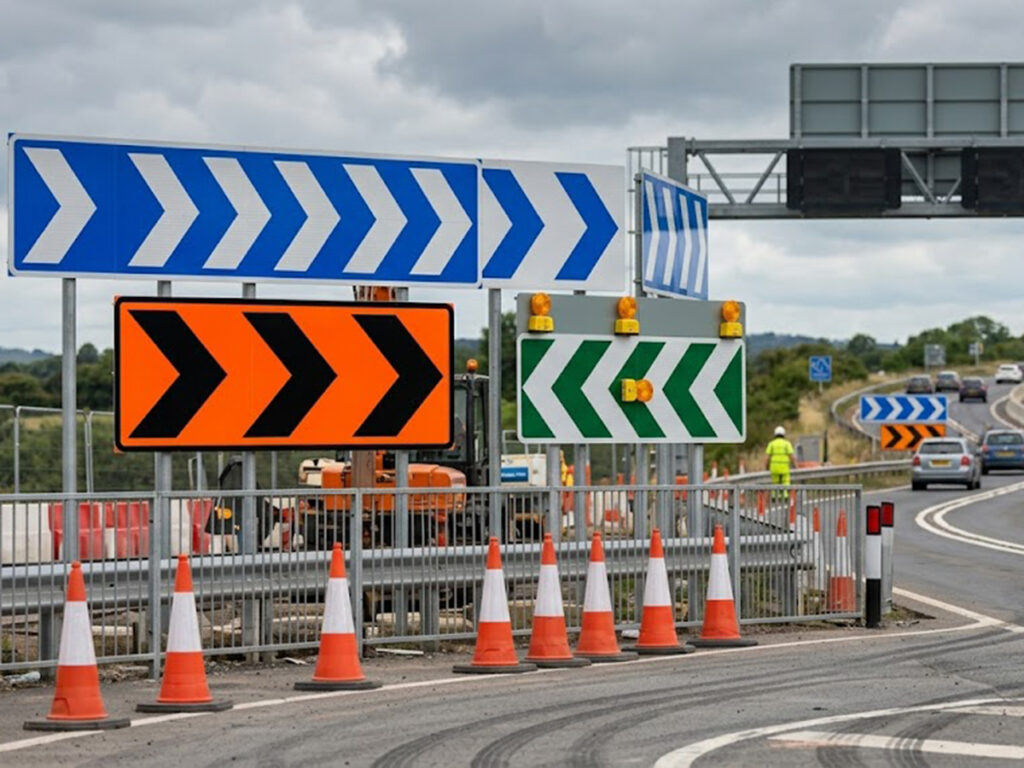
The blue chevron road sign is not a standard MUTCD public road sign. Blue falls under ANSI Z535’s Notice category — mandatory instructions and informational safety content. Private and industrial facility managers have widely adopted blue-white chevrons for this reason.
Inside warehouses, distribution centres, and manufacturing facilities, blue chevrons mark forklift corridors, mandatory PPE zones, and pedestrian-vehicle separation paths. The blue chevron road sign communicates a protocol requirement: personnel must follow this route or comply with this instruction.
The Occupational Safety and Health Administration (OSHA) endorses ANSI Z535 as the recognized workplace safety colour standard. Facilities operating under OSHA’s 29 CFR 1910.144 safety colour requirements benefit from ANSI Z535-aligned signage programs.
Orange and Black Chevron Sign — Temporary Traffic Control and Construction Zones
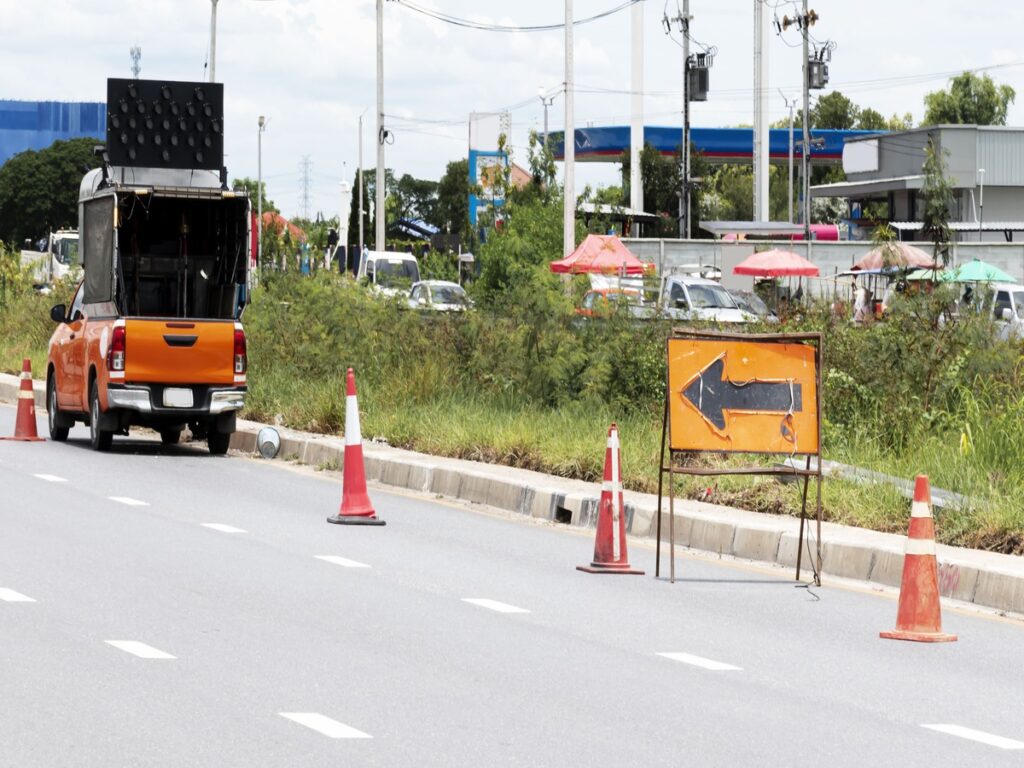
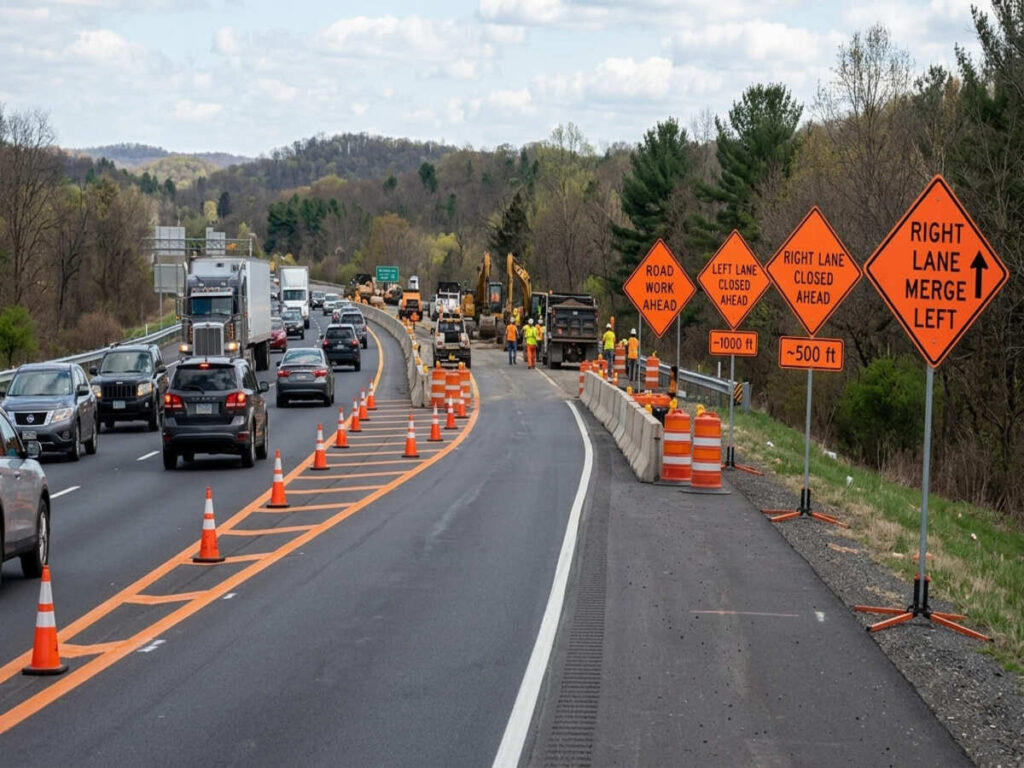
MUTCD Part 6 mandates orange as the required colour for all temporary traffic control signage. Any construction, renovation, or utility work on private property that affects vehicle or pedestrian flow requires orange-black chevrons for the duration of the temporary condition.
Temporary traffic control chevron colour standards are not optional suggestions. Private property managers who fail to deploy orange chevrons during active site work face the same liability exposure as public-road operators — particularly when delivery carriers, contractors, or visitors access the affected area.
Once the temporary condition ends, orange chevrons must be removed or covered. Leaving orange signage in place after work is completed creates navigational confusion and undermines the colour-coding system.
ANSI Z535 Industrial Safety Chevron Colours — Facility-Specific Applications
Facilities running formal ANSI Z535-based safety programs can extend the colour hierarchy beyond MUTCD defaults. ANSI Z535 recognizes green for safe-condition and first-aid locations, orange for warning-level conditions (one step below red danger), and blue for all mandatory notice requirements.
Any custom chevron sign colour program must still comply with applicable OSHA standards and local Authority Having Jurisdiction (AHJ) requirements. Internal colour systems that deviate from MUTCD without documented rationale create liability exposure if challenged post-incident.
Chevron Sign Colour Selection by Facility Type — A Private Property Manager’s Decision Matrix
Commercial Parking Lots, Shopping Centres, and Mixed-Use Developments
Yellow-black chevron signs cover most general traffic warning needs in commercial parking environments — curved entry ramps, blind exits, and access lane alignment changes. Red-white chevrons are required wherever a navigational error leads to a fire lane intrusion, ADA drop-off zone conflict, or emergency access obstruction.
Local fire marshals and AHJs frequently mandate specific chevron sign colours for fire access routes. Property managers should confirm AHJ requirements before specifying sign colours on any fire-lane-adjacent installation.
Warehouses, Distribution Centres, and Manufacturing Facilities
Indoor and outdoor colour logic differs in industrial environments. Yellow-black governs exterior yard traffic — truck entry lanes, dock approach curves, and perimeter road alignment changes. Blue-white dominates inside the facility, marking forklift corridors and mandatory pedestrian separation routes.
Dock edges and loading bay approach curves that present a fall or impact hazard require red-white chevrons, not yellow-black. The distinction matters: yellow implies the hazard is manageable with care; red implies the consequence of error is severe.
For a detailed breakdown of chevron sign colour requirements specific to warehouse and private road environments, refer to our private roads & warehouses buyer’s guide.
Private Roads, Gated Communities, and Campus Environments
Private roads and campus environments use a layered chevron sign colour strategy. Black-and-white chevrons handle regulatory lane assignments on internal one-way roads. Yellow-black covers curves and alignment changes on perimeter driveways. Red-white marks emergency gate approaches and restricted zone entries.
Gated community managers should audit their entire road network against MUTCD colour criteria at least annually. Site layout changes — new kerbs, added speed tables, reconfigured fire lanes — all trigger a colour reassessment.
MUTCD Compliance on Private Property — What Colour Rules Actually Apply
When MUTCD Colour Standards Become Legally Binding on Private Property
The MUTCD’s scope applies the standard to any roadway open to public travel—regardless of ownership. This typically includes commercial parking lots, shopping center access roads, and industrial parks accessible to delivery carriers.
State DOTs, local municipalities, and insurance carriers frequently extend MUTCD applicability based on this “open to public travel” test. A private property manager who ignores MUTCD chevron sign colour standards on a publicly accessible site may face challenges in establishing a credible compliance defense in a post-incident investigation.
For precise details on regulatory requirements regarding chevron sign colour and placement, specifically governed by MUTCD Section 2C.12, please refer to the resource “MUTCD Section 2C.12 Requirements,” which outlines specific regulatory language.
How ANSI Z535 Fills the Gap Where MUTCD Does Not Reach
Generally, purely private, access-controlled facilities—such as closed manufacturing campuses and private logistics yards—fall outside the direct scope of the MUTCD. ANSI Z535 often governs these environments. While OSHA utilizes ANSI Z535 as a basis for evaluating workplace safety, it’s crucial to refer to specific OSHA regulations like 29 CFR 1910.145 (regarding specifications for accident prevention signs and tags) for binding requirements within OSHA-inspected facilities.
The practical implication: Every private facility needs a clearly defined governing standard for chevron sign colour. Either MUTCD applies because the site is open to public travel, or ANSI Z535 might apply, with potential regulatory oversight by OSHA. Therefore, properly operated commercial properties must actively manage their colour-standard compliance.
Common Colour Compliance Mistakes Private Property Managers Make — and How to Avoid Them
Using Yellow Where Red Is Required — Underestimating Hazard Severity
The most common chevron sign colour error is defaulting to yellow-black on every curve, regardless of consequence severity. A missed turn into a parking aisle is not the same risk level as a missed turn at a dock edge. Courts and insurers evaluate whether the signage colour matched the actual hazard severity.
The FHWA’s safety signage research program consistently identifies colour-severity mismatches as a contributing factor in post-incident liability findings. Selecting red-white for high-consequence locations is the single most defensible colour decision a property manager can make.
Deploying Permanent Colours on Temporary Hazards (and Vice Versa)
Using permanent yellow-black chevrons in a construction detour zone is a MUTCD Part 6 compliance failure. Orange is mandatory for all temporary traffic control conditions. Conversely, leaving orange chevrons in place after a temporary condition ends signals a hazard that no longer exists — creating driver confusion and potential liability.
Property managers should include chevron sign colour relevance reviews in their post-construction site commissioning checklists. Temporary orange must come down or be covered the moment permanent conditions are restored.
Ignoring Retroreflectivity Requirements Alongside Colour Choice
Chevron sign colour selection is incomplete without the correct retroreflective sheeting grade. A yellow-black sign with degraded retroreflectivity is a nighttime compliance failure regardless of its daytime colour accuracy.
MUTCD Table 2A-3 establishes minimum retroreflectivity levels by sign type and speed environment. Type III sheeting is the minimum for warning signs on roads with speeds above 45 mph. Property managers should verify sheeting grade — not just colour — when auditing existing chevron signage.
How to Specify and Order the Right Chevron Sign Colour for Your Facility
The Five-Point Colour Specification Checklist Before You Order
Property managers should verify five criteria before specifying any chevron sign colour:
- Hazard classification: Confirm whether the condition warrants warning (yellow), danger (red), regulatory (black-and-white), mandatory (blue), or temporary (orange) treatment.
- Governing standard: Identify whether MUTCD, ANSI Z535, or AHJ requirements apply to your specific property type and access classification.
- Visibility conditions: Day/night use, approach speed, and ambient lighting affect retroreflective sheeting grade selection alongside chevron sign colour.
- Facility access classification: Public-access vs. controlled-access determines which standard takes precedence for colour selection.
- Consistency audit: New signs must match the colour system already deployed across the facility to avoid mixed-message confusion.
Custom Colour Chevron Signs for Branded or Non-Standard Industrial Applications
Some industrial facilities operate internal safety colour programs that extend beyond standard MUTCD and ANSI Z535 palettes. Custom chevron sign colour orders require clear specification of substrate material, retroreflective sheeting grade, legend colour versus background colour, and mounting hardware compatibility.
Private property managers overseeing multi-site compliance programs can work with OPT Signs to source MUTCD-compliant and ANSI Z535-aligned chevron signs in standard and custom colour configurations — with bulk ordering and specification review available. Get a custom quote for your facility.
Choosing the Right Chevron Sign Colour Is a Compliance Decision, Not a Design Decision
Chevron sign colour carries legal, operational, and safety weight that no property manager can afford to treat as an aesthetic preference. The right colour is the one a court, insurer, or OSHA inspector would recognize as appropriate for the specific hazard and context. Yellow warns. Red prohibits. Black-white regulates. Blue mandates. Orange signals temporary conditions.
Property managers should review all chevron sign colours against current MUTCD and ANSI Z535 standards at least annually — and immediately after any site layout change that creates a new or modified traffic condition.
For a complete technical grounding — covering MUTCD standards, placement formulas, retroreflectivity requirements, and full specification details — consult the Ultimate Guide to Chevron Signs: MUTCD Standards, Placement & Specs as the master compliance reference for any chevron sign programme.
Frequently Asked Questions
What does a yellow and black chevron sign mean?
A yellow and black chevron sign is a MUTCD W1-8 series warning sign indicating a sharp curve, alignment change, or traffic hazard. Yellow communicates caution — proceed with reduced speed — rather than a full stop. On private property, yellow-black is the standard chevron sign colour for curves and moderate-hazard alignment changes.
What is the difference between a red and white chevron sign and a yellow and black one?
The difference is hazard severity. Yellow-black signals a caution-level condition manageable with reduced speed. Red-white signals an immediate danger where non-compliance risks severe injury or property damage. Red-white is the required chevron sign colour for dock edges, fire access lanes, and emergency vehicle zones.
What does a black-and-white chevron road sign mean?
A black-and-white chevron road sign carries a regulatory meaning — not a warning. It designates required lane assignments and directional flow without implying active danger. It is the appropriate chevron sign colour for one-way internal roads, gated entry lanes, and structured parking flow.
Are blue chevron road signs used on public roads?
Blue chevron signs are not standard MUTCD public-road signs. Blue is an ANSI Z535 Notice designation for mandatory instructions. Blue-white chevrons are widely used in private warehouses and industrial facilities to mark forklift corridors and mandatory safety protocol zones.
What colour are temporary traffic control chevron signs required to be?
Under MUTCD Part 6, all temporary traffic control chevron signs must use an orange background with black legends. Orange is the federally designated temporary traffic control chevron colour. Orange chevrons must be deployed for the full duration of any temporary site condition and removed immediately once permanent conditions are restored.
Do MUTCD chevron sign colour rules apply to private property?
MUTCD colour standards apply to any property open to public travel — including commercial parking lots and industrial parks accessible to delivery carriers. For access-controlled private facilities, ANSI Z535 governs. Local AHJ requirements may impose additional standards in either case.
References
- Federal Highway Administration. Manual on Uniform Traffic Control Devices (MUTCD), 11th Edition, 2023.
- ANSI Z535.1-2017 (R2022): American National Standard for Safety Colors. National Electrical Manufacturers Association
- Occupational Safety and Health Administration. Safety Color Coding, 29 CFR 1910.144.
- U.S. Bureau of Labor Statistics. Census of Fatal Occupational Injuries Summary, 2023.