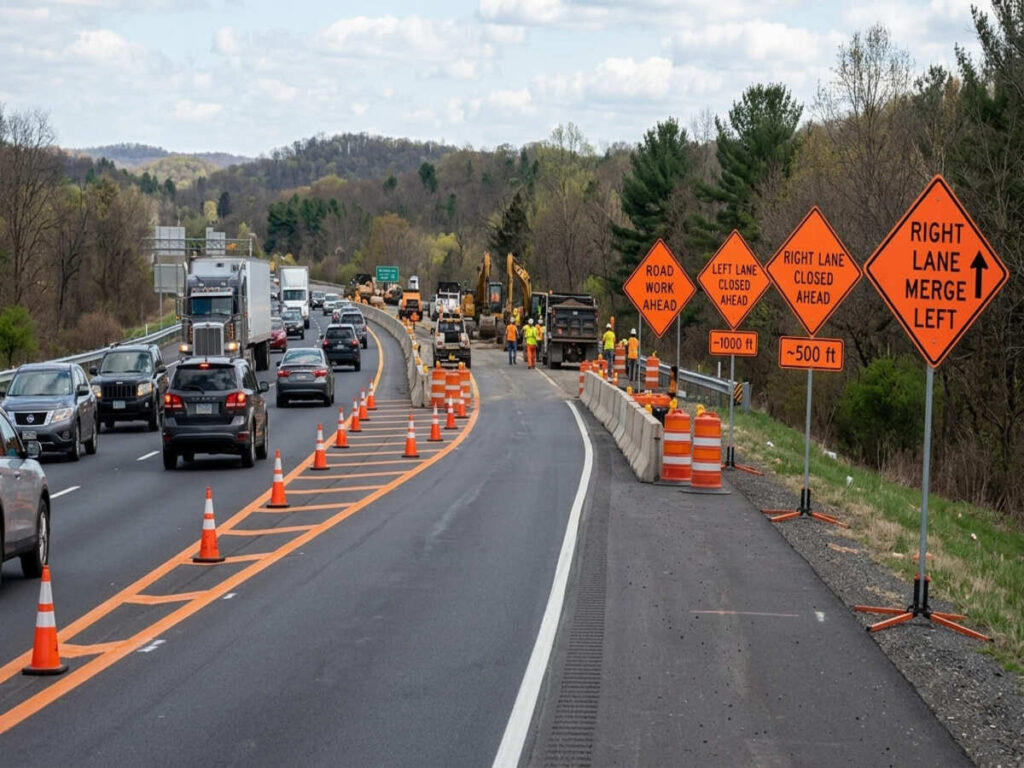

Converting a two-way road into a temporary one way section sounds simple on paper. In practice, it’s one of the easier setups to get wrong. It’s also one of the more dangerous ones when a crew gets it wrong. A driver who enters from the wrong end doesn’t just get confused. They now face oncoming traffic on a road they expect to be clear.
Our team has walked back into work zones after a shift change and found a problem. The exit end of a converted lane still showed the original two-way signage. The crew swapping out the sign for one way traffic had only covered the entry point. That gap is exactly where wrong-way crashes happen. Fortunately, it’s avoidable. A good sign package and a checklist that covers both ends of the conversion close that gap, not just the end facing the flagger.
This guide walks through what MUTCD requires for a one-way conversion. It also covers where crews most often miss coverage. Finally, it shows how to build a sign package that closes those gaps before the first shift starts.
Key Takeaways
- Wrong-Way Coverage: Sign every entry point of a one-way conversion, not just the flagger-facing approach.
- MUTCD R6-1/R6-2: Use the divided-arrow variant at median or channelized approach points.
- Package by Duration: Match sign density and mounting to conversion length, not a single default kit.
- Shift Handoffs: Require outgoing crews to walk incoming crews through every entry point before leaving site.
- Pre-Built Kits: Bundled one-way conversion packages close inventory gaps that cause missed coverage.
Why One-Way Conversions Are Riskier Than They Look
A permanent one-way street has redundant cues. Painted arrows, curb markings, signal phasing, and drivers who’ve learned the route all reinforce the pattern. A temporary work zone conversion has none of that. Instead, drivers approaching a one way road sign for the first time rely entirely on the sign package. If that package is incomplete, they have no fallback.
The risk also compounds at night and in low-visibility weather. In these conditions, drivers often miss a knocked-over sign. By the time they notice, they’ve already committed to the wrong direction.
What MUTCD Requires for One-Way Traffic Control
The Manual on Uniform Traffic Control Devices sets the baseline for one way signs and their companion devices in temporary traffic control (TTC) zones. Specifically, three sign types define a compliant setup:
- R6-1 (One Way) — the standard rectangular arrow sign. Crews place it at the entry point of the conversion and repeat it at each intersection along the converted section.
- R6-2 (One Way, divided arrow) — used where the one-way section faces oncoming approaches directly, typically paired at median or channelized points.
- Wrong-Way and Do Not Enter signs (R5-1a, W16-6P) — required at every point a driver could physically enter from the closed end, not just the main approach.
The Federal Highway Administration maintains these standards. Every U.S. jurisdiction references them for TTC compliance.
Crews working across state lines, or exporting packages to Canada or Australia, should note one caveat. The shape and color logic is broadly shared internationally. However, the specific sign codes and mounting heights differ by jurisdiction. Always confirm against the local supplement before shipping a standard MUTCD package into another market.
Where Crews Actually Miss Coverage
Field feedback from rental fleets running short-duration lane conversions points to the same three gaps, again and again:
- The far end of the conversion. Crews sign the entry point where the flagger stands. They then forget the exit end, which still needs a Do Not Enter or Wrong-Way sign facing traffic from the other direction.
- Mid-block driveways and side streets. Any private driveway or unsigned side street feeding into the converted section is a potential wrong-way entry point. It needs its own signage, not just coverage at the two main intersections.
- Shift-change handoff. A conversion set up correctly at 7am can develop gaps by the evening shift. This happens whenever the outgoing crew skips walking the incoming crew through every entry point, not just the primary ones.
One-Way Sign Package by Conversion Duration
The right package depends on how long the conversion stays in place. After all, a two-day detour doesn’t need the same hardware as a six-week lane closure.
| Conversion Type | Typical Duration | Core Sign Package | Mounting |
|---|---|---|---|
| Short-term (shift-length) | Under 24 hours | R6-1 One Way, W16-6P Wrong Way arrow, portable Do Not Enter | Portable A-frame or cone-mounted |
| Medium-term | Several days to weeks | R6-1 + R6-2 at each intersection, reflective Wrong-Way at all entry points | Post-mounted, sandbagged base |
| Long-term (project-length) | Weeks to months | Full R6-1/R6-2 set, illuminated Wrong-Way signs for night visibility, redundant signage at every side-street entry | Permanent-style post mount |
Matching the package to the duration up front avoids two common failure modes. On one hand, a long-term conversion can end up under-signed and degrade over weeks of weather exposure. On the other hand, a two-day detour can get over-built and eat into a rental fleet’s margin.
Building the Package Without Piecing It Together On Site
The gaps described above usually aren’t a training problem. Instead, they’re an inventory problem. A crew often has to piece together R6-1 signs from one bin, Wrong-Way arrows from another, and improvised Do Not Enter placards because the right stock ran out. Coverage gaps become the predictable result.
A pre-built one-way conversion kit changes that. It bundles R6-1, R6-2, Wrong-Way, and Do Not Enter signage to match the package tiers above, which removes the guesswork. Optraffic’s rental and sale packages follow exactly this logic. A crew requests a “medium-term one-way conversion” and receives a complete, MUTCD-matched set, instead of assembling one from whatever’s left in the yard. On top of that, Optraffic’s free web-based tracking system helps too. It lets a fleet manager confirm every unit in a package is accounted for and back in inventory once the conversion is struck, with no separate software subscription required.
Related Reading
- How Transportation Departments Select the Right Wrong-Way Sign
- Single Lane Closure Signs Guide: MUTCD Setup & Taper
- Flagging Operations: Flagger Ahead Sign & Buffer Zone Guide
- Road Work Ahead Sign Guide: W20-1 Standards, Placement & “Men at Work” Rules
FAQ
What does a one way sign mean? It shows that traffic on that section may only travel in the direction of the arrow. Entering from the opposite end is prohibited. Crews typically pair it with a Wrong-Way or Do Not Enter sign facing that approach.
Is a one way sign regulatory or warning? Regulatory. R6-1 and R6-2 are white rectangular regulatory signs, distinct from the diamond-shaped warning signs used for hazards.
How many one-way signs are required when converting a two-way lane in a work zone? There’s no single fixed count. Instead, MUTCD requires coverage at every point a driver could enter the converted section, so the total varies with the number of intersections and driveways along the route.
What happens if a driver enters a temporary one-way section from the wrong end? They face oncoming traffic with no advance warning. As a result, this scenario remains the leading cause of head-on collisions in short-duration work zone conversions.
Conclusion
A one-way conversion is only as safe as its weakest entry point. Getting MUTCD placement right at the flagger’s end means little if the far end or a mid-block driveway goes unsigned. That’s why the Optraffic team builds one-way conversion packages around conversion duration. As a result, crews stop assembling coverage from whatever’s left in stock, and every one way sign gets placed and every entry point gets covered before the first vehicle arrives.