Why Specification-Level Comparison Matters in Traffic Bollard Procurement
Procurement officers and traffic engineers face a recurring problem: bollards that fail prematurely or get rejected at jurisdictional inspection. A rigorous traffic bollard comparison at the specification level prevents both outcomes. The FHWA recorded 850 work zone fatalities in 2024, with roadway intrusions remaining a critical safety threat (Source: https://www.atssa.com/news/new-statistics-show-decline-in-work-zone-fatalities/).
This guide treats bollards as engineered assets, not commodities. Buyers should evaluate four specification axes before any purchase order moves forward. Each axis influences the total cost of ownership across a five- to ten-year horizon. A defensible traffic bollard comparison requires every axis in play.
The Four Specification Axes Every Buyer Must Evaluate
Mechanism, impact behavior, visibility system, and base configuration form the procurement decision matrix. Material selection sits inside these axes rather than alongside them. Every credible traffic bollard comparison addresses all four.
Common Procurement Mistakes That Trigger Premature Replacement
Three errors dominate rejected installations:
- Under-specified retroreflectivity tops the list.
- Mismatched mechanism for access frequency follows close behind.
- Ignored jurisdictional QPL requirements round out the trio.
Each error typically costs 1.5× the original unit price to remediate.
Traffic Bollard Mechanism Types Compared
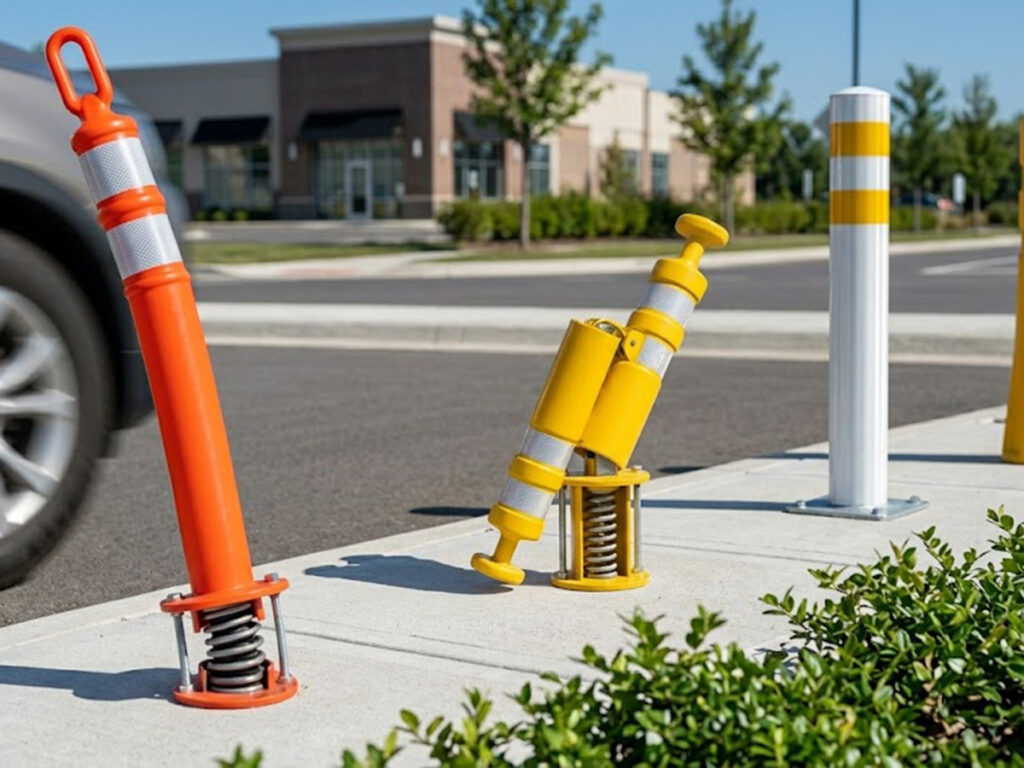
Mechanism dictates installation cost, recurring labor, and access flexibility. This traffic bollard comparison axis carries the largest lifecycle impact. Procurement should resolve it first.
Fixed vs Removable: Installation Cost vs Operational Flexibility
Fixed bollards anchor via cast-in-place concrete or surface-bolt plates. They carry the highest installation cost but eliminate recurring labor. Removable bollards use socket-mount hardware with locking pins, enabling 30 to 90 second swap cycles.
Sockets accumulate debris in roadway environments. Maintenance crews should budget quarterly socket cleaning at high-cycle locations. Fixed installations skip this overhead entirely.
Retractable Bollards: When Hydraulic Investment Pays Back
Retractable bollards range from manual lift-assist to fully automatic hydraulic systems. Hydraulic units typically rate for 200,000+ cycles and carry IP67 or IP68 below-grade enclosures. Acquisition cost runs $3,500 to $15,000+ per unit installed.
Payback math favors retractables only when daily access cycles exceed five. Below that threshold, removable bollards deliver better economics.
Collapsible Mechanisms and Spring-Base Engineering
Collapsible bollards use spring-hinged bases that deflect 90° under vehicle contact, then return to vertical. Quality units rate for 300 to 500 impact cycles before spring fatigue. They sit between rigid and flexible bollards in both cost and performance.
For a complete decision matrix covering anchor type, cycle frequency, and total cost of ownership across these three mechanisms, see the side-by-side breakdown of fixed, removable, and retractable bollards.
Impact Behavior: Flexible vs Rigid vs Collapsible Bollard Design
The flexible vs rigid bollards decision drives the largest performance variance in any traffic bollard comparison. Buyers misjudge this axis constantly. The wrong choice destroys the product within months.
Self-Recovering Polyurethane and Material Memory
Polyurethane and TPU bollards absorb impact through molecular deflection. Quality units recover to vertical within seconds and survive 500 to 1,000+ low-speed strikes under 25 mph. Shore A hardness typically ranges from 85 to 95 for traffic-grade compounds. Cold-weather performance favors polyurethane over HDPE below freezing.
Rigid Steel and Ductile Iron: Stopping Power
Rigid bollards refuse to yield. Steel pipe variants with 6mm walls and concrete-filled cores resist most passenger-vehicle intrusions. Crash-rated security bollards follow ASTM F2656 or F3016 ratings, which differ fundamentally from standard traffic delineators
Cost-Per-Impact: The Metric Most Buyers Miss
Acquisition cost alone misleads procurement teams. A $45 flexible bollard rated for 500 impacts delivers $0.09 per strike. The same dollar spent on a $35 rigid plastic bollard destroyed on first contact delivers $35.00 per strike. Any honest traffic bollard comparison must include this calculation.
The trade-off between mechanical-hinge collapsibility and material-memory recovery deserves its own analysis. Review why self-recovering designs outperform collapsible bollards under repeated impact for the full breakdown.
Visibility Systems: Reflective Grades vs Illuminated Bollards
Visibility specifications drive nighttime safety performance. Value engineering frequently strips this line item from the procurement scope. The cost shows up in collision data three years later.
ASTM D4956 Retroreflective Sheeting Grades
ASTM D4956 defines retroreflective sheeting performance classes. The relevant grades for any traffic bollard comparison include the following:
| Sheeting Type | Common Name | Min. RA (cd/lx/m²) | Typical Application |
| Type I | Engineering Grade | 70 | Parking, low-speed zones |
| Type III | High Intensity Prismatic | 250 | Standard roadway |
| Type IV | High Intensity Prismatic II | 360 | High-speed corridors |
| Type IX | Diamond Grade VIP | 380 | Critical visibility zones |
Source: https://reflectivetape.info/reflective-tape-types-astm-d4956/
Solar, Hardwired, and Battery-Operated Illumination
Illuminated bollards are split into three power architectures. Solar units cost $200 to $400 and require panel maintenance. Hardwired LED systems demand trenched conduit at $50 to $150 per linear foot installed. Battery-only flashing bollards run $80 to $200 with six-month battery replacement cycles.
When Reflective Is Enough
Reflective Type III or IV typically satisfies MUTCD requirements below 45 mph in well-lit zones. Illuminated systems justify their cost in unlit rural corridors and pedestrian-heavy night-shift sites.
The wiring and trenching costs of illuminated systems often outweigh their nighttime advantage. Review the case for skipping the wiring while preserving visibility performance for the full traffic bollard comparison on this axis.
Base Design and Stackability: T-Top, Standard, and Weighted Configurations
Base geometry affects storage, transport, and deployment labor. Fleet operators feel this axis more than any other procurement variable. The math compounds at scale.
T-Top Stackable Geometry
T-Top bollards nest 4 to 6 inches deep. A standard pallet stores 60 to 80 T-Tops versus 20 to 25 standard cylindrical units. Forklift handling stays simple because the tapered top centers each unit into the one below.
Want high-quality T-Top bollards? Browse OPTSIGNS bollards to get the right ones for your projects!
Weighted Base Options for Temporary Deployment
Rubber recycled-base bollards weigh 8 to 18 lbs and resist 35+ mph wind. Sand-fillable bases scale to 60+ lbs for semi-permanent installation. Concrete-anchored bases enter fixed-installation territory.
Compliance, Certification, and Regulatory Specifications
Compliance failures kill contracts. Every traffic bollard comparison at the procurement stage must verify technical performance against the controlling jurisdiction’s precise specifications. Three regulatory frameworks dominate U.S. traffic engineering and procurement practice.
MUTCD and ASTM Compliance Requirements
The Manual on Uniform Traffic Control Devices (MUTCD) governs all channelizing and temporary traffic control device requirements nationally. Specifically, MUTCD Chapter 6H sets strict minimum heights, retroreflective sheeting placement, and color uniformity standards to ensure driver visibility. The 11th Edition, published in December 2023, remains the active federal mandate through 2026.
Furthermore, any reflective elements must comply with ASTM D4956 standards. Procurement officers must specify the exact retroreflectivity grade—typically Type IV (High-Intensity Prismatic) for standard roadway demarcation or Type XI (Diamond Grade) for high-speed, high-risk work zones—to guarantee legal compliance and low-light performance.
State DOT Approved Product Lists (APL/QPL)
State Departments of Transportation, such as Caltrans, TxDOT, and FDOT, maintain independent Qualified Products Lists (QPL) or Approved Product Lists (APL). A plastic or flexible bollard approved under the Caltrans QPL does not automatically clear TxDOT or FDOT review, as each state evaluates proprietary assets against localized environmental factors, unique wind-load minimums, and specific impact-recovery cycle tests. Engineering teams must cross-reference the exact manufacturer model number against the local state DOT APL before locking procurement specifications.
Decoding Manufacturer Engineering Spec Sheets
When reviewing manufacturer submittals, marketing terms like “heavy-duty,” “premium-grade,” or “unbreakable” carry zero procurement weight. True engineering spec sheets must explicitly state verifiable data lines: the specific testing methodology (such as MASH TL-3 or NCHRP 350 crashworthiness), the ASTM D4956 sheeting classification, the exact polymer density or steel wall thickness (e.g., Schedule 40 or 80 steel), and concrete anchoring pull-out strengths. Buyers should routinely demand official laboratory test reports and active certification numbers rather than relying on catalog copy.
How to Choose the Right Traffic Bollard: A Procurement Decision Framework
Specifications resolve in sequence. Each step narrows the remaining options. The framework below structures any traffic bollard comparison for procurement purposes.
The Four-Step Specification Framework
- Define impact frequency and severity. High-frequency low-speed conditions point to flexible polyurethane. Security-grade applications point to rigid steel.
- Define visibility environment. Lit urban zones suit Type III reflective. Unlit rural corridors call for Type IV or active illumination.
- Define deployment permanence. Fixed install equals anchor-mount. Rotating fleet equals T-Top stackable. Temporary deployment equals weighted base.
- Verify jurisdictional compliance. Pull the QPL. Match certification numbers. Document the chain.
Total Cost of Ownership Across 5- and 10-Year Horizons
TCO sums acquisition, installation, expected replacements, and recurring labor. A $45 flexible bollard surviving 800 impacts beats a $25 rigid bollard replaced after 40 impacts. Any rigorous traffic bollard comparison should model the longer horizon.
When Adjacent Safety Infrastructure Changes the Spec
Pedestrian railings, curb extensions, and signage systems interact with bollard placement. Sometimes railings replace bollards entirely. Other times, they complement. Review how pedestrian railings either complement or conflict with bollard placement for the system-level analysis.
This traffic bollard comparison sits within a broader content silo on traffic management infrastructure. For a foundational overview that introduces every bollard family referenced here — including T-Top, flexible, stackable, and reflective designs — buyers can consult the comprehensive guide to traffic bollard solutions.
Frequently Asked Questions on Traffic Bollard Specifications
Q1: What is the difference between flexible and rigid traffic bollards?
Flexible bollards (polyurethane or TPU) deflect under impact and self-recover, surviving 500+ vehicle strikes. Rigid bollards (steel, ductile iron) refuse to yield and provide stopping force. Procurement should match yielding behavior to the underlying safety objective.
Q2: Which traffic bollard material lasts longest outdoors?
UV-stabilized polyurethane and hot-dip galvanized steel per ASTM A123 deliver 7 to 15 year service lives. HDPE performs adequately in moderate climates but turns brittle below freezing without impact-modified grades.
Q3: What ASTM retroreflectivity grade should buyers specify?
ASTM D4956 Type III sits as the practical minimum for active roadways. Type IV or IX suits high-speed corridors and low-ambient-light zones. Type I belongs only in well-lit parking applications.
Q4: Are removable bollards MUTCD compliant?
Removable bollards comply when the installed configuration meets Chapter 6F height, color, and retroreflectivity rules. The removal mechanism itself faces no MUTCD regulation. The empty socket must remain hazard-free during dismount.
Q5: How many vehicle impacts can a flexible traffic bollard withstand?
Quality polyurethane self-recovering bollards survive 500 to 1,000+ low-speed strikes under 25 mph. Higher speeds reduce cycle counts. Specification sheets should state both speed and recovery criteria for any defensible traffic bollard comparison.
Q6: What is the typical cost difference between reflective and illuminated bollards?
Reflective bollards cost $40 to $120 with zero recurring power. Illuminated units run $150 to $600+ plus conduit costs of $50 to $150 per linear foot for hardwired installations. Reflective wins below 25 mph in lit environments.
Reference
ASTM F2656-20 Standard Test Method for Crash Testing of Vehicle Security Barriers
Caltrans Qualified Products List