Warum ein Vergleich auf Spezifikationsebene bei der Beschaffung von Verkehrspollern wichtig ist
Beschaffungsbeauftragte und Verkehrsingenieure stehen vor einem wiederkehrenden Problem: Poller, die vorzeitig ausfallen oder bei der gerichtlichen Prüfung abgelehnt werden. Eine strenge Vergleich von Verkehrspollern auf Spezifikationsebene verhindert beide Ergebnisse. Die FHWA hat aufgezeichnet 850 Todesfälle im Arbeitsbereich in 2024, da Eingriffe in die Fahrbahn nach wie vor ein kritisches Sicherheitsrisiko darstellen (Quelle: https://www.atssa.com/news/new-statistics-show-decline-in-work-zone-fatalities/).
In diesem Leitfaden werden Poller als technische Vermögenswerte behandelt, keine Waren. Käufer sollten vier Spezifikationsachsen bewerten, bevor sie eine Bestellung aufgeben. Jede Achse beeinflusst die Gesamtbetriebskosten über einen Fünfer hinweg- bis zu einem Zeithorizont von zehn Jahren. Ein vertretbares Vergleich von Verkehrspollern erfordert jede Achse im Spiel.
Die vier Spezifikationsachsen, die jeder Käufer bewerten muss
Mechanismus, Aufprallverhalten, Sichtbarkeitssystem, und Basiskonfiguration bilden die Beschaffungsentscheidungsmatrix. Die Materialauswahl erfolgt innerhalb dieser Achsen und nicht neben ihnen. Alles glaubwürdig Vergleich von Verkehrspollern spricht alle vier an.
Häufige Fehler bei der Beschaffung, die zu einem vorzeitigen Austausch führen
Drei Fehler dominieren abgelehnte Installationen:
- Ganz oben auf der Liste steht die unzureichend spezifizierte Retroreflexion.
- Knapp dahinter folgt ein nicht übereinstimmender Mechanismus für die Zugriffshäufigkeit.
- Ignorierte gerichtliche QPL-Anforderungen runden das Trio ab.
Die Behebung jedes Fehlers kostet in der Regel das 1,5-fache des ursprünglichen Stückpreises.
Arten von Verkehrspollermechanismen im Vergleich
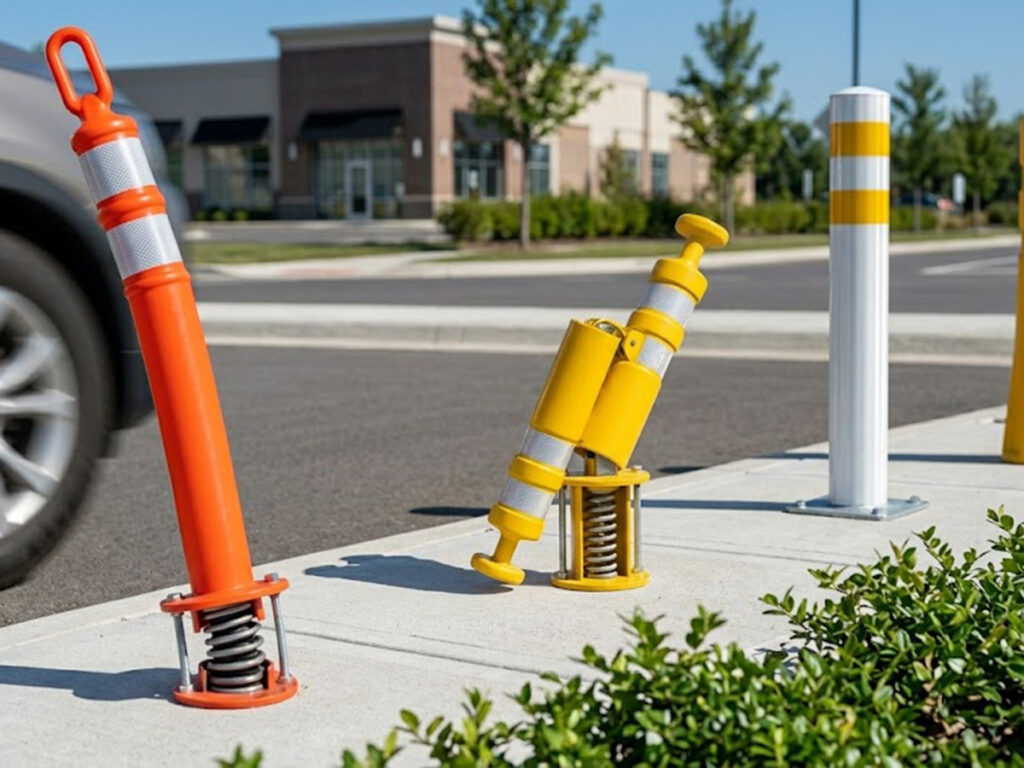
Der Mechanismus bestimmt die Installationskosten, wiederkehrende Wehen, und Zugangsflexibilität. Das Vergleich von Verkehrspollern Die größte Auswirkung auf den Lebenszyklus hat die Achse. Der Einkauf sollte das Problem zunächst lösen.
Fest oder abnehmbar: Installationskosten vs. Betriebsflexibilität
Feste Poller werden über Ortbeton- oder Oberflächenbolzenplatten verankert. Sie sind mit den höchsten Installationskosten verbunden, ersparen aber wiederkehrende Arbeiten. Abnehmbare Poller verwenden Sockelmontageteile mit Sicherungsstiften, ermöglichen 30 Zu 90 zweite Swap-Zyklen.
Steckdosen sammeln Schmutz in Straßenumgebungen an. Wartungsteams sollten an Standorten mit hoher Zyklenzahl eine vierteljährliche Steckdosenreinigung einplanen. Bei Festinstallationen entfällt dieser Aufwand vollständig.
Versenkbare Poller: Wenn sich hydraulische Investitionen amortisieren
Einziehbare Poller reichen von manueller Hubunterstützung bis hin zu vollautomatischen hydraulischen Systemen. Hydraulikeinheiten werden normalerweise für bewertet 200,000+ Zyklen und tragen IP67- oder IP68-Unterbaugehäuse. Anschaffungskosten laufen $3,500 Zu $15,000+ pro installierter Einheit.
Die Amortisationsrechnung begünstigt einziehbare Geräte nur dann, wenn die täglichen Zugriffszyklen fünf überschreiten. Unterhalb dieser Schwelle, Abnehmbare Poller sorgen für eine bessere Wirtschaftlichkeit.
Zusammenklappbare Mechanismen und Federbasistechnik
Zusammenklappbare Poller verfügen über federgelagerte Sockel, die sich bei Fahrzeugkontakt um 90° auslenken, dann kehren Sie in die Vertikale zurück. Preis für Qualitätseinheiten 300 Zu 500 Schlagzyklen vor Federermüdung. Sie stehen hinsichtlich Kosten und Leistung zwischen starren und flexiblen Pollern.
Für eine vollständige Entscheidungsmatrix für den Ankertyp, Zyklusfrequenz, und Gesamtbetriebskosten für diese drei Mechanismen, siehe die Nebeneinander Aufschlüsselung der festen, abnehmbar, und versenkbare Poller.
Aufprallverhalten: Flexibles vs. starres vs. zusammenklappbares Pollerdesign
Die Entscheidung zwischen flexiblen und starren Pollern führt zu den größten Leistungsunterschieden überhaupt Vergleich von Verkehrspollern. Käufer schätzen diese Achse ständig falsch ein. Die falsche Wahl zerstört das Produkt innerhalb von Monaten.
Selbsterholendes Polyurethan und Materialgedächtnis
Poller aus Polyurethan und TPU absorbieren Stöße durch molekulare Ablenkung. Hochwertige Einheiten kehren innerhalb von Sekunden in die Vertikale zurück und überleben 500 Zu 1,000+ Streiks mit niedriger Geschwindigkeit unter 25 Meilen pro Stunde. Die Shore-A-Härte liegt typischerweise im Bereich von 85 Zu 95 für verkehrstaugliche Verbindungen. Die Leistung bei kaltem Wetter begünstigt Polyurethan gegenüber HDPE unter dem Gefrierpunkt.
Starrer Stahl und duktiles Eisen: Stoppende Kraft
Starre Poller geben nicht nach. Stahlrohrvarianten mit 6-mm-Wänden und betongefüllten Kernen widerstehen den meisten Eingriffen in Personenkraftwagen. Crash-geschützte Sicherheitspoller entsprechen den ASTM F2656- oder F3016-Bewertungen, die sich grundlegend von Standard-Verkehrsleitschildern unterscheiden
Kosten pro Wirkung: Die Kennzahl, die die meisten Käufer vermissen
Allein die Anschaffungskosten führen Beschaffungsteams in die Irre. A $45 Flexibler Poller, ausgelegt für 500 Auswirkungen liefert $0.09 pro Schlag. Der gleiche Dollar, der für a ausgegeben wurde $35 starrer Plastikpoller, der beim ersten Kontakt zerstört wird $35.00 pro Schlag. Jeder ehrlich Vergleich von Verkehrspollern muss diese Berechnung enthalten.
Der Kompromiss zwischen der Zusammenklappbarkeit mechanischer Scharniere und der Wiederherstellung des Materialgedächtnisses verdient eine eigene Analyse. Rezension Warum selbsterholende Designs zusammenklappbaren Pollern bei wiederholtem Aufprall überlegen sind für die vollständige Aufschlüsselung.
Sichtbarkeitssysteme: Reflektierende Markierungen im Vergleich zu beleuchteten Pollern
Sichtbarkeitsspezifikationen beeinflussen die Sicherheitsleistung bei Nacht. Beim Value Engineering wird dieser Posten häufig aus dem Beschaffungsumfang entfernt. Die Kosten tauchen drei Jahre später in den Kollisionsdaten auf.
ASTM D4956 Retroreflektierende Folienqualitäten
ASTM D4956 definiert Leistungsklassen für retroreflektierende Folien. Die entsprechenden Noten für alle Vergleich von Verkehrspollern Folgendes einschließen:
| Blattart | Allgemeiner Name | Min. RA (CD/LX/m²) | Typische Anwendung |
| Typ I | Ingenieurnote | 70 | Parken, Zonen mit niedriger Geschwindigkeit |
| Typ III | Hochintensität Prismatisch | 250 | Standardfahrbahn |
| Typ IV | Hochintensives Prisma II | 360 | Hochgeschwindigkeitskorridore |
| Typ IX | VIP mit Diamant-Grade | 380 | Kritische Sichtbereiche |
Quelle: https://reflektierendetape.info/reflective-tape-types-astm-d4956/
Solar, Fest verdrahtet, und batteriebetriebene Beleuchtung
Beleuchtete Poller sind in drei Leistungsarchitekturen unterteilt. Kosten für Solaranlagen $200 Zu $400 und erfordern eine Wartung des Panels. Bei festverdrahteten LED-Systemen ist ein Kabelkanal erforderlich $50 Zu $150 pro installiertem linearen Fuß. Blinkende Poller funktionieren nur mit Batterie $80 Zu $200 mit sechsmonatigen Batteriewechselzyklen.
Wenn Reflexion ausreicht
Reflektierende Typ III oder IV erfüllen in der Regel die unten aufgeführten MUTCD-Anforderungen 45 Meilen pro Stunde in gut beleuchteten Zonen. Beleuchtete Systeme rechtfertigen ihre Kosten in unbeleuchteten ländlichen Korridoren und an stark frequentierten Nachtschichtstandorten.
Die Kosten für die Verkabelung und den Grabenbau von beleuchteten Systemen überwiegen häufig deren Nachtvorteil. Überprüfen Sie die Gehäuse zum Überspringen der Verkabelung bei gleichzeitiger Wahrung der Sichtleistung für das volle Vergleich von Verkehrspollern auf dieser Achse.
Basisdesign und Stapelbarkeit: T-Top, Standard, und gewichtete Konfigurationen
Die Basisgeometrie beeinflusst die Lagerung, Transport, und Einsatzkräfte. Flottenbetreiber spüren diese Achse stärker als jede andere Beschaffungsvariable. Die mathematischen Zusammenhänge im Maßstab.
Stapelbare T-Top-Geometrie
T-Top-Pollernest 4 Zu 6 Zoll tief. Ein Standard-Palettenlager 60 Zu 80 T-Tops versus 20 Zu 25 Standard-Zylindereinheiten. Die Handhabung mit dem Gabelstapler bleibt einfach, da die konische Oberseite jede Einheit in der darunter liegenden Einheit zentriert.
Sie wünschen sich hochwertige T-Top-Poller? Durchsuchen OPTSIGNS-Poller um die richtigen für Ihre Projekte zu bekommen!
Gewichtete Basisoptionen für den temporären Einsatz
Poller aus recyceltem Gummi wiegen 8 Zu 18 Pfund und widerstehen 35+ Meilen pro Stunde Wind. Mit Sand befüllbare Sockel skalieren bis 60+ lbs für semipermanente Installation. Mit Beton verankerte Sockel betreten den Bereich der Festinstallation.
Einhaltung, Zertifizierung, und behördliche Spezifikationen
Compliance-Verstöße zerstören Verträge. Jeder Vergleich von Verkehrspollern In der Beschaffungsphase muss die technische Leistung anhand der genauen Spezifikationen der kontrollierenden Gerichtsbarkeit überprüft werden. In den USA dominieren drei Regulierungsrahmen. Verkehrstechnik und Beschaffungspraxis.
MUTCD- und ASTM-Konformitätsanforderungen
Das Handbuch auf einheitlichen Verkehrssteuerungsvorrichtungen (MUTCD) regelt alle landesweiten Anforderungen an Kanalisierungs- und temporäre Verkehrskontrollgeräte. Speziell, MUTCD Kapitel 6H legt strenge Mindesthöhen fest, Platzierung der retroreflektierenden Folie, und Farbeinheitlichkeitsstandards, um die Sichtbarkeit des Fahrers zu gewährleisten. Die 11. Auflage, im Dezember veröffentlicht 2023, bleibt der aktive Bundesauftrag bestehen 2026.
Außerdem, Alle reflektierenden Elemente müssen den ASTM D4956-Standards entsprechen. Beschaffungsbeauftragte müssen den genauen Grad der Retroreflexion angeben – typischerweise Typ IV (Hochintensive Prismatik) für Standard-Fahrbahnbegrenzung oder Typ XI (Diamantqualität) für Hochgeschwindigkeit, Arbeitsbereiche mit hohem Risiko – um die Einhaltung gesetzlicher Vorschriften und die Leistung bei schlechten Lichtverhältnissen zu gewährleisten.
Staatliche DOT-zugelassene Produktlisten (APL/QPL)
Staates Verkehrsbehörden, wie Caltrans, Txdot, und FDOT, Führen Sie unabhängige Listen qualifizierter Produkte (QPL) oder genehmigte Produktlisten (APL). Ein nach der Caltrans QPL zugelassener Poller aus Kunststoff oder flexiblem Material besteht nicht automatisch die TxDOT- oder FDOT-Prüfung, da jeder Staat eigene Vermögenswerte anhand lokaler Umweltfaktoren bewertet, einzigartige Windlastminima, und spezifische Aufprall-Erholungszyklus-Tests. Ingenieurteams müssen die genaue Modellnummer des Herstellers mit der örtlichen DOT APL vergleichen, bevor sie Beschaffungsspezifikationen festlegen.
Dekodierung technischer Datenblätter von Herstellern
Bei der Durchsicht von Herstellerunterlagen, Marketingbegriffe wie “Hochleistungs,” “Premium-Qualität,” oder “unzerbrechlich” kein Beschaffungsgewicht tragen. Echte technische Datenblätter müssen explizit überprüfbare Datenzeilen angeben: die spezifische Testmethodik (wie MASH TL-3 oder NCHRP 350 Unfallsicherheit), die Folienklassifizierung ASTM D4956, die genaue Polymerdichte oder Stahlwandstärke (Z.B., Zeitplan 40 oder 80 Stahl), und Auszugsfestigkeit der Betonverankerung. Käufer sollten regelmäßig offizielle Labortestberichte und aktive Zertifizierungsnummern verlangen, anstatt sich auf Katalogkopien zu verlassen.
So wählen Sie den richtigen Verkehrspoller aus: Ein Beschaffungsentscheidungsrahmen
Spezifikationen werden nacheinander aufgelöst. Jeder Schritt schränkt die verbleibenden Optionen ein. Das folgende Framework strukturiert alle Vergleich von Verkehrspollern für Beschaffungszwecke.
Das Vier-Schritte-Spezifikationsrahmenwerk
- Definieren Sie die Häufigkeit und Schwere der Auswirkungen. Hochfrequente Bedingungen bei niedriger Geschwindigkeit deuten auf flexibles Polyurethan hin. Sicherheitsanwendungen deuten auf starren Stahl hin.
- Definieren Sie die Sichtbarkeitsumgebung. Beleuchtete städtische Zonen sind mit Reflektoren vom Typ III ausgestattet. Unbeleuchtete ländliche Flure erfordern Typ IV oder aktive Beleuchtung.
- Definieren Sie die Dauerhaftigkeit der Bereitstellung. Eine feste Installation entspricht einer Ankermontage. Rotierende Flotte gleich T-Top stapelbar. Temporärer Einsatz entspricht gewichteter Basis.
- Überprüfen Sie die Einhaltung der gesetzlichen Bestimmungen. Ziehen Sie die QPL. Passen Sie die Zertifizierungsnummern an. Dokumentieren Sie die Kette.
Gesamtbetriebskosten insgesamt 5- und 10-Jahres-Horizonte
TCO summiert den Erwerb, Installation, voraussichtlicher Ersatz, und wiederkehrende Wehen. A $45 flexibler Poller 800 Schläge schlagen a $25 Starrer Poller später ersetzt 40 Auswirkungen. Irgendein strenges Vergleich von Verkehrspollern sollte den längeren Horizont modellieren.
Wenn angrenzende Sicherheitsinfrastruktur die Spezifikation ändert
Fußgängergeländer, Bordsteinverlängerungen, und Beschilderungssysteme interagieren mit der Pollerplatzierung. Manchmal ersetzen Geländer die Poller vollständig. Andere Zeiten, sie ergänzen. Rezension wie Fußgängergeländer die Platzierung von Pollern ergänzen oder mit ihr im Konflikt stehen für die Analyse auf Systemebene.
Das Vergleich von Verkehrspollern befindet sich in einem breiteren Content-Silo zur Verkehrsmanagement-Infrastruktur. Für einen grundlegenden Überblick, der alle hier genannten Pollerfamilien vorstellt – einschließlich T-Top, flexibel, stapelbar, und reflektierende Designs – Käufer können die konsultieren umfassender Leitfaden für Verkehrspollerlösungen.
Häufig gestellte Fragen zu den Spezifikationen von Verkehrspollern
Q1: Was ist der Unterschied zwischen flexiblen und starren Verkehrspollern??
Flexible Poller (Polyurethan oder TPU) werden bei Aufprall abgelenkt und erholen sich von selbst, überleben 500+ Fahrzeugstreiks. Starre Poller (Stahl, Sphäroguss) Weigere dich, nachzugeben und Bremskraft bereitzustellen. Die Beschaffung sollte das Nachgiebigkeitsverhalten an das zugrunde liegende Sicherheitsziel anpassen.
Q2: Welches Material für Verkehrspoller hält im Freien am längsten??
UV-stabilisiertes Polyurethan und feuerverzinkter Stahl gemäß ASTM A123 7 Zu 15 Jahr Lebensdauer. HDPE weist in gemäßigten Klimazonen eine angemessene Leistung auf, wird jedoch ohne schlagzähmodifizierte Qualitäten unter dem Gefrierpunkt spröde.
Q3: Welchen ASTM-Retroreflexionsgrad sollten Käufer angeben??
ASTM D4956 Typ III gilt als praktisches Minimum für aktive Straßen. Typ IV oder IX eignet sich für Hochgeschwindigkeitskorridore und Zonen mit wenig Umgebungslicht. Typ I gehört nur in gut beleuchtete Parkanwendungen.
Q4: Sind abnehmbare Poller MUTCD-konform??
Abnehmbare Poller erfüllen die Anforderungen, wenn die installierte Konfiguration der Höhe von Kapitel 6F entspricht, Farbe, und Retroreflexionsregeln. Der Entfernungsmechanismus selbst unterliegt keiner MUTCD-Regulierung. Bei der Demontage muss die leere Steckdose gefahrlos bleiben.
F5: Wie vielen Fahrzeugstößen kann ein flexibler Verkehrspoller standhalten??
Hochwertige, sich selbst erholende Poller aus Polyurethan überleben 500 Zu 1,000+ Streiks mit niedriger Geschwindigkeit unter 25 Meilen pro Stunde. Höhere Geschwindigkeiten verringern die Anzahl der Zyklen. In den Spezifikationsblättern sollten sowohl Geschwindigkeits- als auch Wiederherstellungskriterien für alle vertretbaren Geräte angegeben sein Vergleich von Verkehrspollern.
F6: Was ist der typische Kostenunterschied zwischen reflektierenden und beleuchteten Pollern??
Kosten für reflektierende Poller $40 Zu $120 ohne wiederkehrende Leistung. Beleuchtete Einheiten laufen $150 Zu $600+ zzgl. Leitungskosten von $50 Zu $150 pro linearem Fuß für festverdrahtete Installationen. Reflektierende Siege unten 25 Meilen pro Stunde in beleuchteten Umgebungen.
Referenz
ASTM F2656-20 Standardtestmethode für Crashtests von Fahrzeugsicherheitsbarrieren
Liste qualifizierter Caltrans-Produkte