Queensland facilities managers know school car parks are among the most unpredictable traffic environments in the state. Every school day, dozens of vehicles converge on a single Drop-and-Go zone within a narrow fifteen-minute window. Children move between cars far less predictably than adult pedestrians do. Queensland Road Safety Week (QRSW) puts this exact scenario under a public spotlight each year. School infrastructure teams are increasingly expected to demonstrate a genuine standard of care. This guide sets out practical school zone traffic management solutions for Queensland schools to deploy before, during, and after QRSW. The focus stays on surface-mounted flexible bollards, wheel stops, and compliant signage. All three suit real car park conditions without disruptive concrete works.
Effective school zone traffic management solutions rarely rely on a single product. They combine physical delineation, impact-absorbing guide posts, and clear signage to shape driver behaviour. Together, they target the exact points where risk is highest. The sections below walk through the compliance context, the product logic, and the procurement steps facilities managers need. The goal is simple: move from a chaotic car park to a defensible, well-documented safety layout.
Why QRSW Puts School Car Park and Drop-and-Go Zones Under the Spotlight
Queensland Road Safety Week is a joint TMR and Queensland Police Service initiative. It is typically held across a week in August each year. The campaign exists because road trauma remains a persistent problem across the state. In one recent QRSW period, organisers reported over 150 road deaths already recorded that year. Close to 8,000 people are seriously injured on Queensland roads every year (Source: https://datahub.roadsafety.gov.au/reporting/monthly-road-deaths). Children and young adults are disproportionately represented in this trauma. TMR’s own road safety education material names transport-related injury as a leading cause of death for children aged one to fourteen. Children and young adults make up roughly a quarter of all road deaths.
School zones sit at the centre of this risk profile. Reduced sightlines, high pedestrian density, and rushed adult drivers all combine in one small footprint. TMR has acknowledged genuine enforcement challenges in these zones. Where monitoring has taken place, a significant share of drivers were clocked well over the posted limit. Some exceeded it by more than 20 km/h. This is the underlying case for investing in school zone traffic management solutions well before QRSW arrives. The week itself is a visibility moment. The underlying risk sits there every single school day.
The QRSW Calendar and What It Means for Procurement Timing
QRSW is generally scheduled in August, mid-way through the school year. That sits well past the peak of Term 1 procurement cycles. Facilities managers who wait until the week itself risk missing supplier lead times for custom signage or bulk bollard orders. Booking a car park safety review during Term 2 gives enough runway for installation before the campaign. It also avoids competing with every other Queensland school ordering stock at once.
Peak-Hour Drop-and-Go Chaos and Why It Matters for Compliance
Morning and afternoon peaks compress the highest pedestrian volume of the school day into the shortest vehicle dwell time. Facilities managers preparing a school Traffic Management Plan are expected to identify these conflict points. Queensland’s own infrastructure funding programs recognise “Stop, Drop and Go” zones as a fundable category. Pedestrian crossings and parking bay upgrades sit in that same category.
Understanding School Zone Traffic Management Solutions Under DTMR and Australian Standards
Before selecting products, facilities managers should understand the compliance layer behind any school zone traffic management solutions deployment. Static signage and physical delineation each answer a different part of the risk equation. Queensland’s approach ties both together through its infrastructure funding programs.
Two Australian Standards form the backbone of any car park safety upgrade. AS 1742.2:2022 (Part 2: Traffic control devices for general use) governs school zone and shared zone signage placement. For off-street parking, AS/NZS 2890.1:2004 (Part 1: Off-street car parking) Section 2.5 explicitly outlines the physical boundary controls required to protect pedestrian paths. While neither standard mandates a single product brand, they dictate precise visibility, clearance, and height benchmarks that a compliant installation must satisfy to mitigate school council liability.
Core Compliance Requirements for QLD School Zones
- Reduced-speed school zone signage should be clearly retroreflective and correctly positioned for driver sightlines under AS 1742.2.
- Off-street car park layout, including bollard and wheel stop placement, should align with AS/NZS 2890.1 general parking requirements.
- In a shared or accessible zone, bollard guidance aligns with AS 1428.1 (Design for access and mobility), calling for a minimum height of 1300mm to ensure visibility from the cabin of heavy vehicles (like school buses) and for visually impaired pedestrians. Positioning should maintain a continuous clear path of travel (CPOT) of no less than 1200mm, with the bollard baseplate typically set back 800mm from the zone’s painted roadway edge to prevent wing-mirror clipping.
Where Static Signage Alone Falls Short in the Car Park
Signage manages driver expectations on approach to the school zone. It cannot physically stop a vehicle drifting across a pedestrian path once inside the car park. This is the practical gap that surface-mounted flexible bollards and other physical delineations fill. A complete school zone traffic management solutions package always pairs signage with a physical layer. Reviewing your broader signage program ahead of QRSW too? Our detailed breakdown of compliant high-visibility signage and mounting brackets covers retroreflectivity classes and bracket selection in depth.
Why Flexible Springback Bollards Are the Safer Choice for QLD School Car Parks
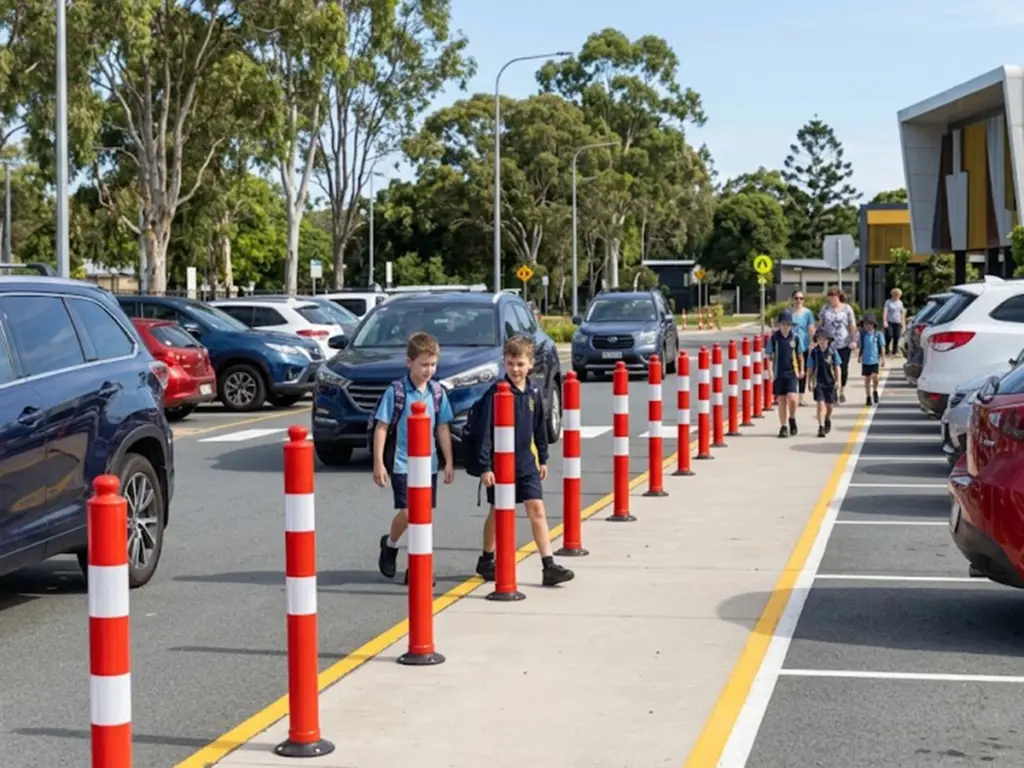
This is where school zone traffic management solutions move from paper compliance to physical protection. Our company supplies surface-mounted flexible and springback bollards exclusively. These impact-absorbing guide posts are engineered to flex on contact and rebound to a vertical. Rigid steel or concrete-embedded units, by contrast, transfer collision force straight back into a vehicle, or worse, a child.
Flexible bollards suited to school environments are typically built from UV-stabilised polymer over an internal flexible core. Manufacturers commonly finish them in high-contrast safety colours for day and night visibility. The flexible body is designed to rebound upright after impact, limiting damage to both the post and the vehicle. This construction is why flexible bollards sit at the centre of a child-friendly approach to school zone traffic management solutions. They absorb kinetic energy on contact instead of presenting a rigid obstacle. That distinction matters when a child, a cyclist or a scooter rider darts between parked cars.
The Child Safety Case for Impact-Absorbing Bollards
A rigid steel bollard does not move. On impact, the full force is either absorbed by the vehicle or deflected sideways. That is a real risk in a crowded Drop-and-Go zone where children may be standing metres away. A surface-mounted flexible bollard flexes under load and springs back into position instead. This lowers the chance a low-speed car park incident turns into a secondary hazard for a nearby pedestrian.
For transparency: flexible delineator bollards sit in a different category from crash-tested road safety barriers under Australian guidance. Bollards that have passed formal crash testing are classed as road safety devices.[8] Bollards without crash testing fall under “roadside furniture” instead. Flexible bollards are not a substitute for engineered barrier systems (governed by AS/NZS 3845) where heavy vehicles or high-speed kinetic energy absorption is required. Facilities managers should apply the Austroads Guide to Road Safety risk-assessment method: for internal areas where vehicle speeds are engineered to remain under 10-20 km/h (such as Drop-and-Go lanes), flexible ‘roadside furniture’ is ideal as it minimises secondary ricochet risks. However, for perimeter zones adjacent to public roads with speed limits exceeding 40 km/h, structural steel or energy-attenuating barriers must be deployed.
Surface-Mount Installation — No Concrete Excavation Required
Surface-mounted flexible bollards bolt directly onto existing asphalt or concrete via a baseplate.[9] Installation stays straightforward compared with in-ground alternatives. There is no excavation and no wet-concrete curing time. The car park can reopen for the next school day without disruption. For a facilities manager working within school holiday windows, this speed is often the deciding factor.
Springback Bollards QLD — Material Durability in Australian Climate
Queensland’s UV exposure and heat are demanding on outdoor polymer products. Specifying springback bollards, QLD schools can rely on long-term means of confirming UV-stabilised material that resists colour fade and cracking. Faded colour undermines the retroreflectivity and visibility standards that the bollard was installed to support in the first place.
As an end-to-end Australian traffic sign and safety hardware manufacturer, we offer bulk provisioning of flexible bollards with custom colour, height and branding. It’s a practical option for schools standardising Drop-and-Go zones ahead of QRSW. Request a bulk quote to lock in stock before the August rush.
Essential School Parking Lot Safety Supplies Beyond Bollards
School parking lot safety supplies extend beyond the bollard itself. A well-designed Drop-and-Go zone layers several product types to control both vehicle speed and pedestrian pathways.
Wheel Stops — Preventing Overrun into Pedestrian Zones
Wheel stops mark the physical limit of a parking bay. They stop a vehicle creeping forward into a walkway, covered pathway or building entry. This low-cost addition delivers high value near classroom entries and bus zones, where the overrun risk is highest.
Speed Humps and Cushions for Internal Car Park Traffic Calming
Internal car park speed humps sit in a different product category to public-road humps. They are profiled for very low-speed environments. Installation encourages drivers to slow instinctively as they approach a Drop-and-Go zone or a pedestrian crossing point within the site.
Delineators and Line-Marking for Clear Pedestrian Pathways
High-contrast line-marking, paired with delineator posts, visually separates pedestrian walking routes from vehicle circulation space. This is one of the simplest and most cost-effective school zone traffic management solutions available. It works best when combined with the physical bollard layer described above.
Some QRSW community events call for short-term traffic control too, such as roadside checks or pop-up safety displays near a school precinct. Our guidance on temporary traffic control equipment for community safety events covers certified cones and barriers suited to that specific use case.
Designing a Safer Drop-and-Go Zone Layout for QRSW Readiness
Signage, bollards, wheel stops and line-marking only work together if the layout reflects real traffic movement, not assumed movement.
Mapping High-Risk Conflict Points in Existing Car Park Layouts
Facilities managers should physically observe their own Drop-and-Go zone during a live peak period. Mark every point where a pedestrian path crosses a vehicle path. Blind spots near building exits, garden beds or portable classrooms are common. They are frequently overlooked in original car park design.
A Phased Bollard and Signage Rollout Plan Before QRSW
A practical rollout typically follows three stages. The first stage is a site audit against AS 1742.2 and AS/NZS 2890.1 benchmarks. Bollards and wheel stops go in next, installed during a school holiday window. A final signage and line-marking pass then finishes the job, timed to complete before QRSW begins in August.
Bulk Procurement, Standards Compliance, and Maintenance for QLD School Infrastructure
Procuring school zone traffic management solutions is rarely a one-off purchase for larger school groups. The equipment then needs to stay compliant year after year, not just for the week of the campaign.
Standardising Safety Equipment Across Multi-Campus School Groups
Diocesan and independent school groups managing several campuses benefit from standardising bollard colour, height and signage specification across every site. Consistent specification simplifies board-level reporting, spare-parts stock, and future maintenance contracts. Every campus then presents the same documented standard of care.
What to Request From Suppliers — Compliance Documentation and Warranties
Facilities managers preparing a procurement submission should request written confirmation of relevant Australian Standards alignment. Product warranty terms and material specification sheets matter just as much. This documentation is what a school board or P&C committee will expect attached to any capital works approval.
A Simple Pre-QRSW Inspection Checklist for Facilities Teams
| Inspection item | What to check |
| Baseplate bolts | Torque and corrosion on surface-mount fixings |
| Bollard body | Cracking, UV fade below acceptable colour contrast |
| Rebound function | Bollard returns fully upright after manual flex test |
| Signage retroreflectivity | Visible legibility at dusk/night under vehicle headlights |
| Wheel stops | Secure fixing, no displacement from the original position |
| Line-marking | Faded or worn paint on pedestrian delineation lines |
Knowing When to Replace vs Repair Surface-Mounted Bollards
A bollard with a cracked base should be replaced, not repaired. The same applies to a baseplate that no longer sits flush. A body that fails to rebound after a light manual test also needs replacing. These failure points compromise the child-friendly impact absorption for which the product was chosen in the first place. Schools in coastal or regional Queensland tend to see faster material wear from salt air and UV exposure. Our guide to durable roadside safety equipment for coastal and regional conditions covers the extra specification considerations for those sites.
Building a Long-Term Road Safety Strategy Beyond QRSW School Zone Requirements
A single QRSW campaign is only one checkpoint in a school’s broader duty of care. Queensland’s road safety programs show sustained, long-term investment in this space. A dedicated school infrastructure funding stream was launched in 2018. Since then, well over 140 school transport projects have been approved statewide.[10] More than 90 of those projects are already completed. Brisbane City Council alone has delivered enhanced school zone signage at 63 schools. The same program has added over 16 kilometres of new footpaths across 74 locations near local schools. Facilities managers who treat their car park layout as a living, annually reviewed system are best positioned to demonstrate genuine compliance. That matters if a car park incident is ever reviewed.
School zone traffic management solutions sit inside a much larger annual calendar of road safety activity across the state. This runs from National Road Safety Week through to QRSW and beyond. Want the broader picture? Explore our complete guide to Australia’s road safety events and traffic solutions, which covers Queensland’s year-round approach to road safety planning.
Frequently Asked Questions on School Zone Traffic Management Solutions
Are flexible springback bollards compliant with Australian Standards for school car parks?
Surface-mounted flexible bollards are typically specified with reference to AS/NZS 2890.1 (off-street parking layout) and AS 1742.2 (traffic control devices). Together, these govern placement, visibility and dimensions. They sit in the “roadside furniture” delineation category rather than the crash-tested AS/NZS 3845.2 barrier category. That is the right classification for low-speed, high-pedestrian school car parks.
What height and spacing are recommended for bollards in school Drop-and-Go zones?
Under general parking provisions (AS/NZS 2890.1:2004), visual guide posts require a minimum height of 900mm. However, for high-density pedestrian environments, standardising on 1000mm to 1300mm models provides optimal visibility over vehicle bonnets.
The technical logic for spacing them 1.5m to 2.0m apart is based on standard passenger vehicle widths (averaging 1.8m). A 1.5m clear aperture between posts physically prevents a standard vehicle from mounting the kerb or traversing into the pedestrian zone, while still allowing compliant clearance for wheelchairs, prams, and mobility scooters under AS 1428.1 clearance keys.”
Do surface-mounted bollards require council approval before installation?
Requirements vary by local government area and by bollard height. Facilities managers should confirm with their local council or DTMR contact before installation. This matters most for taller units or works affecting a public road frontage.
How long do flexible bollards last in Queensland’s climate?
Lifespan depends on material quality. UV-stabilised polymer resists the colour fade and cracking that Queensland’s sun and heat cause in lower-grade plastics. Service life extends well beyond standard outdoor products.
Can flexible bollards be customised with our school’s colours or crest?
Yes. Custom colour specification and branded signage are available for bulk school orders. This is a common request from facilities managers standardising appearance ahead of QRSW.
What’s the difference between a wheel stop and a bollard for car park safety?
A wheel stop is a fixed-point device that stops a parked vehicle creeping forward into a defined space. A bollard provides an ongoing vertical delineation line separating pedestrian pathways from vehicle circulation. The two work as complements, not substitutes.
References
- Department of Transport and Main Roads, Queensland Road Safety Education Blueprint
- Department of Transport and Main Roads, News and media frequently asked questions
- Department of Transport and Main Roads, School Transport Infrastructure Program
- Austroads, Safety Barrier Assessment Panel –Technical Advice: Bollards
- Ministerial Media Statements, Investing in school transport infrastructure and safety across the state
- Brisbane City Council, Safe roads around schools