Cross-border freight, multinational construction, and global engineering procurement all share one challenge. Global highway signage standards are not unified. A single haulage corridor can pass through three regulatory frameworks before reaching its destination. Specifiers who misread these jurisdictional boundaries face rejected installations, contract penalties, and liability exposure.
This pillar guide acts as a navigational hub and maps the major regulatory regions. It also shows where global highway signage standards converge — and where they diverge sharply. The stakes are real. In 2024, an estimated 39,345 people died on U.S. roads, according to NHTSA’s preliminary crash data (Source: https://www.nhtsa.gov/press-releases/nhtsa-estimates-39345-traffic-fatalities-2024). Effective signage saves lives. Compliant signage saves contracts.
Why Global Highway Road Signage Standards Matter for Compliance and Safety
Across every region, global highway signage standards drive three outcomes: safety, legal compliance, and procurement eligibility.
The Business Case for Understanding Jurisdictional Differences in Road Signs
B2B specifiers face direct commercial risk. A non-compliant panel on a federally funded U.S. project can void reimbursement. A non-CE-marked sign in the EU cannot legally enter service. Procurement teams managing multi-region tenders must read each jurisdiction’s rulebook before issuing specifications.
Cross-border haulage adds another layer. Drivers expect intuitive visual cues. Inconsistent global highway signage standards raise cognitive load and crash risk.
How Regulatory Frameworks Shape Specification and Procurement
Government road signage guidelines dictate everything downstream. Material grades, retroreflective sheeting class, dimensional tolerances, and mounting heights all flow from regulatory documents. Traffic control device standards are not aesthetic preferences. They are legal instruments.
International Road Sign Conventions and Harmonisation Frameworks
The Vienna Convention on Road Signs and Signals anchors most of the world’s global highway signage standards.
The Vienna Convention on Road Signs and Signals Explained
The 1968 UN treaty entered force in 1978. As of late 2025, 72 countries have ratified it. The treaty harmonises shapes, colours, and pictograms across signatories. Red triangles warn. Red circles prohibit. Blue rectangles inform.
In March 2025, the UNECE Global Forum for Road Traffic Safety (WP.1) adopted a major amendment proposal. The update modernises the treaty text, introduces a new sign numbering scheme, and addresses digital signage and autonomous vehicles.
Countries Operating Outside the Vienna Convention Framework
Several major economies sit outside the convention. The United States, Canada, Australia, and Ireland chose alternative frameworks. China, Japan, Israel, and Malaysia are also non-parties. These divergences shape regional road sign design specifications worldwide.
North American Road Signage Regulations and Compliance Standards
North America operates the largest non-Vienna framework. Its rules now sit at the centre of any global highway signage standards discussion.
MUTCD Compliance Standards in the United States
The Federal Highway Administration publishes the Manual on Uniform Traffic Control Devices. The 11th Edition took effect on January 18, 2024. States must achieve substantial conformance by January 18, 2026. The update introduced 213 new guide and regulatory signs. FHWA published Revision 1 on March 5, 2026.
Key changes include purple as a standard colour for managed lanes and tolling. Section 2A.22 retroreflectivity management remains a binding compliance pillar.
Canadian Road Signage Compliance Requirements and Provincial Variations
Canada follows the Transportation Association of Canada framework. Bilingual obligations apply across most provinces. Quebec enforces French-first signage. Alignment with the U.S. MUTCD is partial, not complete.
European Road Sign Regulations and Member State Compliance
Europe layers treaty law, EU directives, and CEN technical standards into a tightly governed framework. This shapes a distinct slice of global highway signage standards.
The European Union Regulatory Framework for Road Signage
EN 12899 governs fixed vertical road signs across the EU. CE marking has been mandatory since January 1, 2013, under Regulation (EU) No 305/2011 [8]. Manufacturers must complete Factory Production Control testing through a Notified Body before placing panels on the market.
Most EU member states are also Vienna Convention parties. The visual language is therefore broadly consistent. The compliance paperwork is not.
➡️Explore the Clusters:
A Complete Guide to Understanding UK Highway Road Signs
Notable Member State Variations in Regional Road Sign Design Specifications
Germany applies the Straßenverkehrs-Ordnung (StVO). France enforces the Instruction Interministérielle. The United Kingdom maintains the Traffic Signs Regulations and General Directions (TSRGD), which have diverged further since Brexit. These national codes overlay the EU baseline. Together, they create a road sign regulatory framework by country that demands close attention.
Asia-Pacific and Oceania Road Signage Standards
Asia-Pacific contains the widest divergence within global highway signage standards. Some nations adopt the Vienna principles. Others build entirely independent codes.
Australian Road Signage Compliance Under AS 1742
Australia operates the AS 1742 series. State and territory road authorities issue supplementary guidelines. Australian warning signs use a yellow diamond — visually closer to MUTCD than to the European triangle.
Comparative Road Sign Regulatory Frameworks in Japan, China, and India
Japan deploys unique pictograms outside the Vienna Conventions. China enforces GB 5768 as its national traffic control device standard. India applies IRC:67, with substantial state-level implementation variation. The comparative complexity is significant for export manufacturers.
Emerging and Regional Frameworks in the Middle East and Africa
These regions complete the global highway signage standards picture. Both feature growing infrastructure investment and rising specifier demand.
GCC Road Signage Standards and National Variations Across the Middle East
The Gulf Cooperation Council coordinates regional alignment. The UAE, Saudi Arabia, and Qatar each apply national supplements. Bilingual Arabic-English signage adds dimensional and legibility complexity.
African Regulatory Frameworks and the SADC-RTSM Standard
The Southern African Development Community Road Traffic Signs Manual governs ten countries. Many provisions echo Vienna. Some adapt to regional traffic patterns and rural conditions.
Comparing Global Standards: A Strategic Reference for Specifiers
This section synthesises the most visible differences across global highway signage standards for procurement leads.
Color Coding Variations Across Jurisdictions
| Sign Function | Vienna Convention | MUTCD (USA) | Australia (AS 1742) |
| Warning | Red triangle, white/yellow ground | Yellow diamond | Yellow diamond |
| Prohibition | Red circle, white ground | Red circle (limited) | Red circle |
| Mandatory | Blue circle | White rectangle, black text | Blue/white circle |
| Information / Guide | Blue or green rectangle | Green rectangle | Green/white rectangle |
| Managed Lanes / Tolling | Not specified | Purple (since 11th Ed.) | Not specified |
Shape, Symbol, and Dimensional Standards Compared
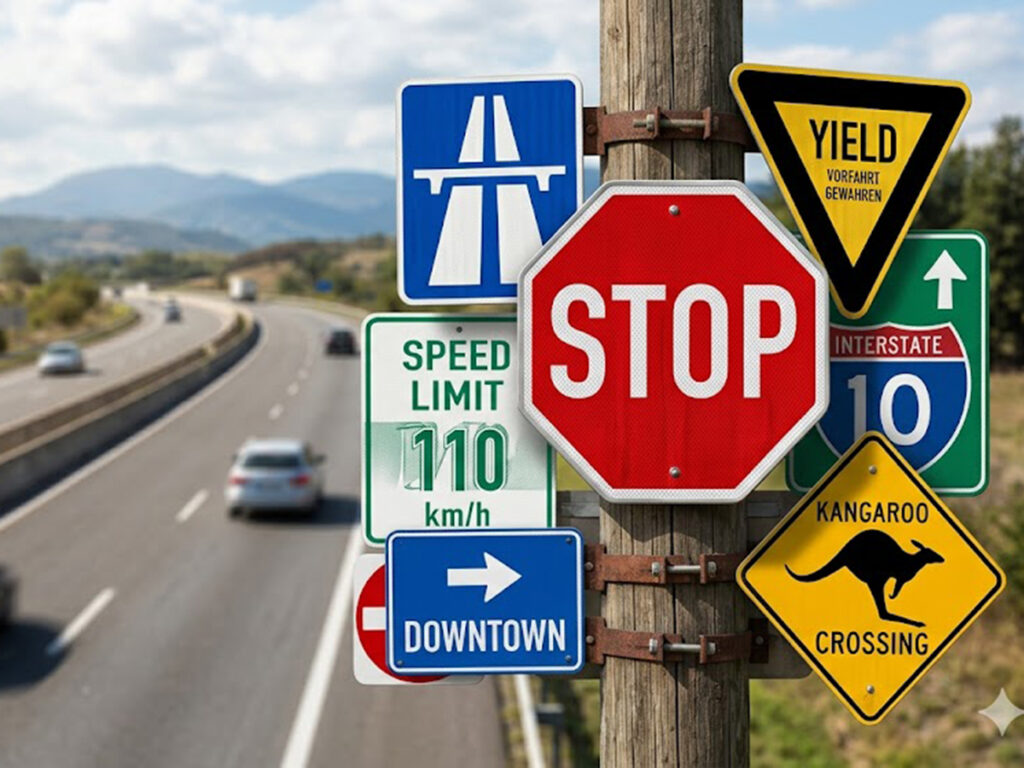
While the octagonal “STOP” sign is a rare global consensus, most highway signage is governed by distinct regional philosophies. For specifiers, understanding these technical divergences is critical to ensuring compliance and avoiding costly procurement errors:
- Pictograms vs. Text-Heavy Designs:
The Vienna Convention (EU/UK/Asia) prioritizes universal symbols to bypass language barriers, whereas the MUTCD (North America) often utilizes text-based instructions (e.g., “Yield” vs. the red-bordered inverted triangle). - Color-Coded Jurisdictional Logic:
Directional signage colors are not universal. While the US primarily uses Green for Interstates, many European and Middle Eastern regions use Blue for Motorways and Green for Primary/A-roads. Misidentifying these can lead to systemic installation failures. - Retroreflectivity & Material Standards:
A major technical hurdle is the divergence in sheeting performance. Specifiers must choose between ASTM D4956 (North American standards) and EN 12899-1 (European standards). These frameworks utilize different classification systems (e.g., Class 1, 2, 3 vs. RA1, RA2, RA3) for micro-prismatic performance and durability. - Dimensional & Font Tolerances:
The legibility of a sign at high speeds depends on local “Clearview” or “Transport” fonts and specific letter heights mandated by regional authorities (e.g., the UK’s TSRGD vs. Australia’s AS 1742).
💡Strategic Tip: For multi-region tenders, always establish the “Dominant Jurisdiction” early in the asset lifecycle. Retrofitting a sign to meet a late-identified EN or ASTM standard often carries a 3x cost multiplier compared to early-stage compliance.
2026 Compliance Snapshot: Why This Year Matters for Global Highway Signage Standards
Several regulatory deadlines converge in 2026. Specifiers face simultaneous transitions across multiple jurisdictions.
Active Regulatory Deadlines Affecting Global Procurement
| Region | Standard / Framework | 2026 Status |
| USA | MUTCD 11th Edition | State adoption deadline: January 18, 2026 |
| USA | MUTCD 11th Ed. Revision 1 | Published March 5, 2026 |
| EU | EN 12899 / CE marking | Mandatory since 2013, enforcement ongoing |
| Global | Vienna Convention amendments | Adopted March 2025, implementation 2026+ |
| Australia | AS 1742 series | Active, with state-level supplements |
Procurement and Specification Checklist for 2026
- Verify state DOT adoption status against the January 18, 2026 federal deadline.
- Confirm retroreflective sheeting grade against ASTM D4956 Type III or higher for U.S. projects.
- Audit EU-bound inventory for current EN 12899 CE marking and Declaration of Performance.
- Cross-check Vienna Convention amendments for any signage retired in the 2025 update.
- Document compliance evidence for every project tender.
Conclusion: Navigating Global Highway Road Signage Standards with Confidence
Global highway signage standards remain fragmented. They are also navigable. Treat compliance as a procurement function, not an afterthought. Map each project to its governing jurisdiction. Reference our cluster articles for granular technical detail.
For the complete technical foundation across specification, MUTCD compliance, procurement, and asset lifecycle management, return to our master resource: The Definitive Highway Road Signs Handbook.
References
- NHTSA Crash Stats — Early Estimate of Motor Vehicle Traffic Fatalities, 2024. https://crashstats.nhtsa.dot.gov/
- RINA — UNI EN 12899: CE Marking for Vertical Road Signs. https://www.rina.org/en/fixed-vertical-road-traffic-signs
- UNECE — Road Traffic and Road Signs and Signals Agreements and Conventions. https://unece.org/road-traffic-and-road-signs-and-signals-agreements-and-conventions
- FHWA — MUTCD 11th Edition Compliance Dates. https://mutcd.fhwa.dot.gov/
- FHWA — Standard Highway Signs Publication, February 2026 Release. https://mutcd.fhwa.dot.gov/ser-shs_millennium.htm
- FHWA — MUTCD News Feed (Revision 1, March 5, 2026). https://mutcd-dr.fhwa.dot.gov/mutcd_news.htm
- EUR-Lex — Regulation (EU) No 305/2011 on Construction Products. https://eur-lex.europa.eu/legal-content/EN/TXT/?uri=CELEX:32011R0305