A catalog sign reading “Eye Protection Required” satisfies OSHA’s posting threshold under 29 CFR 1910.145. A custom sign reading “Safety Glasses Required — Chemical Splash Hazard, ANSI Z87.1+ Rated — Post Contact, Flush Eyes 15 Minutes” communicates the hazard type, the required equipment class, and the emergency response action in a single posting. The gap between those two signs represents a gap in documented hazard communication — and a measurable difference in employer liability protection.
This article delivers a structured decision framework for procurement specialists evaluating whether custom PPE safety signs or standard off-the-shelf products are the correct specification for a given facility environment. For a complete reference, see the full compliance standards, materials, and placement rules.
What Standard Off-the-Shelf PPE Signs Guarantee — and What They Do Not
A standard off-the-shelf sign from a recognized supplier provides three documented guarantees: ANSI Z535.2 design compliance, OSHA 1910.145 posting compliance, and substrate durability certification for the listed material type.
What a standard sign does not guarantee is hazard accuracy, equipment specificity, or workforce language accessibility — three conditions that determine whether a sign provides adequate hazard communication under US law.
The Three Compliance Gaps That Standard Catalog Signs Cannot Close
Equipment class specification: A sign reading ‘Respirator Required’ does not specify whether NIOSH P100 filtering, a half-face respirator, or SCBA is required. In environments where the consequence of the wrong equipment choice is chemical exposure or death, that omission is a documented hazard communication failure.
Hazard consequence communication: ANSI Z535.2 recommends stating the consequence of non-compliance for DANGER and WARNING level hazards. Catalog signs rarely include this element, weakening the documented case for adequate hazard communication during OSHA inspections.
Workforce language accessibility: OSHA’s General Duty Clause (Section 5(a)(1) of the OSH Act) requires employers to protect workers against recognized hazards. Where a significant portion of the workforce cannot read English-only signage, posting English-only catalog signs may not constitute adequate hazard communication under this clause.
When to Use Custom PPE Signage — A Decision Framework for Procurement
The custom vs. standard decision is not a preference question. It is a compliance and risk management question with objective criteria. The following framework maps facility conditions to defensible sign specifications.
| Condition | Standard Sign Sufficient | Custom Sign Required |
| Generic single-category PPE requirement | √ | — |
| Catalog language accurately matches the hazard | √ | — |
| English-literate workforce only | √ | — |
| Compatible deployment environment | √ | — |
| Requires equipment CLASS specification | — | √ |
| Multilingual workforce, no bilingual program | — | √ |
| Post-incident or post-citation documentation need | — | √ |
| Facility layout or process has changed | — | √ |
| Multi-site standardisation required | — | √ |
| SOP, SDS cross-reference, or QR code needed | — | √ |
Source: https://www.osha.gov/laws-regs/regulations/standardnumber/1910/1910.145
Conditions Where Standard Signs Meet the Compliance Threshold
Standard signs satisfy OSHA 1910.145 and ANSI Z535.2 simultaneously when the hazard is a single-category PPE requirement, the catalog language accurately matches the specific hazard, the workforce reads English, the substrate suits the deployment environment, and the signal word correctly represents hazard severity.
Six Triggers That Require Custom PPE Signs Instead
- Equipment class specificity: The hazard requires naming a specific PPE standard (e.g., ANSI Z87.1+, NIOSH P100, ANSI/ISEA 105 Level 4).
- Multilingual workforce: A documented non-English-speaking workforce with no separate bilingual hazard communication program.
- Post-incident or post-citation documentation: A prior OSHA citation or near-miss event creates a liability record demanding higher specificity.
- Facility or process changes: Layout or process modifications that render the existing catalog sign language inaccurate.
- Multi-site standardisation: Enterprise-wide zone identifiers, facility codes, or operational instructions that no catalog sign accommodates.
- SOP, SDS, or QR code cross-reference: The sign must link to a specific procedure, permit, or safety data sheet.
Industry-Specific Use Cases for Custom PPE Safety Signs
Chemical Processing and Manufacturing
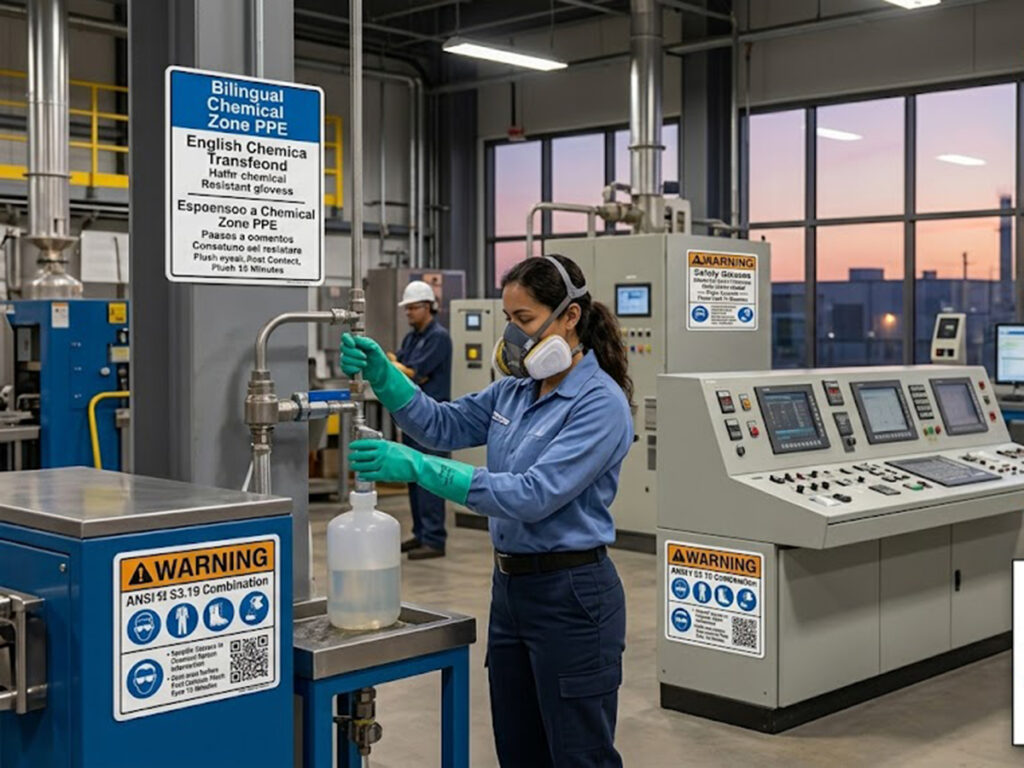
Facilities handling multiple chemical hazard classes require zone-specific signs naming the chemical class, the required PPE standard, and the emergency response action. OSHA’s updated Hazard Communication Standard (HazCom), effective July 19, 2024, and phased through 2026–2028, requires employers to align workplace labelling with GHS Revision 7. Custom PPE safety signs that reference updated SDS station locations and specific chemical identifiers help satisfy this phased compliance obligation.
Construction Sites Post-2025 OSHA PPE Rule
The OSHA Final Rule, effective January 13, 2025 (29 CFR 1926.95(c)), explicitly requires that all construction PPE ‘properly fit each affected employee.’ Custom PPE safety signs that reflect this updated language — specifying that properly fitting, size-appropriate equipment is mandatory — provide stronger documented hazard communication than generic catalog signs that reference only equipment category.
Manufacturing Facilities With Multilingual Workforces
OSHA’s General Duty Clause requires hazard communication to reach all workers, regardless of language. Bilingual custom PPE signs — English primary, Spanish or other language secondary — are fully permitted under ANSI Z535.2, which allows supplementary text panels without altering ANSI compliance. DuraLabel guidance notes that ANSI multilingual sign layouts position a shared pictogram symbol panel to serve both language panels simultaneously.
ANSI Z535 Design Boundaries — What Can and Cannot Be Customized
ANSI Z535.2 governs customization within strict design boundaries. Suppliers accepting briefs requesting non-standard header colors or unapproved signal words produce non-compliant product regardless of their claimed compliance status. Procurement specialists must verify these boundaries before approving any custom PPE sign production run.
| Fixed — Cannot Customise | Customisable Within ANSI Z535.2 |
| Signal word (DANGER / WARNING / CAUTION / NOTICE / SAFETY INSTRUCTION) | Message panel text — hazard-specific language |
| Header panel color (Pantone-specified by signal word) | Supplementary safety instruction panel |
| Safety Alert Symbol (triangle + !) | Bilingual or multilingual text |
| Symbol panel colors (black on white only) | Zone / facility identifiers, permit numbers |
| Layout proportions between panels (per ANSI Z535.2 Annex) | QR codes or SDS cross-references |
| Sign dimensions (above ANSI Z535.2 Annex A minimums) | |
| Substrate material and gauge |
Fixed Elements — The Non-Negotiable ANSI Z535 Design Parameters
The five fixed elements are: signal word (one of five approved ANSI terms only), header panel color (Pantone-specified exclusively by signal word), Safety Alert Symbol (triangle + exclamation mark, mandatory for DANGER / WARNING / CAUTION), symbol panel colors (black on white only under ANSI Z535.3), and layout proportions between panels (governed by ANSI Z535.2 Annex tables). Corporate branding colors cannot override the Pantone specifications. Non-standard signal words, such as facility-internal hazard tier names, are compliance violations.
Customisable Elements — What Procurement Can Legitimately Specify
Seven elements permit customisation within compliance bounds: message panel text with hazard-specific language, supplementary safety instruction panels, bilingual or multilingual content, zone or facility identifiers, QR codes or SDS cross-references, sign dimensions above ANSI Z535.2 Annex A minimums, and substrate material and gauge selection.
⚠️Procurement Warning: Request a digital design proof before approving any production run. Verify Pantone color accuracy — particularly for WARNING orange (Pantone 152C), which has a lower contrast ratio than DANGER red or CAUTION yellow and is most vulnerable to print deviation.
Writing Compliant Custom PPE Sign Text — The Four-Element Specification Framework
Most procurement failures in custom signage occur not in design elements — which reputable suppliers manage correctly — but in message text, which the purchasing organisation writes. The four-element framework below produces message panel text that satisfies OSHA 1910.145, ANSI Z535.2, and OSHA’s Hazard Communication Standard (29 CFR 1910.1200) simultaneously.
Element 1 — Hazard Identification
State the specific hazard present, not the generic category. OSHA 29 CFR 1910.1200 requires hazards to be ‘clearly and accurately identified.’ Example: ‘Hydrofluoric Acid Present’ rather than ‘Chemical Hazard.’
Elements 2–4 — Equipment Specification, Consequence, and Avoidance Action
- Element 2 — Required PPE specification: Name the standard and class. Example: ‘Chemical-Resistant Gloves Required — ANSI/ISEA 105 Level 4 Minimum.’
- Element 3 — Consequence of non-compliance (DANGER/WARNING level hazards): Example: ‘Skin Contact Will Cause Severe Chemical Burns.’
- Element 4 — Avoidance or emergency action: Example: ‘Flush Affected Area with Water for 15 Minutes — See SDS Station 4-B.’
Before / After Text Comparison
| PPE Category | Standard Catalog Text | Compliant Custom Sign Text |
| Eye Protection | Eye Protection Required | Safety Glasses Required — Chemical Splash Hazard, ANSI Z87.1+ Rated — Post Contact: Flush Eyes 15 Minutes |
| Respiratory Protection | Respirator Required | Half-Face Respirator Required — NIOSH P100 — Acid Vapor Present — See SDS Station 3-B |
| Hearing Protection | Hearing Protection Required | Hearing Protection Required — Noise Level Exceeds 95 dB — ANSI S3.19 Rated Earmuffs Minimum NRR 25 |
| Hard Hat | Hard Hat Required | Hard Hat Required — Properly Fitting PPE Mandatory (29 CFR 1926.95(c)) — Type II Class E Minimum |
| Chemical Gloves | Gloves Required | Chemical-Resistant Gloves Required — ANSI/ISEA 105 Level 4 — Hydrofluoric Acid Present |
Cost Analysis — Custom vs. Standard PPE Signs: A Total Cost of Ownership Analysis
The financially rational procurement decision compares the total cost of ownership, not per-unit price. A facility saving $15–$30 per sign by choosing standard signs in an environment requiring custom specification faces $16,550 minimum per OSHA serious violation citation (2025 rate) if that specification gap generates a citation. Willful or repeated violations reach $165,514 per violation.
Per-Unit Pricing Benchmarks for the US Market
| Cost Type | Standard Signs | Custom Signs |
| Per-unit retail (10″×14″ aluminum) | $12–$30 | $20–$80+ |
| Per-unit volume (50+ units) | $6–$18 | $15–$45+ |
| Setup/design charge | None | $25–$75 per design |
| Minimum viable run | 1 unit | 5–10 units typically |
| OSHA citation risk (inadequate spec) | Workers’ comp/litigation exposure | Lower |
| Serious violation penalty (2025) | Up to $16,550/violation | Up to $16,550/violation |
| Workers’ comp / litigation exposure | Higher | Lower |
Source: https://www.osha.gov/penalties
The True Risk-Adjusted Cost of Choosing the Wrong Option
The per-unit premium for a custom PPE sign versus a standard catalog sign typically runs $8–$50 per sign, depending on material, quantity, and design complexity. A single OSHA serious violation citation for inadequate hazard communication in a zone covered by that sign costs $16,550 minimum — an amount that represents the procurement savings from approximately 330–2,000 signs. Workers’ compensation claims arising from incidents at inadequately signed hazard zones consistently exceed $40,000 per claim. The custom sign premium is not a cost. It is an insurance mechanism with a documented positive return on investment.
The Procurement Specification Checklist for Custom PPE Safety Signs
Apply this 11-point checklist before approving any custom PPE sign order. Each point represents a quality control gate that protects the purchasing organisation from receiving non-compliant product.
Pre-Order Specification Requirements
Confirm signal word selection against ANSI Z535.2 hazard severity criteria — document the decision and the hazard assessment that drove it.
- Specify header panel color by Pantone reference — e.g., ‘WARNING header: Pantone 152C’ — not by name or hex code.
- Confirm substrate material specification: minimum gauge or thickness, UV stability rating, surface finish, and mounting compatibility.
- Confirm sign dimensions meet ANSI Z535.2 Annex A viewing distance requirements for the intended deployment location.
- Specify all message panel text using the four-element framework: hazard identification, required PPE standard/class, consequence, and avoidance/emergency action.
- Specify bilingual requirements: primary language, secondary language, and confirm ANSI Z535.2 compliance for supplementary panel placement.
- Request a digital design proof before production approval — verify Pantone color accuracy against a reference standard.
Supplier Qualification Requirements
Require written ANSI Z535.2 compliance certification with the specific edition referenced (current edition: ANSI Z535.2-2023).
- Request UV stability test data for any outdoor substrate.
- Confirm the supplier’s policy on replacement of non-conforming product — at no cost to the purchaser.
- For large volume orders, request a pre-production physical sample for Pantone colour verification before the full production run.
Building a Defensible Custom Signage Decision Record for Long-Term Compliance
The decision between custom workplace PPE signs and standard off-the-shelf signs is not a preference. It is a consequence-based compliance assessment with objective criteria. When catalog language accurately communicates the specific hazard, the required equipment, and the severity of non-compliance consequences, standard signs meet the legal threshold. When any of those three conditions are unmet, custom signs are both the compliant choice and the risk-managed choice.
Procurement specialists should document this decision as part of the facility’s hazard communication program. That documentation — recording the hazard assessment, the sign specification decision, and the ANSI Z535.2 compliance verification — transforms a procurement action into a demonstrable proactive compliance record that protects the organisation during inspections and litigation.
Frequently Asked Questions — Custom PPE Safety Signs
Q: Can custom PPE safety signs be OSHA-compliant?
Yes. Custom PPE safety signs are fully OSHA-compliant when designed in accordance with OSHA 29 CFR 1910.145 and ANSI Z535.2. The mandatory fixed elements — signal word, header color, and Safety Alert Symbol — must conform precisely to ANSI specifications. The message panel text, supplementary instructions, and bilingual content may be customized within the layout constraints ANSI Z535.2 establishes.
Q: What is the difference between a custom PPE sign and a standard catalog sign?
A standard catalog sign uses pre-printed generic hazard language designed for broad applicability. A custom PPE sign specifies the exact hazard present, the required PPE class or standard, and, where hazard severity warrants it, the consequence of non-compliance and the emergency response action. Custom signs provide stronger hazard communication documentation, which is material evidence in OSHA inspections and personal injury litigation.
Q: Does ANSI Z535 allow customization of safety sign text and layout?
ANSI Z535.2 permits customization of message panel text, supplementary information panels, bilingual content, sign dimensions above the standard minimums, and substrate material. It does not permit modification of the signal word, header panel color, Safety Alert Symbol, or symbol panel colors. Suppliers who accept briefs requesting non-standard header colors or unapproved signal words are producing non-compliant product.
Q: When should a facility use custom PPE signs instead of standard off-the-shelf signs?
A facility should specify custom PPE safety signs when the hazard specificity, required equipment class, or workforce language profile cannot be accurately communicated by catalog language. Key triggers include: environments handling identifiable chemical hazards (especially post-HazCom 2024 updates), facilities requiring equipment class specification beyond generic categories, multilingual workforces without separate bilingual hazard communication programs, post-incident documentation requirements, and multi-site operations requiring standardised zone identifiers.
Q: Are bilingual PPE signs ANSI Z535 compliant?
Yes. ANSI Z535.2 permits bilingual or multilingual text in the supplementary message panel without altering the sign’s ANSI compliance. The primary signal word must remain in English. The secondary language content appears below the primary message panel. Multilingual sign layouts position a shared safety pictogram symbol panel to serve both language panels simultaneously, consistent with ANSI Z535.3 symbol requirements.
Related articles in this series
Pillar:
PPE Signs: The Complete Guide to OSHA Compliance, Materials, Placement & Procurement
Clusters:
Complete Guide to Procuring PPE Signage
How Bulk PPE Required Signs Procurement Can Save Your Company Money
Compliant Printable PPE Signs vs. Cheap Imitation: A Side-by-Side Breakdown for Procurement
References
- OSHA 29 CFR 1910.145 — Specifications for Accident Prevention Signs and Tags — https://www.osha.gov/laws-regs/regulations/standardnumber/1910/1910.145
- OSHA General Duty Clause — Section 5(a)(1) of the OSH Act — https://www.osha.gov/laws-regs/oshact/section5-duties
- OSHA Final Rule: PPE Fit Requirements in Construction, 29 CFR 1926.95(c) — Federal Register, Dec 12 2024 — https://www.osha.gov/laws-regs/federalregister/2024-12-12
- OSHA 2025 Civil Penalty Amounts (effective Jan 15 2025) — https://www.osha.gov/penalties
- OSHA Hazard Communication Standard (HazCom) — 29 CFR 1910.1200 — https://www.osha.gov/hazcom
- Morgan Lewis — OSHA Extends HazCom Compliance Deadlines (January 2026) — https://www.morganlewis.com/pubs/2026/01/more-time-to-comply-osha-pushes-back-hazard-communication-deadlines-by-four-months
- FY2024 Top 10 Most Cited Standards — https://www.osha.gov/data/commonstats