Why ‘Good Enough’ Signage Is a Procurement Liability, Not a Savings
Procurement specialists in the industrial and safety sector face a deceptively simple choice every day: order professionally manufactured, compliant printable PPE signs or cut costs with cheap, office-printed alternatives. The difference looks minor on a purchase order. It rarely stays minor. A single OSHA willful-violation citation carries a penalty of up to $16,131 per violation as of 2026 — a figure the Bureau of Labor Statistics wage tracker confirms has risen with annual inflation adjustments. (Source: https://www.osha.gov/penalties)
Workplace injuries tied to inadequate safety communication remain a persistent problem. The Bureau of Labor Statistics reported 2.8 million nonfatal workplace injuries and illnesses in 2023, the most recent full-year dataset available, with exposure to harmful substances or environments accounting for a significant share of preventable incidents. (Source: https://www.bls.gov/news.release/osh.nr0.htm)
This article breaks down the technical, regulatory, and financial differences between compliant and non-compliant printable PPE safety signs — section by section, spec by spec. Procurement teams building a comprehensive PPE safety signage program should treat the regulatory framework below as the operational baseline for every signage decision.
What OSHA and ANSI Standards Actually Require From Any Printable PPE Sign
Most procurement teams know OSHA governs workplace safety. Few know the precise code sections that apply to printable PPE signs — and that gap is where cheap alternatives quietly create compliance exposure.
OSHA 29 CFR 1910.145 — The Baseline
OSHA 29 CFR 1910.145 sets the foundational specification for accident prevention signs. It mandates strict color assignments: Danger signs must use Safety Red (PMS 186C), white, and black only. Caution signs require a Safety Yellow background (PMS 109C) with a black panel. An office printer operating in uncalibrated sRGB cannot reliably reproduce these Pantone values.
ANSI Z535.2 — The Design Standard OSHA References
OSHA defers to ANSI Z535.2 for design specifics. ANSI Z535.2 establishes the signal word hierarchy — DANGER, WARNING, CAUTION, NOTICE, SAFETY INSTRUCTION — and prescribes minimum symbol panel ratios and header-to-message proportions. A high-quality printable PPE safety sign must satisfy this hierarchy. A sign that uses incorrect signal word placement violates ANSI Z535.2 even if the color is correct.
The General Duty Clause Risk
OSHA Section 5(a)(1) — the General Duty Clause — allows OSHA inspectors to cite employers for hazards not covered by a specific standard. A sign that violates ANSI Z535 design requirements, even without a direct OSHA rule citation, qualifies as a recognized hazard under this clause. This is the compliance trap, cheap printable PPE signs set for procurement teams who focus only on cost.
Compliant Printable PPE Safety Signs vs. Cheap Alternatives: A Spec-by-Spec Breakdown
Color Accuracy — The First Failure Point
ANSI Z535.1 mandates Safety Red at CMYK 0-100-75-4 and Safety Yellow at CMYK 0-9-100-0. Standard inkjet and laser printers operate in sRGB and cannot hit PMS targets without color-profiled substrates. Compliant PPE sign printing standards require Delta-E color variance below ΔE 2.0. Cheap printable alternatives routinely measure ΔE above 5.0 — a difference visible to the naked eye under industrial lighting conditions.
Symbol and Pictogram Accuracy
ISO 7010 and ANSI Z535.3 prescribe exact pictogram geometry. ANSI Z535.2 Annex A provides the viewing-distance sizing formula: 1 inch of letter height per 50 feet of viewing distance. A sign with 1-inch text becomes illegible beyond 50 feet. Free downloadable templates rarely apply this formula — and an illegible sign is an OSHA deficiency under 29 CFR 1910.145(f)(3).
Side-by-Side Comparison Table
| Specification | Compliant Printed PPE Sign | Cheap Printable Alternative |
| Color Standard | PMS/CMYK calibrated to ANSI Z535.1 | Uncalibrated RGB output |
| Color Variance (ΔE) | < 2.0 | Often > 5.0 |
| Substrate | Aluminum, rigid PVC, or laminated polyester ≥ 4 mil | Standard 20–28 lb copy paper |
| UV Resistance | 3–7 year outdoor rating | Fades within 30–90 days |
| Chemical Resistance | Vinyl overlay or hard laminate | None — ink degrades on contact |
| Pictogram Source | ISO 7010 / ANSI Z535.3 certified | Clip art / unverified templates |
| Minimum Sign Size | Calculated per ANSI Z535.2 Annex A | No standardized sizing applied |
| Legibility at 20 ft | Verified | Often fails |
| Compliance Docs | Supplier cert available | None |
| OSHA Citation Risk | Low | High |
| Estimated Lifespan | 3–10 years (substrate dependent) | Weeks to months |
Why the Material You Print On Determines Whether Your PPE Sign Passes or Fails Inspection
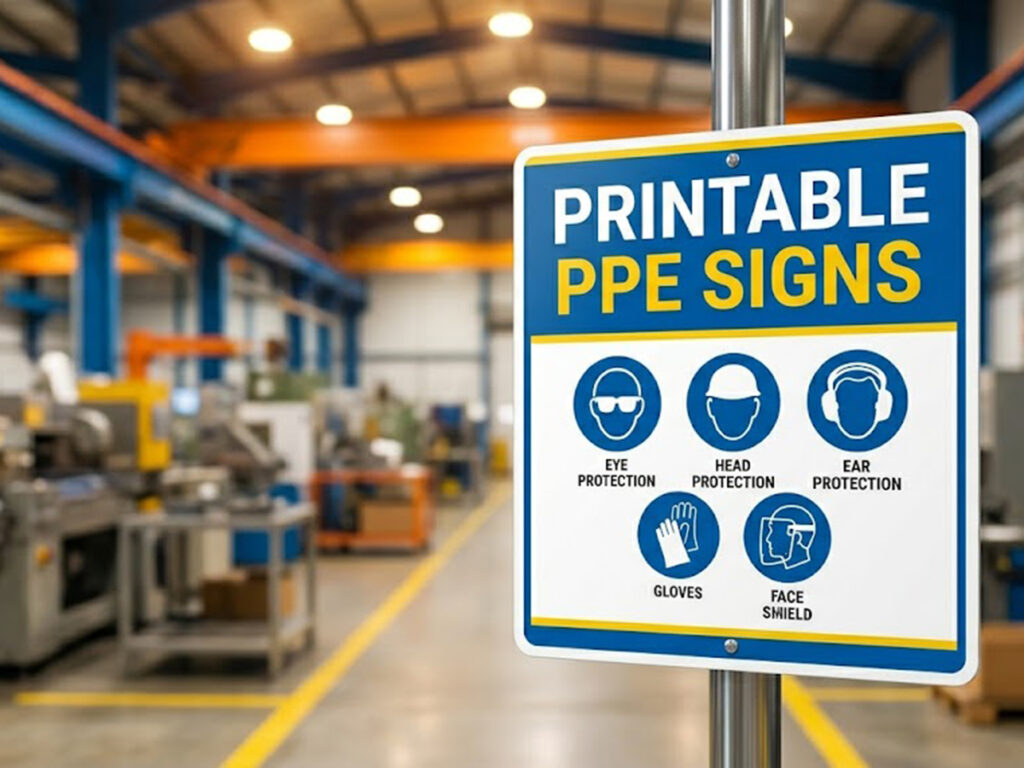
Material specification is where bulk PPE signs procurement decisions either hold up or collapse under inspection. The substrate determines durability, chemical resistance, and UV longevity — and OSHA inspectors evaluate all three.
Approved Substrate Hierarchy
- Aluminum (.040″ and .063″ gauge): OSHA preferred for permanent installations. Meets ASTM B209. Required for chemical exposure zones. Corrosion-resistant with stainless steel fasteners.
- Rigid PVC / Foamex (3mm–6mm): Acceptable for interior manufacturing floors. Not rated for continuous UV or chemical splash environments.
- Adhesive-backed polyester (3–4 mil, laminated): Acceptable for secondary surface applications — machinery, lockers, equipment. Requires hard laminate overlay for full ANSI compliance.
- Paper (any weight): Acceptable only for temporary construction signage under OSHA 1926.200. Explicitly unacceptable as permanent printable PPE signs in any ongoing hazard zone.
Ink Technology — The Hidden Variable
The ink system determines whether a printable PPE sign survives its environment. UV-cured ink — the standard for compliant professional printing — is outdoor-rated, chemical-resistant, and required for permanent OSHA-compliant signage. Solvent-based ink handles 3–5 year outdoor applications. Aqueous ink, the default output of standard office printers, has no chemical resistance and is indoor-only. It is the primary failure mode in cheap printable PPE safety signs used in industrial environments.
How to Ensure Your Printed PPE Signs Pass OSHA Inspection the First Time
Passing a first-attempt OSHA inspection requires more than purchasing compliant printable PPE signs. Installation precision and documentation are equally critical. Inspectors measure and record — procurement teams that provide contractors with these specifications avoid rework.
Placement Calculations Inspectors Actually Check
- Mounting height: Bottom of sign minimum 7 feet AFF (above finished floor) in pedestrian zones, per OSHA 1910.145 and ANSI Z535.2 Section 8.
- Viewing distance rule: For every 1 inch of letter height, the sign provides 50 feet of legible viewing distance. Inspectors measure this actively.
- Approach-side installation: Signs must be visible from the direction of approach to the hazard — not installed parallel to foot traffic or behind structural obstructions.
- Minimum illumination: 5 foot-candles at the sign face per OSHA 1910.303(b)(1) in electrically designated zones. Photoluminescent backing is required where emergency egress intersects PPE zones.
Fastening and Surface Requirements
- Aluminum signs in corrosive environments require stainless steel fasteners only. Galvanic corrosion from mismatched metals is a cited deficiency.
- Adhesive-backed signs require a clean, dry, primed surface. Adhesive failure in high-humidity or chemical environments constitutes an OSHA deficiency.
- No adhesive-only mounting in OSHA Class I hazard zones — mechanical fastening is mandatory.
First-Inspection Documentation Checklist
- Sign color verified against PMS/ANSI Z535.1 swatch
- Viewing distance calculation documented per sign location
- Mounting height recorded — ≥7 ft AFF confirmed
- Substrate and laminate specifications on file from the supplier
- Approach-side installation confirmed
- Illumination level at the sign face was measured and logged
- Supplier compliance certification in the procurement file
The Real Procurement Math: Why Cheap Printable PPE Signs Cost More Over Time
The sticker price of cheap printable PPE signs rarely survives contact with a total cost of ownership model. Procurement specialists who present TCO analysis to finance stakeholders almost always win the compliance investment argument.
Direct Cost Comparison — 5-Year Horizon
| Cost Factor | Compliant Sign | Cheap Printable |
| Unit Cost | $8 – $35 | $0.10 – $2.00 |
| Replacement Frequency | Every 5–10 years | Every 3–12 months |
| 5-Year Replacement Cost | $8 – $35 | $0.60 – $24.00+ |
| Labor to Replace (installs) | 1× | 4–20× |
| OSHA Fine Exposure | Minimal | Up to $16,131/violation |
| Incident Liability Exposure | Low | Elevated |
| True 5-Year Cost Per Sign (est.) | $15 – $50 | $300–$500+ (with 1 citation) |
Source: https://www.osha.gov/penalties
Bulk Procurement Volume Thresholds
The breakeven point for professional printable PPE signs vs. in-house printing typically falls between 25 and 50 signs once substrate, ink, laminator, and labor costs are factored in. Above 100 units, professional compliant printing is almost always cheaper on a per-unit TCO basis. Procurement teams managing multiple facilities should negotiate blanket purchase orders with standardized SKUs to lock in both price and compliance consistency. For a deeper analysis of the financial benefits, procurement teams can see how bulk PPE required signs procurement can save your company money by offsetting the initial investment with long-term durability.”
How to Qualify a PPE Sign Printing Vendor Before You Issue a Purchase Order
Vendor qualification prevents compliance gaps before they reach the facility floor. Procurement specialists should require answers to these five questions before issuing any PO for printable PPE signs:
- Can the vendor provide color calibration documentation confirming ΔE < 2.0 for ANSI Z535.1 safety colors?
- What substrate options are available, and which carry outdoor or chemical-environment ratings?
- Do pictograms conform to ISO 7010 or ANSI Z535.3, and are source files available for review?
- What quality control process applies to bulk orders across multiple SKUs?
- Does the vendor provide a certificate of compliance or a material data sheet per order?
Red Flags in Vendor Evaluation
- No mention of ANSI or OSHA compliance on product pages
- “Customizable” templates with no color-calibration guarantee
- No substrate specifications listed or available on request
- No compliance documentation available per order
Procurement teams managing long-term bulk safety sign sourcing and vendor qualification strategies should build these criteria directly into RFQ templates and supplier qualification scorecards.
Compliance Is the Floor, Not the Ceiling — A Procurement Decision Framework
The price gap between cheap printable PPE signs and professionally manufactured, compliant alternatives narrows dramatically when substrate costs, replacement cycles, labor, and citation risk enter the model. Procurement specialists who establish clear vendor qualification criteria, specify substrates in every PO, and document compliance create organizations that pass first-attempt inspections — and absorb zero preventable citation costs.
A three-step framework anchors this approach:
- Audit existing signage against ANSI Z535.2 and OSHA 29 CFR 1910.145 specifications
- Qualify vendors using the five-question RFQ framework from Section 6
- Standardize across facilities with blanket POs that include compliance documentation requirements built into the contract language
Procurement teams building a full signage compliance program — from material selection through placement audits — will find the complete regulatory and operational framework in our industrial PPE safety sign procurement and compliance guide.
Frequently Asked Questions About Printable PPE Signs
Are printable PPE signs OSHA compliant?
They can be — but only if they satisfy OSHA 29 CFR 1910.145 and ANSI Z535.2 design standards. The printing method, substrate, color accuracy, and pictogram source all determine compliance. A paper printout from an uncalibrated office printer is almost never compliant for permanent PPE zone signage.
What material should printable PPE signs use for industrial applications?
For permanent indoor use, the minimum specification is rigid PVC (3mm) or aluminum (.040″). Outdoor or chemical-exposure environments require .063″ aluminum with UV-resistant ink and a 3 mil overlaminate. Paper qualifies only for temporary construction signage under OSHA 1926.200.
Can free downloadable templates produce compliant printable PPE signs?
Not reliably. Most free templates use unverified clip art, uncalibrated RGB colors, and incorrect signal word hierarchies. Unless the template explicitly cites ANSI Z535.2/Z535.3 compliance and is printed on a calibrated system to an approved substrate, it creates OSHA citation exposure.
How often should printable PPE signs be replaced?
Compliant signs on aluminum or rigid PVC typically last 5–10 years indoors and 3–7 years outdoors. Signs printed on unapproved substrates can degrade within weeks under industrial conditions. A faded or illegible sign is itself an OSHA violation under 29 CFR 1910.145(f)(3).
What is the minimum size for a compliant printable PPE sign?
ANSI Z535.2 Annex A specifies 1 inch of letter height per 50 feet of viewing distance. The full sign panel must also include the signal word header, symbol, and message panel at proportional ratios. Size is not a single fixed number — it depends on where the sign is installed and the required viewing distance.
Related articles in this series
Pillar:
PPE Signs: The Complete Guide to OSHA Compliance, Materials, Placement & Procurement
Clusters:
How Bulk PPE Required Signs Procurement Can Save Your Company Money
Complete Guide to Procuring PPE Signage
References: