
Construction signs look different in different countries — not just in the words they use, but in their fundamental shape and background color. A procurement manager who orders work zone signs without specifying shape or color is not writing a procurement specification. In the United States, construction signs that warn drivers of road work ahead are orange diamonds. In the United Kingdom, the equivalent warning signs are white equilateral triangles with a red border. These two formats share no visual characteristics. A pallet of MUTCD-compliant orange diamond road construction signs delivered to a UK roadworks project fails TSRGD 2016 on both shape and color. Every sign must be returned.
This guide explains the shape and color system each market uses for construction signs and temporary traffic signs, why the systems differ, and what a procurement specification must include to be unambiguous across markets. The UK’s yellow-background roadworks boards — a common source of confusion — are also explained in their correct context: they are a distinct sign category, not a replacement for warning triangles.
How to use this guide: Specifying construction signs for a single market? Go directly to Part 2 (USA), Part 3 (UK), or Part 4 (Australia/GCC). Ordering for multiple markets? Part 5 (procurement decision matrix) tells you whether one product works across markets — and when you need separate SKUs. Part 7 (common errors) is essential reading before placing any international work zone sign order.
Part 1: Two Separate Sign Standards Systems — Why Shape Matters
The difference between US and UK construction signs traces to two separate regulatory frameworks that developed independently before either influenced the other.
1.1 MUTCD: Orange Diamonds Unify the US Work Zone
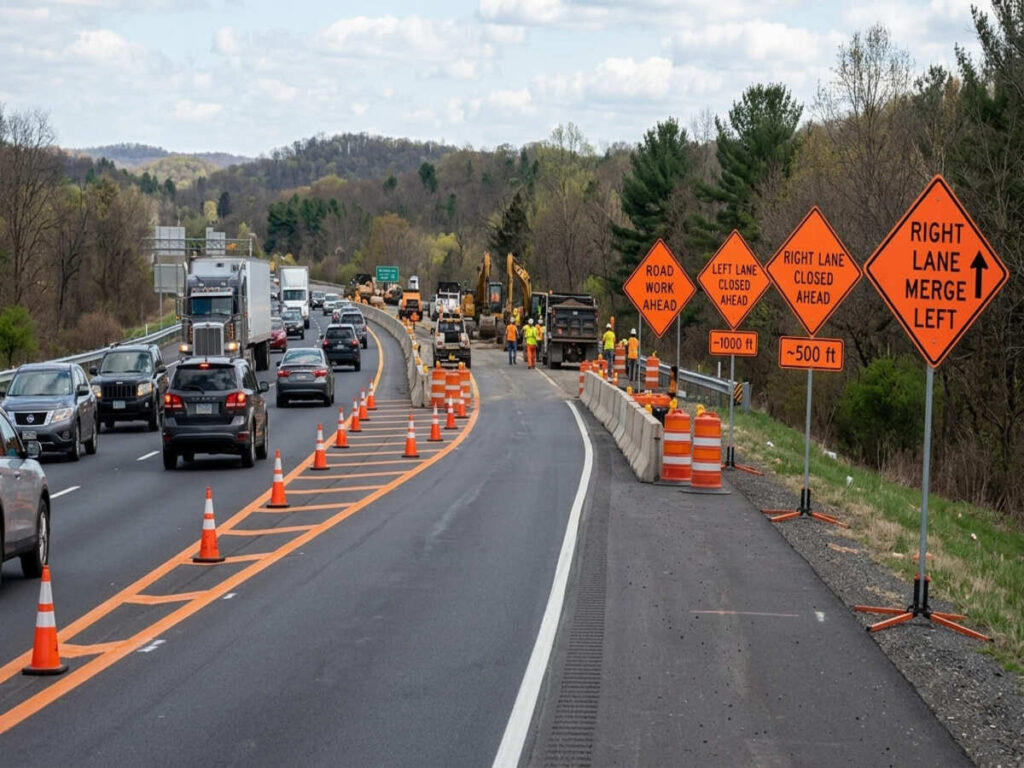
The Manual on Uniform Traffic Control Devices (MUTCD), published by the Federal Highway Administration, assigns orange as the exclusive background color for all temporary traffic signs, work zone signs, and road construction signs in the United States. Diamond shape (a square rotated 45°) carries all advance warning signs for work zones. This combination — orange background, diamond shape — is the single visual signal that tells a US driver they are entering a work zone. Nothing in the permanent US traffic sign palette uses orange, so the color is unambiguous: orange means temporary, orange means construction.
1.2 TSRGD: Vienna Convention Triangles Govern UK Warning Signs
The UK’s Traffic Signs Regulations and General Directions (TSRGD 2016), published by the Department for Transport, governs all UK traffic signs including construction signs and temporary traffic signs. The UK follows the Vienna Convention on Road Signs and Signals, which specifies that all hazard warning signs — permanent or temporary — must be equilateral triangles with a red border on a white background. A roadworks hazard warning sign in the UK therefore uses the same shape and color as a sharp bend warning sign, a pedestrian crossing warning sign, or any other hazard warning sign. The context — road work — is conveyed by the symbol inside the triangle (the ‘digging man’, Diagram 7001), not by a change in background color.
1.3 What UK Yellow Actually Means
Yellow-background signs appear regularly at UK roadworks, which has led to the widespread but incorrect belief that yellow is the UK’s equivalent of US orange for construction signs. The reality is more specific. TSRGD 2002 introduced a prescribed category of black-on-yellow temporary traffic signs for roadworks project information and diversion routing — boards showing the contractor name, project phone number, completion dates, and detour arrows (Diagrams 7006.1, 7007.1, 7008 in Schedule 13). These are information signs, not warning signs. Chapter 8 Part 3, Section U2.8.6 also permits Schedule 13 Part 6 temporary traffic signs to use fluorescent yellow background material — the word used is ‘may’, meaning optional, not mandatory.
Warning triangles at UK roadworks remain white with a red border. Yellow-background signs at the same site are project information boards or diversion markers. These are two different sign categories operating alongside each other, not interchangeable formats.
Core distinction: In the USA, all construction signs — warning, information, and regulatory — share the orange background. In the UK, warning signs (triangles, white/red) and information signs (yellow background) are separate categories that happen to appear at the same roadworks site.
Part 2: USA — Orange Diamond Construction Signs under MUTCD
2.1 Shape: Diamond Only
MUTCD Part 6 assigns the diamond shape to all advance warning signs in US work zones. The standard size for highway-speed construction signs is 48″×48″ (1,219 mm). Urban road construction signs may use 36″×36″ (914 mm). Rectangular formats apply to regulatory work zone signs such as speed limit and lane control signs, but these use black-on-white coloring, not orange. The orange background is exclusive to the warning and guidance category of construction signs.
2.2 Color: Fluorescent Orange, ASTM Type IX
All US construction signs and work zone signs in the warning category must use a fluorescent orange background with black legend. Standard non-fluorescent orange is no longer recommended for new road construction signs — fluorescent orange improves daytime detection distance and has been the practical standard since the mid-1990s. Retroreflective sheeting must be ASTM Type IX (Diamond Grade) for highway-speed construction signs and ASTM Type III (High Intensity Prismatic) for urban-speed temporary traffic signs. Night operations require Type IX regardless of road speed. For how retroreflective sheeting grades for construction signs map to international equivalents, see Reflective Traffic Signs: ASTM vs EN vs AS Grade Guide.
2.3 How Orange Construction Signs Deploy in Practice
The MUTCD sequences construction signs through a standardized advance warning area, buffer space, transition taper, and work space. Every sign in this sequence — from the first ‘Road Work Ahead’ warning sign through the ‘End Road Work’ sign at the downstream end — uses the same orange diamond format. For detailed deployment sequences and spacing requirements for highway and urban work zone signs, see the Field Playbook Series guides: Highway One-Lane Two-Way Flagging Guide and Urban Intersection Work Zone Guide.
Part 3: UK — White Triangle Warning Signs and Yellow Information Boards
3.1 Warning Signs: White Triangle, Red Border — Diagram 7001
The primary construction sign used to warn UK drivers of road work ahead is Diagram 7001 — an equilateral triangle, white background, red border, black ‘digging man’ symbol. This warning sign is prescribed in TSRGD 2016 Schedule 13 Part 2, which covers all temporary hazard warning signs. Its dimensions, colors, and retroreflective sheeting requirements are the same as any other UK hazard warning sign: white sheeting on the sign face, red border, RA3 specification for motorways and RA2 for other roads under BS EN 12899-1. There is no orange background. There is no diamond shape. A UK driver approaching roadworks is warned by the same visual language that warns them of a sharp bend — only the symbol changes.
3.2 Temporary Speed Limit Signs: No Change in Color
UK temporary speed limit signs at construction sites are white circles with a red border and black numerals — exactly the same design as permanent UK speed limit signs. The MUTCD approach — using an orange diamond to signal that the speed limit is temporary — has no equivalent in TSRGD. UK drivers read the temporary nature of the restriction from the context (road works cones, Diagram 7001 warning signs) rather than from a color change on the speed sign itself.
3.3 Yellow Background Signs: Information and Diversion
Yellow-background temporary traffic signs appear at UK roadworks because TSRGD 2016 Schedule 13 Part 6 prescribes a yellow background for the roadworks project information category (Diagrams 7006.1, 7007.1, 7008) and permits yellow for other Schedule 13 Part 6 temporary traffic signs. These are distinct from the white-triangle warning signs. They carry contractor information, apologies for delays, completion dates, and phone numbers — the equivalent of a US contractor information board, but in a standardised format. Diversion route temporary traffic signs in the UK also typically use a yellow background to distinguish temporary routing from the permanent green or white direction sign system.
To summarise: at a typical UK roadworks site, a driver will see white-triangle warning signs (advance warning, Diagram 7001), white-circle speed limit signs (temporary restriction), and yellow-background boards (project information, diversion routes). All three are construction signs under TSRGD, but they belong to different sign categories with different color rules.
3.4 US vs UK Side-by-Side: Construction Signs
| Sign Type / Function | USA (MUTCD) | UK (TSRGD 2016 + Ch.8) |
| ‘Roadworks ahead’ / ‘Road Work Ahead’ advance warning | Orange diamond, 48″×48″ Black ‘ROAD WORK AHEAD’ text and/or worker symbol (W21-1) ASTM Type IX fluorescent orange sheeting | White equilateral triangle, red border Black ‘digging man’ symbol (Diagram 7001) RA3 retroreflective white sheeting Size: 750 mm per side (motorway) or 600 mm |
| Temporary speed limit sign | Orange diamond with speed numeral Same orange background as all work zone warning signs Part of continuous orange sign sequence | White circle, red border, black numerals Identical in design to permanent speed limit signs — only context signals it is temporary; no color change |
| ‘Road closed’ temporary closure | Orange rectangle: ROAD CLOSED (R11-2) or Road Closed to Thru Traffic (R11-4) Fluorescent orange, ASTM Type IX | White rectangle, red text or yellow background, black text (Diagram 7009 series / Schedule 13); closure instructions typically on yellow-background info boards |
| Lane taper / cone line supplementary sign | No dedicated sign — cones and taper layout convey the lane closure; orange roll-up signs supplement | No dedicated sign either; cones and road markings are primary; yellow info boards supplement at complex sites |
| Roadworks project info board (contractor, phone, dates) | No MUTCD prescribed format; contractor boards are site-managed, not standardised in color | Yellow background, black text — prescribed format in TSRGD Schedule 13 (Diagram 7007.1 / 7008); this is where UK’s yellow consistently appears |
| Temporary diversion / detour route sign | Orange rectangle with ‘DETOUR’ and arrow; fluorescent orange continues the work zone color scheme | Yellow background with black arrow and text; yellow clearly distinguishes temporary routing from permanent green or white direction signs |
Procurement warning: Orange diamond construction signs — including fully MUTCD-compliant, Diamond Grade, highway-rated work zone signs — do not comply with TSRGD 2016 in the UK. They fail on both shape (diamond vs triangle) and color (orange vs white/red). Similarly, UK white-triangle warning signs are non-compliant for US work zones. These are two different products, not color variants of the same product.
Part 4: Australia and GCC — Where Each Market Sits
4.1 Australia: Orange Diamonds, MUTCD Model
Australia’s road construction signs follow the Australian edition of MUTCD and AS 1742.3. Advance warning signs for work zones use orange diamonds — the same shape and color as US construction signs. Retroreflective sheeting must comply with AS/NZS 1906.1 Class 3 (highway) or Class 2 (urban). Australia also uses yellow-background information boards at roadworks, following the UK practice introduced through shared engineering heritage, but the primary warning signs remain orange diamonds. A supplier delivering MUTCD-compliant orange diamond construction signs to an Australian project is delivering the correct shape and color. For state-by-state size and sheeting requirements, see Traffic Sign Size Requirements Across Australian States.
4.2 GCC: Predominantly Triangle Warning Signs, Country-Level Variation
GCC countries — Saudi Arabia, UAE, Qatar, Kuwait, Bahrain — use warning triangles for their road warning signs, reflecting European and British engineering influence during infrastructure development. Construction signs and road construction signs in GCC markets therefore align more closely with the UK/EU triangle format than with the US diamond format, though the governing standards differ by country (UAE: Abu Dhabi Highway Design Manual; Saudi: SASO / Ministry of Transport; Qatar: QHDM). Retroreflective sheeting requirements are typically EN 12899-1 RA3 with CE marking, which is the procurement path of least resistance for GCC construction sign supply. Always verify shape, color, and sheeting specification against the project tender document — GCC country and project-level specifications vary enough that general guidance can be overridden.
Part 5: Master Comparison Table — Construction Signs by Market
The table below maps all specification dimensions for construction signs and work zone signs across four markets. Use this as the starting point for any cross-market temporary traffic sign specification.
| Specification | USA — MUTCD | UK — TSRGD 2016 | Australia — MUTCD AU | GCC — typical |
| Warning sign shape | Diamond (square on point) 45° rotation | Equilateral triangle red border, white fill | Diamond (same as USA) follows MUTCD model | Triangle dominant (European influence) or diamond (older roads) |
| Work zone advance warning sign color | Fluorescent orange black legend (ASTM Type IX) | White, red border black symbol — same as all permanent warning signs | Fluorescent orange black legend (Class 3) | White, red border (triangle) or orange (diamond — varies) |
| Temporary speed limit sign | Orange diamond with black numerals | White circle, red border black numerals — identical to permanent speed limits | White circle, red border (follows UK/EU model) | White circle, red border (EU-influenced markets) |
| Roadworks info / project signs | No dedicated category; orange warning covers all temporary TTC | Yellow background, black text — separate category from warning signs (TSRGD 2002 introduced) | Yellow background for some info signs (follows UK model where adopted) | Yellow or white; varies by country and project spec |
| Diversion / detour signs | Orange rectangular with black arrows | Yellow background, black text and arrows | Yellow background (follows UK / TSRGD model) | White or yellow; country-level spec |
| Advance warning sign standard size (highway) | 48″×48″ (1,219 mm) W20-series | 750 mm per side (triangle) per TSRGD | 900 mm per side (triangle) or equivalent | 750–900 mm per project spec |
| Governing standard | MUTCD 11th Edition Part 6 | TSRGD 2016 Schedule 13 + Traffic Signs Manual Ch.8 | Australian MUTCD + AS 1742 series | UAE AHD / Saudi SASO / Qatar QHDM — varies |
| Retroreflective sheeting (highway warning signs) | ASTM Type IX fluorescent orange | EN 12899-1 RA3 white (triangle) or yellow (info signs) | AS/NZS 1906.1 Class 3 orange (warning) or yellow (info) | EN 12899-1 RA3 (CE-marked preferred) |
Part 6: Reflective Sheeting by Sign Color — Procurement Specification
Retroreflective sheeting requirements for construction signs depend on sign background color as well as road speed. The table below maps each sign color to its required sheeting grade.
| Sign Color & Application | USA ASTM Type | UK EN Grade | Australia AS Class | Min cd/lx/m² |
| Fluorescent orange — highway construction signs / warning signs | Type IX (DG) Fluorescent orange | Not standard in UK work zones | Class 3 Fluorescent orange | 1,000 |
| Fluorescent orange — urban work zone warning signs (daytime) | Type III (HIP) Fluorescent orange | Not standard in UK work zones | Class 2 Fluorescent orange | 250 |
| White with red border — UK/EU triangle warning signs (highway) | Not USA format | RA3 (white sheeting on sign face) | Class 3 (where triangle format used) | 1,000 |
| Yellow background — UK/AU roadworks info boards | Not MUTCD category | RA2 minimum (yellow sheeting) | Class 2 (yellow info boards) | 250 |
| White circle red border — temporary speed limit signs | Not work-zone format in USA | RA3 (same as permanent speed signs) | Class 3 (same as permanent speed signs) | 1,000 |
For a full cross-market comparison of ASTM, EN, and AS/NZS reflective sheeting grades and their procurement equivalency, including how orange and white sheetings compare in retroreflectivity values, see Reflective Traffic Signs: ASTM D4956 vs EN 12899 vs AS/NZS 1906 Grade Guide.
Part 7: Procurement Decision Matrix — Which Construction Signs Work Where
Before placing a cross-market construction sign order, use this matrix to confirm whether the product you are ordering is compliant in each target market.
| Product you are supplying | USA compliant? | UK compliant? | Australia compliant? | GCC (typical)? |
| Orange diamond construction signs (ASTM Type IX, fluorescent orange) | ✓ Yes | ✗ Wrong shape and color | ✓ Yes | ⚠ May be accepted on older/US-influenced projects; confirm |
| White triangle construction signs with red border (RA3, CE marked) | ✗ Wrong shape and color | ✓ Yes | ✗ Wrong shape | ⚠ Accepted on newer EU-influenced projects; confirm per tender |
| Yellow background info boards (black text, EN RA2+, CE marked) | ✗ Not MUTCD category | ✓ Yes — Diagram 7007.1 / 7008 | ⚠ Accepted where UK/EU practice is followed | ⚠ Confirm per country and project spec |
| Orange rectangle signs (DETOUR / ROAD CLOSED, ASTM Type IX) | ✓ Yes | ✗ Wrong color for UK detours | ✓ Yes | ⚠ Often accepted; confirm spec |
| White circle speed signs red border (EN RA3, CE marked) | ✗ Wrong shape for US work zones | ✓ Yes — matches UK permanent speed sign style | ✓ Yes — matches AU permanent speed sign style | ✓ Yes — matches EU-influenced speed sign style |
7.1 When You Need Two Separate Products
The US/Australia orange diamond system and the UK/GCC white triangle system are not compatible. No single construction sign product satisfies both MUTCD and TSRGD simultaneously. If your business supplies work zone signs to both US/Australian and UK/GCC markets, two separate SKUs are required: orange diamond road construction signs (ASTM Type IX, fluorescent orange) for US and Australia, and white triangle construction signs (RA3, white sheeting with red border) for UK and GCC. The retroreflective performance tier is equivalent across both — the difference is shape and background color only.
OPTRAFFIC aluminum construction signs: orange diamond work zone signs with ASTM Type III / IX / XI fluorescent orange sheeting for US and Australian markets; white triangle construction signs with EN RA3 CE-marked sheeting for UK and GCC markets. CE marking, RoHS, ISO 9001 certified manufacturer. Browse Safety Signage →
Part 8: Five Common Errors When Sourcing Construction Signs Across Markets
| Error | Root Cause | Consequence |
| Shipping MUTCD orange diamond construction signs to a UK project | Buyer assumes ‘work zone signs’ is a universal product category; does not check shape or color | Non-compliant with TSRGD 2016 Schedule 13; wrong shape (diamond vs triangle) and wrong color (orange vs white/red border); all construction signs must be replaced |
| Ordering UK-style white triangle warning signs for a US project | Buyer sources from a UK supplier or purchases EN-compliant stock without checking MUTCD shape requirement | Non-compliant with MUTCD Part 6; triangle warning signs do not exist in the MUTCD system; rejected by DOT inspector |
| Treating all UK yellow-background signs as ‘work zone signs’ | Yellow is visible at UK roadworks so buyer concludes yellow = work zone for UK (echoes the earlier error this article corrects) | Yellow background applies only to info/project boards and diversion signs, not to warning triangles; warning triangles remain white + red border |
| Assuming Australia follows UK because both were British colonies | Cultural assumption; Australia also drives on the left which reinforces the assumption | Australia follows the MUTCD model (orange diamonds) not the TSRGD model; ‘white triangle’ construction signs are non-compliant in Australia |
| Specifying ‘fluorescent sheeting’ without stating sign color | Procurement spec focuses on sheeting performance, ignores background color | Factory produces correct sheeting grade but on the wrong background color; entire batch may be non-compliant for the target market |
Summary: Construction Sign Shape and Color by Market
Construction signs and work zone signs serve the same purpose in every country: warn drivers, reduce speed, and protect workers. The shape and color used to deliver that message differ by market in ways that are not negotiable. The US and Australia use orange diamonds. The UK and most of the GCC use white triangles with red borders. UK roadworks sites also use yellow-background information boards and diversion signs — a separate sign category, not a replacement for warning signs.
No single construction sign product satisfies both MUTCD and TSRGD. For procurement managers supplying road construction signs internationally, the practical outcome is two SKUs: one in orange-diamond format for the US/Australia/MUTCD markets, and one in white-triangle format for the UK/GCC/Vienna Convention markets. The retroreflective sheeting grade (Type IX / RA3 / Class 3) is equivalent across both — only shape and background color change.
Next in this series: LED Warning Lights: MUTCD Type A/B/C vs EN 12352 vs AS 2080 — certification, flash rate, amber rules, and procurement requirements for barricade lights and flashing warning lights across five markets.
Related Guides
From the OPTRAFFIC International Standards Series:
- Reflective Traffic Signs: ASTM vs EN vs AS Grade Guide (Series #1)
- Traffic Cone Standards: MUTCD, BS EN 13422, and AS 1742.3 Compared (Series #2)
From the OPTRAFFIC Field Playbook Series:
- Work Zone Signs: Highway One-Lane Two-Way Flagging Guide
- Road Closed Signs: Urban Intersection Short-Term Work Zone Guide
- Railroad Warning Signs: Rail-Adjacent Work Zone TTC Guide
- Work Zone Safety Signs: Extreme Weather Failure Guide
OPTRAFFIC Color and Design Library: