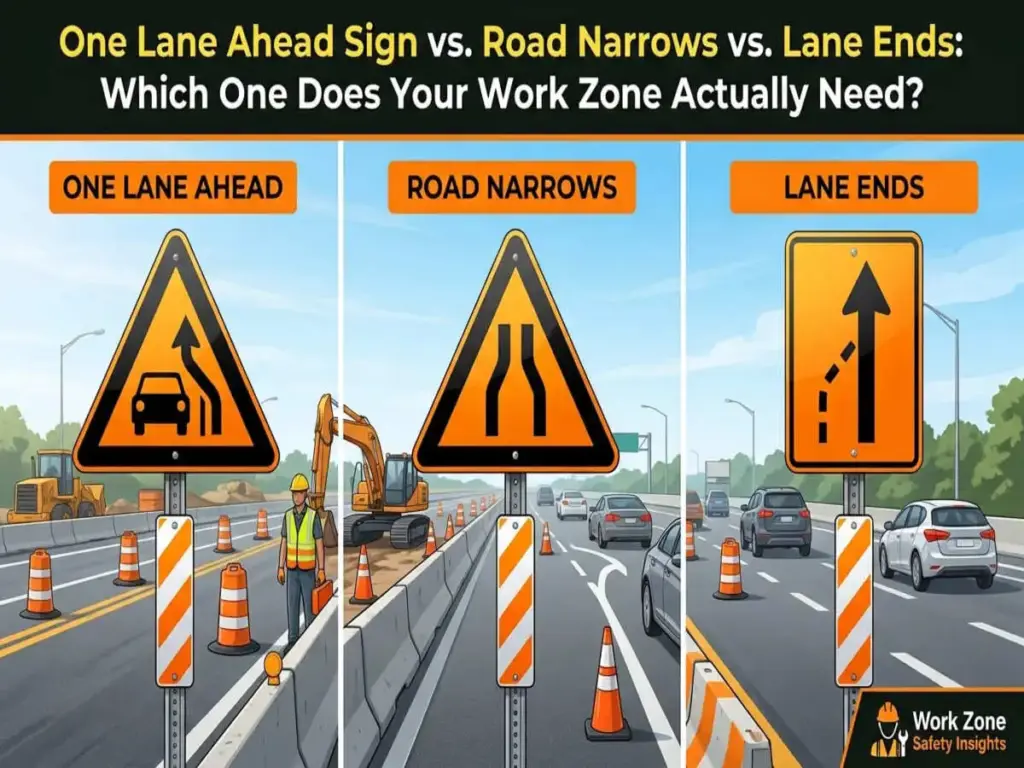
Three warning signs get mixed up on work zone sites more than almost any others: one lane ahead sign, Road Narrows, and Lane Ends. They look similar. All three warn drivers that the road ahead changes. However, each one describes a legally distinct situation, and posting the wrong one can leave a site out of MUTCD compliance even when a sign is technically present.
Our team has walked sites where a crew posted a Road Narrows sign at a spot that actually needed a one lane ahead sign with flagger or signal control. The road did narrow. However, traffic also had to alternate through a single lane, which the posted sign never communicated. That gap isn’t cosmetic. It changes whether drivers expect to stop and wait or simply merge and continue.
This guide breaks down what each sign legally means, when to use which one, and how to avoid the mix-up that gets flagged during a site inspection.
Key Takeaways
- One Lane Ahead (W20-4): Use it only when traffic must alternate through a single lane under flagger or signal control.
- Lane Ends (W4-2): Use it when one through lane permanently ends and traffic merges into an adjacent lane, no alternating control needed.
- Road Narrows (W5-1): Use it when pavement width decreases but the lane count stays the same.
- Wrong Sign, Right Location: Posting the wrong one of these three still fails an inspection, even though a warning sign is technically present.
- Match the Control, Not Just the Shape: The correct sign depends on whether the site needs alternating traffic control, not just how the road narrows.
What Each Sign Actually Communicates
These three signs look alike: yellow, diamond-shaped, and focused on a change in the road ahead. That’s exactly why they get confused. Underneath the similar shape, each one tells drivers to expect a different traffic pattern.
One Lane Ahead (W20-4)
This sign warns drivers that the road ahead narrows to a single lane shared by traffic from both directions. Crucially, it signals that alternating control is coming, whether from a flagger, a temporary signal, or a pilot car. Drivers need to be ready to stop, not just merge.
Lane Ends, Merge Left/Right (W4-2)
This sign applies when one of two or more through lanes permanently ends. Traffic in the ending lane merges into the adjacent lane, but both directions keep moving. No flagger or signal control is implied.
Road Narrows (W5-1)
This sign indicates the pavement width decreases, often at a bridge or a section with obstructions on both sides. The lane count itself doesn’t change. This is the sign we’ve already covered in detail, including how it differs from a full lane reduction, in our Road Narrows sign guide.
Choosing the Right Sign for the Site Condition
| Site Condition | Correct Sign | Alternating Traffic Control Required? | Lane Count Change? |
|---|---|---|---|
| Single-lane closure, traffic alternates both directions | One Lane Ahead (W20-4) | Yes — flagger, signal, or pilot car | Yes, down to one shared lane |
| One through lane permanently ends, others continue | Lane Ends (W4-2) | No | Yes, one fewer through lane |
| Pavement narrows but lane count stays the same | Road Narrows (W5-1) | No | No |
The table above is the fastest way to check a site plan before signage goes out. In short, if the crew has arranged a flagger or a temporary signal, the site needs a one lane ahead sign, not a Lane Ends or Road Narrows sign. If lanes merge without any stop-and-go control, Lane Ends is correct instead. If the road simply gets tighter without losing a lane, Road Narrows applies.
Why the Mix-Up Happens on Real Sites
The confusion usually isn’t about knowing the definitions. Instead, it comes from how work zone conditions change mid-project.
- A site starts as a Lane Ends condition and later adds flagger control. Crews sometimes leave the original Lane Ends sign up instead of swapping it for a one lane ahead sign once alternating control starts.
- A narrow bridge gets temporary lane restrictions added for construction equipment. What was a straightforward Road Narrows condition becomes a single-lane alternating condition, and the signage needs to change with it.
- Crews default to whichever sign is already in the truck. When a specific sign isn’t on hand, a close-enough substitute goes up instead, even though the legal meaning doesn’t match the site.
Keeping the Right Sign Available for the Actual Condition
The fix isn’t more training on sign definitions. Instead, it’s keeping the right stock on hand. Site conditions change over the course of a project, and the signage needs to change with them. A crew that only carries Road Narrows signs, for example, can’t correctly re-sign a site once flagger control gets added.
The Optraffic team builds work zone sign sets that include all three variants — One Lane Ahead, Lane Ends, and Road Narrows — so crews can match the sign to the actual site condition on the day, not whatever happens to be in the truck already. That flexibility matters most on longer projects, where the traffic control plan shifts as work progresses.
Related Reading
- Understanding the Road Narrows Sign and Its Critical Role in Traffic Safety
- Single Lane Closure Signs Guide: MUTCD Setup & Taper
- Work Zone Sign Sizes: MUTCD Dimensions Reference for Rental Fleets
- Work Zone Signs for Highway One-Lane, Two-Way Operations: Flagging & Pilot Car Guide
FAQ
What does a one lane ahead sign mean?
It warns drivers that the road ahead narrows to a single lane shared by both directions of traffic, and that alternating control, such as a flagger or temporary signal, controls who moves through.
Is One Lane Ahead the same as Lane Ends?
No. Lane Ends means one through lane merges into another while both directions keep moving. One Lane Ahead means traffic from both directions shares a single lane under alternating control.
Do I need a flagger with a Road Narrows sign?
Not necessarily. Road Narrows only indicates the pavement width decreases. It doesn’t imply a lane count change or alternating traffic control on its own.
What happens if the wrong sign is posted for the site condition?
The site can fail an inspection even with a sign in place, because the posted sign doesn’t match what drivers actually encounter. This gap also increases the risk of a driver misjudging the situation ahead.
Conclusion
These three signs look alike, but they tell drivers three different things about what’s ahead. Posting the wrong one doesn’t just risk a failed inspection. It leaves drivers guessing about whether to stop, merge, or simply hold their lane. That’s why the Optraffic team stocks all three one lane ahead sign variants together, so crews can match the signage to the site condition as it changes, not just whatever’s closest to hand.