
A 2-hour permit window at a signalized urban intersection gives you roughly 90 minutes of actual work time — once you subtract setup and teardown. Miss that window and the city inspector pulls your permit. Deploy segnali stradali chiusi in the wrong sequence and you create a pedestrian trap, an ADA violation, or a driver running into your crew from an uncovered approach direction. Inoltre, a single No Turn on Red sign left in place after teardown triggers an enforcement citation that outlasts the job.
Questa guida traduce MUTCD 11a edizione parte 6 short-term stationary operation requirements into a deployment-ready SOP for city contractors, municipal crews, and utility supervisors working at or near signalized intersections. It covers the full sequence of temporary road closure signs, pedestrian detour signs, and channelizing devices — from the pre-shift site read to the final cone pull — sequenced for a sub-2-hour window.
What this guide covers: Signalized urban intersections at 25–35 mph · Permit windows ≤2 hours · Four-approach road closed sign sequencing · ADA-compliant pedestrian detour setup · Flexible delineator channelization · Signal coordination · Teardown order
What it does not cover: Multi-day lane closures · Freeway on-ramp intersections · High-speed arterials above 45 mph (see the highway one-lane two-way guide for those scenarios)
MUTCD 11th Edition Note: All references cite the 11th Edition, effective January 18, 2024. Short-term stationary operations follow Part 6G Typical Applications. Always verify your state DOT supplements and local permit conditions before deployment — city-specific requirements frequently exceed MUTCD minimums for pedestrian protection and signal coordination.
Parte 1: Why Urban Intersection Road Closed Signs Demand a Different Setup
Setting up road closed signs at a signalized urban intersection is not a simplified version of a highway work zone. Invece, it introduces three constraints that do not exist on open highway sections: a compressed permit window, four simultaneous approach directions each requiring its own sign sequence, and pedestrian, bicicletta, and transit users who cannot simply be directed to use the shoulder.
1.1 The 2-Hour Window Is Shorter Than It Looks
Most city permits for short-term intersection work specify a 2-hour window, typically during off-peak hours. Tuttavia, that window includes setup and teardown — not just productive work time. The table below breaks down where the time actually goes.
| Phase | Tempo | Note |
| Arrival and equipment unload | 10–15 min | Time lost before any sign goes up |
| Full deployment — four approaches plus pedestrian detour | 20–30 min | Longer when ADA detour routing is complex |
| Actual work window | 60–75 min | The only time the crew produces output |
| Teardown and pavement check | 15–20 min | Skipping this step creates liability |
| Contingency buffer | 5–10 min | Inspector arrival, equipment issue, unexpected traffic |
In pratica, a crew that does not pre-stage equipment and pre-walk the site typically spends 35–40 minutes on setup alone, leaving under an hour for actual work. Di conseguenza, the pre-shift site read in Part 2 is not optional — it is where the work window is either protected or lost.
1.2 The Four Failure Modes Specific to Urban Intersection Road Closed Sign Operations
Road closed signs on a single approach. Urban intersections have four entry directions. A setup that covers only the primary work approach leaves three directions with no advance warning. Di conseguenza, drivers arriving from uncovered approaches enter the work space without any prior signal — and the permit holder bears liability for the resulting conflict.
Sidewalk Closed sign at the wrong location. Placing a Sidewalk Closed sign at the physical closure point gives pedestrians no route choice — they walk to a dead end and backtrack. Di conseguenza, complaints accumulate and inspectors arrive. The sign must go at the last point where pedestrians can still make a routing decision, not at the barrier itself.
No Turn on Red omitted. Right-turning vehicles at signalized intersections routinely bypass queued through-traffic. Without a No Turn on Red sign, those vehicles bypass your road closed signs entirely and enter the work space from the side. Infatti, this is the highest-frequency vehicle intrusion cause in urban intersection work zones.
ADA continuity broken. A single curb drop without a ramp, a surface with loose gravel, or a detour that routes pedestrians across an unsignalized crossing can each constitute an ADA violation. Inoltre, city inspectors check pedestrian path continuity specifically in short-term work zones, because these setups change daily and are the most frequent source of violations.
Parte 2: Pre-Deployment Site Read — Six Checks Before the First Road Closed Sign Goes Up
Every permit overrun and stop-work order at an urban intersection traces back to something visible during the pre-shift site read. Spesa 15 minutes before the crew arrives is the most productive investment in the 2-hour window.
2.1 Signal Phase Assessment
Before deploying any road closed signs, identify which approach directions share a signal phase with the work approach. Closing one approach arm mid-cycle without coordinating with the signal center can create a green phase that releases vehicles into a closed lane. Inoltre, if the work requires blocking pedestrian signal heads or disabling a pedestrian phase, most cities require 24–48 hours advance notice to the traffic signal operations center.
The trigger for mandatory pre-notification is straightforward: if the work physically obstructs a signal head, affects the timing of a pedestrian phase, or requires signal maintenance staff on site, notify the signal center before the permit window opens — not during it.
2.2 Four-Approach Entry Point Mapping
At each of the four approach directions, identify the first decision point — the location where a driver can still choose an alternate route before committing to the closed intersection. In urban grids, that decision point sits at the preceding intersection, typically 200–400 feet upstream.
This mapping determines where the W20-1 Road Work Ahead sign goes on each approach. Signs placed past the last turn opportunity give drivers no actionable information. Di conseguenza, those drivers enter the approach, find it closed, and either block traffic while attempting a U-turn or force entry into the work space.
2.3 ADA Path Inventory
Walk the proposed pedestrian detour path before the shift. Specificamente, check each of the following:
- Curb ramps at every grade change — a missing ramp is an ADA violation regardless of how short the detour is
- Surface condition — temporary pedestrian paths must be firm, stabile, and slip-resistant per ADA Standards Section 402
- Minimum clear width — 36 inches is the ADA hard floor; 48 inches is preferred to allow two-way pedestrian flow without conflict
- Crossings — if the detour routes pedestrians across a street, that crossing must be signalized or have adequate sight distance
If any element of the proposed detour path fails these checks, identify a compliant alternative before the crew arrives. Altrimenti, discovering an ADA gap during setup wastes 10–20 minutes of the work window.
2.4 Business Access and Transit Stop Check
Urban intersection closures frequently affect adjacent businesses and bus stops. Two specific checks prevent the most common complaints and enforcement triggers:
Business entrances: Confirm that the closure does not fully block the primary customer entrance to any operating business. Se lo fa, either modify the work footprint or notify the business owner in advance — most city permits require this.
Fermate dell'autobus: If an active bus stop falls within the closure zone, contact the transit agency before the permit window. In most cities, temporary bus stop relocation requires 48–72 hours of notice and coordination with the agency’s operations center. A conflict discovered at setup cannot be resolved within a 2-hour window.
2.5 Permit Condition Review
Read the permit conditions on site, not from memory. Specifically verify: permitted hours, any approach directions that must remain open, the minimum pedestrian path width required by the permit (Spesso 48 inches rather than the ADA minimum of 36), and any mandatory notifications that must be completed before work begins. In particolare, notification requirements are easy to overlook when the crew is focused on setup.
2.6 Equipment Count Verification
Before the permit window opens, count all equipment against the four-approach deployment list in Part 3. Short-term urban work zones offer no time to retrieve missing items after the window starts. Inoltre, if the count is short, the options are to cancel, reschedule, or reconfigure — none of which are preferable to a five-minute pre-shift inventory check.
Parte 3: Road Closed Signs and Equipment — The Complete Urban Intersection Kit
3.1 The Four-Approach Road Closed Sign Sequence
Each of the four approach directions requires its own independent sign sequence. The sequence is not optional on any approach — a single uncovered direction is the same as no coverage for drivers arriving from that direction.
The table below shows the standard sequence for a signalized urban intersection at 25–35 mph. Measure all distances from the closure point back toward approaching traffic on each arm.
| Cartello | Codice MUTCD | Distanza | Min. Misurare | Classificazione |
| Lavoro su strada davanti | W20-1 | ≥200 ft | 36″ × 36″ | Standard (deve) |
| Strada chiusa più avanti | W20-3 | ≥100 ft | 36″ × 36″ | Standard (deve) |
| Strada chiusa | R11-2 | At closure point | 36″ × 36″ | Standard (deve) |
| Non svoltare con la luce rossa accesa | R10-11 | At signal head | 24″ × 30″ | Required at intersections |
Critical sequence rule — W20-3 must precede R11-2 on every approach: Strada chiusa più avanti (W20-3) gives drivers advance notice so they can divert before reaching the closure. Strada chiusa (R11-2) marks the physical closure point. Deploying R11-2 without the upstream W20-3 means the first indication drivers receive is the physical barrier — at which point they cannot divert safely. This is the most common road closed sign sequencing error in urban short-term operations.
Sign placement on constrained urban blocks. When block spacing is shorter than the recommended sign spacing, position each sign at the upstream side of the nearest intersection. Specificamente, the W20-1 Road Work Ahead sign goes at the block before the one containing the closure. That way, drivers can choose to divert before committing to the final approach block.
OPTRAFFIC — Road Closed Signs: W20-1, W20-3, and R11-2 as MUTCD-compliant temporary road closure signs in 36″ × 36″ aluminum — Browse road closed signs →
3.2 Signs Specific to Signalized Intersection Work Zones
Non svoltare con la luce rossa accesa (R10-11). This sign is unique to signalized intersection closures. Install it at the signal head on each approach where a right turn would bring vehicles into the closed area. The sign must go up before any lane restriction is established. Drivers approaching a red signal with a right-turn option will use it unless R10-11 is already in place.
Marciapiede chiuso (R9-9 / R9-11). Place this sign at the last upstream decision point — the intersection before the closure, where pedestrians can still choose an alternate route. Do not place it at the physical barrier. A pedestrian who sees the sign at the prior intersection makes a route choice without reaching the barrier; a pedestrian who reaches the barrier first has no useful options.
Pedestrian Detour arrow signs. Posto pedestrian detour signs — directional arrows — at each turn point along the detour route. The detour sequence must be continuous — a pedestrian who follows the first arrow must find the next arrow without searching for it. Gaps in the detour sequence are the second most common ADA compliance failure in urban work zones, after path width violations.
3.3 Flexible Delineator Posts for Pedestrian Channel Protection
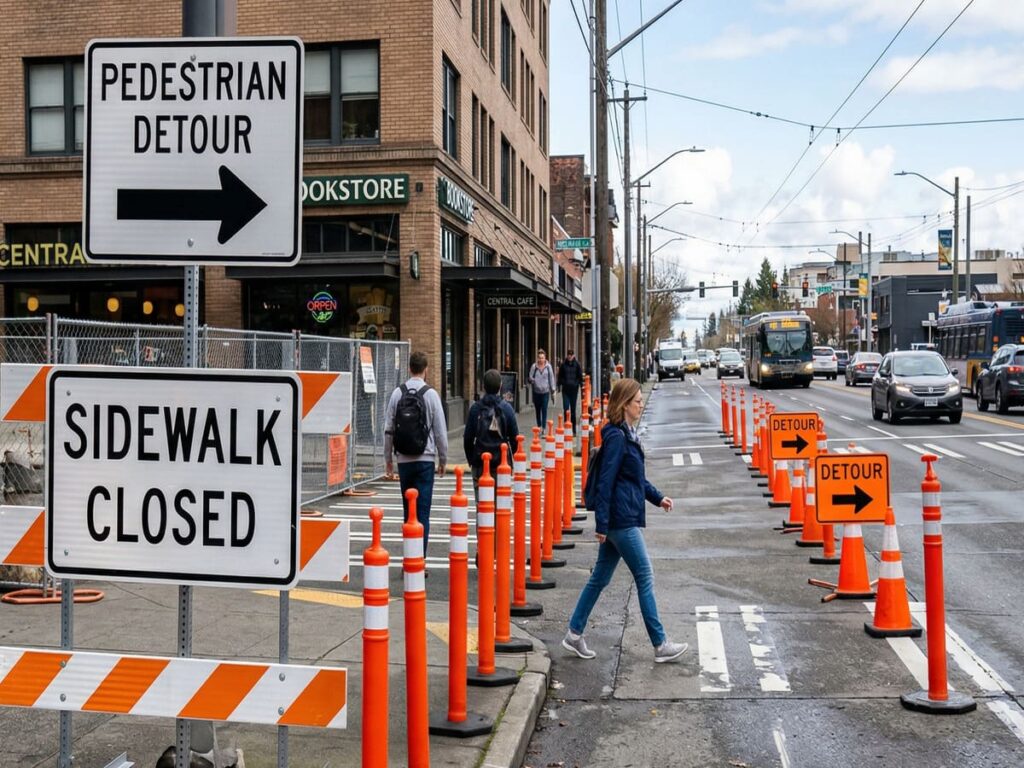
In urban short-term operations, pali delineatori flessibili replace heavy water-filled barriers for pedestrian path definition. They deploy in under 45 seconds per unit, are light enough for a single person to carry a full kit, and can be repositioned mid-operation if the work footprint changes.
The minimum compliant temporary pedestrian path configuration requires delineator posts on both sides of the path at a maximum 36-inch spacing, with a clear path width of 36 inches minimum and 48 inches preferred. Inoltre, delineators must create a continuous, unambiguous boundary — drivers and cyclists must not mistake the pedestrian channel for a vehicle through-lane.
ADA path width is a hard floor, not a target: 36 inches is the minimum accessible route width per ADA Standards Section 403.5.1. Tuttavia, 36 inches does not allow two wheelchair users to pass each other. Where pedestrian volumes are moderate or where the detour exceeds one block, utilizzo 48 inches as the working standard. City inspectors and ADA compliance officers frequently cite 36-inch paths that technically meet the standard but create functional barriers for mobility device users.
OPTRAFFIC — Traffic Delineators: pali delineatori flessibili for urban pedestrian channeling — fast deployment, ADA-compatible spacing — Browse traffic delineators →
3.4 Portable Sign Stands for Urban Sidewalk Conditions
Urban sidewalks present ground conditions that eliminate ground-spike and sand-anchor sign stand options: tile surfaces, utility access covers, concrete that cannot be punctured under permit conditions, and uneven slopes. Di conseguenza, portable sign stands for urban work zones must use ballast weight rather than ground penetration.
Key mounting requirements for pedestrian-area signs:
- Bottom of sign: minimo 7 feet above the sidewalk surface — MUTCD Standard for business, commerciale, and residential areas with pedestrian activity
- Stand footprint: must not reduce the clear pedestrian path width below 36 inches at any point
- Base weight: sufficient to resist 30 mph wind gusts without tipping — most highway-grade urban stands specify a minimum of 20 lbs ballast for open-sidewalk exposure
OPTRAFFIC — Sign Frames & Parentesi: portable work zone sign stands with heavy base for urban pavement conditions — Browse sign frames →
3.5 Coni stradali: 18-Inch Is the Correct Choice for Urban Low-Speed Operations
MUTCD specifies a minimum cone height of 18 inches for low-speed roadways (pubblicato 25 mph or below) and allows 18-inch cones for speeds up to 35 mph in daytime operations. For urban intersection work at 25–35 mph, 18-coni di traffico pollici are not a budget substitution — they are the correctly specified device. Using 28-inch or 36-inch highway cones in a constrained urban sidewalk environment creates unnecessary tripping hazards and reduces the clear pedestrian path width.
OPTRAFFIC — Traffic Cones: 18 coni di traffico pollici for urban low-speed work zones — Browse traffic cones →
3.6 Complete Equipment Kit Reference
The table below consolidates the full equipment list for a standard four-approach urban intersection closure with pedestrian detour. Use it as a pre-shift count checklist.
| Articolo | Quantità | Misurare | Note |
| Lavoro su strada davanti (W20-1) | 4 minimo | 36″ × 36″ | One per approach, upstream of first decision point |
| Strada chiusa più avanti (W20-3) | 4 minimo | 36″ × 36″ | One per approach between W20-1 and R11-2 |
| Strada chiusa (R11-2) | 4 minimo | 36″ × 36″ | One per approach at closure point, on barricade or stand |
| Non svoltare con la luce rossa accesa (R10-11) | Per turn count | 24″ × 30″ | Each signalized right-turn approach into closure zone |
| Marciapiede chiuso (R9-9 / R9-11) | Per path | 24″ × 30″ | At upstream decision point, not at the closure itself |
| Pedestrian Detour arrows | Per route | 24″ × 24″ | At each decision point along the detour path |
| Pali delineatori flessibili | Se necessario | 42″ standard | Both sides of temp pedestrian path; max 36″ spaziatura |
| 18-coni di traffico pollici | Se necessario | 18″ | Approach tapers and work space perimeter |
| Supporti per insegne portatili | Per sign count | Heavy base | 7 ft minimum mounting height in pedestrian areas |
Parte 4: ADA-Compliant Pedestrian Detour — the Most-Cited Compliance Gap
ADA compliance failures account for a disproportionate share of stop-work orders and post-project citations in urban short-term work zones. The reason is not that contractors ignore accessibility — it is that pedestrian path continuity is complex to maintain when temporary setup changes the existing infrastructure, anche brevemente.
4.1 Why Urban Pedestrian Detours Fail
Three failure patterns appear most often in city inspector reports and ADA compliance reviews:
The detour announcement comes too late. Sidewalk Closed signs placed at the physical barrier give pedestrians no route options. By the time they see the sign, they have already committed to the approach block and must backtrack. Di conseguenza, pedestrians often take informal paths through the work space rather than the designated detour.
The path has grade changes without compliant ramps. A temporary pedestrian path that routes users onto a street crossing at a location without a curb ramp violates ADA Standards regardless of path width or surface quality. Inoltre, temporary ramps must themselves meet ADA slope requirements — otherwise, a plywood ramp with an excessive slope does not comply.
The detour is not continuous. Each turn along the detour route requires a directional sign. A path with two turns and only one directional sign has a gap — and pedestrians who reach that gap choose their own route, which frequently takes them through the work space.
4.2 The Correct Placement Rule for Sidewalk Closed Signs
MUTCD Part 6D establishes the principle: pedestrians must receive information about temporary traffic control conditions at a point where they can still choose an alternate route. Applied to sidewalk closures, this means the sidewalk closed sign goes at the last intersection before the closure — not at the physical barrier. In pratica, position the sign at the upstream corner of the block containing the closure, on the side being closed, facing pedestrians before they enter that block.
4.3 Minimum Compliant Temporary Pedestrian Path Components
ADA Standards Section 402 and MUTCD Part 6D together define the requirements for temporary pedestrian paths. Each of the following elements is independently required:
- Clear width: 36 inches minimum, measured between obstructions — not the nominal corridor width
- Superficie: ditta, stabile, and slip-resistant — loose gravel, uneven pavement gaps, or wet plywood do not qualify
- Grado: massimo 5% running slope; massimo 2% cross slope
- Protezione dei bordi: delineator posts or barriers on both sides at maximum 36-inch spacing to define the path boundary
- Curb ramps: provided at every grade transition, with maximum 8.33% slope and detectable warning surfaces
If any of these requirements cannot be met on the proposed detour route, identify an alternative route during the pre-shift site read. Attempting to modify a non-compliant path during the work window consumes time the operation cannot afford.
Parte 5: Signal Coordination — Two Situations That Require Different Actions
Most short-term urban intersection closures do not require active signal modification. Tuttavia, two situations change that default, and confusing them with ordinary operations causes delays and enforcement issues.
5.1 When You Must Contact the Signal Center Before Starting
Contact the traffic signal operations center in advance if any of the following apply:
- The work physically obstructs a signal head, making it unreadable from the approach lane
- The work requires disabling or temporarily disconnecting a pedestrian signal phase or push button
- The closure eliminates an approach lane that has its own signal phase, changing the intersection’s phase structure
- The permit explicitly requires signal center coordination as a condition
In most cities, advance notice must reach the signal center 24–48 hours before the permit window opens. Signal center staff may need to be present on site or make remote timing adjustments — neither action can be arranged within a 2-hour window.
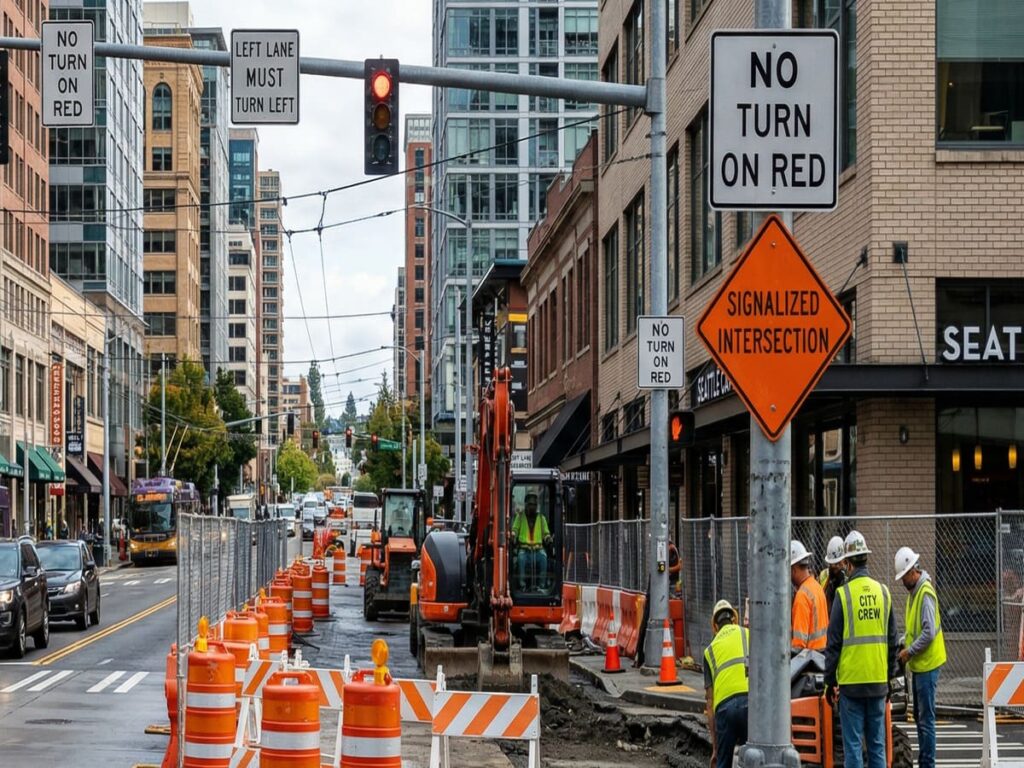
5.2 Non svoltare con la luce rossa accesa: Installation and Removal Timing
The No Turn on Red sign (R10-11) has two timing rules that operators frequently reverse:
- Installazione: R10-11 must go up Prima the lane restriction is established — not after. If the lane restriction is in place before R10-11 is installed, right-turning vehicles enter the work space during the gap. Install the sign as the first step in the deployment sequence.
- Rimozione: R10-11 must come down Dopo the closure is fully cleared — not as part of work-space teardown. A No Turn on Red sign left in place after work is complete creates a regulatory restriction on a public road without authorization — a permit violation. Remove it as the last step in the teardown sequence.
Parte 6: Teardown SOP — Clearing the Intersection in Under 20 Minuti
Teardown proceeds from the work space outward. Specificamente, devices closest to the work area come out first; advance warning signs come out last. As long as any device remains in the work area, drivers must still receive advance warning — removing W20-1 Road Work Ahead signs before the work space is clear tells drivers the road is normal when it is not.
6.1 The Correct Teardown Sequence
- Fare un passo 1: Stop all work activity. Confirm the work space is clear of workers, attrezzatura, e materiali.
- Fare un passo 2: Remove work-space devices — traffic cones, Delineatori, and any temporary signs marking the active work area.
- Fare un passo 3: Remove pedestrian path delineators and Sidewalk Closed signs. Di conseguenza, the sidewalk reopens and pedestrian flow returns to normal.
- Fare un passo 4: Remove No Turn on Red signs (R10-11) from all signal heads.
- Fare un passo 5: Remove Road Closed (R11-2) signs and barricades from all four closure points.
- Fare un passo 6: Remove Road Closed Ahead (W20-3) e lavori stradali da realizzare (W20-1) signs from all four approach directions. These come out last.
6.2 Post-Teardown Four-Direction Check
After the final W20-1 signs come down, one crew member walks each of the four approach directions and confirms:
- No cones, Delineatori, or barricades remain in the roadway or sidewalk
- No Road Closed, Strada chiusa più avanti, or Road Work Ahead signs remain on any approach
- No Turn on Red signs are confirmed removed from all signal heads
- Signal operation returns to normal on all phases — confirm by observing one full signal cycle per approach
- Pedestrian path is fully restored and accessible, with no temporary detour signs remaining that would route pedestrians toward a detour that no longer exists
The four-direction check takes 5–7 minutes. It is the difference between a clean closeout and a complaint or citation that arrives after the crew has left. Insomma, it is the cheapest insurance available at the end of a permit window.
Parte 7: Six Common Road Closed Sign and Equipment Failures at Urban Intersections
The table below consolidates the six most common compliance failures in urban short-term intersection work zones, their consequences, and their corrections. Each is preventable with the pre-shift checks and deployment sequence in Parts 2 E 3.
| Fallimento | Conseguenza | Aggiustare |
| Road closed signs on one approach only | Vehicles enter from uncovered directions | Map all four approach entry points before deployment; verify all four in the pre-shift equipment count |
| Sidewalk Closed sign placed at the barrier | Pedestrians reach a dead end and must backtrack | Place Sidewalk Closed at the last decision point — the intersection before the closure — so pedestrians can still reroute |
| No Turn on Red omitted | Right-turning vehicles bypass the queue and enter the work space | Add R10-11 to the standard kit; install it before the lane restriction is established |
| ADA path has a grade change without a ramp | Stop-work order; ADA compliance citation | Walk the detour route during the pre-shift site read; identify every grade change and confirm a compliant ramp exists |
| Teardown starts with advance warning signs | Drivers see a clear road signal while equipment is still in place | Tear down from the work space outward — work-area devices first, advance warning signs last |
| No Turn on Red left in place after teardown | Enforcement citation after permit expiry | Include R10-11 removal in the four-direction post-teardown check; treat it as the final verification step |
Riepilogo: Road Closed Signs Are Only Half the Urban Intersection Setup
The 2-hour permit window does not forgive incomplete setups. Road closed signs handle the vehicle approach on each of the four entry directions. Tuttavia, the sidewalk closed signs, pedestrian detour sequence, No Turn on Red placement, and flexible delineator channeling are what keep the operation compliant — and what prevent a stop-work order or an ADA citation.
The teardown sequence is as important as the deployment sequence. A No Turn on Red sign left in place after work ends, or an advance warning sign pulled before the work zone is clear, creates a liability that outlasts the permit. Di conseguenza, both sequences deserve the same structured attention as the work itself.
The pre-shift site read in Part 2 is where the work window is either protected or lost. Crews that walk the site before the permit opens consistently complete setup, lavoro, and teardown within the permitted window. Crews that skip it consistently run over.
OPTRAFFIC — Complete Urban Intersection Work Zone Equipment
- Road closed signs (W20-1, W20-3, R11-2, R10-11, R9-9) in MUTCD-compliant aluminum — Safety Signage →
- Pali delineatori flessibili for urban pedestrian channeling — Traffic Delineators →
- 18 coni di traffico pollici · portable work zone sign stands - Traffic Cones → · Sign Frames →
References and Further Reading
- MUTCD 11a edizione parte 6 — Temporary Traffic Control (FHWA): https://mutcd.fhwa.dot.gov/pdfs/11th_Edition/part6.pdf
- Scheda informativa sulla sicurezza stradale della zona di lavoro OSHA: https://www.osha.gov/sites/default/files/publications/work_zone_traffic_safety.pdf
- ADA Standards for Accessible Design — Section 402 (Percorsi accessibili) and Section 403.5.1 (Clear Width)
- Segnaletica di zona di lavoro per l'autostrada a una corsia, Two-Way Operations — OPTRAFFIC: optsigns.com/work-zone-signs-highway-one-lane-two-way-flagging-guide/
- When and How to Use Road Closed Signs in Various Work Zones — OPTRAFFIC: optsigns.com/when-how-use-road-closed-signs-work-zones/
- A Guide to Effective Detour Sign Management on Construction Sites — OPTRAFFIC: optsigns.com/a-guide-to-effective-detour-sign-management-on-construction-sites/
- The Professional Guide to Construction Sign Installation — OPTRAFFIC: optsigns.com/construction-sign-installation-guide/