Disclaimer: This article provides general guidance on supplier certification standards for informational purposes only. It does not constitute legal advice. Certification requirements vary by jurisdiction, product category, and project specifications. Verify certification validity directly with the issuing body before making procurement decisions.
ISO certified traffic signs and CE-marked products appear regularly in supplier catalogs from international manufacturers. For US rental fleet buyers, these certifications raise a practical question: what do they actually prove about the signs you are about to purchase — and what don’t they prove?
The honest answer is nuanced. ISO 9001 certification is a meaningful signal about a supplier’s quality management processes. CE marking, however, is an EU market requirement that carries limited direct relevance for US procurement. Neither certification substitutes for ASTM D4956 sheeting documentation or MUTCD dimensional compliance — the two standards that actually govern traffic sign performance on US roadways.
This guide explains each certification clearly, from a US buyer’s perspective, so you can use them appropriately when evaluating wholesale traffic sign suppliers.
OPTRAFFIC holds ISO 9001 certification with scope covering traffic sign manufacturing. Our ISO certified traffic safety signs comes with ASTM D4956 sheeting documentation on request.
ISO 9001 Traffic Sign Manufacturer: What the Certification Proves
What ISO 9001 Is
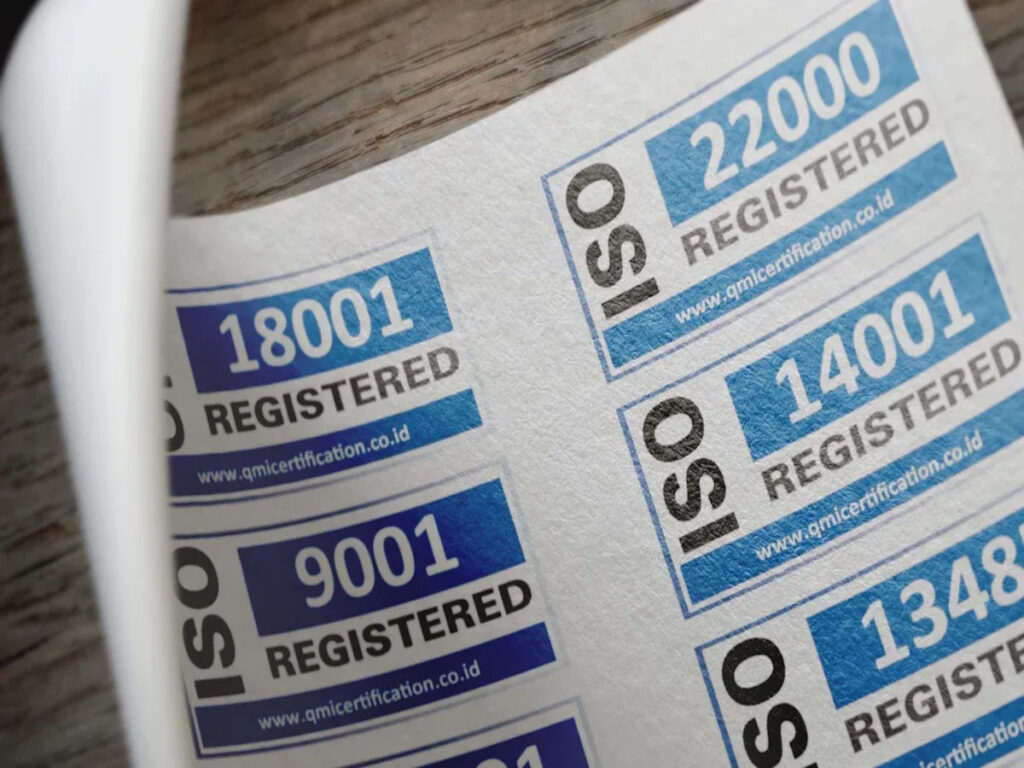
ISO 9001 is the international standard for Quality Management Systems (QMS), published by the International Organization for Standardization. It specifies requirements for how a company documents, monitors, and continuously improves its internal processes. Over one million organizations in 189 countries hold ISO 9001 certification, making it the most widely used management system standard in the world.
Importantly, ISO 9001 certifies the organization’s processes — not its products. The American Society for Quality describes it as a framework that ‘helps organizations ensure their customers consistently receive high-quality products and services.’ The certification demonstrates that the manufacturer has implemented structured, auditable quality management processes.
What It Proves for Traffic Sign Procurement
For a rental fleet buyer evaluating a wholesale traffic sign supplier, ISO 9001 certification from an accredited body proves three things:
- The supplier has documented quality control procedures covering their manufacturing process.
- Those procedures have been audited by an independent third-party certification body — not self-declared.
- The certification is reviewed annually and renewed every three years, meaning it reflects current operations, not a one-time snapshot.
In practical terms, an ISO 9001-certified traffic sign manufacturer is less likely to ship out-of-specification signs undetected. Their process includes incoming material inspection, in-process quality checks, and documented corrective action for non-conformities. For bulk fleet orders where unit-by-unit inspection is impractical, this process documentation reduces the risk of receiving signs that fail your specification.
How to verify ISO 9001 certification
1. Request a copy of the ISO 9001 certificate from the supplier.
2. Check the issuing certification body — it should be an accredited body (IAF-recognized). Common examples: Bureau Veritas, SGS, TÜV Rheinland, DNV.
3. Read the certificate scope statement carefully. It must explicitly cover traffic sign manufacturing or the product category you are ordering.
4. Check the expiry date. Certificates are renewed every 3 years; an expired certificate is no longer valid.
5. Contact the certification body directly to verify the certificate number if needed.
ISO 9001 Certification Meaning: What It Does NOT Prove
A Common Misconception
A frequent mistake in supplier evaluation is treating ISO 9001 as a product quality guarantee. It is not. The standard itself states that ISO 9001 certifies quality management processes — it does not certify that any specific product meets any specific performance standard.
A manufacturer with ISO 9001 certification could, in principle, produce signs with the wrong sheeting grade and still maintain a valid certificate — as long as their quality management process consistently delivers whatever specification they have documented internally. The QMS certifies consistency, not the specification itself.
Three Things ISO 9001 Cannot Tell You
- Whether the sheeting meets ASTM D4956 Type III or higher — that requires separate ASTM test certification from the sheeting manufacturer.
- Whether the sign dimensions conform to MUTCD 11th Edition requirements — that requires dimensional verification against MUTCD Section 2C and Part 6 Table 6F-1.
- Whether the aluminum substrate meets .080″ thickness and 5052 or 6061 alloy specifications — that requires a mill certificate.
Therefore, ISO 9001 is a useful procurement signal but not a sufficient one. It belongs in your supplier evaluation alongside — not instead of — ASTM D4956 sheeting certifications and dimensional specifications in your purchase order.
ISO 9001 vs. ISO 7010 — Two Different Standards
One source of confusion in traffic sign procurement is the difference between ISO 9001 and ISO 7010. They are unrelated standards. ISO 9001 governs a supplier’s quality management system. ISO 7010 is a separate standard that governs safety sign graphic symbols and colors — used primarily in European and international workplace safety sign design. A supplier can hold ISO 9001 certification without ever referencing ISO 7010, and vice versa. For US traffic sign procurement, ISO 7010 has no direct relevance to MUTCD compliance. For more on ISO 7010 and its role in sign symbol standardization, see our guide on ISO 7010 safety sign EU standardization.
CE Marking Traffic Signs: What It Means for US Buyers
What CE Marking Is
CE marking — from the French Conformité Européenne, meaning European Conformity — is a mandatory label for products sold in the European Economic Area (EEA). It indicates that the manufacturer has declared the product meets applicable EU health, safety, and environmental requirements for that product category.
Two important clarifications from official sources:
- CE marking is not a quality indicator. The American Society for Quality states explicitly: ‘It is not a quality assurance declaration, it does not show evidence of third-party testing.’
- CE marking is not legally required in the United States. It has no regulatory standing under MUTCD, OSHA 29 CFR 1926.200, or ASTM D4956.
The US Buyer’s Perspective
For a US rental fleet buyer sourcing international traffic signs, CE marking carries a limited but non-zero signal. A manufacturer that has gone through CE marking for EU customers has demonstrated an ability to produce documentation — a Declaration of Conformity, technical file, and conformity assessment — that evidences structured compliance processes. This is a modest indicator of process maturity.
However, that signal is weaker than ISO 9001 certification from an accredited body. CE marking for many product categories involves manufacturer self-declaration with no third-party audit. The manufacturer signs a Declaration of Conformity stating compliance — but no independent body has necessarily verified the claim.
The practical conclusion for US procurement: treat CE marking as a minor positive indicator that the supplier has EU export experience, not as an independent quality or compliance certification for your US purchase.
The ‘China Export’ Mark — A Known Risk
A practical caution: a counterfeit version of the CE mark — sometimes called the ‘China Export’ mark — exists and looks visually similar to the genuine CE mark. The main visual difference is letter spacing. In the genuine CE mark, the letters have specific proportions with a visible gap. In the counterfeit version, the letters are typically placed closer together.
If CE marking is present on signs you are evaluating, request the manufacturer’s EU Declaration of Conformity — a legally required document that names the specific EU directive(s) under which the mark was applied. A supplier with genuine CE marking can produce this document on request.
CE marking quick check for US buyers
Genuine CE marking: Letters have correct spacing and proportions per EU guidelines.
Ask for: EU Declaration of Conformity (DoC) — names the directive(s) and standards the product was assessed against.
Verify: If CE marking references a Notified Body (NB), a four-digit number follows the mark — verify the NB on the EU NANDO database.
Remember: For US market compliance, CE marking is not a substitute for ASTM D4956 sheeting certification or MUTCD dimensional compliance.
Traffic Sign Supplier Certification: How to Verify Before You Order
The Verification Checklist
Regardless of what certifications a supplier claims, the following verification steps protect your procurement before any purchase order is placed.
| Certification / Document | What to Request | How to Verify | US Market Relevance |
| ISO 9001 | Certificate with scope statement and expiry date | Confirm issuing body is IAF-accredited; call body to verify certificate number | High — confirms quality management process |
| ASTM D4956 sheeting | Test certificate from sheeting manufacturer (not distributor attestation) | Confirm Type III or higher; check certificate date and sheeting brand | Critical — directly governs US sign performance |
| Aluminum mill certificate | Mill cert for alloy grade (.080″, 5052 or 6061) | Cross-reference with purchase spec; request per batch | Critical — governs substrate specification |
| CE marking | EU Declaration of Conformity | Check DoC for directive reference; verify NB number on NANDO if applicable | Low — no US legal standing; minor process indicator |
| ISO 7010 | Confirm scope of any ISO 7010 reference | Distinguish from ISO 9001 — applies to graphic symbols, not QMS | Not applicable for MUTCD compliance |
Scope Statement — the Most Important Detail
When reviewing an ISO 9001 certificate, the scope statement is the most critical element. An auditor only verifies what is inside the stated scope. A certificate with the scope ‘manufacture of promotional signage and displays’ does not cover traffic sign manufacturing — even if the supplier also makes traffic signs.
Request that the scope statement explicitly reference traffic sign manufacturing, road sign fabrication, or equivalent language. If it does not, ask the supplier whether traffic sign production falls within the audited QMS scope, and request written confirmation from the certification body.
Certified Traffic Sign Supplier: The US Procurement Decision Framework
What to Prioritize in Order of US Market Relevance
For a US rental fleet buyer, here is the correct prioritization of supplier credentials — ordered by actual impact on MUTCD and OSHA compliance:
- First priority: ASTM D4956 sheeting certification (Type III minimum) from the original sheeting manufacturer. This directly determines whether your signs meet MUTCD Table 2A-5 retroreflectivity minimums.
- Second priority: Aluminum alloy mill certificate (.080″, 5052-H38 or 6061-T6). This confirms the substrate meets your specification.
- Third priority: ISO 9001 certification with scope covering traffic sign manufacturing. This confirms the supplier’s quality management processes are audited and documented.
- Fourth: CE marking with Declaration of Conformity available on request. Minor positive indicator; not a US compliance credential.
A supplier with strong ASTM D4956 documentation and a valid ISO 9001 certificate covering traffic sign manufacturing represents a defensible procurement choice for bulk rental fleet orders. A supplier with CE marking but no ASTM D4956 documentation does not.
For a complete supplier evaluation framework — including MOQ negotiation, purchase order specifications, and documentation requirements — see our guide on how to source wholesale traffic signs for a rental fleet. OPTRAFFIC’s MUTCD-compliant work zone signage is available for wholesale fleet orders with ISO 9001 certification and ASTM D4956 documentation on request.
Traffic Sign Quality Standards: ASTM D4956 vs ISO Certifications
A common point of confusion is the relationship between ISO certifications and the ASTM D4956 standard that governs US traffic sign sheeting performance. They operate in completely different domains.
| Standard | Type | What It Governs | US Legal Standing | Who Issues It |
| ASTM D4956 | Product performance standard | Retroreflective sheeting classification (Types I–XI), minimum RA values | ✅ Referenced by MUTCD; legally binding on US public roads | ASTM International; tested by accredited labs |
| ISO 9001:2015 | Management system standard | Supplier’s quality management processes — not product performance | No direct legal standing in US | IAF-accredited certification bodies |
| CE marking | EU market access label | Conformity with EU product directives (health, safety, environment) | No US legal standing | Manufacturer self-declaration or EU Notified Body |
| ISO 7010 | Graphic design standard | Safety sign symbols and color codes for international/EU workplace signs | No direct US legal standing | ISO; adopted by EU and many national standards bodies |
The practical takeaway is straightforward. When sourcing traffic signs for US rental fleet deployment, ASTM D4956 certification is the non-negotiable document. ISO 9001 is a valuable supplementary indicator. CE marking and ISO 7010 are EU-market instruments with limited direct relevance to MUTCD compliance. For more detail on ASTM D4956 Type I through XI and which grades belong in a rental fleet, see our guide on reflective sheeting grades for rental fleets.
Frequently Asked Questions: ISO and CE Certified Traffic Sign Suppliers
Q1: Does ISO 9001 certification mean a traffic sign meets MUTCD standards?
No. ISO 9001 certifies the supplier’s quality management processes — not product performance. A sign from an ISO 9001-certified manufacturer still requires separate ASTM D4956 sheeting certification to confirm retroreflectivity compliance under MUTCD Table 2A-5. ISO 9001 reduces the risk of receiving out-of-spec signs by confirming the supplier has documented quality controls, but it does not substitute for product-level documentation.
Q2: Is CE marking required for traffic signs sold in the United States?
No. CE marking is an EU market requirement with no legal standing in the United States. MUTCD, OSHA 29 CFR 1926.200, and ASTM D4956 are the applicable standards for US traffic sign compliance. CE marking may appear on internationally sourced signs as an indicator that the manufacturer exports to the EU, but it does not confirm MUTCD compliance and is not required by any US regulatory authority.
Q3: How do I verify that an ISO 9001 certificate is genuine?
Request the certificate with the issuing certification body’s name and the certificate number. Confirm the certification body is accredited by an IAF (International Accreditation Forum) member body. Contact the certification body directly to verify the certificate number and check that the scope statement covers traffic sign manufacturing. An expired or misapplied scope makes the certificate irrelevant to your purchase.
Q4: What is the difference between ISO 9001 and ISO 7010?
They are entirely separate standards. ISO 9001 governs a company’s quality management system — its internal processes for consistently delivering products. ISO 7010 governs safety sign graphic symbols and color codes, primarily used in European and international workplace safety sign design. For US traffic sign procurement, ISO 9001 is the relevant certification to request from a supplier. ISO 7010 has no direct bearing on MUTCD compliance.
Q5: How can I tell if a CE mark on a sign is genuine?
The genuine CE mark has specific letter spacing and proportions. A counterfeit version — sometimes called the ‘China Export’ mark — places the letters closer together. To verify authenticity, request the manufacturer’s EU Declaration of Conformity, which names the EU directive(s) under which the mark was applied. For products assessed by a EU Notified Body, a four-digit identification number appears next to the CE mark and can be verified on the European Commission’s NANDO database.
Q6: What documents should I require from an ISO-certified international traffic sign supplier?
For a US rental fleet order: ISO 9001 certificate with scope covering traffic sign manufacturing and a current expiry date; ASTM D4956 sheeting certification from the original sheeting manufacturer (Type III minimum, with ASTM type and test date); aluminum alloy mill certificate (.080″, alloy 5052-H38 or 6061-T6); and acquisition date on the invoice or packing list. CE marking documentation is optional and informative but not a compliance requirement for US deployment.
Using Certifications as Part of a Larger Procurement Framework
ISO 9001 certification is a genuine positive signal — it tells you the supplier has structured, auditable quality management processes. CE marking is a weaker signal for US buyers, useful mainly as an indicator of documentation habits. Neither replaces the ASTM D4956 sheeting certification and mill certificate that directly govern whether your signs will meet MUTCD and OSHA requirements on US work zones.
The most defensible approach is straightforward: build a supplier evaluation checklist that requires ASTM D4956 documentation as a mandatory line item and treats ISO 9001 certification as a strong additional qualifier. A supplier that meets both criteria gives you a combination of process confidence and product performance documentation that holds up to compliance scrutiny.
Related articles in this series
- How to Source Wholesale Traffic Signs for a Rental Fleet (C1)
- Reflective Sheeting for Traffic Signs: Rental Fleet Grade Guide (B2)
- Back to pillar: Traffic Signs for Rental Companies — Complete Fleet & Sourcing Guide
Supplementary reading