Espacement des panneaux en chevron sur les courbes horizontales est une obligation d'ingénierie calculée - pas une estimation sur le terrain. Les ingénieurs de la circulation et les entrepreneurs en entretien routier qui appliquent des intervalles d'espacement imprécis exposent leurs agences à des constatations de non-conformité MUTCD., Audit de sécurité routière (RSA) carences, et responsabilité délictuelle.
Selon la Federal Highway Administration (Fhwa), les courbes horizontales représentent environ 25% de tous les accidents de la route mortels, même s'ils ne représentent qu'une petite fraction du kilométrage total des autoroutes (Source: https://Highways.dot.gov/safety/rwd/keep-vehicles-road/horizontal-curve-safety). Le placement correct des panneaux à chevrons est une contre-mesure principale, mais uniquement lorsque les entrepreneurs exécutent correctement les formules d'espacement..
Ce guide fournit la formule d'espacement complète, Mécanique du tableau 2C-6 du MUTCD, flux de travail d'installation étape par étape, et une liste de contrôle de conformité après l'installation : tout ce dont les ingénieurs de la circulation et les entrepreneurs ont besoin pour atteindre un résultat juridiquement défendable., installations de panneaux à chevrons précises sur les courbes d'autoroute horizontales traditionnelles. Ce guide technique a été examiné pour sa conformité par des ingénieurs supérieurs en contrôle du trafic afin de garantir son alignement avec la FHWA et les normes d'ingénierie au niveau de l'État..
Pourquoi l'espacement des panneaux en chevron est une décision d'ingénierie calculée, Pas une estimation
La relation entre la géométrie des courbes et la fréquence des signes
Rayon de courbe (R.) détermine directement le nombre de chevrons requis par une courbe et la fréquence à laquelle ils doivent apparaître. La relation est inverse: à mesure que le rayon diminue, l'intervalle d'espacement se raccourcit, et plus de signes par courbe sont nécessaires. Un entrepreneur installant des chevrons sur une courbe de 300 pieds de rayon à 45 mph utilise un intervalle d'espacement considérablement plus serré que celui travaillant sur un rayon de 1 000 pieds à 60 mph.
MUTCD 11e édition Section 2C.12 (spécifiquement les paragraphes 02 à travers 04) est l'autorité régissant toutes les installations de panneaux d'alignement à chevrons sur les courbes horizontales. Les ingénieurs doivent faire des références croisées à cette section pour connaître les termes obligatoires et consultatifs avant d'appliquer une valeur d'espacement des panneaux à chevrons à un projet spécifique., garantir le plein respect des Exigences en matière de panneaux d'alignement à chevrons de la section 2C.12 du MUTCD.
Exposition à la conformité due à un espacement incorrect
Un espacement insuffisant gaspille le budget et crée un encombrement visuel qui peut désensibiliser les conducteurs. Le surespacement est la violation la plus grave: il laisse les conducteurs sans guidage d'alignement adéquat à travers l'arc critique d'un virage. L’une ou l’autre de ces conditions constitue une constatation de non-conformité au cours d’un processus de découverte d’une réclamation RSA ou d’une réclamation délictuelle..
Les DOT des États imposent fréquemment des exigences d'espacement supplémentaires qui remplacent les minimums fédéraux MUTCD. Les entrepreneurs doivent vérifier le manuel de contrôle de la circulation de leur État avant de finaliser tout projet. espacement des panneaux en chevron plan. S'appuyer uniquement sur les minimums fédéraux est insuffisant dans les États dotés de normes améliorées de délimitation des courbes..
Ce que couvre ce guide – et ce qu'il ne couvre pas
Ce guide aborde la formule d'espacement, MUTCD Tableau 2C-6, spécifications de placement latéral et vertical, règles d'installation de routes à double sens, et un flux de travail de déploiement sur le terrain étape par étape, le tout adapté aux courbes d'autoroute horizontales traditionnelles.
Extrémités du garde-corps, obstructions fixes, Intersections en T, ronds-points, et les déploiements temporaires de contrôle du trafic ne relèvent pas du champ d’application de ce guide.. Les panneaux à chevrons ne peuvent pas être utilisés pour ces applications. Les ingénieurs recherchant les principes d'ingénierie fondamentaux de ces dispositifs de sécurité devraient revoir la signification du panneau d'alignement des chevrons et la prévention des accidents données avant de calculer les placements sur le terrain
Variables d'entrée de base: Ce que les ingénieurs doivent rassembler avant tout calcul d'espacement
Rayon de courbure (R.) — La variable principale
Le rayon de courbure est l'entrée la plus importante dans tout espacement des panneaux en chevron détermination. Les ingénieurs extraient R des plans de conception d’autoroutes approuvés, dessins d'exécution, ou des mesures sur le terrain à l'aide de calculs de corde-arc et d'une station totale ou d'un équipement GPS. Les valeurs R apparaissent sur les cartouches de feuille de plan DOT standard dans la tabulation des données géométriques.
Lorsque R n'est pas disponible dans les forfaits existants, la mesure du champ à l'aide d'une corde de 100 pieds produit une approximation fiable. La formule est: R = C² / (8M), où C est la longueur de la corde, et M est l'ordonnée du milieu (décalage du milieu de la corde à la courbe). Cette approche est une pratique courante pour les anciens corridors routiers ruraux dépourvus de documentation d'enquête à jour..
Vitesse de conception vs. Vitesse de fonctionnement – Quelle valeur contrôle?
Le MUTCD utilise la vitesse de conception comme entrée principale pour les recherches dans le tableau 2C-6.. Cependant, Lorsque des études sur le terrain confirment que la vitesse de fonctionnement du 85e percentile dépasse largement la vitesse de conception – une condition courante sur les anciennes autoroutes rurales – la valeur la plus élevée prévaut pour espacement des panneaux en chevron fins.
L'utilisation d'une valeur de vitesse trop faible est l'erreur la plus courante des entrepreneurs dans espacement des panneaux en chevron calculs. Il produit des intervalles d'espacement plus larges, moins de signes par courbe, et une condition de sous-installation systématique. Sur les plaques de vitesse consultatives (W13-1) affiché en dessous de la limite de vitesse, les ingénieurs doivent toujours appliquer la vitesse réglementaire aux recherches dans les tables d'espacement, pas la valeur consultative.
Degré de courbe (D) — Conversion en rayon pour les recherches de table
Les ensembles de plans plus anciens expriment l'alignement horizontal en degré de courbe. (D) plutôt que le rayon. Le tableau MUTCD 2C-6 nécessite un rayon comme entrée. La formule de conversion standard est:
R = 5,729.58 ÷D
Par exemple, une courbe de 5° se convertit en R = 5,729.58 ÷ 5 = 1,145.9 pieds. Une courbe serrée de 15° se convertit en R = 381.97 pieds. Les entrepreneurs qui ignorent cette conversion et tentent une recherche directe dans le tableau des valeurs D produiront des valeurs d'espacement incorrectes - une erreur de conformité qui peut survivre jusqu'à l'inspection finale si les réviseurs ne sont pas familiers avec les formats de plan existants..
MUTCD Tableau 2C-6: Comment lire, Interpoler, et appliquer les valeurs d'espacement
Tableau de lecture 2C-6 — Rayon, Vitesse, et intervalles d'espacement de sortie
Le tableau MUTCD 2C-6 organise espacement des panneaux en chevron valeurs par deux entrées: rayon de courbe (en pieds) et la vitesse (en mph). Le résultat du tableau est l'intervalle d'espacement requis (S) en pieds entre les chevrons successifs le long de la courbe.
Valeurs d'espacement représentatives du tableau MUTCD 2C-6 (11ème édition)
| Rayon de courbe (ft) | Vitesse (mph) | Intervalle d'espacement (ft) | Remarques |
| < 300 | 45 | 40 | Courbe serrée — densité maximale |
| 300–500 | 45–50 | 80 | Autoroute rurale standard |
| 500–750 | 50–55 | 100 | Courbe modérée |
| 750–1 000 | 55–60 | 120 | Courbe douce à grande vitesse |
| > 1,000 | 60–65 | 160–200 | Interpoler selon les besoins |
Source: Mutcd 11e édition, Tableau 2C-6 — Administration fédérale des routes
Lorsque le rayon de courbe du projet se situe entre deux lignes du tableau, les ingénieurs doivent interpoler linéairement entre les valeurs limites. L'interpolation évite l'erreur conservatrice consistant à choisir par défaut la ligne à espacement plus serré (ce qui ajoute un nombre de signes inutile) ou la ligne la plus lâche, ce qui produit une sous-installation non conforme..
Une fois que les ingénieurs ont confirmé la quantité de panneaux requise dans le tableau 2C-6, L'approvisionnement en panneaux W1-8 corrects dans le bon volume devient l'étape critique d'approvisionnement.. Les entrepreneurs gérant des projets de corridors à courbes multiples doivent demander des prix de gros pour les panneaux à chevrons conformes au MUTCD afin de garantir la rentabilité à l'échelle du projet et des spécifications cohérentes en matière de feuilles rétroréfléchissantes..
Comment effectuer une interpolation linéaire pour le tableau 2C-6:
Lorsqu'un rayon mesuré sur le terrain se situe entre les valeurs officielles du tableau MUTCD 2C-6, les ingénieurs doivent utiliser la formule d'interpolation linéaire pour déterminer l'espacement exact (S):
S = S_1 + (R. – R_1) (R_2 – R_1)/ (S_2 – S_1)
Où R est le rayon du champ, R_1 et R_2 sont les rayons de la table englobante, et S_1 et S_2 sont leurs espacements de table respectifs.
Exemple: Si votre rayon de courbe (R.) est 450 pieds à une vitesse de fonctionnement de 50 mph, et le tableau 2C-6 fournit uniquement des données pour 400 pieds (S_1 = 60 ft) et 500 pieds (S_2 = 80 ft):
$$S = 60 + (450 – 400)(500 – 400) / (80 – 60) = 60 + (0.5 x 20) = 70 ft}
L'utilisation de cette méthode de précision garantit que votre plan de signature reflète des calculs techniques exacts plutôt que des approximations risquées en matière de conformité..
Exemple de calcul travaillé: Application de la formule d'espacement de bout en bout
L'exemple fonctionnel suivant montre une application complète espacement des panneaux en chevron calcul à partir de la géométrie brute de la courbe jusqu'au nombre final de signes.
Données d'entrée: R = 500 ft | Vitesse de conception = 50 mph | Longueur de l'arc de courbe = 800 ft
- Étape 1 — Recherche de table: En utilisant R = 500 pieds et 50 mph, Le tableau 2C-6 donne un intervalle d'espacement (S) de 80 ft.
- Étape 2 — Nombre de signes: N = Longueur de l'arc ÷ S = 800 ÷ 80 = 10 signes. Arrondissez toujours vers le haut, jamais vers le bas, pour maintenir une couverture continue..
- Étape 3 - Mise en page: Jalonner les emplacements des panneaux commençant au point de courbure ou immédiatement en amont (PC), se poursuivant à intervalles de 80 pieds à travers l'arc jusqu'au point de tangence (TP).
- Étape 4 — Convention d'arrondi: Si l'arc ne se divise pas uniformément, arrondir l'intervalle d'espacement légèrement plus court plutôt que de placer le dernier signe au-delà du PT. Le panneau final doit se trouver au niveau ou à l'intérieur du PT.
Ancrages PC et PT – Où vont le premier et le dernier signe
Le point de courbure (PC) marques où l'alignement tangent passe à l'alignement courbe. Le premier panneau à chevrons doit être placé au PC ou en amont de celui-ci à un intervalle d'espacement lorsque la distance de visibilité d'approche est restreinte.. Le dernier signe de la course tombe au niveau ou juste à l'intérieur du point de tangence. (TP).
Les ingénieurs ne doivent pas prolonger le panneau en chevron sur la tangente au-delà du PT.. La délimitation post-tangente revient à la délimitation standard du bord de la route, pas de panneaux d'alignement à chevrons. Mélanger ces applications sur une même tangente crée une confusion des pilotes et constitue une mauvaise utilisation du dispositif W1-8.
Placement latéral, Hauteur de montage, et exigences d'alignement angulaire
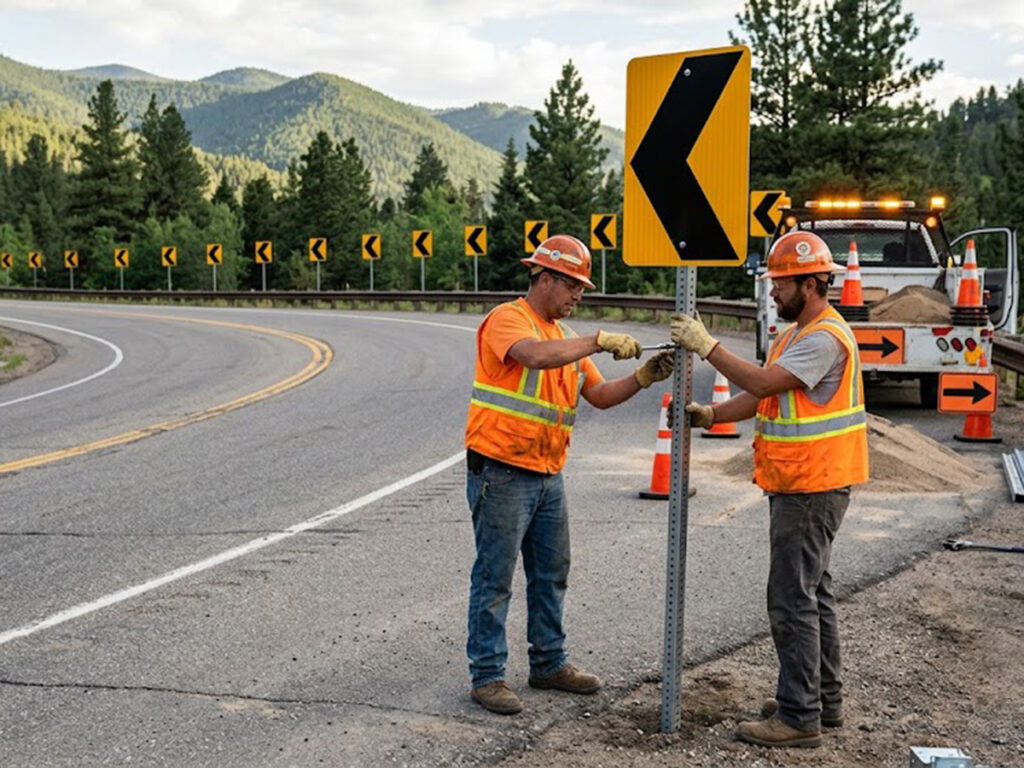
Décalage latéral par rapport au chemin parcouru
Les panneaux à chevrons sont installés à l'extérieur de la courbe (la direction vers laquelle la route tourne) et positionnés de manière à ce que la face du panneau se trouve dans le champ de vision naturel du conducteur à travers l'arc.. Le guidage MUTCD nécessite un dégagement horizontal à partir du bord de la voie parcourue, cohérent avec la zone dégagée de la chaussée., mais l’emplacement ne doit pas positionner le panneau si loin latéralement qu’il tombe en dehors de la ligne de vue périphérique du conducteur dans les virages à rayon étroit.
Sur les tronçons urbains en bordure de trottoir, les panneaux sont montés sur des poteaux détachables en retrait de la façade du trottoir. Sur les routes rurales à accotement ouvert, le message définit généralement 2 à 6 pieds de la ligne de bord. Les couloirs contraints par des garde-corps nécessitent un montage sur le matériel existant à l'aide de supports de garde-corps approuvés, mais uniquement à des fins de délimitation., pas pour marquer l'extrémité du garde-corps lui-même.
Hauteur de montage minimale – L'exigence verticale de 4 pieds
MUTCD 11e édition impose une hauteur de montage minimale de 4 pieds, mesuré verticalement depuis le bas du panneau jusqu'à l'élévation du bord le plus proche du chemin parcouru. Cela diffère de la garde au bord de la route standard de 5 pieds appliquée à la plupart des panneaux d'avertissement et reflète la proximité de la chaussée des installations de délimitation des courbes..
L'erreur de terrain la plus courante sur les sections surélevées consiste à mesurer la hauteur à partir du niveau du sol à la base du poteau plutôt qu'à partir de l'élévation de la voie parcourue.. Sur une courbe surélevée avec 8% pente transversale et retrait de 6 pieds, la différence de niveau entre la base du poteau et le bord de la voie parcourue peut dépasser 4 à 6 pouces - suffisamment pour produire une installation non conforme qui réussit une inspection occasionnelle mais échoue à une mesure RSA précise.
Alignement angulaire – Orienter chaque panneau perpendiculairement au trafic à l'approche
MUTCD exige que les panneaux à chevrons soient installés à angle droit par rapport à la direction de la circulation à l'approche – et non perpendiculairement à l'axe de la route ou à la tangente de l'autoroute.. Sur une courbe horizontale continue, le sens de la circulation à l'approche change à chaque point le long de l'arc. Chaque poteau de signalisation successif nécessite un angle de lacet ajusté progressivement.
La méthode de terrain est simple: l'installateur se tient à l'emplacement du panneau proposé, fait face à la direction du trafic venant en sens inverse à ce point spécifique le long de la courbe, et oriente la face du panneau pour qu'elle pointe directement vers cette ligne de visibilité. Sur des projets de haute précision ou à grande vitesse, une boussole à main ou un instrument optique fournit un azimut documenté pour chaque poste.
Les installations par lots où tous les poteaux sont parallèles (traitant la courbe entière comme s'il s'agissait d'une tangente) produisent des faces de panneaux mal alignées qui réfléchissent sous des angles incorrects et perdent leur efficacité rétroréfléchissante aux distances de visualisation les plus critiques..
Installations routières à double sens: Exigences relatives aux panneaux à chevrons dos à dos
Quand les panneaux dos à dos sont obligatoires
Sur deux voies, routes à double sens, La section 2C.12 du MUTCD impose une exigence obligatoire: les panneaux à chevrons doivent être recto-verso, avec des faces de signalisation orientées correctement vers le trafic venant de chaque direction. Il s'agit d'une exigence obligatoire - et non consultative. Les panneaux à chevrons unilatéraux sur les routes rurales à double sens et non divisées constituent une non-conformité directe au MUTCD..
Les ingénieurs doivent évaluer si la courbe crée des besoins de guidage d'alignement pour un ou les deux sens de déplacement.. Une courbe composée qui présente des problèmes d'alignement dans une seule direction peut nécessiter des panneaux unilatéraux pour cette direction.. Lorsque les deux directions nécessitent un guidage (condition la plus courante sur les tracés ruraux sinueux), une installation dos à dos est obligatoire..
Considérations sur le matériel de poteau et la structure pour les assemblages double face
Les installations dos à dos nécessitent des poteaux détachables conçus pour supporter une charge de vent à double signe. Un ensemble de panneaux double face présente une surface de voile composite environ le double de celle d'une installation simple face.. Les entrepreneurs doivent vérifier que le poteau sélectionné et la profondeur d'encastrement sont conformes aux critères de séparation de l'AASHTO pour ces conditions de chargement et cette classe de sol..
Le montage panneau à panneau utilise des supports de panneau dos à dos ou des assemblages de barres en Z. La contrainte critique est que les deux faces des panneaux doivent être orientées indépendamment vers leurs sens de circulation respectifs.. Sur un alignement courbe, les deux faces pointeront dans des directions divergentes — elles ne seront pas parallèles. Le montage parallèle de chevrons dos à dos sur une courbe est une erreur d'installation systématique qui annule l'efficacité d'une ou des deux faces..
Calculs d'espacement sur les courbes bidirectionnelles
Les intervalles d'espacement du tableau 2C-6 du MUTCD s'appliquent indépendamment à chaque sens de déplacement.. Sur une courbe symétrique — où chaque direction parcourt le même arc à la même vitesse — un seul emplacement physique de panneau avec des panneaux dos à dos peut satisfaire simultanément les deux séquences d'espacement.. Les courbes asymétriques nécessitent des calculs de disposition des panneaux indépendants pour chaque direction.
Les entrepreneurs qui équipent les couloirs ruraux à deux voies d'assemblages de panneaux à chevrons dos à dos devraient planifier leurs achats en fonction du nombre total de panneaux., pas de compte de messages. Chaque emplacement de poteau sur une courbe bidirectionnelle nécessite deux panneaux (un pour chaque direction) ainsi que le matériel de montage approprié à double panneau.. L'approvisionnement des deux panneaux en assemblages W1-8 assortis avec des qualités de feuilles rétroréfléchissantes cohérentes garantit des performances de visibilité nocturne uniformes dans les deux directions..
Où les formules d'espacement des signes Chevron ne s'appliquent PAS: Applications interdites
Extrémités de garde-corps et obstructions fixes
MUTCD interdit explicitement l'utilisation de panneaux d'alignement Chevron (W1-8) pour délimiter les obstacles fixes ou les extrémités de garde-corps. La famille d'appareils adaptée à ces applications est la série Object Marker. (OM-1, OM-2, OM-3) comme spécifié dans la section 2C.63 du MUTCD.
Une mauvaise utilisation sur le terrain des chevrons aux extrémités des garde-corps est une condition de non-conformité documentée et récurrente.. Les entrepreneurs qui disposent de panneaux à chevrons les déploient généralement pour marquer les terminaux de garde-corps, généralement pour combler une pénurie de matériaux.. L'interdiction MUTCD est explicite, et cette mauvaise application constitue une exposition à la responsabilité légale de l'agence d'installation. Le marqueur OM fournit le profil rétroréfléchissant correct et le conditionnement des attentes du conducteur pour la délimitation des obstacles..
Intersections en T, Impasses, et applications sans courbe
Les valeurs d'espacement du tableau 2C-6 sont dérivées pour un alignement curviligne continu où un conducteur nécessite un guidage directionnel progressif à travers un arc.. Les intersections en T et les approches sans issue impliquent des changements d'alignement brusques (et non des arcs continus) et nécessitent des assemblages de panneaux entièrement différents.: Ensembles d'avertissement de carrefour et marqueurs d'impasse, respectivement.
Routes privées, installations de stationnement, et les demandes de droit de passage non publiques ne relèvent pas de la compétence du MUTCD. Espacement des panneaux en chevron les formules du tableau MUTCD 2C-6 ne s'appliquent pas dans ces contextes. Les entrepreneurs appliquant les valeurs d'espacement dérivées de MUTCD aux courbes des établissements privés introduisent un langage réglementaire dans un contexte non réglementaire et peuvent créer une exposition juridique involontaire concernant la norme de diligence..
Zones de construction — Différentes règles s'appliquent sous la partie 6
Contrôle du trafic temporaire (TTC) les déploiements fonctionnent sous MUTCD Part 6, pas la partie 2C. Le espacement des panneaux en chevron les valeurs du tableau 2C-6 sont des valeurs d'installation permanente de la partie 2C et ne peuvent pas être directement appliquées aux contextes TTC.. Partie 6 l'espacement est régi par différentes tables, Géométries des zones TTC, et conditions de vitesse dans la zone de travail.
Les entrepreneurs qui opèrent à la fois dans des contextes de maintenance permanente et de TTC doivent maintenir une séparation opérationnelle claire entre la partie 2C et la partie 6 normes d'espacement. L'application des valeurs du tableau d'installation permanente à un déploiement TTC — ou vice versa — est une erreur de conformité qui peut être identifiée lors d'un audit de sécurité d'une zone de travail..
Flux de travail d'installation sur le terrain: Une liste de contrôle de déploiement étape par étape
Enquête préalable à l'installation et collecte de données (Étapes 1 à 4)
- Étape 1: Obtenir des plans de conception d'autoroute approuvés ou mener une enquête sur le terrain. Extraire le rayon de courbe (R.) en pieds et longueur d'arc à partir de tableaux de données géométriques ou de mesures sur le terrain.
- Étape 2: Confirmer la vitesse de conception. Si les données de vitesse de fonctionnement du 85e centile issues d'une étude de trafic dépassent la vitesse de conception, utilisez la valeur la plus élevée pour la recherche dans le tableau 2C-6.
- Étape 3: Si vous travaillez à partir d'anciens ensembles de plans avec des valeurs de degré de courbe, appliquer la formule de conversion R = 5,729.58 ÷ D avant de passer à la table d'espacement.
- Étape 4: Localisez et marquez les enjeux PC et PT. Rétablissez-les avec GPS ou station totale s'ils ne sont pas présents sur le terrain. Documenter les coordonnées dans le journal de terrain du projet pour la défendabilité du RSA.
Calcul du nombre de signes et jalonnement de la disposition (Étapes 5 à 8)
- Étape 5: Appliquer le tableau 2C-6 pour déterminer l'intervalle d'espacement (S) pour le R et la vitesse confirmés. Interpoler si R se situe entre les lignes du tableau.
- Étape 6: Calculer le nombre total de signes: N = Longueur de l'arc ÷ S. Arrondir au nombre entier supérieur.
- Étape 7: Implantation des emplacements des poteaux depuis le PC à l'intervalle S à travers la courbe jusqu'au PT. Ajustez l'intervalle final vers l'intérieur si l'arc ne se divise pas uniformément.
- Étape 8: Ajustez l'alignement angulaire de chaque piquet pour l'orienter perpendiculairement à la direction de la circulation à ce point spécifique le long de la courbe.. Utilisez une boussole manuelle sur des projets de haute précision.
À ce stade du processus de déploiement – avec le nombre de panneaux confirmé et les emplacements des postes jalonnés – les entrepreneurs doivent finaliser leur achat de panneaux W1-8.. Demander un devis groupé pour des panneaux à chevrons conformes au MUTCD à cette étape évite les pénuries de matériaux à mi-projet sur les installations de couloirs multi-courbes.
Paramètres de publication, Montage sur panneau, et inspection finale (Étapes 9 à 12)
- Étape 9: Réglez les poteaux détachables à la profondeur d'encastrement requise selon les critères de séparation AASHTO pour la classe de sol du projet.. Vérifier l'aplomb du poteau avant de remblayer.
- Étape 10: Montez les panneaux de signalisation à la bonne hauteur – bas du panneau au minimum 4 pieds au-dessus de l'élévation du chemin parcouru près du bord. Vérifier avec une tige de niveau ou un laser sur les sections surélevées; ne pas mesurer à partir du niveau du sol après la base.
- Étape 11: Pour installations dos à dos sur routes à double sens, monter et orienter indépendamment chaque panneau vers sa direction de circulation respective.
- Étape 12: Effectuer une inspection au volant dans les deux directions à la vitesse de conception ou à proximité. Vérifier la visibilité rétroréfléchissante et l'alignement angulaire. Document avec photographies horodatées pour le dossier de conformité du projet.
Vérification de la conformité: Liste de contrôle sur le terrain et documentation post-installation
Liste de contrôle de conformité MUTCD — Points de vérification sur le terrain
| Élément d'inspection | Exigence MUTCD |
| Intervalle d'espacement | Selon le tableau 2C-6 (R. + vitesse) |
| Position du premier signe | Sur ou en amont du PC |
| Orientation du visage du panneau | Perpendiculaire à la circulation en approche |
| Hauteur de montage (bas) | Min.. 4 pieds au-dessus du chemin parcouru près du bord |
| Routes à double sens | Panneaux dos à dos, visant de manière indépendante |
| Extrémités du garde-corps / obstructions | Chevrons INTERDITS — utilisez la série OM |
| Conformité des panneaux de signalisation | W1-8, Feuille rétroréfléchissante conforme à la norme MUTCD |
Exigences de documentation pour la responsabilité et la préparation au RSA
Les agences et les entrepreneurs doivent conserver des dossiers spécifiques pour défendre une espacement des panneaux en chevron installation contre les conclusions du RSA ou la découverte d'un délit. La documentation requise comprend: notes de terrain avec entrées R et vitesse, Feuilles de calcul de recherche du Tableau 2C-6, Coordonnées GPS de chaque emplacement de poste, le calcul du nombre de signes, enregistrements photographiques de l'installation finale, et certificats de conformité des matériaux pour les panneaux W1-8, y compris les spécifications de qualité des feuilles rétroréfléchissantes.
L'absence de documentation sur le calcul de l'espacement est traitée lors d'un RSA ou d'un litige comme une absence de diligence raisonnable en matière d'ingénierie.. Les agences qui s'appuient sur le jugement de l'entrepreneur sur le terrain sans formule documentée assument l'entière responsabilité de toute non-conformité d'espacement.. Une documentation structurée à chaque étape d'installation ne représente pas une surcharge administrative : c'est une protection contre la responsabilité..
Rester à jour: MUTCD 11e édition et surveillance des suppléments d'État
Le MUTCD 11e édition, adoptée comme norme fédérale dans 2023, introduit des révisions que les ingénieurs et les entrepreneurs doivent vérifier par rapport à la pratique antérieure. Les DOT des États pourraient imposer des mesures plus strictes espacement des panneaux en chevron intervalles, exigences de délimitation supplémentaires sur les courbes à risque élevé de collision, ou qualité minimale de feuille rétroréfléchissante améliorée.
Les ingénieurs doivent faire des références croisées au manuel de contrôle de la circulation de leur État ou au manuel standard de signalisation et de marquage routier, projet par projet.. Un plan d'espacement conforme aux minimums fédéraux MUTCD peut toujours être non conforme en vertu d'un supplément d'État – et les exigences de supplément d'État régissent dans ces juridictions..
Pour une référence complète couvrant la sélection des signes MUTCD, dimensionnement, contextes d'application, et les spécifications de conformité pour chaque cas d'utilisation de panneaux à chevrons - pas seulement les courbes horizontales - le normes complètes en matière de panneaux à chevrons, placement, et guide des spécifications fournit un aperçu technique définitif à source unique pour les ingénieurs de la circulation et les entrepreneurs travaillant sur tout projet réglementé par MUTCD.
Foire aux questions: Espacement des panneaux en chevron et installation de courbes horizontales
Quel est l'espacement correct des panneaux à chevrons pour une courbe horizontale?
Espacement des panneaux en chevron est déterminé par le tableau MUTCD 2C-6 en utilisant deux entrées: rayon de courbe (R.) en pieds et vitesse de conception ou de fonctionnement en mph. Il n'y a pas d'intervalle d'espacement universel : chaque courbe nécessite une recherche de table individuelle. Les intervalles typiques vont de 40 pieds dans les courbes serrées (R. < 300 ft) à 160-200 pieds dans les courbes douces à grande vitesse (R. > 1,000 ft).
Comment les ingénieurs calculent-ils le nombre total de panneaux à chevrons nécessaires pour une courbe?
Après avoir déterminé l'intervalle d'espacement (S) du tableau 2C-6, les ingénieurs divisent la longueur totale de l'arc par S pour obtenir le nombre de signes: N = Longueur de l'arc ÷ S, toujours en arrondissant. Pour une courbe avec 800 pieds d'arc et un intervalle d'espacement de 80 pieds, le nombre minimum requis est 10 signes.
Quelle est la hauteur de montage minimale pour les panneaux d'alignement à chevrons?
MUTCD 11e édition exige que le bas du panneau soit au minimum de 4 pieds au-dessus de l'élévation du bord le plus proche du chemin parcouru, mesuré verticalement. Cette mesure doit faire référence à l'élévation de la voie parcourue - et non au niveau du sol à la base du poteau - ce qui est essentiel sur les sections surélevées..
Les panneaux à chevrons peuvent-ils être utilisés pour marquer les extrémités des garde-corps ou les obstructions fixes?
Non. MUTCD interdit explicitement les panneaux d'alignement Chevron (W1-8) d'être utilisé pour délimiter des obstructions fixes ou des terminaux d'extrémité de garde-corps. Les appareils appropriés pour ces applications sont les marqueurs d'objets (OM-1, OM-2, OM-3) comme spécifié dans la section 2C.63 du MUTCD. L'utilisation de chevrons dans ces contextes constitue un constat de non-conformité direct.
Sur une voie à deux voies, route à double sens, les panneaux à chevrons doivent-ils être orientés dans les deux sens?
Oui, il s'agit d'une exigence obligatoire du MUTCD. Sur deux voies, routes à double sens, les panneaux à chevrons doivent être recto-verso (dos à dos) avec chaque face visant indépendamment à s'approcher du trafic dans sa direction respective. Les intervalles d'espacement du tableau 2C-6 doivent être appliqués indépendamment pour chaque sens de déplacement..
Quelle est la formule pour convertir le degré de courbe en rayon pour le tableau 2C-6?
La conversion standard est R = 5,729.58 ÷D, où R est le rayon en pieds et D est le degré de courbe. Par exemple, une courbe de 10° se convertit en R = 5,729.58 ÷ 10 = 572.96 pieds. Cette conversion est essentielle lorsque vous travaillez à partir d'anciens ensembles de plans d'autoroute qui expriment l'alignement sous forme de degré de courbe plutôt que de rayon..
Références
- Administration des routes fédérales (Fhwa). Manuel sur les dispositifs de contrôle de la circulation uniformes (Mutcd), 11ème édition, 2023. Article 2C.12: Panneaux d'alignement à chevrons.
- Administration des routes fédérales (Fhwa). Sécurité FHWA — Sécurité à courbe horizontaley.
- Association américaine des responsables de l'autoroute et des transports d'État (Aashto). Guide de conception en bordure de route, 4ème édition. Critères des poteaux détachables et normes de support des panneaux.
- Administration des routes fédérales (Fhwa). Panneaux et marquages routiers standard (SHSM), 2023 Edition. Spécifications du panneau d'alignement à chevrons W1-8.