Cada año, Miles de incidentes en zonas de trabajo ocurren en EE. UU.. caminos. Los EE. UU.. Oficina de Estadísticas Laborales documentada 856 Lesiones laborales fatales en la industria de la construcción en 2022, y Control Temporal de Tráfico inadecuado (TTC) La señalización sigue siendo un factor que contribuye a muchos accidentes en zonas de trabajo. (Fuente: https://www.bls.gov/iif/home.htm). El Control Temporal de Tráfico del MUTCD (TTC) secuencia - anclada por el W20-2 “Desviar por delante” Señal de advertencia y guiado por la M4-9. “Desvío” La señal direccional, designada M4-9, se encuentra en la primera línea de esa protección..
El MUTCD 11ª edición, Totalmente efectivo para proyectos de ayuda federal a partir de enero. 18, 2026 (por 23 Parte CFR 655), eleva el listón del rendimiento del material, colocación avanzada, y resistencia al choque del hardware. Los contratistas deben garantizar el cumplimiento tanto del MUTCD nacional como de los suplementos estatales aplicables del DOT., que reemplazan legalmente las líneas de base federales según la Sección 1A.03. Esta guía ofrece todos los requisitos que los contratistas necesitan para implementar un sistema compatible. Señal de desvío adelante MUTCD configurar en 2026.
Por qué la 11.ª edición del MUTCD cambia lo que está en juego para el cumplimiento de las señales de desvío por delante 2026
lo legal & Peso de responsabilidad del cumplimiento de MUTCD para contratistas de TTC
El MUTCD tiene fuerza de ley federal.. Bajo 23 Parte CFR 655, Todos los dispositivos de control de tráfico en carreteras abiertas al público deben cumplir con los estándares MUTCD.. Los contratistas, no solo los propietarios de proyectos, asumen la responsabilidad directa cuando las configuraciones no conformes contribuyen a accidentes en las zonas TTC..
Las compañías de seguros y los abogados demandantes examinan cada vez más los registros de cumplimiento de MUTCD durante el descubrimiento posterior al incidente.. Un plan TTC firmado que hace referencia a distancias de colocación de letreros que no cumplen con las normas o a la falta de documentación de retrorreflectividad crea una exposición directa a la negligencia.. El despliegue adecuado de señales de desvío anticipado de MUTCD es una obligación legal, no es una mejor práctica.
Novedades de la undécima edición que afectan la señalización de desvíos
La undécima edición agudiza la orientación naranja fluorescente, pasar de una opción calificada a una recomendación sólida con fundamentos de desempeño explícitos para aplicaciones TTC. Las tablas de colocación avanzada actualizadas ajustan los requisitos de espaciado basados en PIEV que los contratistas utilizan para colocar el Señal de desvío adelante MUTCD en relación con los cierres.
La consolidación de los requisitos de soporte a prueba de choques y el lenguaje aclarado sobre la obstrucción del frente de las señales también tienen implicaciones reales en el campo.. Estos son medibles, cambios inspeccionables, no revisiones editoriales. Los contratistas que traten la 11.ª edición como una actualización menor lo harán bajo su propio riesgo..
Decodificando la secuencia de señales de desvío TTC: Advertencia W20-2 vs.. Serie direccional M4-9
Cómo encaja el M4-9 dentro de la secuencia completa de señales TTC
El MUTCD clasifica los “Trabajo por carretera por delante” (W20-1) y “DESVÍO ADELANTE” (W20-2) bajo la Serie W (Señales de advertencia), mientras que el “DESVÍO” Los marcadores de ruta se colocan debajo de la Serie M. (Letreros de guía, subserie M4). Dentro de una zona TTC compatible, el diseño se ejecuta cronológicamente: Señales de advertencia anticipada (Desvío W20-2 por delante) → Tableros de flechas intermitentes/conos → Guías direccionales de intersección (Desvío M4-9 con flecha) → Finalizar desvío (M4-8a).
Estándar VS. Naranja fluorescente — El 2026 Decisión material
Según MUTCD 11.ª edición, sección 6F.02, norma federal eleva especificación de materiales para Control Temporal de Tráfico (TTC) letreros, definir el uso de láminas retrorreflectantes de color naranja fluorescente según una guía formal (Debería) declaración. Mientras que el naranja estándar cumple con las bases técnicas, El naranja fluorescente proporciona una luminancia diurna y de transición considerablemente superior, especialmente al amanecer., oscuridad, y durante condiciones climáticas adversas, porque absorbe la luz ultravioleta y la reemite dentro del espectro visible..
Directrices estrictas de la undécima edición para el color naranja fluorescente en todas las señales de TTC, incluido el W20-2 “Desviar por delante” firmar, está respaldado por décadas de investigación de datos de accidentes de la FHWA.
⚠️ Auditoría PE & Desviaciones estatales: Si bien el MUTCD Nacional estructura esto como un “Debería” (Guía) hito, múltiples autoridades estatales, incluido el FDOT, PennDOT, MasaDOT, y MDOT — haber actualizado esta cláusula hasta convertirla en una norma obligatoria (Deber) requisito dentro de los suplementos TTC de su estado. Los contratistas que operan en carreteras estatales o con ayuda federal deben verificar las enmiendas localizadas antes de la adquisición., ya que las láminas naranjas estándar provocarán fallas inmediatas en la inspección del DOT en estas jurisdicciones.
Selección de tamaño basada en la aplicación: elección de la señal adecuada para su tipo de carretera
Selección basada en la velocidad: Hacer coincidir el tamaño de la señal con la clasificación de la carretera
Lazos de orientación MUTCD Señal de desvío adelante MUTCD tamaño directamente a la velocidad de operación y clasificación de la carretera. Seleccionar una señal de tamaño insuficiente para una vía de alta velocidad es una falta de cumplimiento, no una opción de ahorro de costos. La siguiente tabla resume las reglas de dimensionamiento operativas.:
| Tipo de signo & Código | Clasificación de carreteras | Tamaño estándar (MUTCD 11ª Ed.) |
| Desvío W20-2 por delante (Diamante) | Camino Convencional / Urbano | 36″ x 36″ (Opción por 30″ x 30″ bajo la Sección 6C.04) |
| Autopista / autopista | 48″ x48″ | |
| Desvío M4-9 (con flecha) (Rectángulo) | Camino Convencional | 30″ x 24″ |
| autopista / Autopista | 48″ x 18″ |
Fuente: MUTCD 11ª edición, Parte 6 — Control de tráfico temporal.
Zonas de trabajo urbanas de baja velocidad: cuando llegue el 30″×36″ Aplica mínimo
Según la Sección 6C.04 (Tabla 6C-1), para calles residenciales urbanas con velocidades de operación iguales o inferiores 30 mph, una opción (Puede) existe para reducir el tamaño del letrero W20-2 a 30″ × 30″. Sin embargo, Esta reducción de tamaño requiere un juicio de ingeniería documentado con respecto al espacio lateral restringido o perfiles de baja velocidad..
Incluso en tamaño mínimo, se aplica la lista de verificación de cumplimiento completa: grado de retrorreflectividad correcto, hardware de soporte a prueba de choques, y distancia de colocación precisa. Las dimensiones compactas no reducen ninguna otra obligación..
Colocación avanzada de MUTCD & Estándares de espaciado: conseguir la distancia correcta en todo momento
Comprender el tiempo PIEV y por qué rige la distancia de colocación
PIEV — Percepción, Identificación, Emoción, Volición: representa el tiempo físico y cognitivo total que un conductor necesita para ver una señal., procesar su mensaje, decidir actuar, y ejecutar una maniobra del vehículo. Las tablas de ubicación avanzada de MUTCD están diseñadas al revés a partir de este cálculo de factores humanos.. A Señal de desvío adelante MUTCD colocado demasiado cerca del cierre da a los conductores un tiempo de reacción insuficiente, independientemente de qué tan bien esté fabricado el letrero en sí.
En caminos rurales de alta velocidad donde los vehículos viajan entre 60 y 65 mph, la banda de colocación avanzada de 350 a 500 pies proporciona la ventana de reacción mínima segura. En las calles urbanas en 30 mph, 100–200 pies cubren el requisito de PIEV. Demanda de autopistas 1,000 pies o más. La distancia de ubicación es el error más citado en las investigaciones de accidentes en zonas de TTC.
Nota: Los criterios de espaciado exacto se rigen por la Tabla 6C-4. (Distancia de colocación de la señal de advertencia anticipada) basado en la desaceleración hasta detenerse o en los tiempos de decisión de maniobra.
Cuándo y cómo implementar placas de distancia
Al utilizar el modo independiente “DESVÍO” señal de advertencia, placas suplementarias (como W16-2P para “XX PIES” o W16-3aP para “XX MILLAS”) debe montarse de forma segura debajo del letrero principal. Para el letrero estándar W20-2, que ya integra la “ADELANTE” texto, Las placas retrorreflectantes específicas de la distancia aclaran las ventanas de reacción precisas para el tráfico que viene en sentido contrario..
Las placas de distancia no son mejoras opcionales.. En proyectos de autopistas, La guía de MUTCD requiere un aviso con suficiente antelación de que una placa es el único mecanismo práctico de entrega. La selección de la placa debe documentarse en el plan TTC y debe coincidir con la distancia de colocación medida en el campo.. Los inspectores del DOT verifican la precisión de la placa comparándola con mediciones físicas.
Proyectos rurales y de autopistas de alta velocidad: el 1,000+ Pie estándar
En autopistas y autopistas, el 1,000+ El estándar de colocación avanzada de pies refleja tanto velocidades de operación más altas como la distancia de decisión más larga que los conductores necesitan para incorporarse de manera segura., decelerar, y desviar. Una única señal de desvío de MUTCD en 1,000 ft representa el umbral mínimo, no la solución completa.
Los planes TTC específicos de proyectos en corredores de gran volumen frecuentemente especifican ubicaciones escalonadas en 2,000 ft y 1,000 pie, particularmente donde la geometría horizontal limita las líneas de visión. El hardware de señalización en estas ubicaciones debe cumplir con requisitos mejorados de resistencia a choques dada la elevada energía de impacto a velocidades de autopista..
| Tipo de carretera | Colocación avanzada | Tipo de placa | Referencia clave de MUTCD |
| Urbano de baja velocidad (≤ 30 mph) | 100–200 pies | ADELANTE | MUTCD Parte 6C |
| Rural Convencional (35–55 mph) | 350–500 pies | XX PIES | MUTCD Parte 6C |
| Autopista / autopista (≥ 55 mph) | 1,000+ pie | XX MILLAS | MUTCD Parte 6G |
Fuente: FHWA MUTCD 11ª edición, Parte 6 — Control de tráfico temporal.
Mandatos de retrorreflectividad: lo que requiere la undécima edición durante la noche
Selección del tipo de lámina: igualar la pendiente con la velocidad de la carretera
La retrorreflectividad es un mandato federal. La regla de la FHWA bajo 23 Parte CFR 655 La subparte F requiere que todas las señales de control de tráfico, incluidas las señales TTC, mantengan un rendimiento retrorreflectante mínimo durante toda su vida útil.. Dos categorías principales de láminas gobiernan Señal de desvío adelante MUTCD obtención:
- Tipo III/IV (Lente encapsulada): Adecuado para aplicaciones TTC en carretera convencionales. Rentable para corredores de velocidad estándar.
- Tipo IX/XI (Micropropismático): Requerido para carreteras y autopistas de alta velocidad. Ofrece las distancias de reconocimiento que exigen los cálculos PIEV en 55+ mph.
Mezclar grados de láminas entre letreros en una única secuencia TTC crea una luminancia desigual y provoca inconsistencias en la inspección. Los equipos de adquisiciones que estandarizan las láminas microprismáticas eliminan la variabilidad del cumplimiento a nivel de campo en todos los tipos de proyectos..
Gestión de la degradación de los letreros: el deber de cumplimiento continuo del contratista
Las láminas retrorreflectantes tienen una vida útil definida, normalmente de 7 a 10 años para materiales microprismáticos en condiciones de servicio TTC.. Exposición a los rayos UV, impacto fisico, y la contaminación de la superficie aceleran la degradación. Los programas de cumplimiento del MUTCD y del DOT estatal exigen que los contratistas realicen inspecciones visuales nocturnas periódicas de los letreros TTC desplegados..
Cualquier Señal de desvío adelante MUTCD con rendimiento reflectante visiblemente comprometido deben retirarse y reemplazarse inmediatamente. La undécima edición también deja explícito que las caras de los letreros nunca deben bloquearse ni quedar parcialmente oscurecidas por banderas., luces intermitentes, u otros dispositivos. Mantener un registro del estado de los letreros con fecha es un escudo de responsabilidad documentado en caso de un accidente nocturno en la zona TTC..
Soportes de señales resistentes a colisiones en zonas TTC: los requisitos de hardware que los contratistas pasan por alto
Identificar límites de zona claros en su proyecto
El MUTCD requiere soportes de señales a prueba de choques (de ruptura o de cesión) para cualquier instalación dentro de la zona despejada de una carretera.. El ancho de la zona despejada varía según la velocidad y el tipo de carretera.: en un 45 mph camino rural de dos carriles, puede extenderse de 18 a 30 pies más allá del borde del carril de circulación; en un 30 mph calle urbana, puede ser tan estrecho como de 4 a 6 pies. La Guía de diseño de carreteras de AASHTO proporciona las tablas definitivas de zonas claras por velocidad y terreno.. (Fuente: https://store.transportation.org/item/collectiondetail/180)
Los contratistas deben consultar los planes de diseño de la carretera del proyecto o las tablas de zonas claras del DOT estatales aplicables antes de solicitar soportes para cualquier Señal de desvío adelante MUTCD instalación. No existe ninguna exención basada en la duración; ni siquiera los escenarios de TTC de corta duración eximen los requisitos de resistencia al impacto..
Sistemas de soporte aprobados: qué especificar y qué evitar
Los sistemas de soporte probados por MASH y aceptados por MUTCD para instalaciones de letreros TTC incluyen:
- Sistemas separables de un solo poste de madera o acero con mecanismos de base deslizante
- Postes de soporte con base deslizante estilo tubo clasificados para MASH TL-3
- base ponderada (lastrado con sacos de arena) soportes de letreros portátiles: apropiados para TTC de corta duración
- Canalización de marcos de letreros montados en dispositivos utilizados dentro de la zona canalizada
Advertencia crítica: Los postes de canal en U de acero estándar clavados directamente en el suelo sin un mecanismo de base deslizante siguen estando ampliamente disponibles, pero son rígidos y no cumplen con los requisitos de resistencia a choques.. Su prevalencia en el campo no los hace cumplidores. La especificación de hardware probado por MASH TL-3 en todo el inventario de soporte de la organización elimina las fallas de inspección más comunes relacionadas con el hardware..
Creación de una configuración lista para la inspección del DOT: lista de verificación de campo para contratistas
La lista de verificación de cumplimiento de señales previa a la implementación (W20-2 & División del silo M4-9)
Antes de que cualquier zona TTC con una configuración de desvío entre en funcionamiento, Los supervisores del sitio deben verificar físicamente los siguientes tipos distintos de señales., mapeando su geometría específica, dimensiones, y colocación según los estándares oficiales de la 11.ª edición de MUTCD:
Componente de advertencia anticipada: “DESVÍO ADELANTE” (W20-2) Firmar
- Designación: Designación & Forma: Verifique que el letrero sea un diamante naranja. (W20-2) con leyenda negra en negrita.
- Color de fondo: Naranja (fluorescente preferido según la 11.ª edición)
- Dimensiones & Apresto:
- 36″ × 36″ para carreteras convencionales y arterias de baja velocidad.
- 48″ × 48″ para autopistas de alta velocidad, autopistas, o autopistas de varios carriles.
- Nota: Una reducción temporal a 30″ × 30″ está permitido sólo en calles residenciales urbanas con velocidades indicadas iguales o inferiores 30 mph bajo estricto criterio de ingeniería.
- Distancia de colocación (Ventana PIEV): Mida físicamente y verifique que el letrero esté colocado antes del estrechamiento del carril o del punto de cierre.:
- Urbana de baja velocidad (≤ 30 mph): 100 a 200 Colocación avanzada de los pies..
- Rural Convencional (35–55 mph): 350 a 500 Colocación avanzada de los pies..
- Autopista / autopista (≥ 55 mph): 1,000 a 1,500+ Colocación avanzada de los pies..
- Placas de distancia (Si corresponde): Si se utilizan subplacas suplementarias (P.EJ., W16-2P “XX PIES”), asegúrese de que estén montados directamente debajo del diamante W20-2 y que la leyenda de distancia coincida con las mediciones físicas en el sitio.
Componente de guía direccional: “DESVÍO” con flecha (M4-9) Firmar
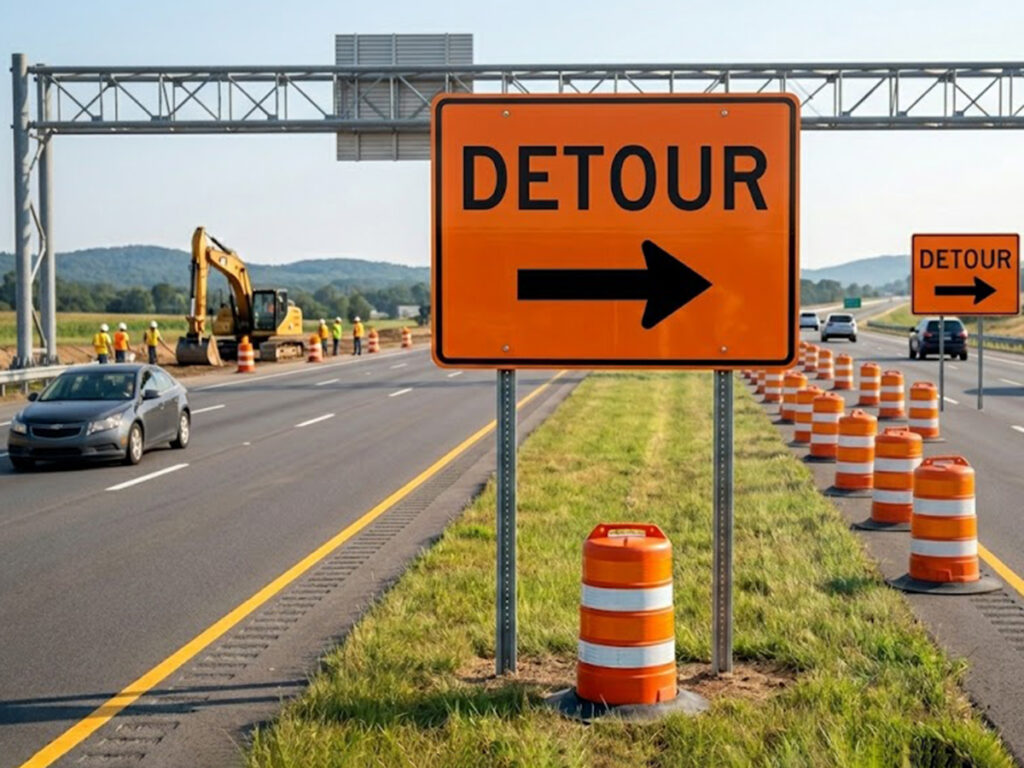
- Designación & Forma: Verifique que el letrero sea un rectángulo horizontal naranja. (M4-9) con una flecha direccional negra y nítida.
- Dimensiones & Apresto:
- 30″ × 24″ Tamaño estándar para calles e intersecciones convencionales..
- 48″ × 18″ para rampas de autopista, autopistas, y desvíos de alta velocidad.
- Colocación & Orientación: Confirme que el M4-9 esté colocado exactamente en el punto del giro. (entrada de intersección o rampa). La flecha física debe apuntar exactamente en la dirección de la ruta de desvío.. No debe colocarse prematuramente en la zona de advertencia anticipada, donde podría provocar cambios erráticos de carril del conductor..
Material compartido & Estándares de hardware (Todos los carteles desplegados)
- Color de fondo: Láminas de color naranja fluorescente estándar en todas las caras (Muy recomendado en la 11ª edición para impulsar el amanecer., oscuridad, y luminancia nocturna).
- Grado de láminas:
- Tipo III/IV (Prismático de alta intensidad) mínimo para aplicaciones convencionales estándar.
- Tipo IX/XI (Micropropismático) Se requiere que las carreteras de alta velocidad cumplan con los techos de retrorreflectividad obligatorios..
- Claridad de la cara del signo: Asegúrese de que no haya banderas de advertencia, luces intermitentes, o corchetes oscurecen o superponen cualquier parte del borde retrorreflectante o la leyenda del texto.
- Hardware de soporte: Confirme que todos los soportes ubicados dentro del límite de la zona despejada sean sistemas de separación resistentes a choques probados por MASH TL-3 o soportes portátiles lastrados con sacos de arena.. Están estrictamente prohibidos los postes de canal en U accionados estándar sin un mecanismo de base deslizante separable certificado..
Los inspectores de campo del DOT utilizan una lista de verificación funcionalmente equivalente. Los contratistas que se autoauditan según esta norma informan constantemente menos hallazgos de cumplimiento y autorizaciones de inspección más rápidas..
Colocación & Verificación de espaciado: protocolo de medición de campo
La medición de campo para la verificación de ubicación se ejecuta de la siguiente manera: identificar el punto de cierre (Dispositivo de inicio cónico o canalización de cables.) → medir hacia atrás a lo largo del carril de circulación a la distancia aplicable basada en PIEV → marcar la posición de la señal → verificar el espacio libre en la línea de visión con una verificación física de la línea de visión.
En alineaciones curvas, la distancia lineal por sí sola es insuficiente. A Señal de desvío adelante MUTCD colocado a la distancia medida correcta aún puede fallar si una curva horizontal restringe la línea de visión de aproximación. La línea de visión debe ser confirmada físicamente.. Desviaciones de colocación superiores 10% del plan TTC aprobado debe ser marcado para revisión del ingeniero de registro antes de que el carril se abra al tráfico.
Conclusiones sobre adquisiciones: especificación de señales de desvío anticipadas que cumplan con las normas para 2026 Proyectos
Cinco puntos de control de especificaciones para cada orden de compra
Las decisiones de adquisición tomadas previamente eliminan las fallas de cumplimiento de campo más comunes. Para cada pedido de señalización relacionado con desvíos, Los gerentes de adquisiciones deben dividir las especificaciones en dos categorías distintas de MUTCD 11.a edición y verificar:
- Designaciones de signos & Geometría: Separe claramente el pedido en W20-2 “DESVÍO ADELANTE” letreros (Forma de diamante para avisar con antelación) y M4-9 “DESVÍO” letreros (Rectángulo horizontal con una flecha direccional para guiar la intersección). Nunca solicite una designación fusionada o no estándar.
- Dimensiones ligadas a la forma: Verifique que las dimensiones coincidan con los perfiles de letreros específicos. Los diamantes W20-2 deben pedirse en 36″×36″ (caminos convencionales) o 48″×48″ (autopistas). Los rectángulos M4-9 deben pedirse en 30″× 24″ (intersecciones estándar) o 48″× 18″ (rampas de autopista).
- Grado de lámina adaptado a la velocidad: Especifique láminas de color naranja fluorescente en todos los artículos.. Garantizar que los corredores de alta velocidad utilicen láminas microprismáticas Tipo IX o XI para satisfacer las distancias obligatorias de reconocimiento PIEV.; El mínimo de tipo III/IV está reservado estrictamente para aplicaciones convencionales de baja velocidad..
- Certificación de documentación de cumplimiento: Exigir al proveedor que proporcione una hoja de especificaciones de cumplimiento de láminas ASTM D4956 certificada y cartas de certificación del fabricante que indiquen explícitamente el cumplimiento de la 11.ª edición de MUTCD para presentaciones de ingeniería inmediatas al DOT..
- Hardware de soporte probado por MASH: Haga coincidir la orden de soporte con el diseño de zona clara del proyecto. Todos los soportes portátiles temporales o postes permanentes deben poseer la certificación MASH TL-3 documentada a prueba de choques.; Los postes de canal en U rígidos estándar sin mecanismos de separación de base deslizante certificados deben rechazarse en el momento de la adquisición..
Trabajar con proveedores: preguntas que debe hacer antes de comprar
Los proveedores que no pueden responder preguntas sobre cumplimiento con documentación (no con garantía verbal) representan un riesgo de adquisición en proyectos de licitación del DOT.. Los contratistas deben confirmar:
- ¿Este letrero cumple con las especificaciones TTC de MUTCD 11.a edición??
- ¿Qué tipo de lámina ASTM D4956 se utiliza??
- ¿Cuál es la vida útil nominal??
- ¿Está probado el hardware de soporte MASH TL-3??
- ¿Se puede proporcionar una hoja de especificaciones para la presentación al DOT??
La consolidación en una única especificación de señalización compatible simplifica la preparación de la inspección, reduce el costo unitario a través de adquisiciones en volumen, y garantiza una formación constante de la tripulación. El cumplimiento de las adquisiciones es la decisión inicial que facilita cada paso posterior del cumplimiento en el campo..
Listo para asegurar su 2026 El inventario de TTC cumple con los estándares de la 11.ª edición? Explore nuestra gama completa de señales de desvío adelante que cumplen con MUTCD o contacta con nuestro equipo para precios al por mayor y soporte de especificaciones.
Para los contratistas que construyen una base de cumplimiento completa, desde la designación de señales y estándares de materiales hasta los requisitos federales de señales de desvío en todas las aplicaciones regidas por MUTCD, el Manual completo de cumplimiento de señales de desvío de MUTCD que cubre las especificaciones federales y estatales del DOT. proporciona el punto de referencia autorizado para 2026 Proyectos TTC.
Preguntas frecuentes: Cumplimiento de las señales de desvío adelante del MUTCD para contratistas
¿Cuál es la designación MUTCD correcta para una señal de desvío adelante??
El MUTCD designa la señal de desvío más adelante como M4-9, clasificándolo dentro de las señales guía de la Serie M y la subserie de desvío M4. El letrero presenta un fondo retrorreflectante de color naranja con una leyenda y un borde negros.. Funciona como señal guía de advertencia avanzada en zonas TTC, alertar a los conductores sobre un desvío antes del punto de cierre físico.
¿Qué tamaño de señal de desvío adelante requiere la 11.ª edición de MUTCD??
La selección de tamaño depende de la aplicación: 36″×36″ para carreteras convencionales, 48″×48″ para autopistas y autopistas de alta velocidad, y 30″×36″ como mínimo para calles urbanas de baja velocidad en 30 mph o menos. Implementar una señal más pequeña de lo que requiere el tipo de carretera es una falla directa de cumplimiento de MUTCD, sin importar el costo o la logística.
¿Con cuánta antelación se debe colocar una señal de desvío de la zona de trabajo??
Distancias de colocación basadas en PIEV: 100–200 pies para vías urbanas de baja velocidad, 350–500 pies para caminos rurales de alta velocidad, y 1,000+ pies para autopistas y autopistas. En aproximaciones de alta velocidad, placas de distancia suplementarias - “ADELANTE,” “XX PIES,” o “XX MILLAS” — debe acompañar al W20-2 o al DETOUR estándar (W20-2) firmar para satisfacer el requisito completo de advertencia previa.
¿Se requiere naranja fluorescente para las señales de desvío según la 11.ª edición de MUTCD??
La undécima edición recomienda encarecidamente el color naranja fluorescente para todas las señales TTC, incluyendo el Señal de desvío adelante MUTCD, citando una visibilidad diurna superior. Varios DOT estatales han convertido esta recomendación en un requisito estricto.. Los contratistas deben verificar el estándar estatal aplicable antes de la adquisición., ya que el naranja estándar puede pasar la revisión federal pero no pasar la inspección estatal del DOT.
¿Los soportes de las señales para las señales de desvío deben ser resistentes a los choques??
Sí, cualquier soporte colocado dentro de la zona despejada debe ser resistente a choques. (separarse o ceder) según los requisitos de MUTCD, independientemente de la duración del TTC. Los soportes rígidos que no son a prueba de choques crean responsabilidad directa del contratista cuando son golpeados por vehículos errantes. Postes separables probados MASH TL-3, sistemas de base deslizante, y soportes portátiles con lastre adecuado son las opciones que cumplen con el estándar.
Referencias
- A NOSOTROS. Oficina de Estadísticas Laborales - Censo de Lesiones Ocupacionales Fatales (director financiero), 2022
- FHWA— Manual en dispositivos de control de tráfico uniformes (Muescato) 11décima edición
- FHWA MUTCD 11ª edición PDF — Parte 6: Control de tráfico temporal
- FHWA— 23 Parte CFR 655: Dispositivos de control de tráfico
- FHWA— Mantenimiento de la retrorreflectividad de las señales de tráfico
- ASTM Internacional — Especificación estándar D4956 para láminas retrorreflectantes