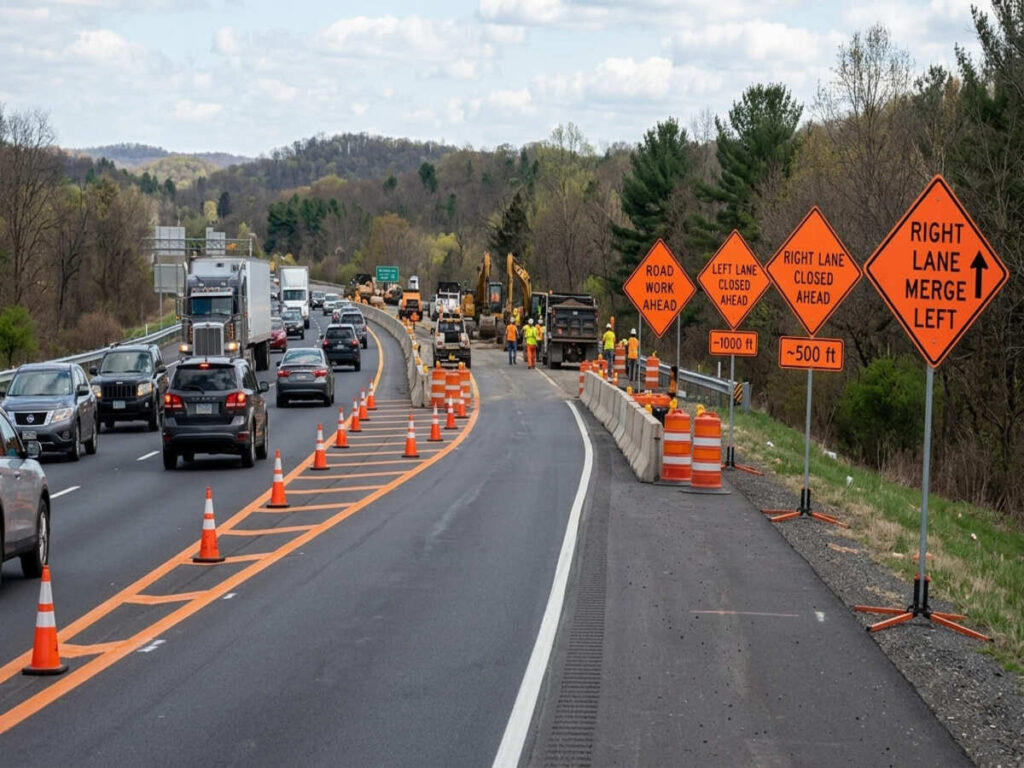
A highway merge sign looks like it only needs to go up somewhere before two lanes become one. In der Praxis, getting that “somewhere” right is what separates a smooth merge from a last-second scramble. Post it too close to the merge point, and drivers barely have room to react. Post the wrong merge sign entirely, and drivers misjudge who has priority.
Our team has reviewed work zone plans with this exact problem. A highway merge sign went up at the exact spot where two separate approach lanes actually joined into one. It wasn’t placed far enough back to give drivers advance notice. That distance matters even more on a work zone merge than a permanent one. Drivers have no prior familiarity with the layout.
This guide covers three things. Erste, what the merge sign actually communicates. Zweite, how it differs from a Lane Ends sign. Dritte, how far back it needs to sit for the approach speed.
Key Takeaways
- Verschmelzen (W4-1) vs. Spur endet (W4-2): A merge sign applies where two separate traveled ways join. A Lane Ends sign applies where one through lane discontinues.
- Advance Placement Scales With Speed: A higher-speed approach needs the sign posted farther back, not the same fixed distance used everywhere.
- Work Zone Merges Have No Familiarity Buffer: Drivers on a permanent merge often know it’s coming. A temporary work zone merge gives them no such warning.
- Priority Isn’t Always Obvious: The merge sign alone doesn’t establish which lane has priority; companion signage or striping needs to make that clear.
- Two Temporary Tapers Merging Needs Extra Care: When two separate work zone lanes converge into one, both approaches need matched signage, not just one side.
What a Highway Merge Sign Actually Means
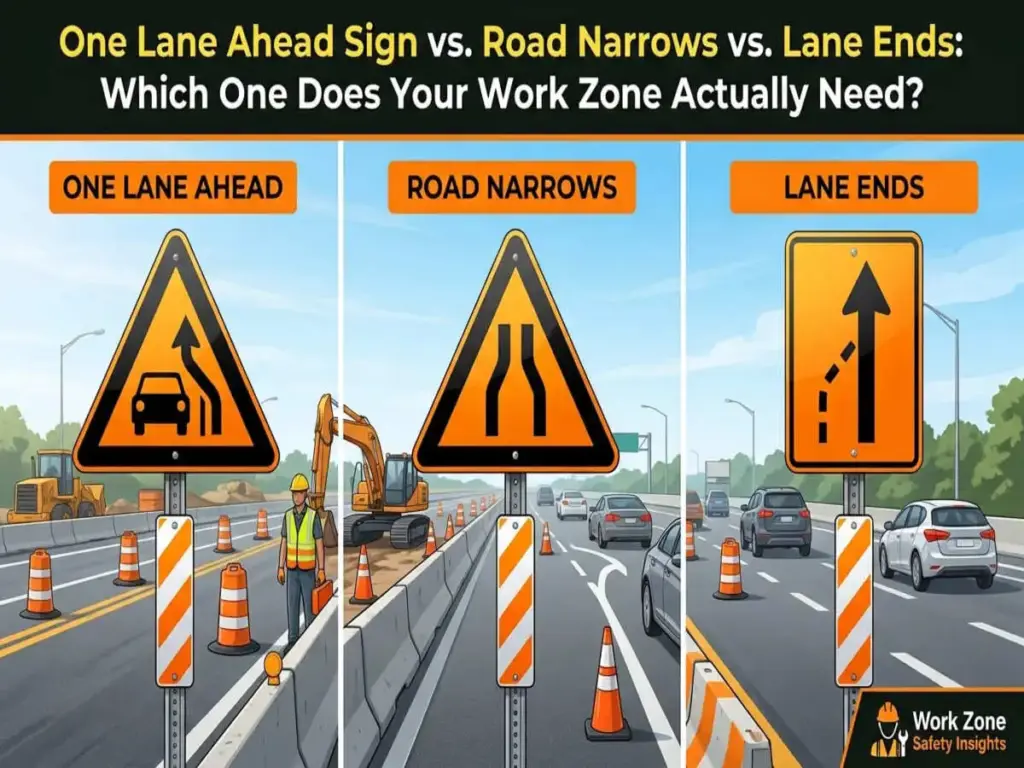
Der highway merge sign (MUTCD W4-1) warns drivers that a lane from one traveled way joins another ahead. This differs from a Lane Ends sign. That sign applies when one of several existing through lanes discontinues and its traffic shifts into an adjacent lane. A merge sign is about two separate paths becoming one. A Lane Ends sign, stattdessen, is about an existing lane disappearing.
That distinction matters most in work zones. Dort, crews build temporary tapers that behave like true merges rather than simple lane reductions. A ramp closure that redirects traffic into the mainline, Zum Beispiel, is a genuine merge situation, not a lane-ends situation.
Why Advance Distance Matters as Much as the Sign
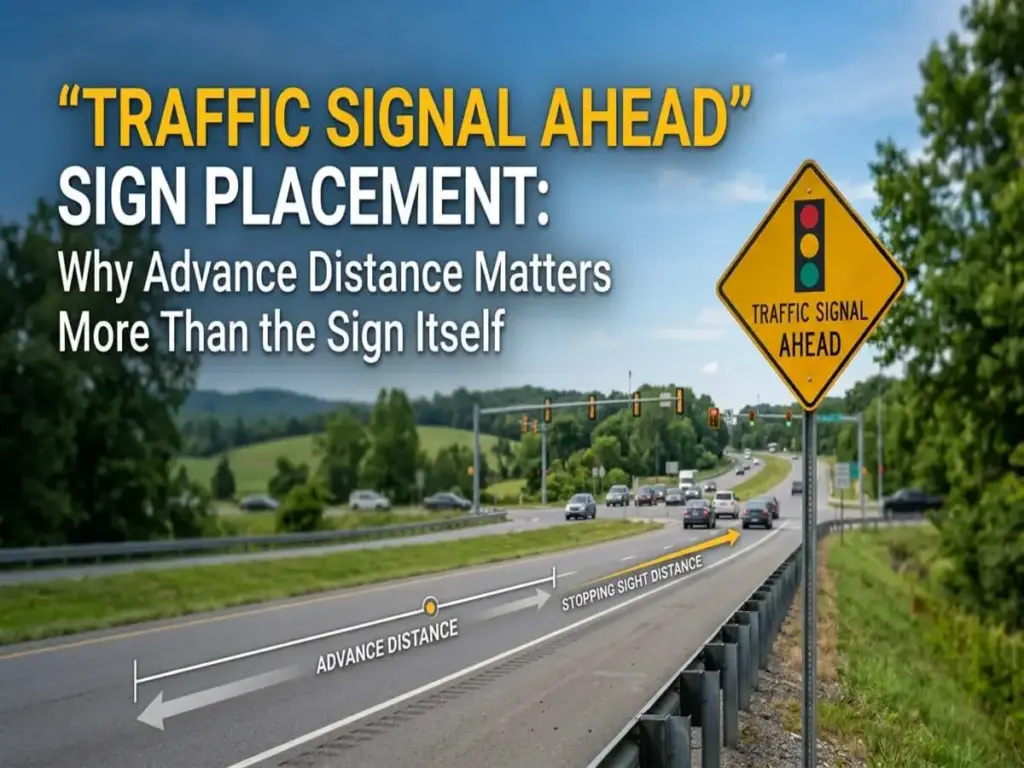
A permanent highway merge, such as an on-ramp joining a freeway, has a driver’s expectation built in. Regular commuters know the merge is coming before they see the sign. A temporary work zone merge has no such advantage. Every driver is seeing this exact layout for the first time.
The correct advance placement distance for the sign scales with approach speed.
| Annäherungsgeschwindigkeit | Advance Placement Distance | Warum |
|---|---|---|
| Lower-speed approach (25-35 Meilen pro Stunde) | Shorter distance | Drivers need less room to process and react at slower speeds |
| Moderate-speed approach (40-50 Meilen pro Stunde) | Moderate distance | Stopping and merging distance increases meaningfully at these speeds |
| Higher-speed approach (55+ Meilen pro Stunde) | Longest distance | Drivers need the most advance notice to safely negotiate the merge |
A crew that uses one standard distance across every job risks under-warning drivers on the higher-speed sites. That’s exactly where the consequences of a late merge are most severe.
When Two Temporary Approaches Merge Into One
The trickiest version of this problem shows up when two separate work zone tapers converge into a single lane. This differs from one lane simply merging into an existing one. In diesem Fall, both approaches need matched merge signage. It’s not enough to sign just the side that appears to have less priority.
Without a clear indication of which approach yields, drivers on both sides can assume they have the right of way. That assumption creates exactly the kind of last-second conflict a merge sign is meant to prevent. Pairing the sign with a flagger or clear striping resolves the ambiguity that the sign alone can’t.
Building Merge Signage Into the Broader Work Zone Package
Getting placement and sign selection right depends on one thing. Crews need to treat the merge point as part of the whole taper, not a standalone sign. A merge sign placed correctly, but paired with a taper built for a different closure type, still leaves drivers with mismatched cues.
The Optraffic team builds merge signage as part of complete work zone packages. Each one gets matched to the closure type and approach speed the site actually presents. It’s not a single generic merge sign used everywhere. That consistency between the sign and the physical taper is what actually gets drivers through a work zone merge smoothly.
Verwandte Lektüre
- „One Lane Ahead“-Schild vs. Road Narrows vs. Spur endet: Welches benötigt Ihr Arbeitsbereich tatsächlich??
- Pakete zur Verkehrskontrolle in Arbeitsbereichen: Passende Schilder, Kegel, und Kanalisierer für Ihren Verschlusstyp
- Leitfaden für einspurige Sperrschilder: MUTCD-Setup & Konisch
- Vorgänge kennzeichnen: Flaggen voraus & Leitfaden zur Pufferzone
FAQ
What does a highway merge sign mean?
It warns drivers that a lane from one traveled way is about to join another. A ramp merging into a mainline is a typical example. It’s distinct from a Lane Ends sign, which applies when an existing through lane discontinues.
How is a Merge sign different from a Lane Ends sign?
A Merge sign applies where two separate traveled ways join into one. A Lane Ends sign applies where one of several existing through lanes ends. Traffic then shifts into an adjacent lane that already exists.
How far back should a merge sign be placed?
The distance scales with approach speed. Higher-speed approaches need the sign placed farther back. Drivers need more room to see it, process it, and merge safely.
What happens when two work zone tapers merge into each other?
Both approaches need matched signage, since drivers on either side can otherwise assume they have priority. Pairing the signs with a flagger or clear striping removes that ambiguity.
Abschluss
A highway merge sign only does its job if it’s placed far enough back for the approach speed. It also needs to pair with signage that matches the rest of the taper. Work zone merges give drivers no prior familiarity to fall back on. Infolge, correct placement matters even more than it does on a permanent road. That’s why the Optraffic team builds highway merge signs into complete work zone packages matched to closure type and speed. Hier entlang, the sign never gets dropped in wherever the taper happens to end.