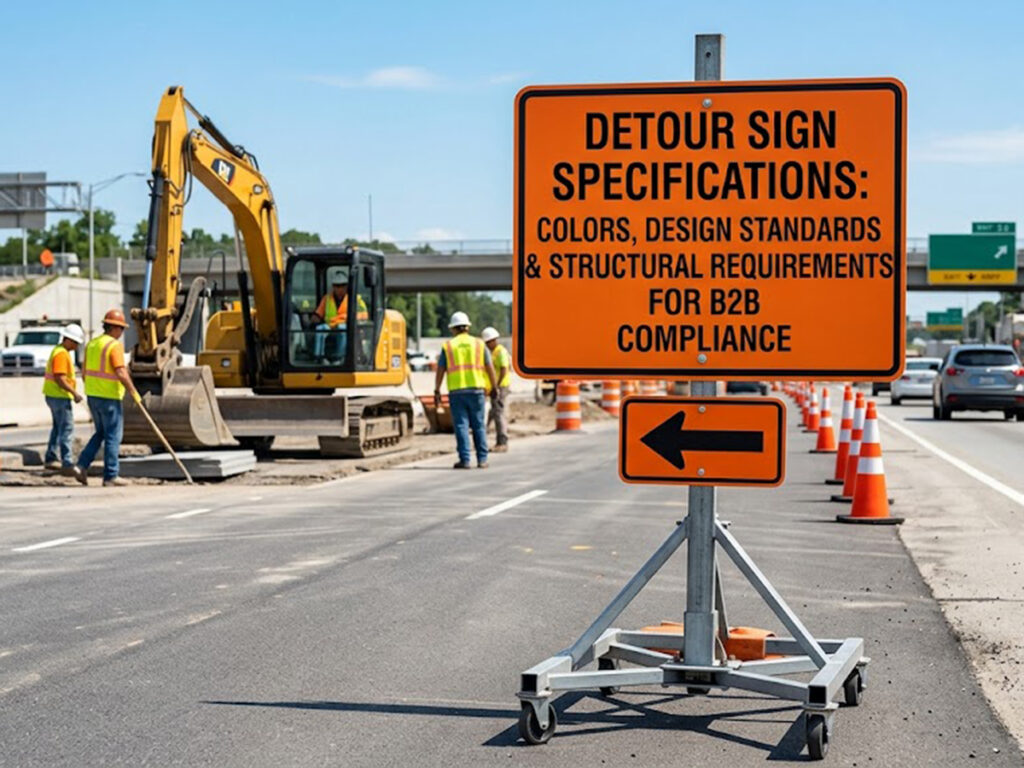
Engineering Precision Starts Here: Why Detour Sign Dimensions Determine Work Zone Safety
Work zone fatalities remain a serious national concern. The Federal Highway Administration (FHWA) recorded 857 work zone fatalities in 2022 — a figure that underscores how critical every element of temporary traffic control (TTC) truly is. Detour sign dimensions sit at the center of that safety equation. An under-sized panel at highway speed is not a minor specification gap; it is a legibility failure that can cost lives and expose contractors to significant legal liability.
MUTCD Section 6F.57 governs TTC sign sizing for all federally funded projects. Engineers who ignore its speed-based sizing matrix risk non-compliance findings during FHWA audits and state DOT inspections. Beyond regulatory exposure, mismatched panel sizes reduce the conspicuity distance — the distance at which a driver can detect and process a sign — well below the reaction threshold required for safe detouring.
This guide addresses the physical compliance layer of detour signage: panel dimensions, mandated shapes, installation clearance heights, and structural wind-load specifications.
MUTCD-Mandated Detour Sign Dimensions by Roadway Classification
The Manual on Uniform Traffic Control Devices (MUTCD) establishes a direct correlation between posted speed and required panel size. Detour sign dimensions are not discretionary — they follow a three-tier matrix codified in MUTCD Table 6F-1. Every procurement decision must begin with a confirmed speed classification.
Low-Speed and Local Roadways (≤35 mph)
The minimum standard for residential streets and low-volume collectors is a 30″×30″ panel. Approach speeds in this range allow shorter conspicuity distances, reducing the minimum sign face area required to meet legibility standards. The legibility index for standard MUTCD series D lettering is approximately 40 to 50 feet per inch of letter height. At 25 mph, a driver approaching from 150 feet has adequate time to process a 30″×30″ detour sign with 4-inch legend text.
Retroreflective sheeting must meet ASTM Type III (Engineer Grade is not acceptable for TTC under MUTCD 6F). Common applications at this tier include neighborhood utility detours and local road maintenance corridors.
Standard Arterial and Collector Roads (35–45 mph)
Detour sign dimensions for standard arterials require a 36″×36″ panel. This is the most common procurement tier for municipal DOT contracts. At 40 mph, stopping sight distance exceeds 300 feet, meaning the sign panel must deliver legible information from that range.
Panel substrate at this tier typically uses 0.080-inch aluminum. High-cycle reuse applications — signs deployed across multiple projects — warrant the heavier 0.100-inch gauge for durability. Engineers specifying for long-term asset value should note the weight differential: a 0.100-inch 36″×36″ panel weighs approximately 7.2 lbs versus 5.8 lbs for the standard gauge.
Highways and Freeways (≥45 mph)
Detour sign dimensions for high-speed corridors demand a 48″×48″ minimum panel. The engineering rationale is straightforward. At 65 mph, a driver covers approximately 95 feet per second. Adequate reaction to a detour requires detection at 500 feet or more — a distance that demands a full 48-inch panel face with high-intensity retroreflective sheeting.
Substrate specifications at this tier escalate accordingly: 0.125-inch aluminum or fiberglass-reinforced composite panels are standard. Several state DOT supplements — including Texas, Florida, and California — mandate 60″×60″ panels on divided interstates. Engineers must verify local supplements before finalizing procurement.
| Speed Zone | Required Detour Sign Dimensions | Substrate Minimum | Sheeting Grade |
| ≤35 mph | 30″ × 30″ | 0.080″ Aluminum | ASTM Type III |
| 35–45 mph | 36″ × 36″ | 0.080″ Aluminum | ASTM Type III |
| ≥45 mph | 48″ × 48″ | 0.125″ Aluminum | ASTM Type IV |
Source: MUTCD Table 6F-1
Shape Classification and Symbol Geometry: The MUTCD Mandates Behind the Form Factor
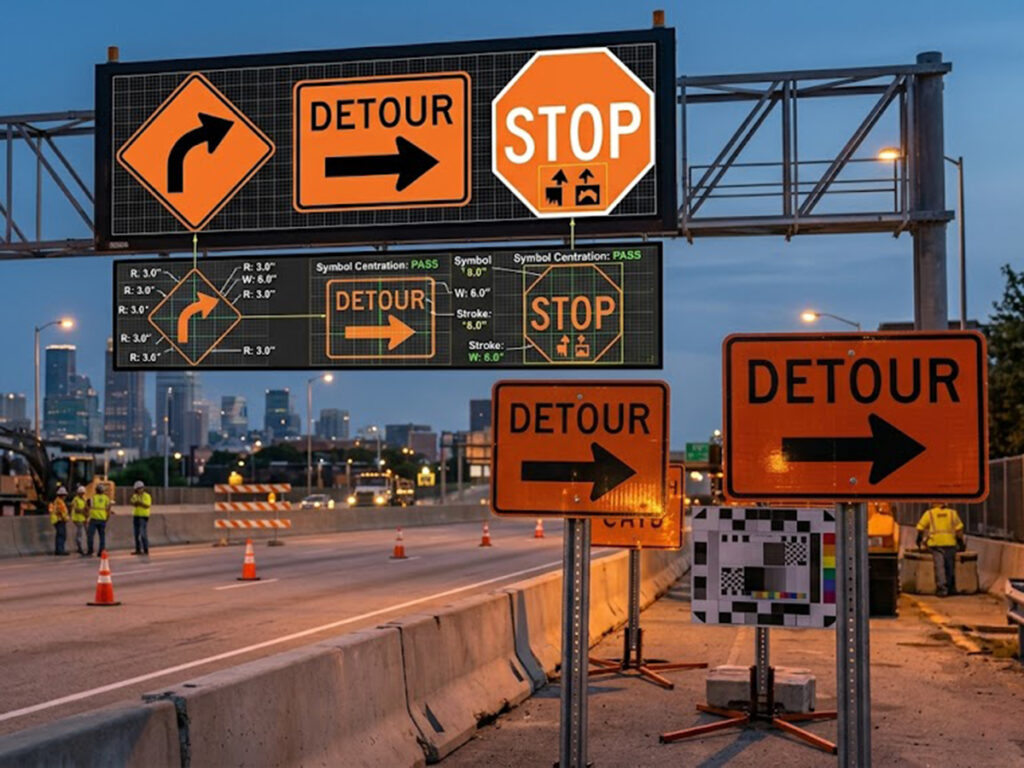
The detour sign shape is federally mandated by sign series and message type. MUTCD Section 2A.05 assigns specific geometries to specific sign functions. Deviating from the prescribed shape violates federal TTC standards — regardless of legend content or retroreflective quality.
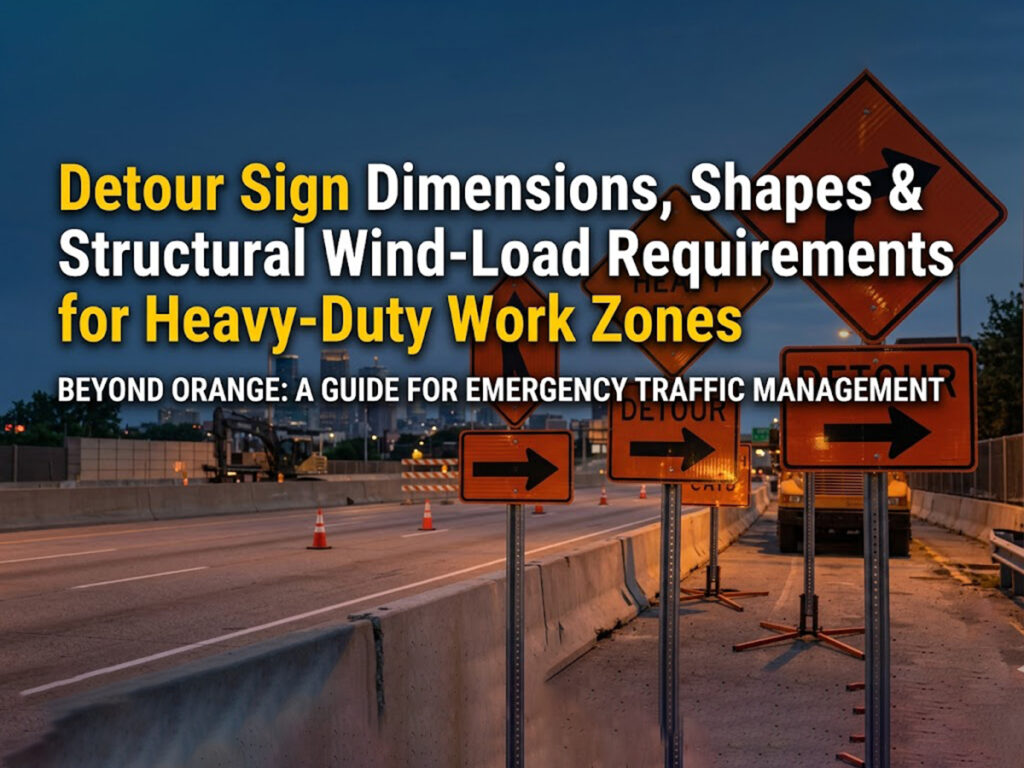
Diamond Shape: W20-2 Advance Warning Signs
All advance warning signs — including the W20-2 “Detour Ahead” — must use the diamond shape: a square panel rotated 45 degrees. The diamond is the universal driver cue for “warning ahead,” a cognitive association embedded through decades of standardization. Altering this geometry undermines that recognition pattern.
Advance placement distance for W20-2 signs scales with speed: 100 feet at 25 mph, 350 feet at 45 mph, and 500 feet or more at 55 mph per MUTCD Table 6C-1. A 48″×48″ diamond panel oriented at 45 degrees presents 1,152 square inches of face area — sufficient for high-speed legibility when combined with Type IV sheeting.
Horizontal Rectangle: M4-9 Directional Marker Signs
Directional marker signs in the M4-9 series — including M4-9(L), M4-9(R), and M4-10 — must use a horizontal rectangle. This geometry communicates directional guidance rather than warning, and the MUTCD’s Standard Highway Signs manual specifies precise arrow proportions, border widths, and margin clearances for each variant.
The engineering implication of the horizontal rectangle is significant. A flat-face rectangular panel presents maximum wind surface area — approximately 2,304 square inches for a 48″×48″ equivalent — versus the reduced frontal area of a diamond orientation. This shape difference directly influences hardware selection for high-wind deployments.
Panel Geometry as a Structural Wind Engineering Variable
Shape affects wind load more than most engineers account for in initial specifications. A diamond-oriented 48″×48″ panel reduces its effective frontal wind area by approximately 30% compared to a flat-face rectangle of identical dimensions — a product of aerodynamic geometry and reduced projected area perpendicular to wind flow.
The sign panel drag coefficient (Cd) varies between 1.2 for flat rectangular panels and approximately 1.0 for diamond configurations at equivalent wind speeds. This difference translates directly into required ballast mass and stand stiffness — variables examined in detail in Section 5.
Installation Clearance Heights: MUTCD Vertical Placement Codes for Every Deployment Environment
MUTCD Section 2A.18 establishes minimum clearance heights for sign installations based on deployment context. These figures represent safety minimums — not targets. Engineers must verify whether site conditions warrant additional clearance above the MUTCD floor.
Rural Roadway Clearance: 5-Foot Minimum
Rural installations require a minimum 5-foot clearance from the bottom of the sign panel to the near edge of the traveled roadway surface. The absence of sidewalks and pedestrian traffic in most rural environments supports the lower threshold. However, vehicle overhang, drainage ditch geometry, and seasonal snowfall can all require additional height above the minimum.
Post embedment depth in rural sites must account for soil variability and frost-line depth. In northern states, frost lines extend 48 to 60 inches below grade — embedment shallower than the frost line risks heave displacement that compromises clearance measurements through a project’s winter months.
Urban and Pedestrian-Zone Clearance: 7-Foot Minimum
Urban installations require a minimum 7-foot clearance from the sign bottom to the sidewalk or pedestrian travel surface. This overhead clearance protects pedestrians — including individuals carrying overhead loads or using assistive equipment. Urban work zones also impose ADA-adjacent obligations: sign hardware placement must not reduce the clear path of travel below 36 inches per PROWAG requirements.
Combining the 7-foot clearance mandate with reduced lateral setback space in urban corridors requires careful selection of low-profile breakaway post systems. Standard U-channel posts often exceed the lateral footprint available in constrained urban environments, making slip-base square tube posts the preferred engineering solution.
Portable Temporary Stands: 1-Foot Minimum
Portable collapsible sign stands used in short-duration or mobile operations require a minimum 1-foot clearance from the roadway surface to the panel bottom. This reduced threshold reflects the temporary, operator-supervised nature of these deployments. However, the 1-foot standard does not reduce crashworthiness obligations — portable stands in the roadway clear zone must remain MASH-compliant regardless of deployment duration.
| Portable/temporary stand | Minimum Clearance | Governing Code |
| Rural roadway (no curb) | 5 feet | MUTCD Section 2A.18 |
| Urban / pedestrian zone | 7 feet | MUTCD Section 2A.18 |
| Portable / temporary stand | 1 foot | MUTCD Section 6F.57 |
Source: MUTCD Section 2A.18
Structural Wind-Load Engineering for Heavy-Duty Work Zone Sign Systems
Wind loading represents the primary structural failure mode for roadside TTC equipment. Heavy-duty work zone signs face two compounding wind threats: ambient atmospheric gusts and aerodynamic wake turbulence from passing commercial vehicles. Engineering sign stands without accounting for both sources of risk, catastrophic stand failure at speeds well below the design maximum.
Quantifying Wind Loads on Temporary Sign Panels
The standard wind pressure formula from ASCE 7 defines lateral panel loading as P = 0.00256 × V² × Cd × Kz, where V is wind velocity in mph, Cd is the panel drag coefficient, and Kz is the exposure factor for the installation height. At 60 mph with a standard flat-face rectangular panel (Cd = 1.2) at a 10-foot mounting height, a 48″×48″ panel generates approximately 22 to 28 lbf of lateral force.
Aerodynamic wake turbulence from Class 8 trucks traveling at 65 mph generates trailing vortex pressures of 15 to 25 psf at 10 to 20 feet behind the vehicle. This intermittent load is often underestimated in initial specifications — yet it exceeds peak gust pressure for many installations near high-volume freight corridors.
Heavy-duty sign stands must sustain design wind loads of 45 to 60 mph without panel displacement or stand toppling.
Heavy-Duty Stand Materials: Dual-Spring Steel vs. Fiberglass
Two material systems dominate MASH-compliant heavy-duty stand specifications:
- Dual-spring steel stands deliver higher tensile strength, greater ballast mass capacity, and greater resistance to repeated deployment cycles. They accommodate 48″×48″ and larger panels in sustained high-wind environments. The spring mechanism absorbs dynamic gust energy without transmitting it to the mounting hardware.
- Fiberglass-reinforced stands offer lighter deployment weight, complete corrosion resistance, and electrical non-conductivity — a critical advantage in utility work zones near energized infrastructure. Their flex-fatigue resistance makes them suitable for multi-season deployments with high wind cycling.
Panel-to-stand attachment must use a minimum of two-point fastening with anti-rattle hardware. High-vibration highway environments require 5/16″ or 3/8″ U-bolt clamps torqued to manufacturer specifications to prevent fatigue-induced loosening.
Wind Ballasting Protocols and Prohibited Configurations
MASH Crashworthiness Compliance for Temporary Traffic Control Hardware
MASH — the Manual for Assessing Safety Hardware — establishes the current federal standard for TTC device crashworthiness. Published by AASHTO in 2016, MASH replaced NCHRP Report 350 as the applicable approval framework for all new TTC devices. The transition deadline passed in January 2020, meaning any stand or post installed in a clear zone after that date must carry current MASH acceptance documentation.
MASH TL-3 Test Parameters and Compliance Requirements
The applicable MASH test level for most roadside sign systems is TL-3: a 62 mph vehicle impact at a 25-degree angle. Compliant hardware must meet three performance criteria: controlled breakaway upon impact, panel release that does not create secondary projectile hazards, and no dangerous debris trajectory toward vehicle occupants or adjacent lanes.
DOT compliance officers must distinguish between MASH-tested (full crash test performed) and MASH-compliant (criteria met by engineering analysis). Some state DOTs accept the latter; many require full test documentation. Engineers must verify state QPL requirements before specifying hardware.
Breakaway Post and Slip-Base Engineering
Slip-base post design uses two steel plates joined by calibrated shear bolts. Upon vehicle impact, the bolts fracture at a defined load threshold, allowing the post to hinge away from the vehicle path. Standard shear bolts for roadside sign posts are 3/8-inch Grade 2 hardware calibrated to fail at 1,500 to 3,000 lbf, depending on post size and speed environment.
Shear bolts require replacement after every impact event. Compliance documentation should include a post-impact inspection protocol with hardware replacement specifications and re-torque requirements.
Mounting Hardware Specifications for Permanent and Semi-Permanent Detour Installations
Post Diameter, Gauge, and Embedment Depth
U-channel steel posts in the 2 lb/ft rating serve standard applications; 3 lb/ft U-channel handles heavy-duty and large-panel installations. Square tube posts — 2″×2″ and 2.25″×2.25″ in 14-gauge steel — are specified for high-wind zones or 48″×48″ and larger panels.
Embedment depth follows the rule: minimum 10% of total post length plus 2 feet, or per AASHTO post foundation design — whichever is greater. Northern climate installations must embed below the local frost line, which varies from 12 inches in Southern states to 60 inches in Minnesota and North Dakota.
Fastener Grades and Torque Specifications
Sign blanks attach to U-channel posts via 7/16″ or 1/2″ bolt holes on 1-inch centers. Fasteners must be minimum Grade 5 (SAE) or Grade 8.8 (metric) carriage bolts with nylon-insert locking nuts. Apply anti-seize compound at all aluminum-to-steel interfaces to prevent galvanic corrosion in field conditions.
Torque specifications: 15 to 20 ft-lbs for 3/8″ hardware; 25 to 35 ft-lbs for 1/2″ hardware. Panels 48″×48″ and larger require four-bolt attachment patterns in high-wind exposures; two-bolt patterns are insufficient for this panel size under sustained gust loading.
Field Inspection Protocols and Dimensional Verification for DOT Compliance Officers
Pre-Installation 5-Point Field Verification Checklist
- Speed zone confirmation: verify the posted speed limit to confirm required detour sign dimensions (30″/36″/48″)
- Panel face measurement: measure the diagonal to verify square panel dimensions within ±1/4″ tolerance
- Retroreflective grade verification: check the sheeting manufacturer label on the panel back for ASTM Type III/IV confirmation
- Stand MASH documentation: verify the MASH acceptance number matches the stand in use
- Clearance height check: measure from roadway or sidewalk surface to panel bottom — confirm 5-foot, 7-foot, or 1-foot minimum as applicable
Post-Wind-Event Inspection Requirements
Any sustained wind event above 45 mph or observed stand displacement triggers a mandatory post-event inspection. Inspectors must verify:
- Stand vertical plumb within 2 degrees of vertical (most state DOT standards)
- Shear bolt integrity — replace any bolt showing deformation
- Ballast displacement — redistribute or replace base ballast to manufacturer specification
- Retroreflective performance — delamination or impact damage triggers panel replacement
FHWA recommends maintaining an inspection log for all TTC devices on projects exceeding three days duration. Retroreflective performance should undergo ASTM E1710 testing every 24 months for long-term deployments.
Common Non-Compliance Failure Points
DOT field audits most frequently cite the following dimensional and structural violations:
- Wrong panel size for the posted speed zone — under-specification is the most common finding
- Incorrect clearance height in urban pedestrian zones (mounting to 5-foot rural standard in a 7-foot urban environment)
- NCHRP 350-only stands still in service post-January 2020 MASH transition deadline
- Ballast placed on the panel face or sign arm rather than the base frame
- Missing ASTM retroreflective sheeting grade certification on the panel back
Engineering Specification Matrix and Full Compliance Framework
Consolidated Project Specification Decision Matrix
| Project Type | Speed Zone | Detour Sign Dimensions | Stand Type | Clearance |
| Local utility detour | ≤35 mph | 30″×30″ | Standard spring stand | 5 ft rural / 7 ft urban |
| Arterial road construction | 35–45 mph | 36″×36″ | Heavy-duty spring stand | 7 ft urban |
| Highway work zone | ≥45 mph | 48″×48″ | Dual-spring / MASH TL-3 | 5 ft rural (verify state supp.) |
Source: MUTCD Table 6F-1; AASHTO MASH 2016
Detour Sign Dimensions Within the Broader Compliance Framework
Detour sign dimensions, shapes, and structural hardware form the physical compliance layer of any TTC specification package. A complete submission-ready specification also requires color coding, retroreflective sheeting grades, legend layout standards, and sign classification frameworks. Engineers preparing full package documentation will find the complete technical requirements — including sheeting specifications, legend standards, and regulatory classifications — consolidated in the comprehensive guide to detour sign specifications and design standards.
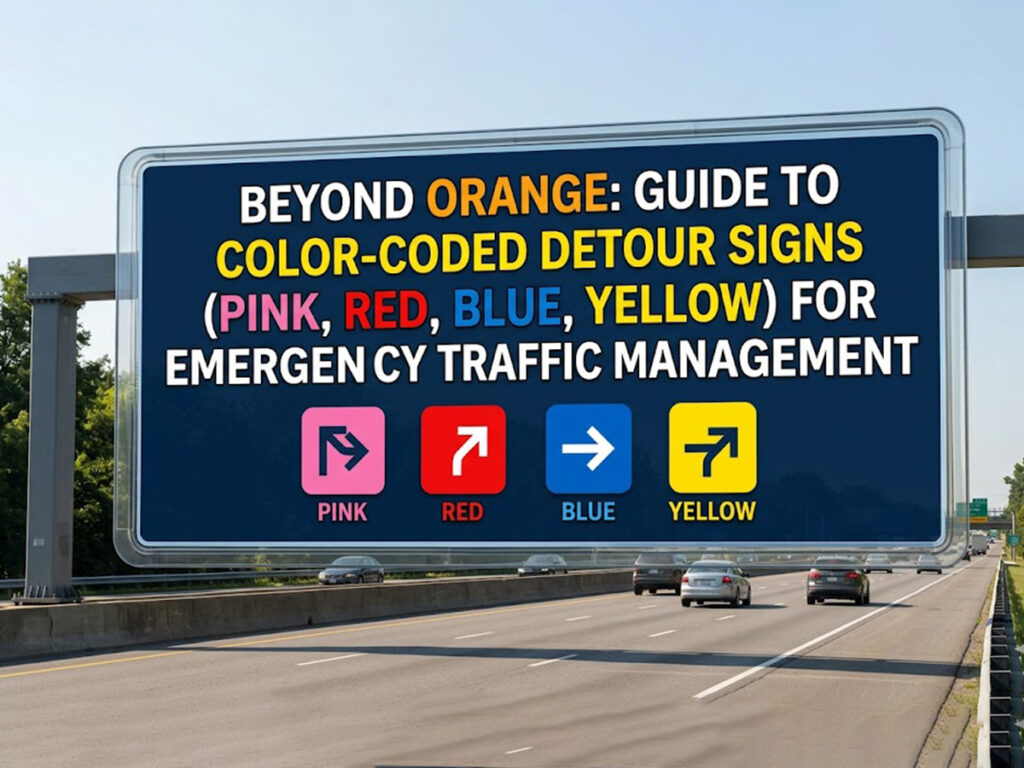
For projects requiring non-standard emergency color variants — including pink, red, or blue emergency detour systems — the color classification protocol operates under separate guidelines. Engineers should consult the dedicated resource on emergency and non-standard color-coded detour applications for those specifications.
FAQ: Detour Sign Dimensions, Shapes & Wind-Load Engineering
What are the standard detour sign dimensions required by MUTCD?
MUTCD Table 6F-1 specifies three standard detour sign dimensions by posted speed: 30″×30″ for roads at or below 35 mph, 36″×36″ for 35 to 45 mph arterials, and 48″×48″ for highways and freeways at or above 45 mph. Some state supplements require 60″×60″ on divided interstates. Engineers must always verify against local DOT standards before finalizing procurement.
What shape must a W20-2 detour advance warning sign use?
Per MUTCD Section 2A.05, the W20-2 “Detour Ahead” advance warning sign must use a diamond shape — a square panel rotated 45 degrees. Directional markers in the M4-9 series must use a horizontal rectangle. Shape is not discretionary; deviating from the mandated geometry violates federal TTC standards regardless of legend content.
What shape must a W20-2 detour advance warning sign use?
Per MUTCD Section 2A.05, the W20-2 “Detour Ahead” advance warning sign must use a diamond shape — a square panel rotated 45 degrees. Directional markers in the M4-9 series must use a horizontal rectangle. Shape is not discretionary; deviating from the mandated geometry violates federal TTC standards regardless of legend content.
What is the minimum clearance height for a detour sign in an urban work zone?
MUTCD Section 2A.18 requires a minimum 7-foot clearance from the panel bottom to the adjacent sidewalk surface in urban environments. Rural roadways require a 5-foot minimum. Portable temporary stands require at least 1-foot clearance from the roadway surface. All measurements reference the nearest pedestrian or vehicular travel surface.
What wind speed must detour sign stands be engineered to withstand?
Heavy-duty sign stands for work zone applications must sustain design wind loads of 45 to 60 mph, including aerodynamic wake turbulence from passing Class 8 trucks. At 60 mph, a 48″×48″ rectangular panel generates approximately 22 to 28 lbf of lateral force using ASCE 7 methodology. Dual-spring steel or fiberglass-reinforced stands are the specified hardware for these conditions.
What does MASH compliance require for temporary detour sign hardware?
MASH (Manual for Assessing Safety Hardware) requires TTC devices to perform controlled breakaway upon vehicle impact without creating dangerous debris trajectories. All hardware installed in clear zones after January 2020 must carry MASH — not legacy NCHRP 350 — acceptance documentation. DOT compliance officers must request the MASH test report number, applicable test level, and state QPL status from vendors before approving procurement.
References
- Federal Highway Administration. (2023). Work Zone Fatal Crashes and Fatalities. FHWA Office of Operations.
- American Association of State Highway and Transportation Officials (AASHTO). (2016). Manual for Assessing Safety Hardware (MASH). AASHTO.
- U.S. Access Board. (2011). Proposed Accessibility Guidelines for Pedestrian Facilities in the Public Right-of-Way (PROWAG). Access Board.