Why PPE Signage Sits at the Top of Every Auditor’s Punch List
OSHA cited employers for 1,665 PPE eye and face protection violations during fiscal year 2025 alone, ranking the standard as the agency’s ninth most frequently cited regulation. Hazard Communication ranked second with 2,546 citations (Source: https://www.osha.gov/top10citedstandards). Most of those citations trace back to one root cause: signage gaps. Faded labels, missing pictograms, and unenforced PPE zones turn routine walkthroughs into expensive citations. This PPE safety signage checklist gives safety managers a field-tested tool to spot those gaps before an OSHA Compliance Safety and Health Officer (CSHO) does.
The 2026 maximum penalty for a single serious violation now stands at $16,550, while willful or repeated violations climb to $165,514 per instance (Source: https://www.osha.gov/penalties). A multi-citation inspection can easily exceed $1 million in total exposure. For deeper context on substrate choices, mounting hardware, and procurement workflows, safety managers should pair this PPE safety signage checklist with the complete PPE signs compliance, materials, placement, and procurement guide.
This article delivers the technical specifications, regulatory citations, and inspection protocols that drive audit-ready compliance. Every requirement maps to 29 CFR 1910.145, 29 CFR 1910.132, or ANSI Z535.2-2023.
The 2026 OSHA PPE Safety Signage Checklist (Quick-Reference Audit Tool)
This PPE safety signage checklist delivers the core audit tool. Print it, walk the floor with it, and close every gap before scheduling your next mock inspection. Safety managers should treat each section as a non-negotiable compliance gate.
Pre-Audit 15-Minute Walkthrough Checklist
Safety managers should run this binary checklist quarterly at a minimum. Each item answers yes or no, with no gray area.
- Every PPE zone displays a sign visible from each authorized entry point.
- Every sign uses the correct ANSI Z535.2 signal word for the hazard severity.
- All signs remain legible from the required viewing distance.
- No sign shows fading, peeling, or pictogram damage exceeding 10% of surface area.
- Signal word panels match the correct color: red, orange, yellow, or blue.
- Pictograms appear consistently across all signs in the same hazard category.
- Mounting heights fall within 60 to 72 inches from the centerline for general industry zones.
- Bilingual signs maintain equal prominence between languages.
- Photoluminescent egress-adjacent signs charge under normal facility lighting.
- Each sign maps to a documented hazard assessment per 29 CFR 1910.132(d).
Documentation Checklist Auditors Will Request
OSHA officers routinely ask for written records during inspections. Safety managers should keep these documents current and accessible.
- Written PPE hazard assessment certification per 29 CFR 1910.132(d)(2).
- Sign inspection log covering the past 24 months.
- Sign replacement records with dates, locations, and reasons.
- Worker training documentation tying PPE signs to job hazard analyses (JHAs).
- Manufacturer compliance certifications for ANSI Z535.2 and Z535.3 alignment.
Common Audit Failures and How to Spot Them Early
Five failure patterns drive most PPE signage citations. Safety managers who learn these patterns catch problems weeks before an auditor arrives.
UV-faded signs in exterior or skylit zones top the list. Signs lose 30% color saturation within 18 months when exposed to direct sunlight without overlamination. Pre-2011 ANSI legacy-format signs remain on walls in older facilities, missing the modern signal word panel layout. Inconsistent pictograms across the same hazard category confuse workers and trigger hazard communication citations. Mismatched signal words for the actual hazard severity (using CAUTION when DANGER applies) create direct 1910.145 violations. Missing signs at secondary or maintenance entry points round out the top five.
OSHA PPE Sign Requirements Under 29 CFR 1910.145 (Decoded for Field Use)
The regulation runs nine pages of dense text. The field-relevant specifications fit on a single reference card. Every PPE safety signage checklist should anchor to the four signal words, the viewing distance formula, and the pictogram standards explained below.
Signal Word Hierarchy: DANGER, WARNING, CAUTION, NOTICE
ANSI Z535.2-2023 defines four signal words that control sign design. DANGER signs use a red panel with white text and indicate imminent hazards likely to cause death or serious injury. WARNING signs use orange panels for hazards that could result in death or serious injury. CAUTION signs use yellow panels for hazards that could cause minor or moderate injury. NOTICE signs use blue panels for property damage warnings or facility policies. Every PPE safety signage checklist item depends on the correct signal word selection.
OSHA accepts ANSI Z535.1 color specifications under 29 CFR 1910.145(d). Manufacturers must match Pantone Safety Red 485, Safety Orange 152, and Safety Yellow 109 to pass third-party verification.
Letter Height and Viewing Distance Calculations
ANSI Z535.2 Section 8.2 defines the formula every safety manager should memorize: minimum letter height equals viewing distance divided by 50. The table below converts that formula into field-ready specifications.
| Required Viewing Distance | Minimum Letter Height | Typical Application |
| 5 feet | 1.2 inches | Equipment-mounted PPE labels |
| 10 feet | 2.4 inches | Doorway-mounted zone signs |
| 25 feet | 6.0 inches | Bay entry signs in warehouses |
| 50 feet | 12.0 inches | Outdoor construction perimeter |
Pictograms and Symbol Standards (ISO 7010 vs. ANSI Z535.3)
ANSI Z535.3 governs symbol design for U.S. workplaces. ISO 7010 governs international facilities. Multinational manufacturers should standardize on one system per site to avoid worker confusion. Fourteen PPE-specific pictograms cover eye, face, head, hearing, foot, hand, body, and respiratory protection. Every PPE safety signage checklist verifies pictogram consistency across all signs in the same hazard zone.
PPE Zone Signage Requirements: Placement Rules That Pass Inspection
Placement errors trigger more citations than design errors. This section addresses the PPE zone signage requirements that auditors verify with a tape measure. Any thorough PPE safety signage checklist treats placement and mounting as separate inspection categories.
Mandatory PPE Zone Boundary Marking
OSHA expects PPE zone signs to appear 6 to 10 feet before workers enter the hazard exposure area. Multiple entry points each require their own sign. Line-of-sight verification matters: a sign hidden behind racking or equipment fails inspection regardless of how close it sits to the boundary.
Sign Mounting Height and Angle Specifications
General industry mounting heights range from 60 to 72 inches to the sign centerline. Forklift traffic zones require mounting at 84 inches or higher to prevent damage. ADA-compliant facilities mount tactile signs at 48 to 60 inches when located adjacent to permanent room identifiers. Overhead hazard signs mount at the ceiling but angle downward 15 to 30 degrees to maintain readability.
Multi-Hazard Zone Sign Combinations
ANSI Z535.2 Section 7 limits readability to four pictograms per panel. Zones requiring eye, hearing, and respiratory protection together fit within that limit. Adding a fifth requirement triggers a multi-panel array. Safety managers building this PPE safety signage checklist for complex zones should specify panel arrays rather than crowding pictograms onto a single sign.
Sign Material Selection: Matching Substrate to Environment
Material failures account for the majority of mid-cycle sign replacements. The right substrate prevents premature degradation and supports a clean inspection record. A complete PPE safety signage checklist verifies substrate suitability for each environment, not just sign content.
Indoor vs. Outdoor Material Specifications
Indoor low-traffic zones perform well with .040-inch aluminum or rigid PVC substrates. Outdoor and high-UV zones require .063-inch aluminum with reflective vinyl overlays. Diamond Grade reflective sheeting delivers the longest service life among reflective grades, typically 10 to 12 years outdoors.
Chemical, UV, and Temperature Resistance Ratings
Standard vinyl fails within months in chemical splash zones. Polycarbonate and laminated polyester resist most industrial solvents. High-temperature areas like foundries and forge shops demand porcelain enamel or anodized aluminum signs rated to 1,000°F continuous exposure. UV exposure without overlamination cuts standard vinyl service life by 50% to 70%. Detailed substrate specifications appear in the substrate selection breakdown for PPE signs in the workplaces.
Photoluminescent and Tactile Requirements
NFPA 101 and 29 CFR 1910.37 require photoluminescent egress-path signage in many facility classifications. Minimum afterglow specifications call for 100 millicandelas per square meter at 10 minutes after light source removal. ADA tactile requirements apply when PPE signs sit adjacent to permanent room identifiers, demanding raised characters and Grade 2 Braille at specified mounting heights.
Industrial Safety Sign Maintenance Schedule and Inspection Protocol
Industrial safety sign maintenance separates audit-ready facilities from citation magnets. A documented maintenance program demonstrates good faith and supports OSHA’s 20% history-based penalty reduction. Pairing the PPE safety signage checklist with a written maintenance SOP closes the most common gap auditors find.
Recommended Inspection Frequency by Sign Location
Indoor low-traffic zones tolerate quarterly visual inspections. Outdoor signs and chemical exposure zones require monthly inspections. Triggered replacements override the calendar: any sign showing more than 30% color shift, illegibility from the required viewing distance, or physical damage to more than 10% of surface area requires immediate replacement.
Documenting Industrial Safety Sign Maintenance for Audit Defensibility
OSHA expects every inspection to generate a record. Each entry should capture the inspector’s name, date, sign location identifier, condition rating on a defined scale, action taken, and photo evidence. Modern EHS platforms support QR-coded sign inventories that automate this workflow. Industrial safety sign maintenance logs become legal evidence during contested citations.
When to Replace Versus Refurbish
Refurbishment makes sense only for substrates with intact base material and surface-level wear. Faded vinyl overlays on aluminum substrates allow vinyl-only replacement. Cracked or warped substrates require full replacement. Cost analysis usually favors replacement when refurbishment exceeds 60% of the new sign cost.
Bilingual and Multilingual PPE Signage Standards
Many U.S. facilities operate with a linguistically diverse workforce. While basic compliance focuses on presence, a risk-mitigation strategy focuses on comprehension. OSHA’s General Duty Clause and the 1994 Letter of Interpretation emphasize that if a worker cannot understand a sign, the employer has failed to communicate the hazard.
Checklist Action: Audit your floor demographics. If more than 10% of your workforce speaks a primary language other than English, single-language signage is a high-probability OSHA citation waiting to happen.
When OSHA “Effectively” Mandates Multilingual Signs
The agency does not mandate specific languages. However, OSHA holds employers responsible for ensuring workers understand hazard communication. Facilities with significant non-English-speaking workforces should add Spanish, Mandarin, Vietnamese, or other workforce-relevant languages to PPE signs. The PPE safety signage checklist should flag any single-language sign in a multilingual workforce setting.
Layout Standards for Dual-Language Signs
A common mistake in procurement is “Secondary Language Sub-texting.” According to ANSI Z535.2 Section 9, for a sign to be truly compliant in a dual-language setting, both languages must have equal prominence.
- Avoid: Small-font translations squeezed at the bottom.
- Adopt: A “Pictogram-First” design. By centering a universal ISO-standard symbol, you reduce the cognitive load on the worker, making the text an endorsement rather than the sole source of truth.
The Hidden Cost of Machine Translation
Using free online translators for PPE signs is a false economy. OSHA inspectors have issued citations for “confusing or nonsensical” safety instructions caused by poor translation.
To lower your Total Cost of Ownership (TCO), avoid the “buy-it-twice” trap. Invest in pre-validated, certified multilingual templates from reputable manufacturers. This ensures the terminology aligns with specific OSHA/ANSI technical definitions, shielding your facility from liability during a 2026 audit.
Building an Audit-Defensible PPE Signage Program
A high-performance PPE safety signage checklist ensures your facility looks compliant on the day of an audit. However, an audit-defensible program ensures your compliance stands up to legal scrutiny. The difference lies in the paper trail.
Linking Signs to Certified Hazard Assessments (29 CFR 1910.132(d))
OSHA auditors don’t just look at the sign; they look for the reason behind it.
The Strategy: Every sign on your checklist should map directly to a written Job Hazard Analysis (JHA) or Hazard Assessment Certification.
Audit Advantage: Proactively showing a cross-reference matrix—linking a “Hearing Protection Required” sign to a specific decibel study—demonstrates Good Faith. This level of professional rigor is often the deciding factor in downgrading a “Serious” violation to “Other-than-Serious,” potentially saving thousands in penalties.
Sign Inventory and Lifecycle Tracking
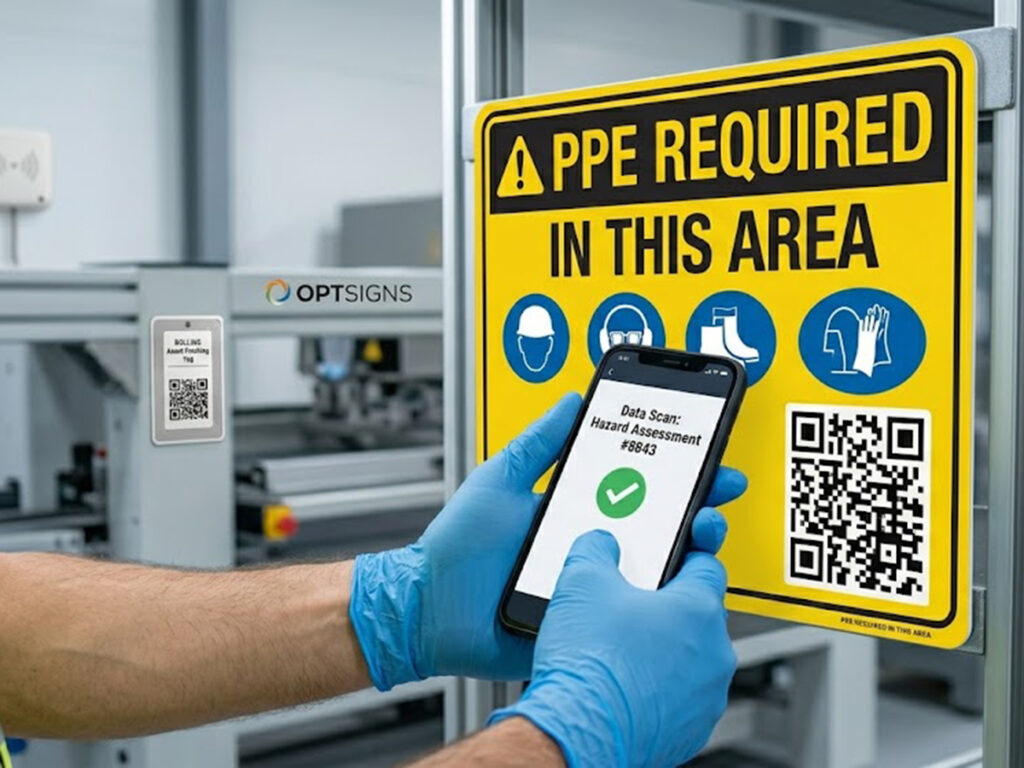
Asset-tagged signs with unique identifiers support automated lifecycle tracking. QR-coded signs link directly to digital inspection records, hazard assessments, and replacement schedules. Modern facilities geo-tag signs to facility CAD overlays for rapid audit response.
Training Workers on Sign Recognition
A sign is only as effective as the worker’s ability to interpret it. 29 CFR 1910.132(f) mandates that employees understand not just what PPE to wear, but when and why.
The “Mock Audit” Test: Your checklist should include a “Worker Interview” section. Ask a floor employee: “What hazard does this ANSI icon represent, and what is your specific PPE protocol here?”
Documentation: If the worker fails, it’s a training gap; if the sign is missing, it’s a facility gap. Documenting these internal spot-checks proves you are maintaining an active, compliant culture—a key defense against “Willful Violation” claims.
Turning Your Checklist Into a Citation-Proof Signage Program
This PPE safety signage checklist covers seven core compliance domains: quick-reference audit, regulatory specifications, zone placement, material selection, maintenance protocols, multilingual standards, and program-level documentation. Safety managers who close every gap on this list rarely face PPE-related citations.
The compliance distinction matters: a checklist captures one moment in time, while a documented program demonstrates ongoing diligence. OSHA inspectors reward documented programs with reduced penalties under the 2025 Field Operations Manual updates, including up to 60% reduction for small employers and 20% for clean inspection histories. Safety managers should review their PPE safety signage checklist annually and monitor ANSI Z535 revision cycles for upcoming standard changes.
Download the printable checklist, schedule a facility walkthrough this quarter, and pair this guide with the full pillar resource on PPE sign procurement and material selection.
Frequently Asked Questions About the PPE Safety Signage Checklist
How often should PPE signs be inspected for OSHA compliance?
Indoor low-traffic zones require quarterly visual inspections. Outdoor signs and chemical exposure areas require monthly inspections. Triggered replacements happen immediately when fading, illegibility, or damage exceeds defined thresholds.
What PPE signs are specifically required by OSHA?
OSHA mandates PPE use under 29 CFR 1910.132 and requires hazard communication under 29 CFR 1910.145 and 1910.1200. Together, these standards effectively require signage that identifies PPE zones, hazard severity, and required protective equipment.
Where should PPE signs be placed in the workplace?
Place PPE signs 6 to 10 feet before zone entry, at every authorized entry point, mounted between 60 and 72 inches to the centerline for general industry. Adjust for forklift traffic, ADA requirements, and overhead hazards.
Do PPE signs need to be bilingual under OSHA?
OSHA does not specify languages but requires comprehension. Facilities with non-English-speaking workers must ensure workers understand all hazard communications, which usually requires bilingual or multilingual signage.
What are the OSHA color requirements for PPE signs?
ANSI Z535.1, incorporated by reference in 29 CFR 1910.145, specifies red for DANGER, orange for WARNING, yellow for CAUTION, blue for NOTICE, and green for safety information. Manufacturers must match specified Pantone values.
How long do PPE safety signs typically last before needing replacement?
Indoor vinyl signs last 5 to 7 years. Outdoor reflective signs last 7 to 10 years with proper overlamination. Porcelain enamel and anodized aluminum signs last 15 to 25 years. Service life drops sharply without UV protection.
What is the OSHA penalty for non-compliant PPE signage in 2026?
Serious violations carry maximum penalties of $16,550 per violation as of January 2026. Willful or repeated violations reach $165,514 per violation. Multi-citation inspections can exceed $1 million in total exposure.
Are digital or electronic PPE signs OSHA-compliant?
Digital signs comply when they meet ANSI Z535.2 visibility, contrast, and reliability standards. Power-loss failover requirements add complexity. Most facilities use digital signs for dynamic information rather than primary hazard warnings.
References
- OSHA Penalties (2026 Maximum Amounts) — https://www.osha.gov/penalties
- OSHA Top 10 Most Frequently Cited Standards FY 2025 — https://www.osha.gov/top10citedstandards
- 29 CFR 1910.145 Specifications for Accident Prevention Signs and Tags — https://www.osha.gov/laws-regs/regulations/standardnumber/1910/1910.145
- 29 CFR 1910.132 General Requirements for Personal Protective Equipment — https://www.osha.gov/laws-regs/regulations/standardnumber/1910/1910.132
- ANSI Z535 Series Standards — https://www.nema.org/standards/z535
- NFPA 101 Life Safety Code — https://www.nfpa.org/codes-and-standards/nfpa-101-standard-development/101