Pourquoi la signalisation des EPI figure en tête de la liste des points à retenir de chaque auditeur
L'OSHA a cité les employeurs pour 1,665 Violations des EPI en matière de protection des yeux et du visage au cours de l'exercice financier 2025 seul, classant la norme au neuvième rang des réglementations les plus fréquemment citées par l’agence. La communication des dangers s'est classée deuxième avec 2,546 citations (Source: https://www.osha.gov/top10citedstandards). La plupart de ces citations remontent à une cause fondamentale: lacunes de signalisation. Étiquettes fanées, pictogrammes manquants, et les zones EPI non appliquées transforment les visites de routine en citations coûteuses. Ce Liste de contrôle de la signalisation de sécurité des EPI donne aux responsables de la sécurité un outil testé sur le terrain pour repérer ces lacunes devant un responsable de la sécurité et de la santé de l'OSHA (CSHO) fait.
Le 2026 la peine maximale pour une seule infraction grave s'élève désormais à $16,550, tandis que les violations volontaires ou répétées grimpent à $165,514 par instance (Source: https://www.osha.gov/penalties). Une inspection multi-citations peut facilement dépasser $1 millions d'exposition totale. Pour un contexte plus approfondi sur les choix de substrats, matériel de montage, et flux de travail d'approvisionnement, les responsables de la sécurité devraient associer cela Liste de contrôle de la signalisation de sécurité des EPI avec conformité complète des panneaux EPI, matériels, placement, et guide d'approvisionnement.
Cet article livre les spécifications techniques, citations réglementaires, et des protocoles d'inspection qui garantissent une conformité prête pour l'audit. Chaque exigence correspond à 29 CFR 1910.145, 29 CFR 1910.132, ou ANSI Z535.2-2023.
Le 2026 Liste de contrôle de signalisation de sécurité EPI OSHA (Outil d'audit de référence rapide)
Ce Liste de contrôle de la signalisation de sécurité des EPI fournit l'outil d'audit de base. Imprimez-le, marcher sur le sol avec, et comblez chaque lacune avant de planifier votre prochaine inspection simulée. Les responsables de la sécurité doivent traiter chaque section comme une porte de conformité non négociable.
Liste de contrôle pas à pas de 15 minutes avant l'audit
Les responsables de la sécurité devraient exécuter cette liste de contrôle binaire au minimum une fois par trimestre. Chaque élément répond oui ou non, sans zone grise.
- Chaque zone EPI affiche un panneau visible depuis chaque point d'entrée autorisé.
- Chaque panneau utilise le mot d'avertissement ANSI Z535.2 correct pour la gravité du danger..
- Tous les panneaux restent lisibles à la distance de visualisation requise.
- Aucun signe ne montre une décoloration, peeling, ou des dommages aux pictogrammes dépassant 10% de superficie.
- Les panneaux de mots d’avertissement correspondent à la bonne couleur: rouge, orange, jaune, ou bleu.
- Les pictogrammes apparaissent de manière cohérente sur tous les panneaux de la même catégorie de danger..
- Les hauteurs de montage se situent dans 60 à 72 pouces de la ligne médiane pour les zones industrielles générales.
- Les panneaux bilingues maintiennent une importance égale entre les langues.
- Les panneaux photoluminescents adjacents aux sorties se chargent sous un éclairage normal des installations..
- Chaque panneau correspond à une évaluation documentée des dangers par 29 CFR 1910.132(d).
Liste de contrôle de la documentation que les auditeurs demanderont
Les agents de l'OSHA demandent régulièrement des documents écrits lors des inspections. Les responsables de la sécurité doivent maintenir ces documents à jour et accessibles.
- Certification écrite d’évaluation des risques liés aux EPI selon 29 CFR 1910.132(d)(2).
- Signer le journal d’inspection couvrant le passé 24 mois.
- Signer les enregistrements de remplacement avec des dates, emplacements, et les raisons.
- Documentation de formation des travailleurs liant les panneaux d'EPI aux analyses des risques professionnels (JHA).
- Certifications de conformité du fabricant pour l'alignement ANSI Z535.2 et Z535.3.
Échecs d’audit courants et comment les repérer tôt
Cinq modèles d'échec sont à l'origine de la plupart des citations sur la signalisation des EPI. Les responsables de la sécurité qui apprennent ces schémas détectent les problèmes des semaines avant l'arrivée d'un auditeur..
Les panneaux décolorés par les UV dans les zones extérieures ou éclairées par les toits sont en tête de liste. Les signes perdent 30% saturation des couleurs à l'intérieur 18 mois en cas d'exposition directe au soleil sans surlamination. Les panneaux au format ANSI antérieurs à 2011 restent sur les murs des installations plus anciennes, il manque la disposition moderne du panneau de mots d'avertissement. Des pictogrammes incohérents dans la même catégorie de danger confondent les travailleurs et déclenchent des citations de communication des dangers. Mots d'avertissement ne correspondant pas à la gravité réelle du danger (en utilisant ATTENTION lorsque le DANGER s'applique) créer directement 1910.145 violations. Les panneaux manquants aux points d’entrée secondaires ou de maintenance complètent le top cinq.
Exigences de l'OSHA en matière de signature d'EPI sous 29 CFR 1910.145 (Décodé pour une utilisation sur le terrain)
Le règlement contient neuf pages de texte dense. Les spécifications pertinentes pour le domaine tiennent sur une seule carte de référence. Chaque Liste de contrôle de la signalisation de sécurité des EPI devrait s'ancrer aux quatre mots d'avertissement, la formule de distance de visualisation, et les normes de pictogrammes expliquées ci-dessous.
Hiérarchie des mots indicateurs: DANGER, AVERTISSEMENT, PRUDENCE, AVIS
ANSI Z535.2-2023 définit quatre mots d'avertissement qui contrôlent la conception des panneaux. Les panneaux DANGER utilisent un panneau rouge avec du texte blanc et indiquent des dangers imminents susceptibles de causer la mort ou des blessures graves.. Les panneaux d'avertissement utilisent des panneaux orange pour les dangers pouvant entraîner la mort ou des blessures graves.. Les panneaux d'ATTENTION utilisent des panneaux jaunes pour les dangers pouvant causer des blessures mineures ou modérées.. Les panneaux AVIS utilisent des panneaux bleus pour les avertissements de dommages matériels ou les politiques des installations.. Chaque Liste de contrôle de la signalisation de sécurité des EPI l'élément dépend de la sélection correcte du mot d'avertissement.
OSHA accepte les spécifications de couleur ANSI Z535.1 sous 29 CFR 1910.145(d). Les fabricants doivent correspondre au Pantone Safety Red 485, Orange de sécurité 152, et jaune de sécurité 109 passer la vérification par un tiers.
Calculs de la hauteur des lettres et de la distance de visualisation
Section ANSI Z535.2 8.2 définit la formule que tout responsable de la sécurité doit mémoriser: la hauteur minimale des lettres est égale à la distance de visualisation divisée par 50. Le tableau ci-dessous convertit cette formule en spécifications prêtes à l'emploi.
| Distance de visualisation requise | Hauteur de lettre minimale | Application typique |
| 5 pieds | 1.2 pouces | Étiquettes EPI montées sur l'équipement |
| 10 pieds | 2.4 pouces | Panneaux de zone montés sur les portes |
| 25 pieds | 6.0 pouces | Panneaux d'entrée de baie dans les entrepôts |
| 50 pieds | 12.0 pouces | Périmètre de construction extérieur |
Pictogrammes et normes de symboles (ISO 7010 contre. ANSI Z535.3)
ANSI Z535.3 régit la conception des symboles pour les États-Unis. lieux de travail. ISO 7010 régit les installations internationales. Les fabricants multinationaux devraient standardiser un système par site pour éviter toute confusion chez les travailleurs. Quatorze pictogrammes spécifiques aux EPI recouvrent les yeux, affronter, tête, audience, pied, main, corps, et protection respiratoire. Chaque Liste de contrôle de la signalisation de sécurité des EPI vérifie la cohérence des pictogrammes sur tous les panneaux dans la même zone de danger.
Exigences de signalisation des zones EPI: Règles de placement qui réussissent l'inspection
Les erreurs de placement déclenchent plus de citations que les erreurs de conception. Cette section traite des exigences de signalisation des zones EPI que les auditeurs vérifient avec un ruban à mesurer.. Tout approfondi Liste de contrôle de la signalisation de sécurité des EPI traite le placement et le montage comme des catégories d'inspection distinctes.
Marquage obligatoire des limites de zone EPI
L'OSHA s'attend à ce que des panneaux de zone EPI apparaissent 6 à 10 pieds avant que les travailleurs n’entrent dans la zone d’exposition aux risques. Plusieurs points d'entrée nécessitent chacun leur propre panneau. La vérification de la ligne de vue est importante: un panneau caché derrière un rayonnage ou un équipement échoue à l'inspection, quelle que soit sa proximité avec la limite.
Spécifications de la hauteur et de l’angle de montage des panneaux
Les hauteurs de montage pour l'industrie générale vont de 60 à 72 pouces jusqu'à la ligne centrale du panneau. Les zones de circulation des chariots élévateurs doivent être montées à 84 pouces ou plus pour éviter les dommages. Les installations conformes à l'ADA montent des panneaux tactiles à 48 à 60 pouces lorsqu'il est situé à côté des identifiants permanents de la pièce. Les panneaux de danger aériens sont montés au plafond mais inclinés vers le bas. 15 à 30 degrés pour maintenir la lisibilité.
Combinaisons de panneaux de zones à risques multiples
Section ANSI Z535.2 7 limite la lisibilité à quatre pictogrammes par panneau. Zones nécessitant un œil, audience, et la protection respiratoire s'inscrivent ensemble dans cette limite. L'ajout d'une cinquième exigence déclenche un réseau multi-panneaux. Les responsables de la sécurité construisent cela Liste de contrôle de la signalisation de sécurité des EPI pour les zones complexes, il convient de spécifier des rangées de panneaux plutôt que de regrouper les pictogrammes sur un seul panneau.
Sélection du matériau de signalisation: Faire correspondre le substrat à l'environnement
Les défaillances matérielles représentent la majorité des remplacements de panneaux en milieu de cycle. Le bon substrat évite une dégradation prématurée et permet d'obtenir un dossier d'inspection propre. Un complet Liste de contrôle de la signalisation de sécurité des EPI vérifie l’adéquation du substrat à chaque environnement, pas seulement signer du contenu.
Indoor vs. Spécifications des matériaux extérieurs
Les zones intérieures à faible trafic fonctionnent bien avec .040-pouces de substrats en aluminium ou en PVC rigide. Les zones extérieures et à fort rayonnement UV nécessitent .063-pouces en aluminium avec superpositions de vinyle réfléchissant. La feuille réfléchissante Diamond Grade offre la plus longue durée de vie parmi les qualités réfléchissantes, typiquement 10 à 12 ans à l'extérieur.
Chimique, UV, et indices de résistance à la température
Le vinyle standard échoue en quelques mois dans les zones d'éclaboussures de produits chimiques. Le polycarbonate et le polyester laminé résistent à la plupart des solvants industriels. Les zones à haute température comme les fonderies et les forges exigent des panneaux en porcelaine émaillée ou en aluminium anodisé évalués à 1 000 °F d'exposition continue.. L'exposition aux UV sans surlamination réduit la durée de vie standard du vinyle de 50% à 70%. Les spécifications détaillées du substrat apparaissent dans le répartition du choix du substrat pour les panneaux EPI sur les lieux de travail.
Exigences photoluminescentes et tactiles
NFPA 101 et 29 CFR 1910.37 exiger une signalisation photoluminescente des chemins de sortie dans de nombreuses classifications d'installations. Les spécifications minimales de rémanence nécessitent 100 millicandelas par mètre carré à 10 minutes après le retrait de la source lumineuse. Les exigences tactiles de l'ADA s'appliquent lorsque les panneaux d'EPI sont adjacents aux identifiants permanents de la pièce., exigeant des personnages élevés et des notes 2 Braille à des hauteurs de montage spécifiées.
Calendrier d’entretien et protocole d’inspection des panneaux de sécurité industrielle
La maintenance des panneaux de sécurité industrielle sépare les installations prêtes à être auditées des aimants de citation. Un programme de maintenance documenté démontre la bonne foi et soutient les exigences de l'OSHA. 20% réduction de pénalité basée sur l'historique. Associer le Liste de contrôle de la signalisation de sécurité des EPI avec une SOP de maintenance écrite comble les lacunes les plus courantes trouvées par les auditeurs.
Fréquence d’inspection recommandée selon l’emplacement du panneau
Les zones intérieures à faible trafic tolèrent des inspections visuelles trimestrielles. Les panneaux extérieurs et les zones d'exposition aux produits chimiques nécessitent des inspections mensuelles. Les remplacements déclenchés remplacent le calendrier: tout signe montrant plus de 30% changement de couleur, illisibilité à la distance de visualisation requise, ou des dommages physiques à plus de 10% de la surface nécessite un remplacement immédiat.
Documenter la maintenance des panneaux de sécurité industrielle pour la défendabilité des audits
L'OSHA s'attend à ce que chaque inspection génère un enregistrement. Chaque entrée doit contenir le nom de l’inspecteur, date, identifiant d'emplacement de signe, évaluation de l'état sur une échelle définie, mesure prise, et preuves photographiques. Les plates-formes EHS modernes prennent en charge les inventaires de panneaux codés QR qui automatisent ce flux de travail.. Les journaux d'entretien des panneaux de sécurité industrielle deviennent des preuves juridiques lors de citations contestées.
Quand remplacer ou remettre à neuf
La remise à neuf n'a de sens que pour les substrats dont le matériau de base est intact et dont la surface est usée.. Les superpositions de vinyle décolorées sur les substrats en aluminium permettent le remplacement du vinyle uniquement. Les substrats fissurés ou déformés nécessitent un remplacement complet. L'analyse des coûts privilégie généralement le remplacement lorsque la remise à neuf dépasse 60% du coût de la nouvelle enseigne.
Normes de signalisation des EPI bilingues et multilingues
Beaucoup de États-Unis. les installations fonctionnent avec une main-d’œuvre linguistiquement diversifiée. Alors que la conformité de base se concentre sur la présence, une stratégie d’atténuation des risques se concentre sur la compréhension. La clause d'obligation générale de l'OSHA et la 1994 La lettre d'interprétation souligne que si un travailleur ne peut pas comprendre un panneau, l'employeur n'a pas communiqué le danger.
Action de la liste de contrôle: Auditez les données démographiques de votre étage. Si plus de 10% de votre personnel parle une langue principale autre que l’anglais, la signalisation en une seule langue est une citation OSHA très probable qui attend de se produire.
Lorsque l'OSHA “Efficacement” Mandats Panneaux multilingues
L'agence n'impose pas de langues spécifiques. Cependant, L'OSHA tient les employeurs responsables de s'assurer que les travailleurs comprennent la communication des dangers. Les établissements comptant une main-d’œuvre importante non anglophone devraient ajouter l’espagnol, mandarin, vietnamien, ou d'autres langues pertinentes pour la main-d'œuvre pour les panneaux EPI. Le Liste de contrôle de la signalisation de sécurité des EPI devrait signaler tout panneau monolingue dans un environnement de travail multilingue.
Normes de mise en page pour les panneaux bilingues
Une erreur courante en matière d'approvisionnement est “Sous-textes en langue secondaire.” Selon la section ANSI Z535.2 9, pour qu'un panneau soit réellement conforme dans un contexte bilingue, les deux langues doivent avoir la même importance.
- Éviter: Traductions en petites polices pressées en bas.
- Adopter: UN “Pictogramme en premier” conception. En centrant un symbole universel selon la norme ISO, vous réduisez la charge cognitive du travailleur, faire du texte une approbation plutôt que la seule source de vérité.
Le coût caché de la traduction automatique
Utiliser des traducteurs en ligne gratuits pour les panneaux EPI est une fausse économie. Les inspecteurs de l'OSHA ont émis des citations pour “déroutant ou absurde” consignes de sécurité causées par une mauvaise traduction.
Pour réduire votre coût total de possession (Coût total de possession), éviter le “acheter-le-deux fois” piège. Investissez dans des projets pré-validés, modèles multilingues certifiés provenant de fabricants réputés. Cela garantit que la terminologie s'aligne sur les définitions techniques spécifiques de l'OSHA/ANSI., protéger votre installation de toute responsabilité lors d'une 2026 audit.
Créer un programme de signalisation EPI défendable par les audits
Un performant Liste de contrôle de la signalisation de sécurité des EPI garantit que votre installation semble conforme le jour d’un audit. Cependant, un programme défendable par un audit garantit que votre conformité résiste à l'examen juridique. La différence réside dans la trace écrite.
Relier les signes aux évaluations certifiées des dangers (29 CFR 1910.132(d))
Les auditeurs de l'OSHA ne se contentent pas de regarder le panneau; ils cherchent la raison derrière tout ça.
La stratégie: Chaque signe de votre liste de contrôle doit correspondre directement à une analyse écrite des risques professionnels. (JHA) ou Certification d'évaluation des risques.
Avantage de l'audit: Afficher de manière proactive une matrice de références croisées reliant un “Protection auditive requise” signer une étude de décibels spécifique – fait preuve de bonne foi. Ce niveau de rigueur professionnelle est souvent le facteur déterminant pour déclasser un “Sérieux” violation à “Autre que sérieux,” permettant d'économiser potentiellement des milliers de dollars en pénalités.
Inventaire des panneaux et suivi du cycle de vie
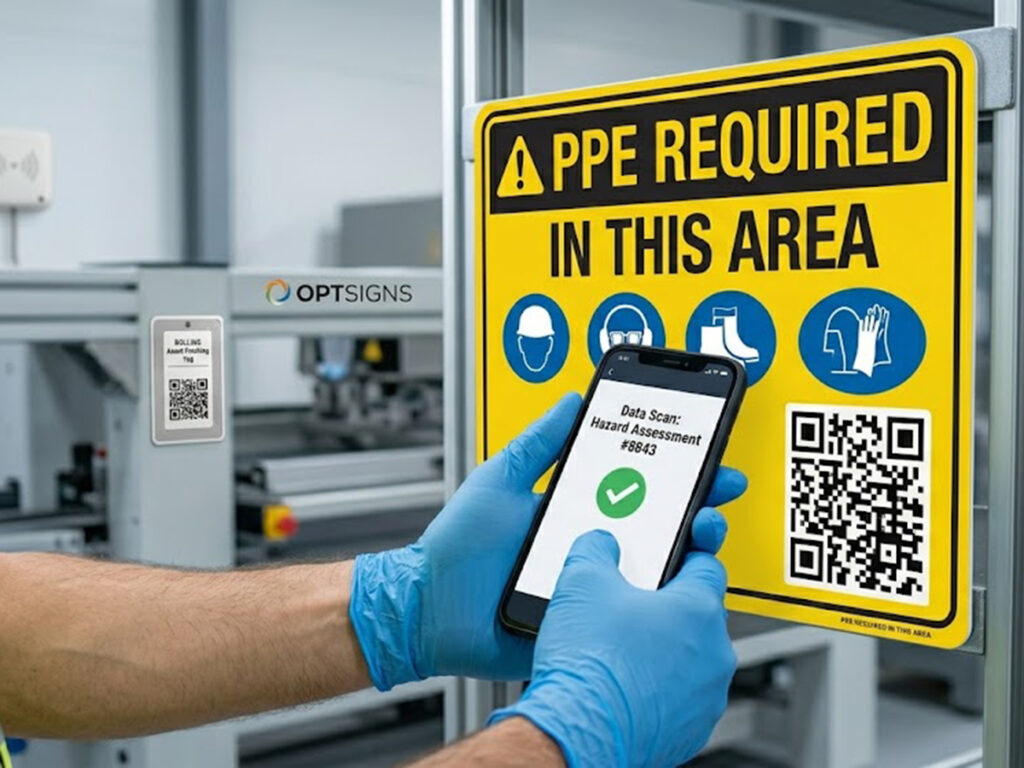
Les panneaux étiquetés avec des identifiants uniques prennent en charge le suivi automatisé du cycle de vie. Les panneaux codés QR sont directement liés aux dossiers d'inspection numériques, évaluations des dangers, et calendriers de remplacement. Les installations modernes géolocalisent les panneaux sur les superpositions CAO des installations pour une réponse rapide aux audits.
Former les travailleurs à la reconnaissance des signes
Un signe n’est efficace que dans la mesure où le travailleur est capable de l’interpréter. 29 CFR 1910.132(f) exige que les employés comprennent non seulement quel EPI porter, mais quand et pourquoi.
Le “Audit simulé” Test: Votre liste de contrôle doit inclure un “Entretien avec un travailleur” section. Demandez à un employé d'étage: “Quel danger cette icône ANSI représente-t-elle ?, et quel est votre protocole EPI spécifique ici?”
Documentation: Si le travailleur échoue, c'est un manque de formation; si le signe manque, c'est une lacune dans les installations. Documenter ces contrôles ponctuels internes prouve que vous maintenez une activité, culture de conformité – un moyen de défense clé contre “Violation volontaire” réclamations.
Transformez votre liste de contrôle en un programme de signalisation à l'épreuve des citations
Ce Liste de contrôle de la signalisation de sécurité des EPI couvre sept domaines de conformité fondamentaux: audit de référence rapide, spécifications réglementaires, placement des zones, sélection des matériaux, protocoles d'entretien, normes multilingues, et la documentation au niveau du programme. Les responsables de la sécurité qui comblent toutes les lacunes de cette liste sont rarement confrontés à des citations liées aux EPI.
La distinction en matière de conformité est importante: une liste de contrôle capture un moment dans le temps, tandis qu'un programme documenté démontre une diligence continue. Les inspecteurs de l'OSHA récompensent les programmes documentés par des pénalités réduites en vertu de la 2025 Mises à jour du manuel des opérations sur le terrain, y compris jusqu'à 60% réduction pour les petits employeurs et 20% pour des historiques d'inspection propres. Les responsables de la sécurité devraient revoir leurs Liste de contrôle de la signalisation de sécurité des EPI chaque année et surveiller les cycles de révision de la norme ANSI Z535 pour connaître les changements de normes à venir.
Téléchargez la liste de contrôle imprimable, planifier une visite guidée des installations ce trimestre, et associez ce guide à la ressource complète du pilier sur l'approvisionnement en panneaux d'EPI et la sélection des matériaux..
Foire aux questions sur la liste de contrôle de signalisation de sécurité des EPI
À quelle fréquence les panneaux d'EPI doivent-ils être inspectés pour vérifier leur conformité à l'OSHA?
Les zones intérieures à faible trafic nécessitent des inspections visuelles trimestrielles. Les panneaux extérieurs et les zones d'exposition aux produits chimiques nécessitent des inspections mensuelles. Les remplacements déclenchés se produisent immédiatement lors de la disparition, illisibilité, ou les dommages dépassent les seuils définis.
Quels panneaux EPI sont spécifiquement requis par l'OSHA?
L'OSHA impose l'utilisation des EPI en vertu 29 CFR 1910.132 et nécessite une communication des dangers en vertu 29 CFR 1910.145 et 1910.1200. Ensemble, ces normes exigent effectivement une signalisation identifiant les zones d'EPI, gravité du danger, et équipement de protection requis.
Où les panneaux EPI doivent-ils être placés sur le lieu de travail?
Placer des panneaux EPI 6 à 10 pieds avant l'entrée de la zone, à chaque point d'entrée autorisé, monté entre 60 et 72 pouces jusqu'à la ligne médiane pour l'industrie générale. Ajuster au trafic des chariots élévateurs, Exigences de l'ADA, et les risques aériens.
Les panneaux EPI doivent-ils être bilingues selon l'OSHA?
L'OSHA ne précise pas les langues mais exige la compréhension. Les installations où travaillent des travailleurs non anglophones doivent s'assurer que les travailleurs comprennent toutes les communications sur les dangers., qui nécessite généralement une signalisation bilingue ou multilingue.
Quelles sont les exigences de couleur de l'OSHA pour les panneaux EPI?
ANSI Z535.1, incorporé par référence dans 29 CFR 1910.145, spécifie le rouge pour DANGER, orange pour AVERTISSEMENT, jaune pour ATTENTION, bleu pour AVIS, et vert pour les informations de sécurité. Les fabricants doivent correspondre aux valeurs Pantone spécifiées.
Combien de temps durent généralement les panneaux de sécurité des EPI avant de devoir être remplacés?
Les panneaux intérieurs en vinyle durent 5 à 7 années. Les panneaux réfléchissants extérieurs durent 7 à 10 années avec une surlamination appropriée. Les panneaux en porcelaine émaillée et en aluminium anodisé durent 15 à 25 années. La durée de vie diminue fortement sans protection UV.
Quelle est la pénalité OSHA pour la signalisation EPI non conforme dans 2026?
Les violations graves entraînent des sanctions maximales de $16,550 par infraction en janvier 2026. Les violations volontaires ou répétées atteignent $165,514 par violation. Les inspections multi-citations peuvent dépasser $1 millions d'exposition totale.
Les panneaux EPI numériques ou électroniques sont-ils conformes à la norme OSHA ??
Les panneaux numériques sont conformes lorsqu'ils répondent à la visibilité ANSI Z535.2, contraste, et normes de fiabilité. Les exigences de basculement en cas de panne de courant ajoutent de la complexité. La plupart des installations utilisent des panneaux numériques pour les informations dynamiques plutôt que pour les avertissements de danger primaires..
Références
- Pénalités OSHA (2026 Montants maximaux) — https://www.osha.gov/penalties
- Haut OSHA 10 Normes les plus fréquemment citées pour l’exercice financier 2025 — https://www.osha.gov/top10citedstandards
- 29 CFR 1910.145 Spécifications relatives aux panneaux et étiquettes de prévention des accidents — https://www.osha.gov/laws-regs/regulations/standardnumber/1910/1910.145
- 29 CFR 1910.132 Exigences générales relatives aux équipements de protection individuelle — https://www.osha.gov/laws-regs/regulations/standardnumber/1910/1910.132
- Normes de la série ANSI Z535 — https://www.nema.org/standards/z535
- NFPA 101 Code de sécurité des personnes — https://www.nfpa.org/codes-and-standards/nfpa-101-standard-development/101