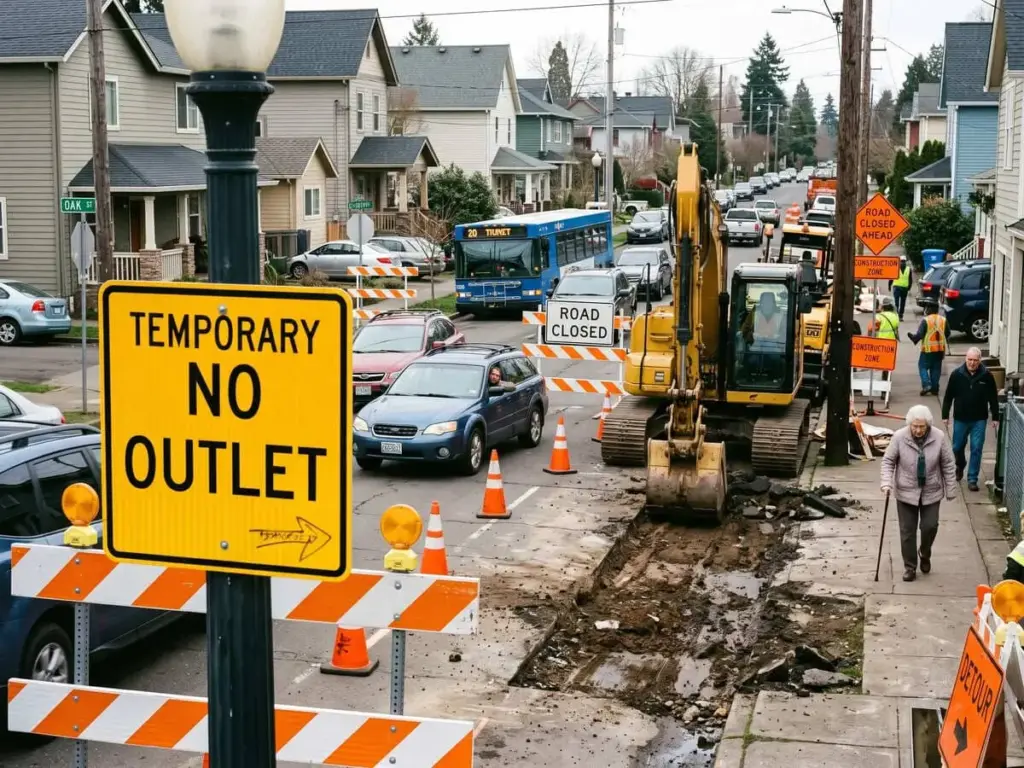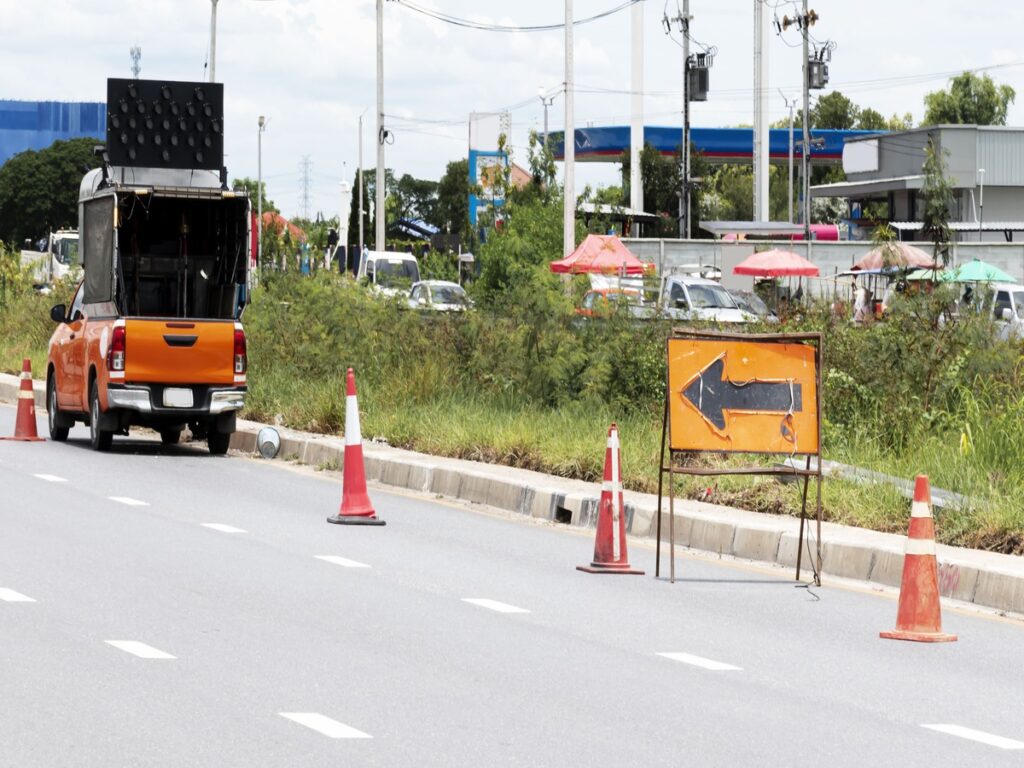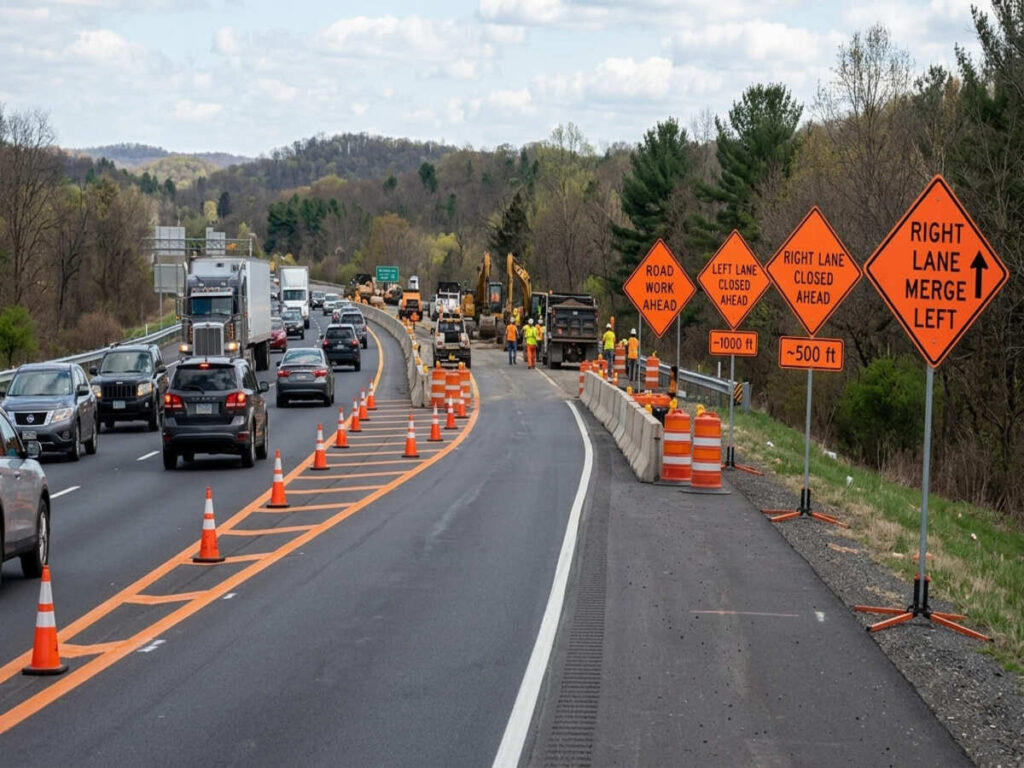
Choosing the right mounting method for temporary traffic signs in the UK directly affects road safety, driver visibility, and site compliance. The Traffic Signs Manual Chapter 8 (Department for Transport) sets out the operational guidance that practitioners follow for temporary traffic management, while BS 8442 defines the performance requirements for portable equipment used in temporary traffic management — including sign assemblies, frames, and supports. Sign panels themselves must additionally meet BS EN 12899-1:2007 for photometric and dimensional performance. This guide compares the three main mounting methods — channel fixings, plate-only mounting, and self-adhesive signs — so you can match the right approach to your specific project. For a full overview of the regulatory framework, see our dedicated guide to UK regulations for temporary traffic signs in roadworks.
At OPTRAFFIC, we supply a full range of temporary traffic signs and road sign frames & brackets designed for easy installation and maximum visibility across all UK road environments.
Key Takeaways
- Always match the mounting method to sign size, road type, weather exposure, and works duration before ordering equipment.
- Channel fixings offer the strongest hold and suit large road sign frames on busy or motorway-grade roads.
- Plate-only mounting is fast and cost-effective; furthermore, it suits smaller signs in urban or low-traffic environments.
- Self-adhesive signs work best for short-term or event-based use on clean, smooth surfaces — however, they are not suitable for active carriageways.
- All temporary traffic signs on UK public highways must follow the operational requirements of Chapter 8 of the Traffic Signs Manual. Portable sign assemblies and frames must meet BS 8442. Sign panels must separately meet BS EN 12899-1:2007 for retroreflective and dimensional performance.
- Regular post-storm inspection keeps signs safe, visible, and compliant throughout the works period.
Overview: Three Mounting Methods for Temporary Traffic Signs Compared
When professionals install temporary traffic signs across UK roads and worksites, they rely on three core mounting approaches. Each method serves a different purpose, so selecting the wrong one can compromise sign stability, driver visibility, and compliance with the Traffic Signs Manual. The table below summarises the key differences before we explore each method in depth.
| Mounting Method | Best Use Case | Durability | Installation Speed |
| Channel Fixings | Motorways, dual carriageways, heavy-duty roadworks | High | Moderate |
| Plate-Only Mounting | Urban streets, car parks, short-term events | Medium | Fast |
| Self-Adhesive Signs | Events, indoor use, smooth surface applications | Low–Medium | Very Fast |
Channel Fixings for Temporary Traffic Signs: The Most Secure Method
What Are Channel Fixings?
Channel fixings use metal channel extrusions mounted on the back of a sign panel. These extrusions then attach to a post or road sign frame via specialist hardware including channel clip extrusions, joining brackets, fixing angles, sliders, sign locators, acrylic clamps, offset brackets, stainless steel nuts and bolts, and anti-slip gaskets.
Because the system creates a rigid metal-to-metal connection, it resists wind load, HGV vibration, and weathering far more effectively than adhesive-based alternatives. As a result, channel fixings represent the industry standard for temporary road signs in high-traffic or exposed locations.
How to Install Channel Fixings: Step-by-Step
- Clean the post or frame pole thoroughly to remove all dirt, debris, and loose corrosion.
- Align the bracket with the channel slots on the pole. Confirm the sign will sit at the correct driver eye level in line with Chapter 8 guidance — specifically, the bottom of the sign face should fall between 900mm and 1,800mm above the carriageway.
- Insert stainless steel bolts through the bracket and pole slots. Stainless steel actively resists corrosion and significantly extends fixing lifespan compared to standard mild steel.
- Tighten the nuts with a wrench, but stop before over-tightening — excessive force deforms the channel extrusion and weakens the joint.
- Fit a rubber or neoprene gasket between the pole and bracket to prevent slippage under vibration from passing traffic.
- In busy public areas, use tamperproof or one-way bolts for additional security. Finally, inspect the completed assembly for stability before leaving the site.
Channel Fixings: Why They Outperform Other Methods on High-Traffic Roads
Channel fixings deliver five key benefits that other mounting methods cannot match:
- Highest durability across all UK weather conditions, including high winds and frost
- Secure attachment for large or heavy sign panels that plate-only methods cannot safely support
- Reusable hardware across multiple projects, which delivers strong long-term value
- Full compatibility with Chapter 8 operational guidance and BS EN 12899-1:2007 sign panels
- Preferred specification for motorways, dual carriageways, and major A-roads throughout the UK
However, channel fixings do carry some trade-offs. They require tools and installation skill, take longer to set up than other methods, and carry a higher upfront cost for materials and hardware. Nevertheless, for long-duration roadworks on busy routes, no other method provides comparable security.
Tip: Inspect your channel fixings after every storm or period of heavy traffic. Vehicle vibration gradually loosens bolts over time, so a regular check actively prevents sign displacement and keeps your site aligned with Chapter 8 requirements.
When to Use Channel Fixings
Use channel fixings for temporary traffic signs on motorways, dual carriageways, or any high-traffic route where signs must stay in place for extended roadworks. OPTRAFFIC stocks a full range of compatible road sign frames & brackets covering both short-term deployment and long-duration programmes.
Plate-Only Mounting for Temporary Road Signs: Fast and Cost-Effective
What Is Plate-Only Mounting?
Plate-only mounting attaches a sign panel directly to a pole, wall, A-frame stand, or portable stanchion without channel extrusions or specialist clips. Instead, contractors use bolts, screws, or heavy-duty adhesive pads to secure the panel. Consequently, this approach suits temporary road signs in towns, car parks, construction sites, and side streets where quick deployment matters more than long-term structural performance.
Sign panels for plate-only mounting typically use lightweight aluminium composite or zintec steel, which keeps weight low and redeployment practical.
How to Install Plate-Only Signs: Step-by-Step
- Choose a clean, stable, and level surface or post. Avoid uneven ground, because an angled base causes the sign to lean out of the required sight line.
- Position the sign and mark fixing points. Confirm height follows Chapter 8 guidance — the bottom of the sign face should sit between 900mm and 1,800mm above the carriageway.
- Drill fixing holes if you use bolts or screws. For portable A-frame stands, drilling is unnecessary.
- Secure the panel using bolts, screws, or approved adhesive pads. Check that the panel does not wobble or rotate after fixing.
- Add sandbags to the base of any free-standing frame to prevent wind displacement. Chapter 8 guidance specifically recommends sandbag ballasting — concrete blocks, traffic cones, or kerbstones are not suitable substitutes.
Plate-Only Mounting: When It Saves Time and Budget
In the right setting, plate-only mounting offers five practical advantages:
- Fast and straightforward to install, which makes it ideal for time-sensitive deployments
- Cost-effective for short-term use, as it requires minimal hardware investment
- Lightweight panels redeploy easily multiple times throughout a project
- Compatible with portable A-frame and stanchion stands without modification
- No specialist skills or tools are necessary for basic installations
That said, plate-only mounting has clear limits. It is less secure in strong winds or highly exposed locations, unsuitable for large or heavy sign panels without additional bracing, and requires more frequent stability checks in adverse weather. In contrast, channel fixings handle all of these scenarios with greater reliability.
Tip: For even quicker deployment at events or utility works, pair plate-only sign panels with OPTRAFFIC portable road sign frames & brackets — pre-ballasted options significantly cut setup time on site.
When to Use Plate-Only Mounting
Plate-only mounting suits temporary road signs for short-duration works in urban settings — for example, utility repairs, pavement obstructions, event traffic management, or temporary car park signage. It also works well when signs need repositioning several times during the same project.
Self-Adhesive Temporary Traffic Signs: Quickest Deployment, Shortest Duration
What Are Self-Adhesive Signs?
Self-adhesive signs carry a pressure-sensitive adhesive on their reverse face. The installer peels back the liner and presses the sign directly onto a compatible surface without any tools, drilling, or additional hardware. Manufacturers typically produce sign faces in polymeric PVC film at approximately 80 microns thickness, which keeps individual units light and bulk storage practical.
These products come with either permanent or removable adhesive backings and adhere to metal, plastic, glass, wood, and painted brick — provided the surface is clean and dry.
How to Install Self-Adhesive Signs: Step-by-Step
- Clean the application surface with isopropyl alcohol or a citrus-based degreaser, then allow it to dry fully before proceeding.
- Confirm ambient temperature sits between 10°C and 35°C. Temperatures outside this range impair adhesive bonding and reduce the working lifespan of the sign.
- Select the appropriate vinyl grade for the surface type. Always test a small area first on porous or powder-coated surfaces, as these substrates may need a primer.
- For signs up to A2 size, use the dry application method. For larger panels, use a wet method with diluted soapy water to allow repositioning before the adhesive fully sets.
- Apply from the centre outward using a squeegee, which pushes air bubbles progressively towards the edges.
- Press all edges firmly and re-check after 24 hours. Seal any lifted edges with exterior-grade sealant to prevent peeling.
Self-Adhesive Signs: Where They Work and Where They Fall Short
Self-adhesive signs offer genuine speed advantages in the right context:
- Fastest possible installation — no tools, clips, or hardware required
- They do not permanently damage the substrate when correctly removed
- Lightweight and easy to transport in bulk quantities to site
- Well suited to events, festivals, building sites, and indoor temporary works
Nevertheless, outdoor performance is significantly limited. UV radiation and temperature cycling cause premature peeling and colour fade. Furthermore, self-adhesive signs will not bond reliably to rough, porous, or wet surfaces. As a result, removable adhesive grades are inappropriate for permanent use or any highway deployment.
Important: Self-adhesive signs must not be the sole mounting method for temporary traffic signs on active carriageways. The Chapter 8 guidance for any sign on the public highway requires rigid panel mounting with an approved, compliant frame.
Channel Fixings vs Plate-Only vs Self-Adhesive: Full Comparison
| Factor | Channel Fixings | Plate-Only | Self-Adhesive |
| Durability | High — all-weather, long-term | Medium — most conditions | Low to medium — mild weather best |
| Installation Time | Moderate — tools required | Quick — basic tools only | Very fast — peel and press |
| Cost | Higher — specialist hardware | Moderate — basic fixings | Low — no additional hardware |
| Reusability | High — hardware reused across projects | Medium — panels reusable | Low — mostly single-use |
| Chapter 8 Aligned | Yes — follows all guidance | Yes — follows all guidance | Supplementary use only on highway |
| Best Environment | Motorways, dual carriageways | Urban roads, car parks, events | Indoor sites, events, building sites |
Chapter 8 and BS EN 12899-1:2007: What UK Practitioners Need to Know
Practitioners installing temporary traffic signs on UK public roads operate within two overlapping frameworks. Chapter 8 of the Traffic Signs Manual (Department for Transport) provides the operational guidance for temporary traffic management — covering sign placement, height, visibility distances, and mounting practices.
Two British Standards apply to the physical equipment. BS 8442 covers portable temporary traffic management equipment — specifically sign frames, supports, and portable assemblies of the type described in this guide. BS EN 12899-1:2007 covers the sign panels themselves, specifying dimensional tolerances, retroreflective sheeting classes, and material performance. Both standards operate alongside Chapter 8, which provides the operational placement guidance.
Note: Chapter 8 is operational guidance, not a standalone piece of legislation. The legal obligations for site safety derive from the Health and Safety at Work etc. Act 1974, the Management of Health and Safety at Work Regulations 1999, and the New Roads and Street Works Act 1991, among others. Practitioners should consult a qualified traffic management professional or their highways authority for specific legal advice.
What Chapter 8 Recommends for Sign Mounting
- Height: The bottom of the sign face should sit between 900mm and 1,800mm above the adjacent carriageway surface for adequate driver visibility.
- Stability: Free-standing frames should use sandbag ballasting. Chapter 8 guidance advises against concrete blocks, traffic cones, or kerbstones as ballast alternatives.
- Alignment: Signs should directly face oncoming traffic and avoid reflecting sunlight into drivers’ eyes. Recheck alignment at the end of each working day as light conditions change.
- Clear sight lines: Parked vehicles, vegetation, or other signage must not obstruct the sign from its required advance visibility distance.
- Sign condition: Remove from service any sign with significant colour fading, damaged retroreflective sheeting, or illegible symbols.
RA1 and RA2 Retroreflective Sheeting: Choosing the Right Grade
BS EN 12899-1:2007 classifies retroreflective sheeting grades for sign panels. Portable sign assemblies that carry these panels must additionally comply with BS 8442 for structural and mechanical performance. Understanding the difference between RA1 and RA2 is essential when specifying temporary traffic signs for different road types. For a full technical breakdown, see our guide to reflective traffic signs and RA1/RA2 sheeting standards.
| Grade | Class | Typical Application | Expected Lifespan |
| RA1 — Engineering Grade | Class 1 | Low-speed urban roads, car parks, short-term works under 40mph | 7–10 years |
| RA2 — High Intensity Prismatic | Class 2 | A-roads, dual carriageways, motorways, all night-time works | 10–12 years |
For works on roads above 40mph, practitioners typically specify RA2 reflective sheeting as a minimum, and many highways authorities require it as a permit condition. Furthermore, night-time works on any road type benefit significantly from RA2’s greater retroreflective brightness at longer advance warning distances.
Tip: Before starting any works on the public highway, confirm with your local highways authority whether a Traffic Management Plan (TMP) is a permit condition. For Category 0 and Category 1 roads, a TMP is typically required and must specify sign types, sizes, and mounting methods. Always verify current requirements with your authority, as conditions vary by location.
Best Practices for Installing and Maintaining Temporary Traffic Signs
How to Select the Right Mounting Method: A Pre-Works Checklist
- Identify the road classification and speed limit first, because these factors determine the minimum sign size and retroreflectivity class aligned with Chapter 8 guidance.
- Assess expected weather exposure next. Wind load and sustained rainfall directly affect which mounting method maintains a safe hold throughout the works period.
- Confirm the works duration. Short-term works under 72 hours carry different signing considerations than long-term roadworks programmes.
- Always specify retroreflective sign faces on every deployment. Temporary traffic signs on UK roads must remain visible at night and in poor weather without supplementary lighting.
- For night works or high-speed road deployments, additionally specify LED warning lights to maximise advance driver awareness.
- Combine signage with physical traffic barriers to channelise vehicles through the works zone and reduce reliance on signs alone.
Inspection and Maintenance Schedule for Temporary Road Signs
- Daily: At the start of each working day, visually inspect sign alignment, stability, legibility, and ballast condition.
- After adverse weather: Conduct a full inspection of all fixings, sandbag weights, and sign faces immediately following wind, heavy rain, or frost.
- Weekly (long-term works): Tighten all bolts and channel fixings, check adhesive panel edges for lift, and replace faded or physically damaged sign faces.
- Following any on-site incident: Inspect immediately whenever a vehicle or pedestrian makes contact with signage, barriers, or adjacent equipment.
Important: A displaced or obscured sign actively removes protection from the site. Under the Management of Health and Safety at Work Regulations 1999, site managers carry a duty to keep all temporary signage effective, visible, and correctly positioned throughout the full works period.
Frequently Asked Questions About Temporary Traffic Signs UK
What is the best mounting method for temporary traffic signs in windy locations?
Channel fixings are the recommended choice for exposed or windy locations. The metal-to-metal connection between the channel extrusion and the road sign frame delivers significantly greater wind resistance than adhesive or clip-on alternatives. Moreover, Chapter 8 guidance recommends sandbag ballasting on all free-standing frames regardless of wind conditions, so always fit sandbags even on calm days.
What standards apply to temporary traffic signs in the UK?
Three frameworks apply. Chapter 8 of the Traffic Signs Manual provides operational guidance for placement, height, and visibility. BS 8442 specifies the performance requirements for portable temporary traffic management equipment — including the sign frames and assemblies covered in this guide. BS EN 12899-1:2007 separately covers sign panel performance, including retroreflective sheeting grades and dimensional tolerances.
What is the difference between RA1 and RA2 reflective sheeting on temporary road signs?
RA1 (Engineering Grade) meets Class 1 retroreflectivity requirements under BS EN 12899-1:2007 and suits low-speed urban roads and short-term works. RA2 (High Intensity Prismatic) meets Class 2 requirements and delivers significantly greater retroreflective brightness at longer advance warning distances. As a result, RA2 is the standard specification for A-roads, dual carriageways, motorways, and all night-time roadworks.
Can temporary road signs be reused after the works are complete?
Yes — sign panels with channel fixings or plate-only hardware are designed for repeated deployment. However, before reuse, inspect each panel for colour fading, damaged retroreflective sheeting, or physical deformation. Remove any panel that no longer meets the photometric performance requirements of BS EN 12899-1:2007 from service. Self-adhesive signs are generally single-use — once removed, the adhesive layer degrades and reliable re-application is not possible.
What is the correct mounting height for temporary road signs in the UK?
Chapter 8 guidance recommends positioning the bottom of a temporary road sign face between 900mm and 1,800mm above the adjacent carriageway surface. This range places the sign within the driver’s natural eye-level sightline so they can read it without looking significantly away from the road ahead.
How often should temporary traffic signs be inspected on site?
At minimum, temporary traffic signs need a visual check at the start of each working day and a full structural inspection after any adverse weather. For long-duration roadworks, additionally maintain a formal weekly inspection log — many highways authorities require this as a Traffic Management Plan condition. Address loose fixings, displaced signs, and faded panels the same day you discover them.
Related Articles
- What Are the UK Regulations for Temporary Traffic Signs in Roadworks
- RA1 vs RA2 Reflective Sheeting: Key Differences, Applications, and Performance
- Top Traffic Sign Manufacturers in the UK
- UK Warehouse Safety Signage: Optimising Traffic and Pedestrian Flow
- UK Safety Sign Colours: The Complete Guide to Workplace Meanings