Pourquoi la communication visuelle est un contrôle de sécurité de première ligne
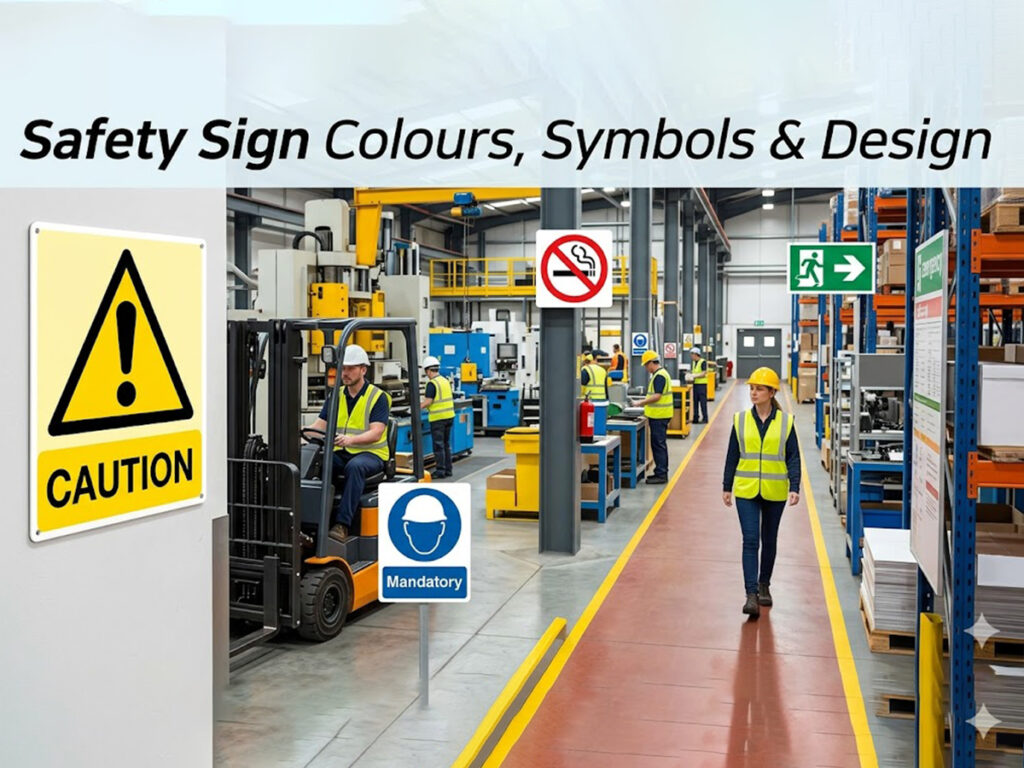
Chaque lieu de travail fonctionne avec des signaux. Un cercle rouge, un triangle jaune, un marqueur de sortie lumineux – chacun porte un message que les travailleurs doivent lire en une fraction de seconde. Fort conception de panneaux de sécurité fait atterrir ce message. La conception faible le laisse passer. Ce guide traite conception de panneaux de sécurité comme une discipline complète, pas une commande sur catalogue.
Les enjeux sont mesurables. Les États-Unis. Bureau of Labor Statistics enregistré 5,070 accidents du travail mortels en 2024 (Source: https://www.bls.gov/news.release/cfoi.nr0.htm). En moyenne, un travailleur meurt tous les 104 minutes. Les employeurs privés ont également signalé 2.5 millions de blessures et de maladies non mortelles cette année-là (Source: https://www.bls.gov/news.release/osh.nr0.htm). La signalisation n’explique pas à elle seule ces chiffres. Mais il se situe sur le chemin critique entre un danger et une décision humaine..
Le coût d’une signalisation ambiguë ou mal conçue
Pauvre conception de panneaux de sécurité échoue tranquillement. Un pictogramme décoloré, un message encombré, ou une palette incohérente crée une hésitation. L’hésitation coûte du temps. À proximité d'un chariot élévateur en mouvement ou d'un panneau sous tension, le temps est la marge entre la sécurité et la gravité.
La sursignalisation comporte son propre risque. Quand chaque surface crie « Danger,« Les travailleurs arrêtent de lire. Les professionnels de la sécurité appellent cela la fatigue d’avertissement. Discipliné conception de panneaux de sécurité le combat en réservant le codage visuel le plus fort aux dangers aux conséquences les plus graves.
Où se situe la signalisation dans la hiérarchie des contrôles
La sécurité au travail suit une hiérarchie de contrôles. L'élimination arrive en premier. Les contrôles de substitution et d’ingénierie suivent. La signalisation appartient au niveau administratif – vers le bas, juste au-dessus des équipements de protection individuelle.
Ce placement compte. La signalisation ne supprime pas un danger. Il éclaire une décision. Donc, conception de panneaux de sécurité doit travailler dur pour compenser un niveau de contrôle faible. De nombreux managers construisent les bases en maîtrisant les significations derrière chaque couleur de panneau de lieu de travail.
Le cadre réglementaire et normatif derrière la signalisation de sécurité
Son conception de panneaux de sécurité repose sur des normes publiées. Ces documents éliminent les incertitudes et donnent aux responsables de la sécurité une base défendable pour chaque choix..
Normes internationales — ISO 7010 et ISO 3864
ISO 7010:2019 est la norme internationale pour les pictogrammes de panneaux de sécurité enregistrés. Il définit une bibliothèque de symboles testés et attribue à chacun un code de référence. ISO 3864-1 définit les principes de conception — couleurs de sécurité, formes géométriques, et règles de mise en page. ISO 3864-4 spécifie les propriétés colorimétriques et photométriques des matériaux de signalisation.
Ensemble, ces normes forment un seul système. ISO 7010 tire ses formes et ses couleurs directement de l'ISO 3864-1. Aucun des deux ne fonctionne seul.
Les réglementations nationales et leur croisement
Aux États-Unis, Réglementation OSHA 29 CFR 1910.145 régit les panneaux et les étiquettes de prévention des accidents. Il définit les catégories de signes, règles de conception, et devoirs de placement. La norme exige des coins arrondis ou émoussés, formulation lisible, et des panneaux placés aussi près que possible du danger en toute sécurité.
L'OSHA oriente également les employeurs vers la série ANSI Z535, qui développe les couleurs de sécurité, symboles d'alerte, et pictogrammes. ANSI Z535.3 autorise explicitement les symboles de style ISO dans le format ANSI. Ce croisement permet à une installation de satisfaire les deux cadres à la fois.
Comment les normes s'intègrent dans un système
Couleur, forme, et le pictogramme ne sont pas des choix indépendants. Chaque norme croise les autres. Un panneau conforme est un objet coordonné, et non un ensemble de pièces détachées.. Traiter conception de panneaux de sécurité car un système est la première marque d’une véritable expertise.
Le système de couleurs des panneaux de sécurité: Significations, Contraste, et erreurs courantes
La couleur est le canal le plus rapide conception de panneaux de sécurité. Les travailleurs le traitent avant de lire un seul mot. Une compréhension claire des couleurs et des significations des panneaux de sécurité ancre l'ensemble du système.
| Couleur de sécurité | Signification | Forme géométrique | Exemple d'utilisation |
| Rouge | Interdiction; équipement d'incendie | Cercle avec barre diagonale; carré pour équipement d'incendie | Interdiction de fumer; emplacement des extincteurs |
| Jaune | Avertissement | Triangle équilatéral | Risque de choc électrique; circulation des chariots élévateurs |
| Bleu | Action obligatoire | Cercle | Portez des lunettes de protection; porter un casque |
| Vert | État sécuritaire; s'échapper | Carré ou rectangle | ISSUE DE SECOURS; poste de secours |
Source: https://www.iso.org/standard/72424.html
Le noir et le blanc servent de couleurs contrastées. ISO 3864-4 lie chaque couleur à des coordonnées chromatiques CIE spécifiques. Un panneau vert dans une usine correspond ensuite à un panneau vert dans une autre.
Spécification des couleurs en pratique
Une couleur spécifiée ne signifie rien jusqu'à ce qu'elle atteigne un substrat. Les fabricants traduisent les valeurs de chromaticité ISO en références RAL et Pantone pour la production. La fidélité des couleurs est importante. Un panneau qui dérive vers l’orange sous l’exposition aux UV brise le code qu’il était censé porter.
Erreurs de couleur courantes qui nuisent à la conformité
Trois erreurs reviennent lors des audits:
- Les managers abusent du rouge pour les messages de non-interdiction.
- Ils associent des couleurs avec un faible contraste chromatique.
- Ils spécifient des pigments qui s'estompent rapidement. Chaque erreur érode le système de couleurs.
Les équipes qui veulent éviter ces pièges doivent étudier les associations de couleurs qui envoient le mauvais message..
Symboles, Pictogrammes et codage de formes géométriques
Les symboles ont un sens au-delà des barrières linguistiques. Les symboles et pictogrammes des panneaux de sécurité bien conçus rendent le panneau lisible par toute personne se trouvant sur le sol..
Le code des formes géométriques
La forme code le sens avant même que la couleur ne soit traitée. Un cercle signale une interdiction ou une action obligatoire. Un triangle équilatéral signale un avertissement. Un carré ou un rectangle signale une condition ou une information sûre. Un travailleur qui voit un triangle s'attend déjà à un danger. La forme amorce la réponse.
Qu'est-ce qui rend un pictogramme efficace
ISO 7010 construit ses pictogrammes sur des principes éprouvés. Chaque symbole utilise une silhouette épurée, détail interne minimal, et un taux de reconnaissance mesuré élevé. La simplicité favorise la compréhension. Un pictogramme encombré ralentit le lecteur et fragilise le panneau.
Symboles d'abord ou panneaux pris en charge par le texte
Mené par des symboles conception de panneaux de sécurité réduit la dépendance aux mots. Ce choix s’avère payant dans toute main-d’œuvre multilingue. Les panneaux de texte sont toujours utiles lorsqu'un danger nécessite une instruction spécifique. L’équilibre entre les deux détermine débat sur les graphiques par rapport au texte écrit sur un panneau.
Réflectivité, Photoluminescence, et conception de panneaux à haute visibilité
Un panneau ne fonctionne que lorsqu'un travailleur peut le voir. La conception des panneaux à haute visibilité étend les messages de sécurité dans l'obscurité, éblouissement, et la distance.
Matériaux rétroréfléchissants et comment ils sont mesurés
Les feuilles rétroréfléchissantes renvoient la lumière vers sa source. Les ingénieurs mesurent les performances comme le coefficient de rétroréflexion, exprimé en candelas par lux par mètre carré. Changements de performances avec les angles d’entrée et d’observation. Les phares des véhicules rendent les panneaux rétroréfléchissants indispensables dans les zones de circulation.
Enseignes photoluminescentes
Les panneaux photoluminescents — « qui brillent dans le noir » — absorbent la lumière et la restituent lentement. Les concepteurs mesurent la luminance en millicandelas par mètre carré et suivent la courbe de décroissance au fil du temps. Ces panneaux guident les issues de secours en cas de panne de courant. Ils n'ont besoin d'aucun câblage ni d'aucune source externe en cas de crise.
Adapter la technologie des matériaux à l’environnement
Le choix des matériaux suit l'environnement. Espaces peu éclairés, issues de secours sans lumière, et les zones de véhicules exigent chacune une technologie différente. Les managers travaillant dans des conditions d'éclairage médiocres bénéficient d'un stratégies pour garder les panneaux lisibles dans des conditions de faible luminosité.
Influence comportementale et facteurs humains dans la conception des enseignes
Le meilleur conception de panneaux de sécurité change de comportement. Il ne se contente pas d'informer : il incite à la bonne action au bon moment..
Comment la couleur et les graphiques influencent la prise de décision
La couleur et la forme agissent comme des indices pré-attentifs. Le cerveau les traite avant le début de la lecture consciente. Intelligent conception de panneaux de sécurité utilise cette longueur d'avance pour raccourcir le temps de réaction.
Avertissement Fatigue et Habitude
L'habitude est l'ennemi de tout système de signes. Les travailleurs se déconnectent à plusieurs reprises, avertissements à faibles enjeux. Les concepteurs ripostent en classant les dangers et en faisant correspondre l'urgence visuelle aux conséquences réelles..
Concevoir pour la compréhension, Pas seulement la conformité
La conformité est la base, pas le plafond. Les signes les plus forts combinent la couleur, forme, et pictogramme en codage redondant - trois signaux qui pointent tous dans la même direction. Les équipes doivent tester leur compréhension auprès de leur effectif réel. Le lien entre la couleur, graphique, et comportement récompense un examen plus attentif.
Concevoir des panneaux de sécurité pour un environnement multilingue, Main-d'œuvre multiculturelle
Les chantiers modernes parlent plusieurs langues. Son conception de panneaux de sécurité des plans pour cette réalité depuis le début.
Pourquoi la conception basée sur les symboles réduit les risques linguistiques
Un pictogramme n'a pas besoin d'être traduit. La conception basée sur les symboles établit une base de compréhension qui survit aux lacunes en matière d'alphabétisation et aux différences linguistiques.. Cette base de référence est au cœur des meilleures pratiques en matière de signalisation de sécurité multilingue..
Interprétation cohérente des couleurs à travers les cultures
Les associations de couleurs varient selon les cultures. La normalisation remplace cette variation. Lorsqu'un site suit le code couleur ISO, le rouge signifie l'interdiction pour tout le monde. Les fabricants assument une partie de cette charge, et interprétation cohérente des couleurs sur un site diversifié dépend d’une production disciplinée.
Quand et comment ajouter plusieurs langues
Alors que les symboles comblent de nombreuses lacunes, des instructions techniques spécifiques ou des avertissements légaux nécessitent souvent un texte supplémentaire.
- Le “Quand”: Déployez un texte multilingue lorsque vous faites face à des dangers à haut risque qui ne peuvent pas être entièrement capturés par un pictogramme seul. (Par exemple, procédures spécifiques de manipulation de produits chimiques ou d’isolation électrique), ou lorsque les réglementations locales imposent spécifiquement les langues secondaires.
- Le “Comment”: Pour maintenir la lisibilité sans créer de fouillis visuel, suivre une hiérarchie de conception stricte:
- Donner la priorité au symbole ISO: Conservez le graphique comme point d'ancrage principal pour la reconnaissance en une fraction de seconde.
- Hiérarchie du texte: Utilisez du gras, des polices plus grandes pour la langue principale et un poids plus léger ou une couleur distincte pour la traduction secondaire.
- Regroupement logique: Éviter “prise en sandwich” texte; regrouper les traductions clairement en dessous ou sur le côté du symbole pour éviter une surcharge cognitive.
Extension du système: Panneaux de sécurité de circulation et d'orientation
La logique de la communication visuelle ne s’arrête pas à la porte de l’usine; il doit s'étendre jusqu'au tarmac pour assurer la sécurité de l'ensemble du site.
Logique partagée entre le lieu de travail et la signalisation routière
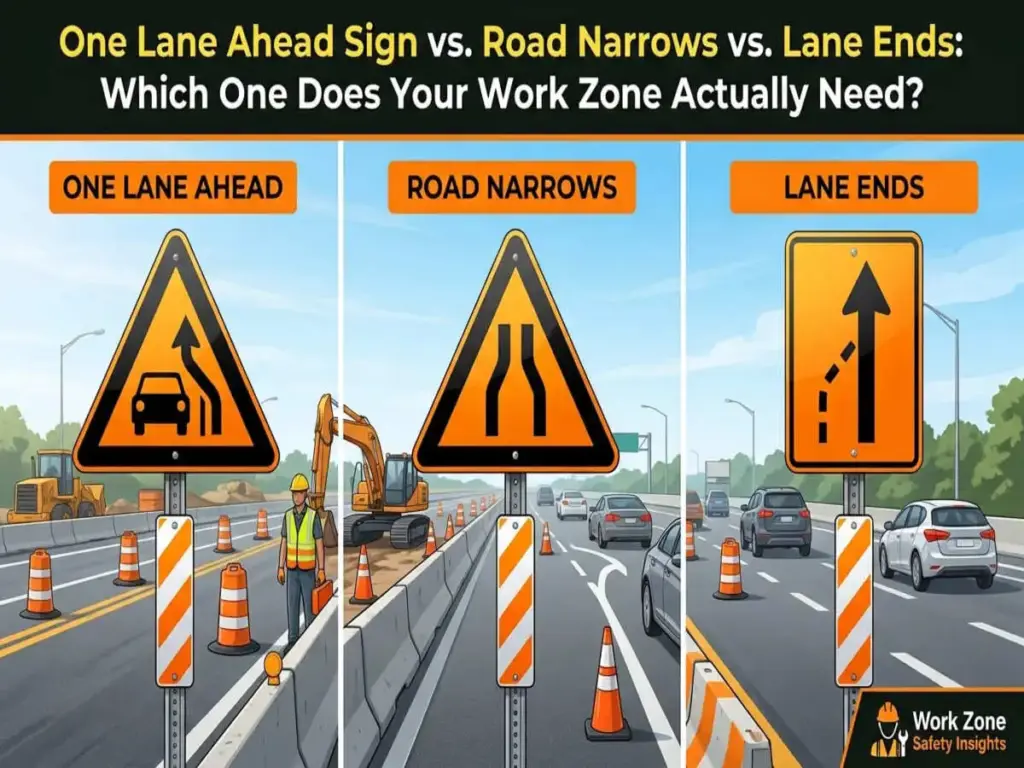
Le codage unifié réduit les frictions cognitives. En maintenant une logique de forme et de couleur cohérente entre les panneaux de sécurité intérieurs et les voies de circulation extérieures, les gestionnaires de chantier veillent à ce que les conducteurs et les piétons réagissent instinctivement, quel que soit leur emplacement. Cette continuité est essentielle pour les sites multimodaux où se croisent fréquemment engins lourds et personnels..
Ingénierie pour la vitesse: Principes de conception pour les environnements de circulation
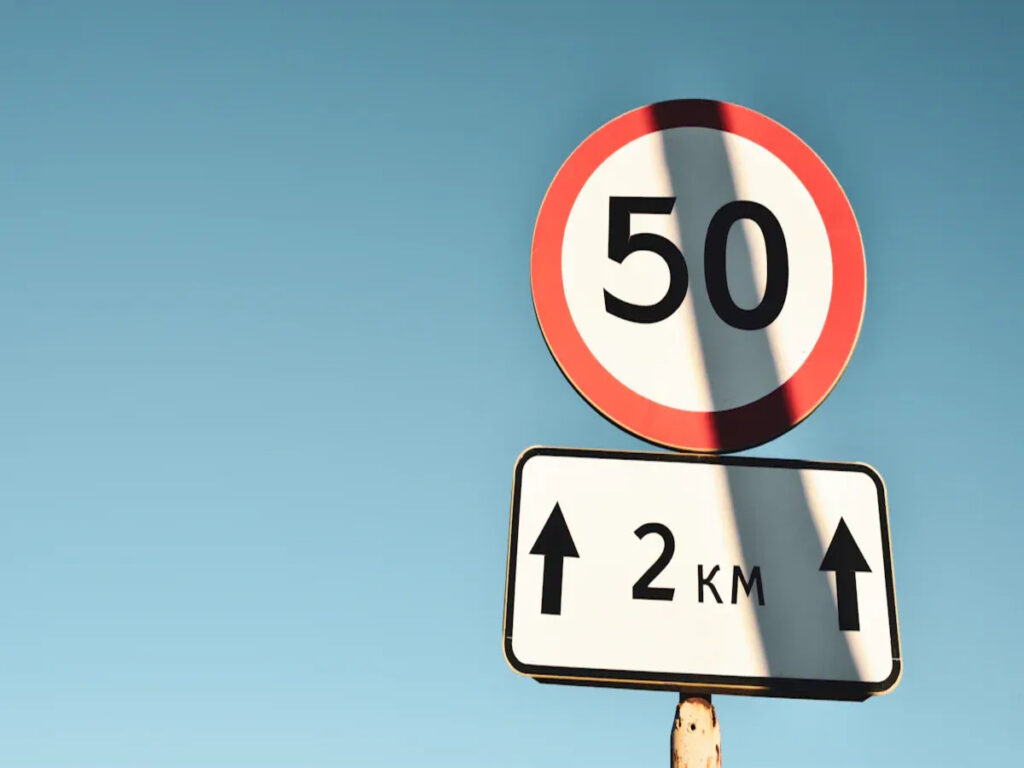
Les environnements de trafic introduisent une variable critique: vitesse. Contrairement aux panneaux statiques sur le lieu de travail, la signalisation routière doit tenir compte “Distance de lisibilité.”
- Échelles de réflectivité: À mesure que la vitesse du véhicule augmente, la qualité requise de feuille réfléchissante (Par exemple, Classe 1 contre. Classe 2) doit augmenter pour fournir un temps de réaction adéquat.
- Mise à l'échelle géométrique: Les hauteurs du texte et les dimensions des symboles sont calculées en fonction des vitesses d'approche pour garantir que le message est décodé avant le point de freinage..
- Adaptabilité visuelle: Le principes de conception derrière les couleurs des panneaux routiers sont conçus pour rester distincts sur des arrière-plans extérieurs complexes et dans des conditions météorologiques variables.
Construire un système de signalisation de sécurité cohérent et efficace
Fort conception de panneaux de sécurité se termine là où il a commencé - en tant que système. Chaque couleur, forme, symbole, et le choix des matériaux sert un seul objectif: un message qu'un travailleur comprend sans effort.
La liste de contrôle de conception - Couleur, Forme, Icône, Matériel
Un pratique conception de panneaux de sécurité l'examen s'étend sur quatre questions:
- Couleur: La couleur de sécurité correspond-elle à la catégorie de danger selon la norme ISO 3864-1?
- Forme: La forme géométrique renforce-t-elle le message avant la lecture des mots?
- Icône: Le symbole est-il un ISO enregistré 7010 pictogramme avec une silhouette épurée?
- Matériel: Le support est-il adapté à l'éclairage - rétroréfléchissant, photoluminescent, ou standard?
Audit et maintien de l’intégrité des panneaux au fil du temps
Âge des signes. Ils s'estompent, fissure, et sont en retard sur les normes révisées. Un audit programmé détecte les dégâts, supprime les panneaux redondants, et maintient le système aligné sur l'ISO actuelle 7010 amendements. L'application de l'OSHA ajoute une raison financière pour respecter ce calendrier.
| Type de violation | Pénalité maximale (2026) |
| Sérieux | $16,550 par violation |
| Autre que-série | $16,550 par violation |
| Délibéré | $165,514 par violation (minimum $11,524) |
| Répéter | $165,514 par violation |
| Incapacité à réduire | $16,550 par jour au-delà de la date d'abattement |
Source: https://www.osha.gov/penalties
Foire aux questions sur la conception des panneaux de sécurité
Quelles sont les quatre principales couleurs des panneaux de sécurité et que signifient-elles ??
ISO 3864-1 définit le rouge pour les équipements d'interdiction et d'incendie, jaune pour avertissement, bleu pour une action obligatoire, et vert pour des conditions sûres et des voies d'évacuation. Le noir et le blanc agissent comme des couleurs contrastées.
Les panneaux de sécurité sont-ils une exigence légale aux États-Unis. lieux de travail?
Oui. OSHA 29 CFR 1910.145 exige des panneaux et des étiquettes de prévention des accidents partout où les dangers ne sont pas facilement apparents. Il définit également les règles de conception et de placement.
Quelle est la différence entre ISO 7010 et normes plus anciennes?
ISO 7010:2019 fournit une bibliothèque unique d'enregistrements, pictogrammes testés. Les normes nationales plus anciennes utilisaient des symboles variés. ISO 7010 les harmonise sous un système référencé.
Quelle est la différence entre les panneaux rétroréfléchissants et photoluminescents?
Les panneaux rétroréfléchissants renvoient les phares ou les torches au spectateur. Les panneaux photoluminescents stockent la lumière et brillent d'eux-mêmes lorsque la zone s'assombrit.. Bien conception de panneaux de sécurité adapte chaque type à son environnement.
Les panneaux de sécurité doivent-ils utiliser des symboles au lieu du texte?
Non, mais la conception basée sur les symboles est une bonne pratique. Les pictogrammes traversent les barrières linguistiques. Les panneaux de texte ajoutent des instructions spécifiques là où un symbole seul ne peut pas transmettre l'intégralité du message..
À quelle fréquence un lieu de travail doit-il vérifier ses panneaux de sécurité?
La plupart des responsables de la sécurité effectuent une revue documentée au moins une fois par an. Ils revérifient également après les modifications de mise en page, incidents, ou mises à jour ISO 7010 ou les conseils de l'OSHA.
Références
- OSHA- 29 CFR 1910.145, Spécifications relatives aux panneaux et étiquettes de prévention des accidents.
- Institut d'information juridique de Cornell — 29 CFR 1910.145.
- GRAND – GRAND 7010:2019, Symboles graphiques, Couleurs de sécurité et panneaux de sécurité, Panneaux de sécurité enregistrés.
- GRAND – GRAND 3864-4:2011, Propriétés colorimétriques et photométriques des matériaux de signalisation de sécurité.