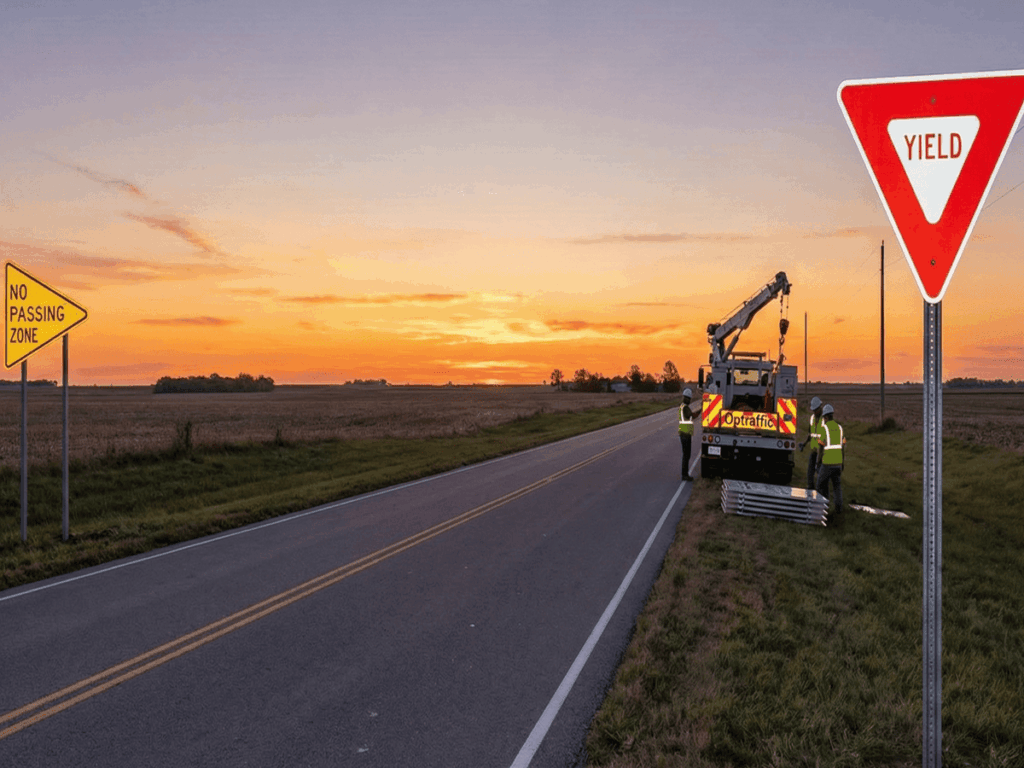
A red and white triangular sign means you must yield. When you see this sign at a junction, slow down and check for crossing traffic. Give the right of way to any vehicle or pedestrian that has priority. It is one of the most recognizable triangular road signs on public roads in the United States and United Kingdom.
However, the red and white triangular sign is not the only triangular road sign you will encounter. The same three-sided shape appears in orange-red on slow-moving vehicles. It also appears in yellow and red combinations across European highways. In addition, it comes in downward-pointing and upright orientations that each carry distinct legal meanings. This guide covers every major triangular sign variant and what each one requires. For broader context on how sign shape communicates meaning, see our guide to the 8 basic road sign shapes.
As a specialist manufacturer of MUTCD and TSRGD-compliant traffic signs, OPTRAFFIC has compiled the information below to reflect current applicable standards across all major regulatory systems.
Key Takeaways
- A red and white triangular sign means yield in the US (MUTCD R1-2) and give way in the UK (TSRGD 2016) — the same downward-pointing geometry, two different regulatory systems.
- In Europe, an upright red-bordered triangle means hazard warning, not yield. Orientation — not just color — determines the meaning.
- The orange and red triangular sign on a vehicle is the Slow Moving Vehicle (SMV) emblem under ANSI/ASABE S276. It signals a speed differential of up to 60 mph, not a road instruction.
- A yellow triangle sign is not a standard US road sign. In Vienna Convention countries, it signals a hazard warning with a pictogram inside.
- For procurement across markets, confirm whether your project is governed by MUTCD, TSRGD 2016, or a national Vienna Convention implementation before ordering. Signs are not interchangeable between systems.
What a Red and White Triangular Sign Means at an Intersection
When you approach a red and white triangular sign at an intersection, the legal instruction is to yield the right of way. Specifically, you must do three things. First, reduce speed as you approach. Second, check whether any vehicle or pedestrian already at the intersection has priority. Third, stop completely if no safe gap exists. If the intersection is clear, you may proceed without a full stop. In other words, the red and white triangular sign does not work like a stop sign. It requires you to give way, not necessarily to halt.
In the United States, the red and white triangular sign is standardized under MUTCD Section 2B.08 (R1-2) as the yield sign (FHWA, MUTCD 11th Edition, 2023). It is an inverted equilateral triangle with a bold red border, white fill, and the word YIELD in red. The point faces down — a deliberate design choice. Visually, it directs the eye downward toward the road. As a result, the sign reinforces the yield instruction before the driver has consciously read the text.
Nevertheless, many drivers treat the red and white triangular sign as optional. That is a legal error. Failing to yield when another vehicle has the right of way is a moving violation in every US state. The scale of the problem is significant. According to NHTSA’s Rural/Urban Traffic Fatalities: 2023 Data (DOT HS 813 728), intersection crashes resulted in 11,843 fatalities in the United States in 2023. Furthermore, NHTSA research identifies failure to yield as one of the most frequent driver decision errors in intersection crashes. Those are precisely the crash types that the triangular road sign exists to prevent.
Why the Sign Points Down: Downward Facing Triangular Signs
The orientation of downward facing triangular signs is not arbitrary. The downward point creates visual directionality. The sign appears to lean toward the road surface. Consequently, it points at the exact space where yielding must happen. This quality makes the downward facing triangle sign more immediately communicative than a circular or rectangular sign with the same text.
Moreover, the inverted or upside down triangle sign format carries international authority. After the 1968 Vienna Convention on Road Signs and Signals, the downward-pointing triangle became the global standard for yield or give-way control (UNECE, Vienna Convention, Annex 1, Section B). In European traffic codes, by contrast, an upright triangle — point facing up — signals a hazard warning. Therefore, a downward facing triangular sign means yield, while an upright triangle means danger. Orientation alone encodes a categorical difference in meaning.
Red and White Triangular Sign at Different Junction Types
The triangular traffic sign carries the same legal instruction regardless of junction type. However, what that instruction requires in practice varies.
- T-intersections and side roads: Traffic on the major road has continuous right of way. You must yield before pulling out.
- Roundabouts: The red and white triangular sign at intersection of a roundabout entry means yield to all circulating vehicles inside. Do not enter until a safe gap exists.
- Merging lanes: At highway on-ramps, the triangular sign requires you to match mainline speed and find a gap. You cannot force a merge.
- Pedestrian priority zones: Some jurisdictions place yield signs where vehicles must give way to pedestrians, rather than to other vehicles.
In every case, the triangular road sign places the burden on the approaching driver. The right of way belongs to whoever does not face the sign.
For more on MUTCD yield sign specifications and placement requirements, see our guide to triangle traffic signs and MUTCD yield standards.
What Does the Orange and Red Triangular Sign Mean?
The orange and red triangular sign does not appear on roadside posts. Instead, it appears on the rear of vehicles. It signals one specific warning: the vehicle ahead is moving significantly slower than normal traffic speed.
This orange triangle sign is the Slow Moving Vehicle (SMV) emblem. It is standardized under ANSI/ASABE S276, the recognized US standard for slow-moving vehicle identification. The design is precise: a fluorescent orange equilateral triangle with a dark red retroreflective border. The two-layer construction serves two purposes. The fluorescent orange center is highly visible in daylight. Additionally, the retroreflective red border returns headlight beams at night. As a result, this is a triangular sign that performs in both conditions.
The orange triangle sign meaning signals a serious risk. Farm tractors, road rollers, and horse-drawn vehicles all travel at speeds 40 to 60 mph slower than surrounding traffic. When a driver rounds a curve and encounters a vehicle with the orange and red triangular sign, reaction time is very short. Consequently, rear-end collisions involving SMV-equipped vehicles are consistently among the most severe rural road crash types.
Red Triangle with Orange Center: What CDL Candidates Need to Know
Commercial driver’s license (CDL) written examinations regularly test knowledge of the SMV emblem. The correct description is red triangle with orange center: a dark retroreflective red border around a fluorescent orange interior. CDL candidates must remember two rules.
- First, this orange triangle traffic sign appears only on slow-moving vehicles. It is never a roadside regulatory or warning sign.
- Second, the SMV emblem does not authorize overtaking in a no-passing zone. It describes the vehicle’s speed only.
In short, any orange colored triangle shaped sign on a truck or construction equipment means: increase following distance and wait for a legal passing opportunity. Construction sites operating slow-moving equipment on public roads must fit a compliant slow-moving vehicle triangle sign.
Give Way Sign vs. Yield Sign: Same Triangular Sign, Different Countries
The give way sign and the US yield sign deliver identical instructions through identical signs. Both are red and white triangular signs pointing downward. The difference is terminology only. The United States uses ‘yield,’ derived from Old English meaning to cede priority. The United Kingdom and many other countries use ‘give way,’ a more literal phrase for the same legal action. In Vienna Convention countries, moreover, the triangular sign may carry neither word. The shape and color alone communicate the instruction.
However, the country of origin matters for procurement. A US-format yield sign and a UK give way sign share the same geometry but have different physical specifications. Specifically, the UK system is governed by the Traffic Signs Regulations and General Directions (TSRGD 2016). TSRGD 2016 sets different requirements for sign dimensions, retroreflectivity class, and mounting heights compared to the MUTCD. Therefore, installing a US-spec sign on a UK road creates a compliance failure.
Yellow Triangle Signs: What the Color Means
The yellow triangle sign meaning depends on where you encounter it. In the United States, a yellow triangle sign is not a standard sign. The MUTCD uses yellow diamonds for road hazard warnings, not triangles (MUTCD Part 2C). If you see a triangular yellow sign on a US road, it is most likely a temporary or non-standard device. Read its supplemental text carefully.
In Europe, by contrast, a yellow or white triangle with a red border is the standard hazard warning sign. This is established under the Vienna Convention framework (UNECE, Vienna Convention, Annex 1, Part A). The specific hazard is communicated by a pictogram inside the triangle. For example, a yellow triangle sign with a skidding car pictogram means slippery road ahead. The same shape with a roadworks symbol means construction zone. Consequently, the triangular shape signals the warning category, and the pictogram provides the content. This is fundamentally different from the US yellow diamond system.
Triangular Road Signs and Meanings: Quick Reference
The table below summarizes every major triangular sign variant. Understanding these combinations is the difference between correctly reading a triangular road sign and misreading a safety instruction.
| Orientation | Colors | Points | System | Meaning | Legal basis |
| Inverted (down) | Red border, white fill | Down | USA / UK | Yield / Give Way | MUTCD R1-2 / TSRGD 2016 |
| Inverted (down) | Red border, white fill | Down | Vienna Convention | Yield / Give Way | UN Vienna Conv. 1968 |
| Upright | Red border, white/yellow fill | Up | Europe (Vienna) | Hazard warning — pictogram specifies type | National implementations |
| Upright | Orange interior, red border | Up | USA / Global | Slow Moving Vehicle (SMV) | ANSI/ASABE S276 |
| Upright | Yellow fill, black border | Up | Non-standard / temporary | Varies — read supplemental text | Non-MUTCD |
In summary, a triangular shaped sign with a red border always signals a priority or hazard instruction. The direction it points and the colors it uses tell you which one. A red-bordered triangle pointing down means yield in the US and UK. The same shape pointing up means danger in Europe. An orange-filled triangle on a vehicle means slow-moving, regardless of country. Although the triangular road signs and meanings vary by system, the underlying logic is consistent: shape encodes category, and orientation plus color encode the specific instruction.
Frequently Asked Questions
What does a red and white triangular sign mean?
A red and white triangular sign means yield. You must give the right of way to traffic or pedestrians that have priority. Slow down and assess the crossing traffic. Stop if necessary. However, a full stop is only required if someone else has priority.
What does a red and white triangular sign at an intersection mean?
When you see a red and white triangular sign at an intersection, you must yield the right of way. This applies at T-junctions, roundabout entries, and merging lanes. The right of way belongs to the through road or circulating traffic. You may proceed without a full stop only if the intersection is clear.
What does the orange and red triangular sign on a vehicle mean?
An orange and red triangular sign on the rear of a vehicle is the Slow Moving Vehicle (SMV) emblem, standardized under ANSI/ASABE S276. It means the vehicle is traveling well below normal speed, typically under 25 mph. Increase your following distance and wait for a legal opportunity before overtaking.
Is a yellow triangle sign a yield sign?
No. In the United States, a yellow triangle sign is not a standard yield sign. The US yield sign uses red and white under MUTCD R1-2. In Europe, a yellow-fill triangle with a red border is a hazard warning sign under the Vienna Convention. If you see a yellow triangular sign on a US road, read its supplemental text carefully.
What is the difference between a give way sign and a yield sign?
The give way sign (UK, TSRGD 2016) and the yield sign (US, MUTCD R1-2) deliver the same instruction: give priority to crossing traffic. Both use the same inverted red and white triangular sign geometry. However, the physical specifications differ between MUTCD and TSRGD 2016. As a result, the signs are not interchangeable for procurement.
What does a downward facing triangular sign mean?
A downward facing triangular sign is the international standard for yield or give-way control, established by the 1968 Vienna Convention (UNECE, Annex 1). The downward point is a deliberate visual cue. It appears to point at the road surface, reinforcing the instruction to yield. By contrast, an upright triangle signals a hazard warning in European road systems.
Conclusion
The red and white triangular sign is one of the clearest examples of traffic engineering design. Before you read the word YIELD, the downward-pointing shape, the red border, and the white field have already communicated their instruction. That immediacy is the point. The triangular road sign needs to work at 50 mph and at dusk. At busy intersections, decision time is measured in fractions of a second.
Nevertheless, triangular signs are not a single category. The orange-red variant signals a slow vehicle. The upright European hazard triangle warns of danger ahead. The give-way sign controls UK junctions. Each carries a distinct instruction. Consequently, conflating them is a practical safety error. Understanding triangular road signs and meanings across all variants means you can read any road correctly.
For procurement, always confirm the applicable standard first — MUTCD, TSRGD 2016, or the relevant national Vienna Convention implementation. Additionally, ensure specifications for dimensions, sheeting grade, and retroreflectivity match the project requirement. For bulk supply of yield signs, give-way signs, or slow-moving vehicle emblems, browse our full regulatory sign range. Contact our team for project-specific sourcing support.
References and Authority Sources
- MUTCD 11th Edition (2023) — Manual on Uniform Traffic Control Devices (FHWA)
- ANSI/ASABE S276 — Slow Moving Vehicle Emblem standard (ASABE)
- Vienna Convention on Road Signs and Signals (1968), Annex 1 — UNECE full text
- UK TSRGD 2016 — Traffic Signs Regulations and General Directions (legislation.gov.uk)
- UK Traffic Signs Manual, Chapter 8 — Traffic Safety Measures and Signs for Road Works (DfT)