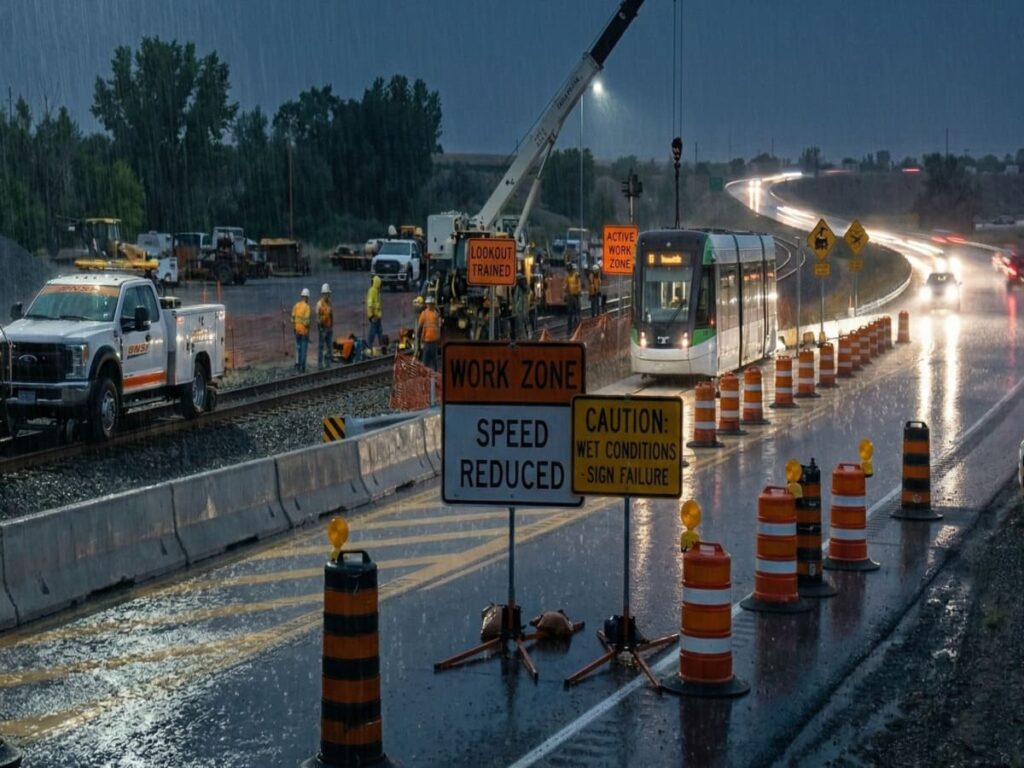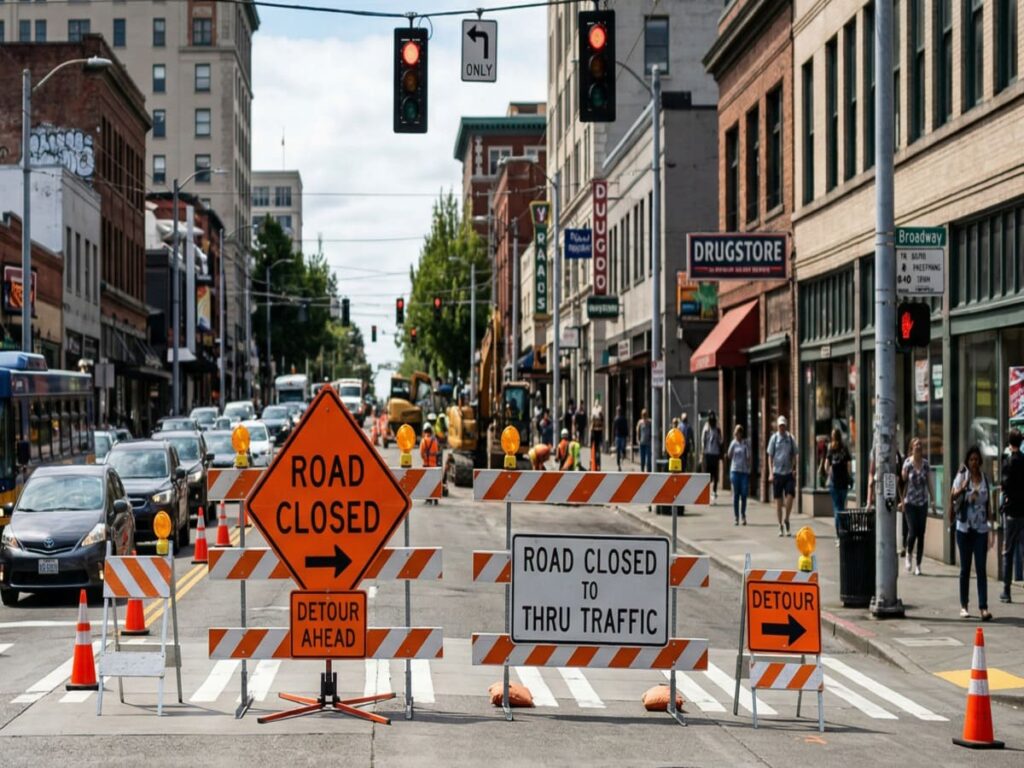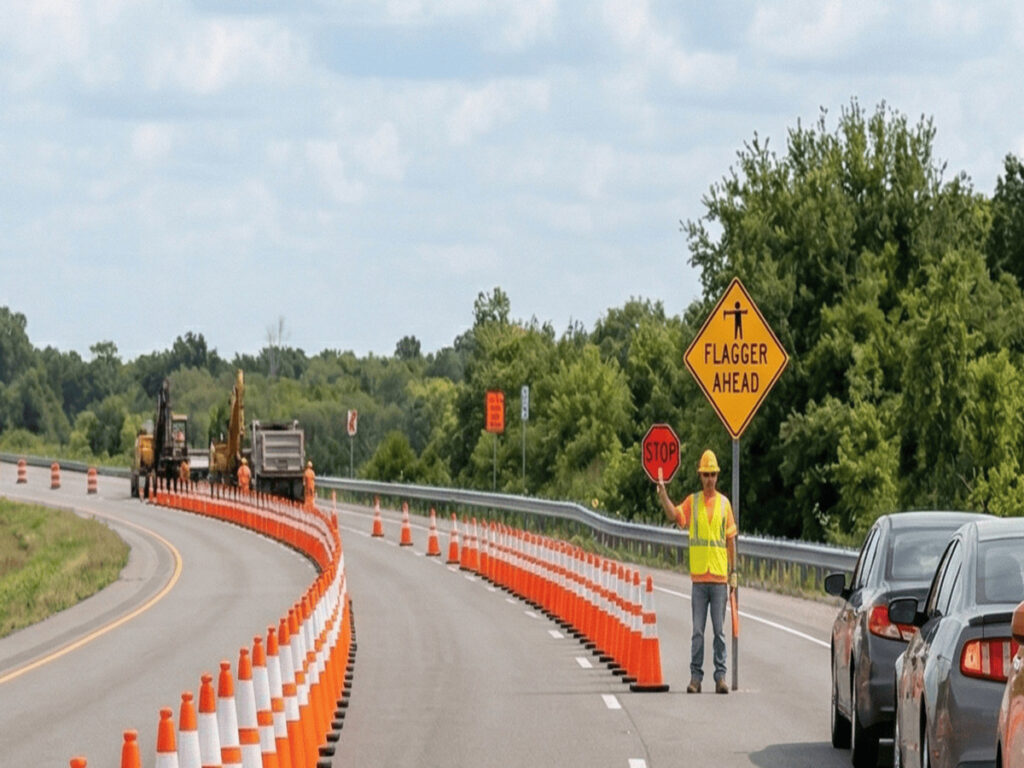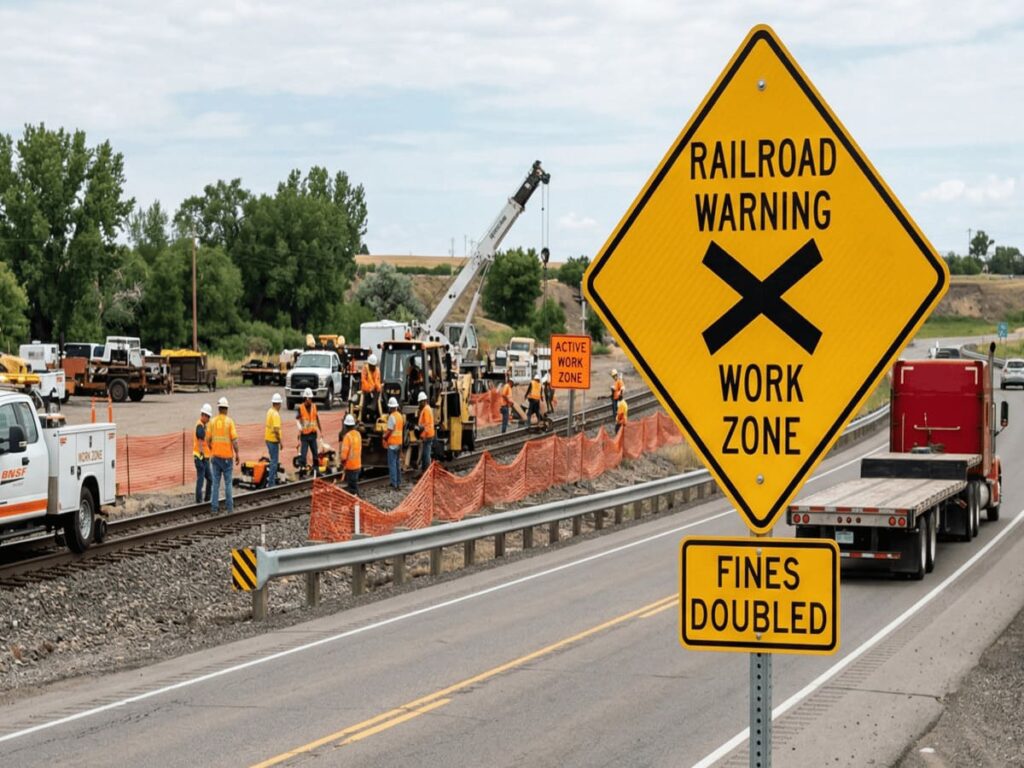
A freight train traveling at 60 mph needs more than one mile to stop from the moment the engineer sees an obstruction on the track. A light rail vehicle in an urban corridor operates near-silently at 35 mph and may be 12 feet wide. Neither can swerve. In both cases, the only protection between a work crew and the approaching rail equipment is the TTC setup — and standard highway work zone procedures are not sufficient for these environments.
Rail-adjacent work zones introduce three hazard categories absent from ordinary roadway operations: the dynamic envelope (the space a moving train physically occupies, including sway and equipment overhang), the blast effect (air displacement and debris thrown outward by passing trains), and electromagnetic interference with radio and electronic equipment near active tracks. All three must be addressed in the TTC plan before a single railroad warning sign goes up.
This guide translates MUTCD 11th Edition Part 6, FRA clearance regulations, and AAR dynamic envelope standards into a field-ready SOP for contractors, utility crews, and TTC supervisors working adjacent to active freight rail, light rail transit (LRT), and tram corridors.
What this guide covers: Active freight rail corridors · Light rail and tram lines · Dynamic envelope identification · Railroad warning sign sequence · Equipment specifications for rail-adjacent exposure · Crew protection SOP · Radio and electronic equipment restrictions
What it does not cover: On-track protection (flag protection, track occupancy permits) · Grade crossing reconstruction · Signal system modifications — all require railroad operating rules and separate written authority from the rail operator
MUTCD 11th Edition Note: All references cite the 11th Edition, effective January 18, 2024. Rail-adjacent TTC also falls under MUTCD Part 8 (Traffic Control for Rail-Highway Grade Crossings). Additionally, FRA regulations at 49 CFR Part 214 govern worker safety near active tracks. The rail operator’s operating rules take precedence over MUTCD in any area of conflict. Always obtain the operator’s current rules before planning the TTC setup.
Part 1: Three Hazard Categories That Make Rail-Adjacent Work Zones Different
Setting up railroad warning signs near active tracks is not a variation of standard highway work zone procedure. Instead, it introduces three distinct hazard categories — categories that the standard MUTCD Part 6 framework, with its work zone warning signs and channelizing device specifications, does not fully address, because it was designed primarily for road-vehicle environments.
1.1 The Dynamic Envelope — Why Your Buffer Zone Is Larger Than You Think
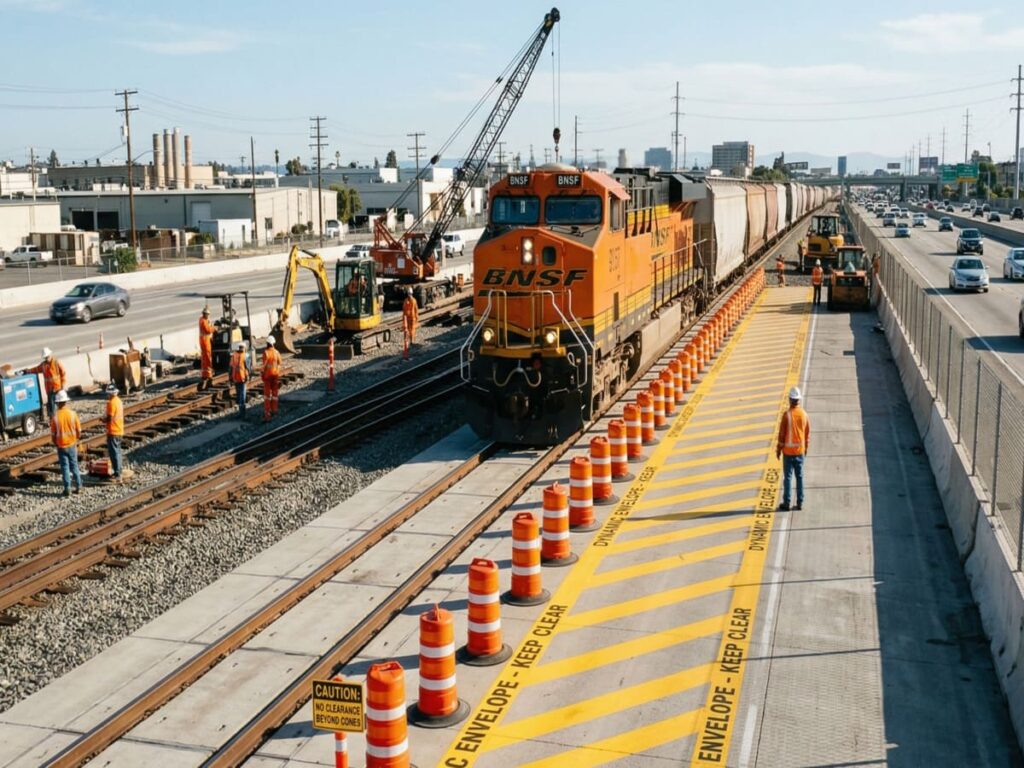
The dynamic envelope is the full space a moving train physically occupies during operation. It includes the static vehicle width plus lateral sway, curve lean, and the overhang of equipment such as pantographs, couplers, and side-mounted hardware. The AAR standard dynamic envelope width for freight rail is 10 feet 8 inches measured from track centerline — but this figure applies to straight track only. On curves, the envelope expands further because the car body swings outward relative to the rails. Furthermore, a train running a worn truck or carrying oversized loads may exceed these standard values.
The practical consequence for TTC planning is that the safe boundary for all equipment, signs, and personnel is not the edge of the rail or the track bed — it is the outer boundary of the dynamic envelope plus a working clearance margin. The table below shows minimum distances for the three most common rail types encountered in roadway-adjacent operations.
| Track Type | Min. Clearance (straight track) | Curve Adjustment | Recommended Crew Distance |
| Freight rail (Class I) | 8.5 ft from rail centerline | +2 ft minimum | 15 ft minimum |
| Light rail / LRT | 7 ft from rail centerline | +1.5 ft | 12 ft minimum |
| Tram / streetcar | 5 ft from rail centerline | +1 ft | 10 ft minimum |
No TTC equipment may be placed inside the dynamic envelope under any circumstances. A cone or sign stand struck by a passing train at 60 mph becomes high-velocity debris. The dynamic envelope boundary is not a suggestion; it is the physical boundary of where a train operates. Any equipment found inside the envelope before or during a shift must be removed immediately.
1.2 Blast Effect — Air Displacement and Debris From Passing Trains
A freight train passing at 60 mph displaces a significant volume of air. The resulting pressure wave creates instantaneous lateral forces on objects near the track — equivalent to sustained wind exposure of approximately 35 mph. Consequently, standard-weight portable sign stands and lightweight traffic cones within 20 feet of the track centerline will be displaced when a train passes at speed.
Two equipment controls address the blast effect. First, all sign stands within 20 feet of the track centerline require additional ballast — typically 30 lbs or more — beyond the standard weight used in ordinary roadway operations. Second, traffic cones used near the dynamic envelope boundary must either be heavy-base (10 lb minimum) or flexible and collapsible so they spring back upright after being knocked over, rather than remaining as debris near the track.
Objects that cannot be adequately stabilized must be moved outside the blast effect radius before train passage. During the 30-second clearance procedure described in Part 5, securing loose equipment is part of the protocol — not an afterthought.
1.3 Electromagnetic Interference Near Active Rail Corridors
Two forms of electromagnetic interference affect TTC operations near active rail corridors. Both require pre-shift verification and contingency planning.
Radio frequency conflicts. Railroad dispatch and operations typically use frequencies in the 160–161 MHz band. Construction radio equipment operating on or near these frequencies can interfere with railroad communications. As a result, the railroad operator must confirm the approved frequency range for construction radio use before the shift opens. If there is a conflict, the operator may require the crew to use a different channel or a landline backup.
Overhead catenary systems. Electrified LRT and tram lines carry 750V DC or 1500V DC on overhead contact wires, typically 18–21 feet above the rail surface. Strong electromagnetic fields extend outward from these wires, affecting electronic survey instruments and some radio devices. Furthermore, any equipment — including telescoping sign stands, elevated work platforms, or extended tools — must maintain the minimum safe clearance from OCS wires specified by the operator. Confirm this clearance requirement before bringing any elevated equipment to the site.
Part 2: Five Pre-Shift Requirements Before Any Railroad Warning Sign Goes Up
Every rail-adjacent work zone incident that results in equipment loss or crew injury traces back to a step skipped before the shift opened. None of the five requirements below can be substituted by field improvisation after the work zone is established.
2.1 Railroad Operator Notification and Flagging Authority
This requirement has no equivalent in standard highway work zones. Before any equipment is placed near active tracks — including the first railroad warning sign — the contractor must notify the railroad operator and obtain written Flagging Authority. Most Class I freight railroads require a minimum of 72 hours advance notice; some require one week or more for specific track segments. LRT and tram operators vary, but 48 hours is a common minimum.
Flagging Authority is the railroad operator’s written permission for the work to proceed. It typically accompanies a Railroad Flagman — an employee or authorized representative of the rail operator whose sole function is to monitor for approaching trains and initiate the crew warning chain. The Railroad Flagman is not a TTC Supervisor role and cannot be filled by a construction crew member. This distinction matters because the Flagman has direct communication with dispatch and access to train schedule data that the construction crew does not have.
2.2 Dynamic Envelope Field Verification and Marking
Dynamic envelope dimensions from the design drawings must be verified in the field before setup begins. Track geometry on the ground often differs from survey data, particularly on older infrastructure or after maintenance activity. In practice, the TCS or Railroad Flagman walks the work zone with a measuring tape and marks the dynamic envelope outer boundary using temporary ground spray paint or physical reference stakes.
Every crew member must be able to identify the boundary visually from their work position. A line on a drawing that no one in the field can locate provides no protection — the same applies to a railroad warning sign sequence that exists on paper but has not been verified against the actual track geometry. The field marking step closes that gap before the first worker enters the zone.
2.3 Train Schedule and Frequency Assessment
Obtain the train schedule or movement frequency data for the specific track segment before the shift. For freight rail, this information comes from the railroad operator’s dispatcher via the Flagman. For LRT and tram systems, scheduled headways are usually publicly available, but actual operation may deviate — therefore, the Flagman’s real-time communication link with dispatch remains the authoritative source during the shift.
The practical purpose is to determine the minimum clearance interval between train passages. If trains pass every 8 minutes, the crew has roughly 7 minutes of productive work time per cycle. If a high-frequency urban LRT passes every 4 minutes, the productive window is under 3.5 minutes after accounting for clearance and re-entry. Planning for the wrong frequency creates a mismatch between the crew’s work pace and the available safe window.
2.4 Radio Frequency Clearance and Communication Backup
Before the shift opens, confirm the approved radio frequency with the railroad operator. Test all radios at the actual work positions — not at the staging area. Terrain and equipment interference that does not exist at the truck often does exist at the shoulder 200 feet away near the track.
Establish a backup communication protocol before the primary radio is needed. The backup plan must not assume radio availability — otherwise it is not a backup. Standard options include a landline phone at the nearest crossing emergency notification box, pre-arranged hand signal protocols between the Flagman and the TCS, or a designated runner. Demonstrate the backup protocol to the full crew before the first train passage of the shift.
2.5 Escape Route and Muster Point Designation
For each work position in the zone, designate a specific escape route and a muster point. The escape route must run perpendicular to the track — laterally away from the rail corridor — not parallel to it. Running parallel to a track when a train approaches does not increase distance from the hazard fast enough.
The muster point must be outside the dynamic envelope by at least 50 feet and must be reachable from every work position within 30 seconds at a brisk walking pace. At shift start, the TCS walks each crew member to their designated escape route and confirms it is unobstructed. This takes 3–5 minutes and cannot be skipped.
Part 3: Railroad Warning Sign Sequence and Equipment Specifications
3.1 The Advance Warning Sign Sequence
The sign sequence for a rail-adjacent work zone builds on the standard MUTCD Part 6 construction signing sequence by adding a mandatory railroad-specific layer. The key rule: the W10-1 Railroad Advance Warning sign must be the first sign road users encounter on every approach. It precedes the W20-1 Road Work Ahead sign in every configuration. This is the most commonly violated sequencing rule in rail-adjacent TTC setups — and it is non-negotiable under MUTCD Part 8.
The logic is straightforward: a driver reading signs in sequence must understand the railroad hazard before they understand the work zone configuration. Reversing the order — placing W20-1 before W10-1 — creates a mental model of a standard road work zone. In that case, the railroad sign arrives as an afterthought rather than as the primary hazard identifier. Specifically, a driver who slows for a work zone but has not yet processed the railroad warning may resume speed at the wrong moment.
| Sign | MUTCD Code | Distance | Min. Size | Notes |
| Railroad Advance Warning | W10-1 | First sign on every approach | 36″ circular | Mandatory first sign — precedes all other work zone signs |
| Road Work Ahead | W20-1 | Per speed / TCP | 36″ x 36″ | Standard work zone sign — placed after W10-1 |
| Closure sign (Flagger / Road Closed / Lane Closed) | W20-7 / R11-2 / etc. | Per TCP | 36″ x 36″ | Per operation type |
| Crossbuck (if existing sign is obstructed by work) | R15-1 | At crossing point | 48″ x 9″ per arm | Deploy temporary replacement if permanent sign is obstructed |
W10-1 is always the first sign on approach — no exceptions: Railroad warning signs belong to MUTCD Part 8, which applies simultaneously with Part 6 in rail-adjacent work zones. The W10-1 circular yellow advance warning sign must appear before any Part 6 construction warning. A setup that places W20-1 first is non-compliant regardless of how well the rest of the layout is executed.
OPTRAFFIC — Railroad Warning Signs: W10-1 railroad advance warning sign (36″ circular), W20-1, R15-1 crossbuck — Diamond Grade reflective aluminum — Browse railroad warning signs →
3.2 Reflective Sheeting — Why High Intensity Prismatic Is the Minimum
Railroad warning signs used in rail-adjacent work zones face retroreflectivity demands that exceed ordinary highway applications. Freight locomotive headlights approach at different angles and heights compared to road vehicle headlights, creating retroreflective blind spots in Engineer Grade (Type I) sheeting that do not appear under normal road conditions. As a result, MUTCD Part 8 and most railroad operator specifications require a minimum of High Intensity Prismatic sheeting (Type III) for all temporary signs in rail-adjacent zones. Diamond Grade (Type IX or XI) is preferred and is increasingly specified by state DOTs for rail corridor work.
Signs on both sides of a road running parallel to the track — not just signs on the approach side — must meet this higher reflective standard. Additionally, retroreflectivity degrades faster in rail corridors because of vibration from passing trains. Consequently, sign inspection frequency should be higher than in ordinary highway work zones.
3.3 Traffic Cone Specifications
Standard lightweight 18-inch cones and standard 28-inch cones without heavy bases are unsuitable for positions within the blast effect radius of active tracks. The weight requirements vary based on proximity to the track centerline:
- Beyond 20 ft from track centerline: 28″ cones with 10 lb bases meet minimum requirements for taper and buffer zone applications
- Within 20 ft of track centerline (outside dynamic envelope): 36″ heavy base cones with minimum 10 lb bases, or flexible collapsible cones designed to spring back upright after blast displacement
- Inside the dynamic envelope: no cones or TTC equipment of any kind — without exception
Flexible, collapsible cones have a specific advantage in blast-exposure positions: they absorb impact and return to position rather than tipping and rolling. Consequently, a cone that topples in place and resets is preferable to one that topples and rolls toward the track. Evaluate both options based on the specific geometry of the work zone.
OPTRAFFIC — Traffic Cones: heavy base 28 inch traffic cones and 36 inch traffic cones for rail-adjacent work zone exposure — Browse traffic cones →
3.4 Portable Sign Stands — Ballast Requirements Near Active Tracks
Standard portable sign stand ballast weights are sized for typical highway shoulder and sidewalk exposure. Near active rail corridors, the blast effect adds a dynamic load on every train passage equivalent to a sustained 35 mph wind. As a result, sign stands within 20 feet of the track centerline require substantially more ballast than standard specifications: 30 lbs minimum within 20 feet, and 20 lbs minimum between 20 and 50 feet from the centerline.
A sign stand knocked over by a passing train that falls toward the track is a secondary hazard — it can enter the dynamic envelope and remain there until the next train arrives. Stands that cannot accept additional ballast weight should be replaced with a heavier-base model before the shift begins.
OPTRAFFIC — Sign Frames: portable work zone sign stands with heavy-base options for high-ballast rail corridor exposure — Browse sign frames →
3.5 Complete Rail-Adjacent Equipment Reference
The table below consolidates equipment specifications for standard rail-adjacent TTC setups. Use it as a pre-shift checklist and procurement specification reference.
| Item | Size | Grade / Weight | Rail-Adjacent Requirement |
| Railroad Advance Warning Sign (W10-1) | 36″ circular aluminum | Diamond Grade (Type XI) | Must be first sign; face toward road users only — not toward track |
| Road Work Ahead (W20-1) | 36″ x 36″ aluminum | HIP (Type III) minimum | Standard sequence applies after W10-1 |
| Crossbuck (R15-1) | 48″ x 9″ per arm | Engineer Grade minimum | Replace temporary if work obstructs permanent crossbuck |
| Traffic cones — taper and buffer zone | 28″ or 36″ | Heavy base >= 10 lbs | Outside dynamic envelope only; extra base weight within 20 ft of track |
| Traffic cones — at dynamic envelope boundary | 36″ collapsible | Flexible / collapsible | Use collapsible type within blast effect radius; never place inside envelope |
| Portable sign stands | Heavy-base frame | >=30 lbs ballast within 20 ft | Blast effect requires extra ballast beyond standard highway specification |
| LED barricade lights | Type B flashing | Amber only | Never face toward track; amber only; confirm flash rate with operator |
Part 4: LED Warning Lights for Rail-Adjacent Work Zones — Three Rules That Override Standard Practice
LED barricade lights and flashing beacons used in rail-adjacent work zones must comply with three rules that do not apply in standard highway operations. Each rule addresses a specific failure mode unique to the rail environment.
4.1 Amber Only — Never Red or Green Near Active Rails
Any LED device visible from the track corridor must use amber light only. Red and green are specifically prohibited because both colors carry explicit command meanings in railroad signal systems — red means stop, green means proceed. A red LED barricade light on the wrong side of a work zone can be misinterpreted by a locomotive engineer as a stop signal. Similarly, a green LED can be misinterpreted as a proceed indication. In either case, the train operator acts on a false signal, creating a collision risk independent of the TTC setup itself.
In practice, inspect every LED device in the inventory before deployment. Replace any red or green units with amber before the shift opens. This inspection takes less than five minutes and cannot be skipped.
4.2 Flash Rate — Avoid Railroad Signal Frequencies
Several North American railroad signaling systems encode information in the flash frequency of signal lights. A common restricted-speed indication uses approximately 1 Hz (one flash per second). The standard MUTCD Type B flash rate for work zone LED lights is 55–75 flashes per minute — also approximately 1 Hz — which directly conflicts with this requirement in some rail corridors.
Consequently, confirm the acceptable flash rate range with the railroad operator before the shift. If the standard Type B flash rate is prohibited, select a device with an adjustable or faster flash pattern (2–4 Hz) that does not fall within the railroad’s signal encoding range. Document the confirmed flash rate in the shift log.
4.3 Mounting Orientation — Do Not Direct LED Light Toward the Track
Mount all LED devices so their primary face points toward approaching road traffic. A Type B LED mounted on a barricade facing the track creates glare that affects the locomotive engineer’s visibility of the actual track ahead, even at distances of several hundred feet at night. Where the geometry of the setup would otherwise direct light toward the rail corridor, use directional shielding or angled mounting brackets to redirect the beam.
OPTRAFFIC — LED Warning Lights: Type B LED barricade lights in amber — MUTCD-compliant for rail-adjacent TTC — Browse LED warning lights →
Part 5: Crew Protection SOP — Train Passage Protocol
The hazard controls in Parts 3 and 4 protect workers from the equipment and signage side of the setup. This section covers the procedural controls required when a train is actually approaching and passing. Both layers are necessary; neither substitutes for the other.
5.1 The Train Approach Warning Chain
The warning chain has a fixed sequence that must be established and tested before the first train passage of the shift. Informality in this chain is a direct cause of crew injuries in rail-adjacent work zones.
- Step 1: Railroad Flagman receives train approach notification from dispatch — this is the triggering event.
- Step 2: Flagman immediately transmits a standardized full-sentence warning to the TCS: “Train approaching from [direction], estimate [time], all personnel clear.” Short phrases such as “Train coming” are not acceptable because they create ambiguity about direction, timing, and required action.
- Step 3: TCS repeats the warning on the crew channel and initiates the clearance countdown.
- Step 4: All crew members stop work, secure or move loose equipment, and move to their designated muster point via their designated escape route.
- Step 5: TCS confirms visual clearance of the zone and reports to the Flagman: “Zone is clear, all personnel at muster.” This step occurs before the train is in the work area — not while it is passing.
- Step 6: After the train has passed and the Flagman confirms the track is clear, the TCS authorizes crew return to work.
5.2 The 30-Second Clearance Requirement
FRA worker safety guidelines and most railroad operator rules specify that all workers must be clear of the danger zone within 30 seconds of the first warning. If the current work layout cannot be cleared in 30 seconds, the layout must be changed before work begins — not after a close call.
The 30-second clock starts at the moment the Flagman transmits the warning. Radio transmission delays, crew members wearing hearing protection, and workers operating noisy equipment all reduce the effective available time. These factors must be accounted for during the clearance drill, not assumed away.
Clearance drill requirement: Run a timed clearance drill at shift start before the first train passage. The TCS announces the drill, starts a stopwatch, and verifies that all crew members reach the muster point within 30 seconds. If they cannot, adjust the work layout — reduce the footprint, reposition crew, or change the work method — until the 30-second requirement is met. Document the drill result and the layout adjustment in the shift log.
5.3 Loose Equipment Protocol During Train Passage
Any object within the blast effect radius that is not secured or removed before the train passes is a potential projectile. Consequently, designate one crew member per shift as the equipment handler for clearance events. Their sole task during a clearance is to quickly collect and secure loose items — tools left on the ground, small sign stands, water jugs, material bags — while the rest of the crew moves to the muster point. This role must be explicitly assigned and rehearsed before the shift opens.
Part 6: LRT and Tram-Adjacent Operations — Key Differences From Freight Rail
Light rail and tram-adjacent work zones share the same fundamental hazard categories as freight rail operations. However, several characteristics of LRT and tram systems create different risk profiles that affect TTC planning in specific ways.
6.1 Silent Approach — The Defining LRT Hazard
Freight trains generate substantial noise and vibration that typically provides crews with perceptible approach warning even before radio notification. LRT vehicles at 15–25 mph in urban corridors produce significantly less noise, and many systems are designed specifically for quiet operation. Consequently, hearing an LRT approach is not a reliable warning mechanism — the Flagman communication chain in Part 5 is the only acceptable primary warning system in LRT corridors.
Furthermore, many urban LRT systems do not require operators to sound horns except in emergency situations, removing an auditory cue that crews working near freight rail learn to rely on. Every crew member must understand that LRT approach is essentially silent, and that the Flagman’s radio transmission is the first and only warning they will receive.
6.2 High Frequency — Shorter Productive Windows
Urban LRT systems commonly operate at 4–8 minute headways during peak hours, and some high-frequency corridors run at 2–3 minute intervals. At a 4-minute headway, a crew has approximately 3 minutes and 30 seconds of productive work time per cycle — after accounting for the 30-second clearance and an equivalent re-entry time. At a 2-minute headway, the productive window shrinks to under 90 seconds.
TTC supervisors planning LRT-adjacent operations must therefore factor in the productive work time per cycle when estimating job duration. A task requiring 45 minutes of continuous working time may require 3–4 hours of permit time in a high-frequency LRT corridor. Underestimating this multiplier is a common cause of permit window violations in urban rail work zones.
6.3 Overhead Catenary System — Elevated Equipment Restrictions
Electrified LRT and tram lines carry 750V DC or 1500V DC on overhead contact wires typically positioned 18–21 feet above the rail surface. Any elevated equipment — including telescoping sign stands, aerial work platforms, cranes, or extended measurement tools — must maintain the minimum safe clearance from OCS wires specified by the operator. The specific clearance requirement varies by voltage and operator, but is typically 10 feet for 750V systems and 12 feet for 1500V systems.
Confirm the exact clearance requirement before bringing any elevated equipment to the site. Additionally, high-voltage OCS creates electromagnetic fields that affect electronic survey instruments and some radio devices within 15–20 feet of the wire — verify equipment compatibility with the operator before the shift. Sign stands used near OCS must have their maximum height confirmed against the clearance requirement; a standard extendable stand reaching 9–10 feet can approach violation limits if the OCS wire is lower than standard height due to terrain or wire sag.
Part 7: Six Common Failures in Rail-Adjacent Work Zone TTC
The table below consolidates the six most common compliance and safety failures in rail-adjacent work zones, covering both railroad warning sign sequencing errors and equipment deployment failures. Each is preventable with the pre-shift procedures and equipment specifications in Parts 2 through 4.
| Failure | Consequence | Fix |
| Work begins without written Flagging Authority from railroad operator | Immediate stop-work; possible FRA enforcement action | Obtain written Flagging Authority before mobilizing any equipment near active tracks |
| TTC equipment placed inside the dynamic envelope | Equipment struck by train; high-velocity debris hazard to crew | Mark the dynamic envelope boundary in the field before setup; verify all devices are outside it |
| Red or green LED lights used facing toward the track | Visual confusion with railroad signal colors; train operator may misinterpret work zone lights as rail signals | Inspect all LED devices before deployment; replace any red or green units with amber |
| W10-1 placed after W20-1 in the sign sequence | Drivers receive work zone warning before railroad warning; incorrect hazard mental model | W10-1 is always the first sign on every approach — it precedes every other work zone sign |
| Lightweight cones used at dynamic envelope boundary | Blast effect from passing trains displaces cones toward the track | Use heavy base (>=10 lb) cones outside the envelope, or flexible collapsible cones where blast effect is present |
| 30-second clearance procedure not tested before shift opens | Crew cannot clear the zone in time when a train approaches; workers remain in the hazard zone | Run a timed clearance drill at shift start; adjust work layout until all crew reach muster point within 30 seconds |
Summary: Railroad Warning Signs Are the Visible Layer — Hazard Control Is the Invisible Layer
Railroad warning signs, together with the broader set of work zone warning signs that guide road users through the affected corridor, establish the advance warning sequence that tells drivers a rail-adjacent work zone exists. However, the signs alone do not protect the crew. The dynamic envelope boundary, the blast effect clearances, the amber-only LED rule, the 30-second clearance procedure, and the Flagman communication chain each address a specific hazard that signage cannot mitigate. Consequently, all layers are required, and none can substitute for another.
In practice, the three most common fatal errors in rail-adjacent TTC are equipment placed inside the dynamic envelope, clearance procedures not established or tested before the shift, and colored LED lights facing the track. Consequently, the pre-shift checklist in Part 2 and the equipment inspection in Part 3 are where rail-adjacent work zone safety is either built or missed — not in the field response when a train is already approaching.
The Railroad Flagman is not a TTC role — they are the rail operator’s representative and the crew’s only reliable early warning system. Furthermore, establishing and testing the Flagman communication chain is inseparable from getting the railroad warning signs right: both steps are required before the first train passage, and neither substitutes for the other.
OPTRAFFIC — Complete Rail-Adjacent Work Zone Equipment
- Railroad warning signs (W10-1, W20-1, R15-1) with Diamond Grade reflective sheeting — Safety Signage →
- Heavy base traffic cones (28″ and 36″) for rail-adjacent blast exposure — Traffic Cones →
- Amber LED barricade lights (Type B) for rail-adjacent TTC — LED Warning Lights →
- Heavy-weight portable sign stands for high-ballast rail corridor exposure — Sign Frames →
References and Further Reading
- MUTCD 11th Edition Part 6 — Temporary Traffic Control: https://mutcd.fhwa.dot.gov/pdfs/11th_Edition/part6.pdf
- MUTCD 11th Edition Part 8 — Traffic Control for Rail-Highway Grade Crossings: https://mutcd.fhwa.dot.gov/pdfs/11th_Edition/part8.pdf
- FRA 49 CFR Part 214 — Railroad Workplace Safety: https://www.ecfr.gov/current/title-49/subtitle-B/chapter-II/part-214
- AAR — Field Manual of the AAR Interchange Rules (Dynamic Envelope Standards)
- OSHA Work Zone Traffic Safety: https://www.osha.gov/sites/default/files/publications/work_zone_traffic_safety.pdf
- Work Zone Signs for Highway One-Lane, Two-Way Operations — OPTRAFFIC: optsigns.com/work-zone-signs-highway-one-lane-two-way-flagging-guide/
- Road Closed Signs for Urban Intersections — OPTRAFFIC: optsigns.com/road-closed-signs-urban-intersection-work-zone-guide/
- Circular Traffic Signs: MUTCD Railroad Safety — OPTRAFFIC: optsigns.com/circular-traffic-signs-mutcd-railroad/
- Railroad Crossing Safety Guide — OPTRAFFIC: optsigns.com/sign-for-railway-crossing-safety-guide-signals-driving-tips/