The Hidden Fleet Costs of Substandard PVC Traffic Cone Selection
Replacing damaged traffic control equipment repeatedly can quietly increase project costs, delay site operations, and create unnecessary procurement pressure for Australian contractors. Many purchasing teams focus on the initial unit price of PVC traffic cones, only to discover that lower-cost products may require more frequent replacement because of cracking, poor impact recovery, or inconsistent manufacturing quality.
For Tier 1 and Tier 2 civil infrastructure companies, these failures create more than additional expenses. They can affect project schedules, contractor reputation and safety management responsibilities. Safe Work Australia reported that 200 workers experienced fatal workplace injuries in 2023, with construction among the industries contributing substantially to workplace fatalities.
The solution is a specification-driven purchasing approach. By evaluating PVC formulation, manufacturing methods and lifecycle performance before procurement, companies can select traffic management assets that deliver predictable performance across Australian project conditions.
What Makes PVC Traffic Cones a Better Long-Term Investment for Australian Projects?
PVC traffic cones are durable traffic management assets manufactured from Polyvinyl Chloride (PVC), a synthetic polymer selected for its flexibility, impact resistance and ability to withstand repeated handling. For Australian procurement teams, their practical value is reduced replacement frequency, improved fleet consistency and stronger cost control.
The purchasing decision for PVC traffic cones should not be based only on colour, shape or initial price. In large-scale infrastructure projects, traffic cones are operational assets that experience repeated transport, stacking, vehicle contact and exposure to harsh environmental conditions.
Australia’s construction and transport sectors require safety equipment that performs consistently because temporary traffic management environments are often demanding.
Why Procurement Teams Should Move Beyond Lowest-Price Purchasing
The lowest purchase price rarely represents the lowest total cost.
For example, two suppliers may offer visually similar PVC traffic cones:
| Procurement Factor | Lower-Cost Cone | Premium PVC Traffic Cone |
| Initial purchase price | Lower | Higher |
| Material consistency | Variable | Controlled formulation |
| Impact recovery | Limited | Designed for repeated use |
| Replacement frequency | Higher | Lower |
| Fleet management cost | Less predictable | More predictable |
The table above compares PVC traffic cones in terms of material reliability, operational lifespan and total ownership impact.
A cheaper cone that requires replacement twice as often may create higher expenses through:
- Additional purchasing administration
- Increased warehouse stock requirements
- Extra transport and handling labour
- Disposal of damaged equipment
- Emergency replacement orders
For procurement officers managing thousands of units, these hidden costs can exceed the original purchase savings.
How Material Integrity Influences Fleet Replacement Costs
PVC traffic cones are exposed to mechanical stress every time they are:
- Loaded into transport vehicles
- Stacked during storage
- Installed and removed from work zones
- Hit or compressed by vehicles
The reason premium PVC performs better is linked to formulation stability. High-quality PVC compounds maintain flexibility through controlled plasticiser selection and manufacturing consistency, helping the cone recover after impact instead of developing permanent deformation or cracking.
For contractors, this means fewer damaged units entering the replacement cycle.
A practical procurement question is:
“How many times can this product survive real site handling before replacement is required?”
That question is more valuable than simply asking:
“What is the purchase price per cone?”
Building a Supplier Evaluation Framework for Australian Infrastructure Contracts
A reliable supplier should provide more than a product catalogue.
Procurement teams should evaluate:
Material Documentation
Request:
- PVC formulation information
- Technical specification sheets
- Product performance documentation
- Manufacturing quality procedures
Documentation allows contractors to compare suppliers objectively instead of relying on appearance or marketing claims.
Production Capability and Supply Reliability
Large infrastructure projects require consistent supply.
A supplier should demonstrate:
- Stable production capacity
- Repeat-order consistency
- Quality control procedures
- Ability to support project-based volumes
A supplier capable of delivering 500 units today but unable to support future project expansion creates avoidable supply chain risk.
Engineering Support for Fleet Specifications
Complex projects may require customised solutions, including:
- Specific cone weights
- Different base configurations
- Custom branding
- Large-volume procurement programs
We are a fully integrated traffic sign manufacturer with an end-to-end supply chain covering raw materials, substrates and custom printing capabilities. This allows infrastructure contractors to work with one supplier from material selection through to finished traffic management products.
Request your free PVC traffic cone samples and a technical specification checklist before approving your next fleet order.
Selecting the Right PVC Formulation for Long-Term Field Performance
Why Does PVC Flexibility Matter for Traffic Cone Durability?
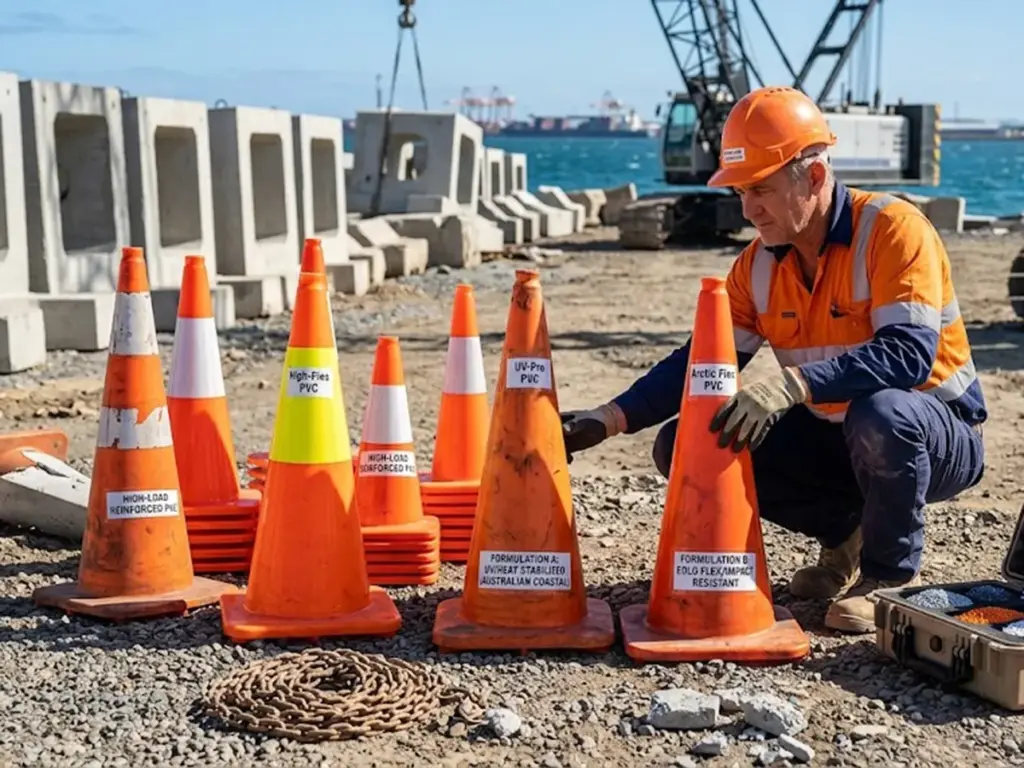
PVC flexibility determines how well traffic cones recover after impact, resist cracking, and maintain operational performance during repeated deployment. This is caused by polymer formulation quality, additive selection, and manufacturing control, which can be optimised through supplier verification.
Flexible PVC traffic cones are commonly preferred for high-use traffic management environments because they are designed to absorb physical stress rather than fail immediately after contact.
The difference between premium and low-grade PVC is not always visible when a cone is new. The performance gap appears after months of:
- Sun exposure
- Temperature fluctuations
- Repeated bending
- Transportation pressure
Evaluating Flexibility, Recovery and Impact Resistance
When assessing flexible PVC traffic cones, procurement teams should consider three performance areas:
Shape Recovery
A quality cone should return close to its original position after bending.
Poor recovery indicates:
- Material fatigue
- Weak formulation balance
- Reduced service life
Crack Resistance
Cracking often occurs when PVC loses flexibility over time.
Common causes include:
- Inferior additives
- Poor polymer processing
- Excessive environmental stress
Long-Term Consistency
For large fleets, every cone should perform similarly.
Manufacturing variation creates problems because contractors cannot accurately predict replacement requirements.
How Plasticiser Quality Influences Cone Lifespan and Replacement Cycles
The reason two PVC cones can look identical but perform differently comes down to what is mixed into the polymer before moulding. Rigid PVC on its own is hard and brittle. Plasticisers are added to make it flexible, and the quality and quantity of those additives determine how long that flexibility lasts.
Why formulation degrades over time:
Lower-grade plasticisers migrate out of the polymer matrix under heat and UV exposure. As they leave, the cone gradually hardens. Once flexibility is lost, the cone no longer absorbs impact — it cracks. In Australian conditions, this process accelerates, particularly in northern and inland regions where sustained high temperatures and intense UV are routine for much of the year.
What this means commercially:
A cone that hardens after 12 months instead of lasting 3–4 years triples the replacement cycle. For a fleet of 2,000 PVC traffic cones, moving from a three-year to a one-year service life means purchasing roughly 1,300 additional units per year — before accounting for freight, warehousing and administration.
How to optimise it:
- Ask suppliers whether the formulation is engineered for UV and thermal stability, not just flexibility at point of sale.
- Request performance information for extended outdoor exposure rather than laboratory-new condition only.
- Where possible, run a controlled field trial: place sample units in your harshest site environment and reassess at 6 and 12 months.
Verifying Material Integrity Through Supplier Documentation
Documentation converts a purchasing decision from a judgement call into an auditable process. For Tier 1 contractors, this matters because procurement decisions may need to be defended internally or during client review.
Documentation worth requesting before approval:
- Request a technical specification sheet listing material composition, dimensions, weight and base configuration.
- Confirm manufacturing process details, including whether the cone is single-piece flow moulded or assembled from separate components.
- Review quality assurance procedures covering batch consistency and inspection.
- Verify production capacity and lead times against your forward project pipeline.
- Retain documentation on file so specifications can be reissued for future tenders without re-evaluating suppliers.
Standardising this process across projects reduces the risk of one depot ordering premium stock while another orders unverified product at a lower price — a common cause of inconsistent fleet performance in multi-site organisations.
Flow Moulded PVC Cones vs Two-Piece Designs: Understanding Manufacturing Quality
Why Do Flow Moulded PVC Cones Reduce Failure Points?
Flow moulded PVC traffic cones are formed as a single continuous structure, meaning the body and base are one piece rather than two components joined together. This removes the join as a potential failure point, which is caused by repeated flexing, lifting stress and impact loading at the connection, and can be resolved by specifying single-piece construction for high-turnover fleets.
The join between body and base is the most mechanically stressed area of any traffic cone. Every time a cone is lifted by the body, dragged, stacked or struck, force concentrates at that transition.
Advantages relevant to procurement:
- Fewer separation failures. There is no join to loosen, split or detach.
- More predictable service life. Failure modes are limited to material fatigue rather than assembly quality.
- Simpler quality assessment. With one moulding process, batch consistency is easier to verify.
For traffic management contractors deploying and retrieving cones daily — where a single crew may handle hundreds of units per shift — single-piece construction typically delivers the lowest failure rate per handling cycle.
Assessing Two-Piece PVC Cone Designs and Base Connection Reliability
Two-piece and interlocking base designs are not inherently inferior. They serve specific operational purposes and can be the correct specification in certain scenarios.
Where two-piece designs can be appropriate:
- Applications requiring a heavier or replaceable base for wind resistance
- Situations where the base is expected to wear before the body
- Storage-constrained operations benefiting from separable components
What to evaluate before approving them:
| Evaluation Point | What to Check | Procurement Risk if Ignored |
| Connection strength | Resistance to pulling and twisting | Base separation during handling |
| Base weight consistency | Uniformity across batches | Unpredictable stability |
| Replacement availability | Can bases be reordered separately | Full unit replacement required |
| Assembly quality | Consistency across production runs | Variable performance in fleet |
The table above compares two-piece PVC traffic cones in terms of connection integrity, batch consistency and replacement flexibility.
The commercial question is straightforward: if the base can be replaced independently and is genuinely the first component to wear, a two-piece design may reduce cost. If the join fails before either component wears out, the design increases cost.
Matching Manufacturing Method to Fleet Usage Conditions
Specification should follow usage intensity rather than product preference.
A practical selection framework:
- Assess deployment frequency — daily rotation favours single-piece flow moulded construction.
- Measure transport exposure — frequent long-haul stacking increases compression stress and rewards durable formulations.
- Identify environmental severity — high UV, coastal salt exposure or extreme heat all shorten service life.
- Determine storage conditions — outdoor storage accelerates material degradation compared with covered warehousing.
- Select construction type based on which failure mode your operation actually experiences most often.
Most contractors already know their dominant failure mode from historical replacement records. Reviewing what actually breaks is often more informative than any product brochure.
When comparing visibility options across your fleet, it is worth reviewing how different reflective sleeve and full-sheeting configurations perform under repeated cleaning and handling.
Assessing Durability Metrics Before Approving PVC Traffic Cone Suppliers
Measuring Resistance to Impact, Compression and Repeated Handling
Laboratory claims are useful, but procurement decisions should be validated against site reality.
Three tests worth conducting on samples:
- Impact recovery test. Strike or drive over the cone at low speed and observe whether it returns to shape. Note any permanent deformation, whitening at stress points, or cracking.
- Stack compression test. Stack the sample quantity as it would be transported, leave it loaded for several days in sun exposure, then check whether cones deform or bind together.
- Repeated handling test. Have a crew deploy and retrieve the same units across multiple shifts, then inspect for wear at the lifting point and base edge.
These tests take minimal effort and reveal the difference between products far faster than waiting for a full replacement cycle to expose it.
Evaluating Colour Retention and Long-Term Visibility Performance
Colour is a functional specification, not an aesthetic one. Faded orange safety cones Australia-wide reduce daytime conspicuity and signal poor asset condition to clients and auditors.
Why fading occurs:
UV radiation breaks down pigment and polymer surface structure. Australia experiences some of the highest UV levels globally, which places greater demand on pigment stability than many overseas markets where products are originally specified.
How to optimise:
- Specify UV-stabilised formulations rather than standard pigmented PVC.
- Compare a new unit against a 12-month field unit from the same supplier where possible.
- Include colour retention as an explicit line item in tender specifications.
A faded fleet often triggers replacement well before structural failure — meaning pigment quality can determine service life even when the PVC itself remains sound.
Identifying Quality Differences Between Premium and Commodity Products
Practical indicators of an engineered product:
- Consistent wall thickness across the cone body
- Uniform weight between units in the same batch
- Clean moulding finish without thin spots or flash defects
- Stable base dimensions
- Supplier able to answer technical questions without deferring
- Documentation provided without hesitation
Warning signs:
- Weight varies noticeably between units
- No specification sheet available
- Vague answers about manufacturing method
- Inability to confirm repeat-order consistency
Supplier transparency is itself a quality indicator. Manufacturers with controlled processes are generally willing to document them.
Calculating the True Cost Advantage of Premium PVC Traffic Cone Fleets
How to Calculate Total Cost of Ownership
- Record your current annual replacement quantity and total spend per unit including freight.
- Add internal handling costs — procurement administration, receiving, warehousing and disposal.
- Divide total annual cost by the number of units in active service to establish cost per cone per year.
- Compare that figure against a premium alternative using its expected service life rather than its purchase price.
- Recalculate across a three-year horizon, since the advantage of a durable product only becomes visible beyond a single procurement cycle.
A worked illustration:
| Metric | Commodity Option | Premium Option |
| Unit price | Lower | Higher |
| Expected service life | 1 year | 3 years |
| Units replaced per 1,000 over 3 years | ~3,000 | ~1,000 |
| Freight and handling events | 3× | 1× |
| Budget predictability | Low | High |
The table above compares PVC traffic cones in terms of replacement volume, handling frequency and budget stability across a three-year cycle.
Even where premium product carries a meaningfully higher unit price, a three-fold reduction in replacement volume typically produces net savings once freight, labour and administration are included.
How Longer Service Life Improves Budget Predictability
Predictability has value independent of cost. A fleet with a known replacement rate allows procurement teams to:
- Forecast annual spend with confidence
- Negotiate scheduled volume pricing rather than reactive orders
- Avoid emergency purchasing at premium rates
- Reduce buffer stock held against unexpected failures
Reactive replacement is usually the most expensive purchasing mode any organisation operates in. Reducing traffic cone replacement cost is often less about negotiating unit price and more about eliminating unplanned orders.
Creating a Supplier Partnership Model for Long-Term Demand
Contractors with recurring project pipelines benefit from supplier relationships rather than transactional purchasing.
What a genuine supply partnership should include:
- Forecast-based production planning
- Consistent specification across repeat orders
- Custom volume support for major project mobilisation
- Technical consultation during tender preparation
- Documented specifications retained for future reference
Final Procurement Checklist for Selecting Reliable PVC Traffic Cones in Australia
The Essential Questions to Ask Before Approving a Supplier
- Confirm the manufacturing method — single-piece flow moulded or assembled.
- Request full technical specifications and material documentation.
- Verify UV and thermal stability suitable for Australian conditions.
- Test samples under your own handling and transport conditions.
- Assess production capacity against your forward pipeline.
- Calculate cost per cone per year rather than cost per cone.
- Standardise the approved specification across all depots and projects.
Aligning Specifications With Future Project Requirements
Organisations that establish a documented standard specification avoid re-evaluating suppliers on every project. This creates consistency across regions, simplifies tender responses and prevents individual sites from purchasing unverified stock.
The practical step is straightforward: once you have identified a product that performs, record the specification formally and reference it in future procurement documents.
Turning PVC Traffic Cone Purchasing Into a Strategic Asset Decision
Traffic cones are among the least expensive items on an infrastructure procurement schedule and among the most frequently handled. That combination makes them easy to under-specify and costly to get wrong.
Treating PVC traffic cones as durable assets rather than consumables shifts the decision from price comparison to performance specification — and that shift is where most of the available savings sit.
Material selection sits underneath every point in this guide. For a deeper technical treatment of polymer behaviour, reflective substrate options and how different materials compare across service conditions, our complete breakdown of traffic cone material selection and integrity covers the engineering context behind these procurement decisions.
Frequently Asked Questions
What are PVC traffic cones made from?
PVC traffic cones are manufactured from Polyvinyl Chloride, a synthetic polymer combined with plasticisers and stabilisers to provide flexibility, impact recovery and UV resistance. Formulation quality determines how long that flexibility is retained in service.
Are flexible PVC traffic cones better than rigid alternatives for daily use?
Generally yes for high-turnover traffic management. Flexible PVC traffic cones absorb impact and return to shape rather than cracking, which reduces replacement rates in operations involving frequent deployment, retrieval and vehicle contact.
What is the difference between flow moulded PVC cones and two-piece designs?
Flow moulded PVC cones are formed as one continuous piece, eliminating the body-to-base join. Two-piece designs use a separate base, which can allow independent base replacement but introduces a connection point that may fail under repeated handling stress.
How can premium cones reduce traffic cone replacement cost?
Extended service life reduces replacement volume, freight events, handling labour and procurement administration. A product lasting three years instead of one typically reduces three-year replacement quantities by around two-thirds for the same fleet size.
How should Australian procurement teams verify quality before bulk ordering?
Request technical specifications and manufacturing details, confirm UV stability suitable for Australian exposure levels, field-test samples under actual handling conditions, and verify the supplier’s capacity to maintain consistency across repeat orders.
References
- Safe Work Australia — Key Work Health and Safety Statistics Australia 2024
- Safe Work Australia — Construction industry dashboard
- Bureau of Infrastructure and Transport Research Economics — Road Safety Statistics
- Office of Road Safety — National Road Safety Data Hub
- Austroads — Guide to Road Safety Part 2: Safe Roads (AGRS02-24)