Um inquilino acabou de enviar por e-mail uma foto de um para-choque rachado e um orçamento de conserto, insistir que o seu redutor de velocidade do estacionamento fez isso. Como o gerente da instalação, agora você possui uma disputa que nunca planejou. Deixado sem solução, essas reclamações são uma bola de neve: uma única reivindicação de alinhamento na Austrália pode custar entre US$ 150 e US$ 400, e um padrão deles corrói a confiança do inquilino, convida ao escrutínio do seguro, e cai na sua mesa como uma responsabilidade que você não pode delegar.
A parte frustrante é que impacto do veículo com lombada é quase totalmente evitável na fase de especificação. Este guia mostra exatamente como os solavancos danificam os veículos, onde a responsabilidade legal recai sobre a propriedade privada, e como selecionar e instalar produtos compatíveis que mantenham o tráfego lento sem gerar uma fila de reclamações por danos.
Por que os danos aos veículos devem estar no radar de todos os gerentes de instalações
A maioria dos artigos sobre este tópico fala aos motoristas. Este fala com a pessoa que assina a instalação. Quando um veículo é danificado em sua propriedade, a conversa raramente é sobre a técnica do motorista – é sobre se o seu dispositivo de controle de velocidade foi especificado, localizado, e assinado corretamente. Essa distinção decide se uma reclamação se torna uma reclamação.
O custo oculto de um redutor de velocidade mal escolhido
Um solavanco não conforme não arrisca apenas carros; isso arrisca sua reputação e seu orçamento. Além das cotações de reparos individuais, A acalmia do tráfego mal projetada pode retardar a resposta a emergências e gerar queixas recorrentes de ruído e poluição.
Pesquisa compilada no Guia Austríaco para Gestão de Tráfego Parte 8 (Seção 7.3.2: Dispositivos de deflexão vertical) destaca que dispositivos de deflexão vertical não conformes podem atrasar veículos de resposta a emergências – retardando uma ambulância padrão em 3 para 5 segundos e um aparelho de combate a incêndio pesado em até 10.7 segundos por dispositivo. Esse atraso se torna crítico se o seu site hospedar instalações para idosos, centros médicos, ou centros logísticos de alto volume. Além disso, usando lombadas não conformes que violam as restrições geométricas do AS/NZS 2890.1:2004 pode expô-lo a reivindicações significativas de responsabilidade pública sob a lei de responsabilidade civil australiana, violando especificamente o dever legal de cuidado descrito na legislação estadual, como a Lei de Responsabilidade Civil 2002 (NSW) ou seus equivalentes estaduais.
O que este guia cobre, e onde ir mais fundo
Aqui nos concentramos na cadeia de causa e efeito entre a escolha do produto e os danos ao veículo, além do ângulo de responsabilidade que os concorrentes ignoram. Para obter os valores exatos de altura legal sob AS2890.1, e para uma decomposição completa do material borracha versus aço, indicamos os guias dedicados nos momentos certos, em vez de duplicá-los.
Os redutores de velocidade realmente danificam os carros? Separando o fato do mito
As lombadas raramente danificam um veículo que é conduzido corretamente através de um dispositivo compatível. Os danos são causados pela altura excessiva do impacto, perfis de borda agressivos, e motoristas se aproximando muito rápido, e isso pode ser resolvido combinando a geometria do relevo com o tráfego do seu site e publicando velocidades de aviso claras. Em outras palavras, maioria “dano de lombada” é um problema de especificação ou comportamento, não é uma inevitabilidade.
Mito: lombadas inevitavelmente causam danos significativos
Um padrão lombada do estacionamento atravessado nos 5–10 km/h indicados transfere apenas uma carga vertical modesta para a suspensão. Os danos tornam-se prováveis quando a altura excede os limites recomendados ou quando uma lombada destinada a uma entrada de automóveis é instalada em uma via de passagem. O aparelho não é o vilão; a incompatibilidade é.
Mito: eles sempre desequilibram o alinhamento das rodas
Um único cruzamento compatível não altera seu alinhamento. Impactos repetidos em alta velocidade sobre um solavanco muito alto podem, durante meses, acelerar o desgaste nos tirantes e nas buchas dos braços de controle. A correção é upstream: altura correta mais velocidade de aproximação forçada.
Quando o dano é real: instalação e comportamento
Danos genuínos agrupam-se em torno de três falhas – um impacto muito alto, um abrupto (não chanfrado) borda, e nenhuma sinalização de velocidade eficaz. Controle esses três e as reclamações caem drasticamente.
Como as lombadas afetam os componentes do veículo
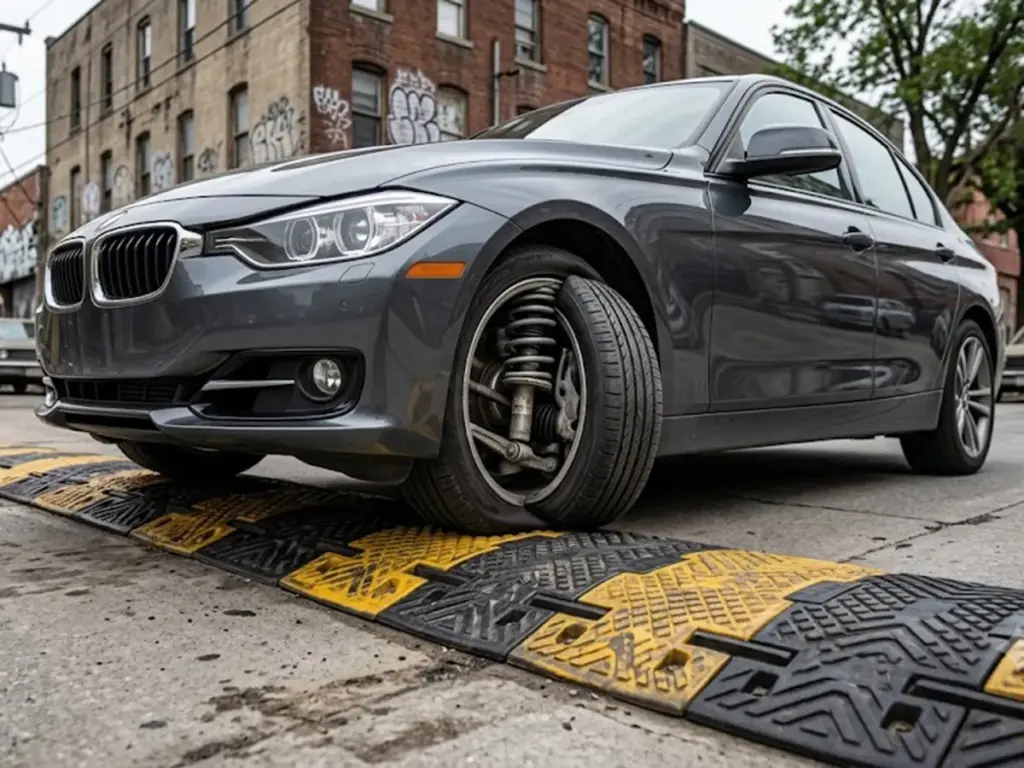
Quando um veículo atravessa um solavanco, a energia cinética é forçada na suspensão e na transmissão como um choque vertical. Compreender quais componentes absorvem esse choque informa quais reclamações esperar – e quais recursos do produto as evitam.
Suspensão e amortecedores: o principal ponto de estresse
A suspensão foi projetada para absorver impactos verticais, então leva o peso de cada travessia. Batidas fortes repetidas em um impacto não conforme aceleram o desgaste dos amortecedores e das molas. Este é o componente mais comum por trás de reclamações de danos em estacionamentos.
Alinhamento de direção e volante
Componentes de direção – tirantes, juntas esféricas, e arbustos – absorvem a tensão lateral quando uma roda cai de uma borda íngreme. Um perfil chanfrado espalha essa carga e é por isso que o design da borda, não apenas altura, aumenta as taxas de reclamação.
Pneus e rodas
Uma borda afiada ou danificada pode prender um pneu contra o aro, arriscando danos nas paredes laterais ou, ao longo do tempo, desgaste irregular do piso. Pneus de baixo perfil em veículos mais novos são especialmente vulneráveis – relevante em locais residenciais e de varejo premium.
Escape, material rodante e eixo
Veículos de baixa altura correm maior risco de raspar o escapamento ou o material rodante em uma lombada acima da altura. É aqui que a combinação de tipos de veículos em seu local determina diretamente a altura máxima segura do impacto que você pode especificar.
A equação de impacto do veículo de lombada: Altura, Perfil e velocidade de abordagem
Impacto do veículo com lombada é o choque físico transferido para um veículo à medida que ele atravessa um dispositivo elevado, e sua gravidade é governada por três variáveis que você controla: altura da colisão, perfil de borda, e velocidade de aproximação. Para um gerente de instalações, o valor prático de compreender esta equação é que cada reclamação de danos remonta a uma destas três alavancas - todas elas definidas na aquisição e instalação, não apenas pelo motorista.
Por que a altura e a inclinação geram a gravidade do impacto
A força de impacto aumenta acentuadamente com a altura do impacto e a brusquidão das bordas. Sob AS/NZS 2890.1:2004 Cláusula 4.6, Tipo 1 as lombadas especificadas para estacionamentos fora da rua devem apresentar estritamente uma altura entre 50 mm e 75 mm, uma largura de plataforma superior de 100 mm a 150 mm, e um íngreme 1:2 gradiente de rampa na borda principal. Um dispositivo dimensionado para um estacionamento de baixa velocidade se comporta de maneira muito diferente de um destinado a uma via pública (que segue as dimensões do perfil Austroads Watts), é por isso que exceder a altura máxima legal de 75 mm ou usar uma borda vertical maior que 5 mm na base é a principal causa de alinhamento evitável e danos ao material rodante.
Para os máximos legais específicos e os valores AS2890.1 por trás deles, veja nosso detalhamento do limites de altura que regem os solavancos dos estacionamentos australianos.
A física da velocidade de aproximação
Escalas de energia cinética com o quadrado da velocidade, então um veículo em 20 km/h fornece cerca de quatro vezes a energia de impacto de um 10 km/h. É precisamente por isso “indo devagar” funciona e por que velocidades de aconselhamento reforçadas são a ferramenta de prevenção de danos mais barata que você tem.
Como suas escolhas de instalação controlam a curva de danos
Altura correta, uma borda principal chanfrada, iluminação adequada, e sinalização clara achatam drasticamente a curva de danos. Estas são decisões de aquisição – o que é uma boa notícia, porque significa que o risco é seu para projetar.
Como um fabricante totalmente integrado de sinalização de trânsito e segurança rodoviária, controlamos toda a cadeia de fornecimento - desde o substrato bruto e compostos de borracha até a impressão e acabamento personalizados - para que os relevos e a sinalização de aconselhamento em seu local sejam combinados e estejam em conformidade imediatamente..
Como os materiais alteram o impacto nos veículos
A tabela abaixo compara os três materiais de lombadas mais comuns em termos de dureza de condução, durabilidade, e caso de uso típico, para que você possa ver rapidamente como a escolha do material altera o impacto do veículo.
| Material | Dirija com dureza em veículos | Vida útil típica | Site mais adequado |
| Borracha (reciclado) | Inferior – flexiona e absorve choques | 7–10 anos | Estacionamento, residencial, varejo |
| Plástico (modular) | Moderado – rígido, mas leve | 5–7 anos | Sites temporários ou de baixo tráfego |
| Aço | Superior - rígido, máxima durabilidade | 15+ anos | Industrial, rotas de veículos pesados |
Materiais rígidos versus materiais compatíveis e dureza de condução
Materiais compatíveis, como borracha reciclada, flexionam sob carga, suavizando o choque passado para um veículo, enquanto o aço rígido transmite mais. Por um custo total, durabilidade, e comparação de instalação, veja nosso guia detalhado sobre como a borracha, plástico, e saliências de aço compare antes de você se comprometer com um substrato.
Design de borda, chanfros, e redução de choque
Um chanfrado (angular) borda permite que um pneu suba em vez de atingir o solavanco, cortando o impacto chocante que gera reclamações. Esse detalhe geralmente é mais importante do que o material do título.
O que perguntar aos fornecedores antes de comprar
- Este produto está em conformidade direta com AS/NZS 2890.1:2004 Cláusula 4.6? Solicite desenhos de engenharia escritos mostrando o perfil de altura de 50 mm a 75 mm e o 1:2 ângulo de rampa de aproximação.
- Qual é a classificação de carga certificada e dureza Shore? Certifique-se de que as variantes de borracha/plástico sejam classificadas para pelo menos 20 toneladas para movimentar veículos de serviço, e têm uma dureza Shore A que equilibra a deflexão com a longevidade.
- Os elementos refletivos integrados estão em conformidade com AS/NZS? 1906.1? Verifique se os olhos de gato amarelos ou painéis retrorrefletivos atendem à Classe 400 (anteriormente Classe 1) ou padrões de visibilidade mais elevados para segurança de instalações com pouca luz.
Reclamações e responsabilidades por danos: A Estrutura de Risco de um Gestor
Quem é o responsável quando uma lombada danifica um veículo em propriedade privada? Na Austrália, a responsabilidade geralmente depende se o ocupante da propriedade exerceu cuidado razoável sob os princípios do dever de cuidado - ou seja, um cumprimento, bem assinado, colisão bem iluminada é uma defesa forte, enquanto um não compatível ou oculto expõe você. A estrutura abaixo transforma esse princípio em prática.
Onde a responsabilidade recai sobre a propriedade privada
Sob ocupantes australianos’ princípios de responsabilidade, a entidade que controla as instalações deve aos visitantes o dever de tomar os devidos cuidados. Um redutor de velocidade que atende aos padrões reconhecidos, está claramente marcado, e está adequadamente iluminado demonstra que o cuidado; um não marcado, dispositivo acima da altura o prejudica.
Documentação, sinalização, e instalação defensável
Combine cada corcova com AS compatível 1742.13:2023 sinais de alerta - especificamente instalando um W5-10 ‘Speed Hump’ sinal combinado com um W8-2 'Velocidade Suplementar’ placa (Por exemplo, '10km/h') na abordagem, e um R4-1 ‘Sem ultrapassagem’ ou R2-4 ‘Mantenha-se à esquerda’ onde ocorre a deflexão de faixa única. Adicionalmente, garantir que o dispositivo possua marcações retrorrefletivas amarelas ou brancas nas teclas do piano, em conformidade com AS 1742.2:2022 e AS/NZS 1906.1 para visibilidade noturna. A documentação dessa configuração exata de sinalização é o que converte uma reclamação em um arquivo fechado, em vez de uma reclamação aberta.
Escolha de produtos compatíveis para antecipar reclamações
Especificar o padrão australiano relevante desde o início é o seguro mais barato que você pode comprar. Isso muda a conversa de “o solavanco foi razoável?” para “o motorista se aproximou muito rápido” - uma posição muito mais forte.
Como prevenir danos a veículos em seu local (5 Passos)
Use esta lista de verificação de cinco etapas para especificar e instalar medidas de acalmia de tráfego que reduzam a velocidade dos veículos sem gerar reclamações de danos.
- Audite seu mix de tráfego – identifique os veículos com menor liberação e maior frequência usando o site.
- Combine a altura e o perfil da colisão com essa mistura, permanecer dentro do máximo legal para estacionamentos.
- Selecione um material compatível e uma borda chanfrada adequada às suas necessidades de durabilidade e condução.
- Instale aviso prévio e marcações no dispositivo, mais iluminação, em cada dispositivo.
- Documente a especificação, padrão, e data de instalação, em seguida, analise as reclamações trimestralmente.
Fazendo a escolha certa para sua propriedade e seus motoristas
A compensação nunca é “Acalmia de trânsito versus danos ao carro” - é calmante complacente versus reclamações. Cada alavanca que reduz o impacto do veículo (altura correta, borda chanfrada, material compatível, sinalização clara) é definido antes que um único veículo cruze. Projete aqueles em, e você mantém a velocidade baixa enquanto mantém seu registro de reclamações vazio.
Próximas etapas e onde obter soluções compatíveis
Para a foto completa nos perfis, padrões, Materiais, e aplicativos em seu portfólio, trabalhar através do nosso guia completo para especificar lombadas comerciais, em seguida, combine seus dispositivos com o mix exato de tráfego do seu site.
Baixe nossa lista de verificação gratuita de especificações de lombadas para auditar seu site em minutos - com a confiança de gerentes de instalações e estacionamentos em toda a Austrália, e apoiado por nossa conformidade em primeiro lugar, fabricação de ponta a ponta.
Perguntas frequentes
Os redutores de velocidade podem realmente danificar um carro?
Sim, mas raramente quando o solavanco é compatível e conduzido corretamente. Os danos ocorrem principalmente quando uma colisão é muito alta, tem uma borda abrupta, ou é ultrapassado muito rápido - todos os quais são evitáveis através de especificações corretas e velocidades de aconselhamento claras.
Quem é responsável se uma lombada danificar um veículo em propriedade privada?
A responsabilidade geralmente recai sobre o ocupante da propriedade e depende de cuidados razoáveis. Um compatível, claramente marcado, colisão bem iluminada é uma defesa forte; um não marcado ou com altura excessiva aumenta a exposição.
Quão alto pode ser legalmente uma lombada?
As alturas dos estacionamentos australianos são regidas por padrões, incluindo AS2890.1. Porque os números exatos dependem do tipo e localização do dispositivo, consulte nosso guia dedicado aos limites de altura para lombadas em estacionamentos australianos para obter os números precisos.
As lombadas de borracha causam menos danos do que aço ou concreto?
Geralmente sim – a borracha reciclada flexiona e absorve choques, transmitindo menos impacto aos veículos do que o aço rígido. O aço oferece maior durabilidade para locais de veículos pesados.
A que velocidade os veículos devem cruzar uma lombada para evitar danos?
Normalmente 5–10 km/h para um solavanco no estacionamento. Porque a energia do impacto aumenta com o quadrado da velocidade, um veículo em 20 km/h proporciona cerca de quatro vezes o choque de um 10 km/h – é por isso que as velocidades recomendadas evitam a maioria dos danos.
Referências
- Padrões Austrália — AS2890.1 Parques de estacionamento (Papel 1: Estacionamento fora da rua)
- Austrália - Guia para parte de gerenciamento de tráfego 8: Gestão de Ruas Locais (Seção 7: Tráfego calmante)
- Padrões Austrália — COMO 1742.13:2023 Manual de dispositivos uniformes de controle de tráfego – Gestão do tráfego local nas ruas
- Departamento de Transporte e Estradas Principais de Queensland (Tmr) - Manual de dispositivos uniformes de controle de tráfego (MUTCD) Papel 13