Mastering Highway Sign Installation Requirements for Regulatory Compliance
Highway sign installation is a high-stakes engineering activity. It directly governs roadway safety, legal liability, and final project approval. Precision in placement ensures that signage delivers clear and timely information to motorists. While successful procurement depends on quality manufacturing and material selection, the physical installation must adhere to federal mandates to function effectively.
Professional site supervisors recognize that installation is the final link in the safety chain. Adhering to established highway sign installation requirements prevents the “information failure” that leads to traffic incidents.
The Role of the MUTCD in Standardizing Roadway Safety
The Manual on Uniform Traffic Control Devices (MUTCD) acts as the primary authority for MUTCD sign installation standards. This manual dictates uniform criteria for mounting height, lateral offset, and visibility across all public roads.
For site supervisors, compliance with these standards is a non-negotiable benchmark. Strict adherence to the MUTCD mitigates several critical project risks:
- Inspection Failures: Non-compliant signs require costly re-work and delay project handovers.
- Safety Hazards: Inconsistent placement confuses drivers and increases the probability of collisions.
- Regulatory Friction: Agencies often verify state DOT sign installation requirements against federal baselines before releasing final payments.
Impact of Improper Installation on Infrastructure Liability
Improper placement creates significant legal and physical risks. If a sign sits outside the driver’s cone of vision, the infrastructure fails its primary purpose. From a professional standpoint, ignoring MUTCD sign installation standards introduces severe liability.
Site supervisors must oversee every technical detail to avoid these consequences. Rejection during final inspections often leads to contractual penalties. More importantly, flawed installations expose stakeholders to litigation if an accident occurs. Maintaining rigorous oversight ensures that all highway sign installation requirements meet the highest engineering safety protocols.
Standardized MUTCD Sign Installation Standards and Positioning
Lateral Offset Requirements for Roadside Safety
The sign lateral offset requirements dictate the horizontal gap between the roadway edge and the sign assembly. This distance creates a vital “clear zone” for errant vehicles. According to MUTCD Section 2A.19, the standard offset for rural highways is 12 feet from the edge of the traveled way. However, if the shoulder is wide, the sign should sit at least 2 feet beyond the shoulder edge.
In constrained urban environments, the MUTCD allows a minimum offset of 2 feet from the face of the curb. This placement prevents side-view mirrors on high-profile vehicles from striking the sign. Proper lateral positioning balances maximum visibility for the driver with the physical safety of the roadside environment.
Vertical Clearance: Highway Sign Mounting Height for Urban vs Rural Areas
Achieving the correct highway sign mounting height for urban vs rural zones is a primary metric for safety inspectors. Vertical clearance ensures that the line of sight remains unobstructed by vegetation or other vehicles. The following table summarizes the core height mandates found in MUTCD Section 2A.18:
| Location Type | Minimum Vertical Clearance | Primary Engineering Rationale |
| Rural (Conventional) | 5 Feet | Optimizes headlight beam reflection in low-density areas. |
| Urban (Business/Res) | 7 Feet | Prevents pedestrian injury and ensures visibility above parked cars. |
| Expressway/Freeway | 7 Feet | Maintains clear sightlines for high-speed multi-lane traffic. |
| Directional (Overhead) | 17 to 22 Feet | Varies by state; prevents contact with oversized freight loads. |
In rural areas, engineers measure the 5-foot minimum from the bottom of the sign to the elevation of the near edge of the pavement. For urban areas, the 7-foot rule applies to the entire assembly, including any secondary plaques. This height prevents the sign from becoming a “fixed-object” hazard for pedestrians using the sidewalk.
Overhead Sign Mounting Specifications
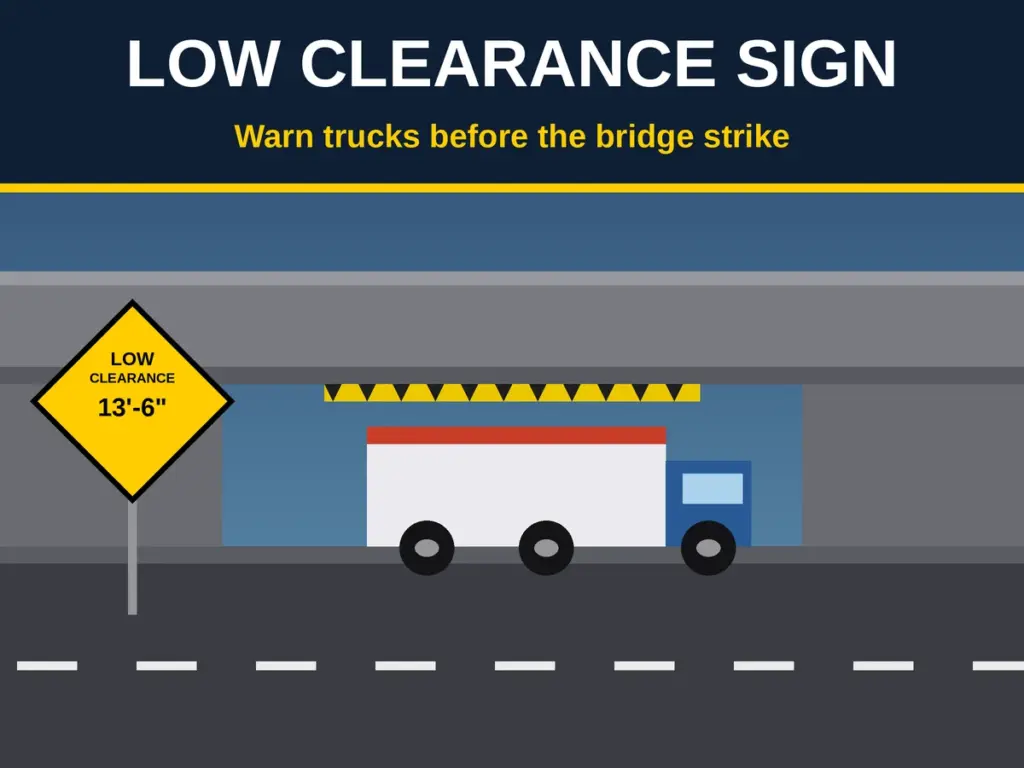
Overhead installations demand the most rigorous engineering oversight. These structures must provide a vertical clearance that typically exceeds 17 feet. This ensures that the tallest legal freight vehicles pass safely beneath the signs. Section 2A.17 of the MUTCD emphasizes that overhead signs are essential where lane-use control is complex or sight distance is restricted.
Beyond height, these signs must meet strict wind load requirements for traffic signs. Engineers must calculate the “effective projected area” of the sign face to design supports that resist high-velocity gusts. Supports often require deep concrete piers to counteract the leverage exerted by wind on the large overhead panels. These installations must also feature specialized mounting hardware to prevent the sign from vibrating loose over time. Compliance with these specifications ensures that overhead structures remain stable under extreme weather conditions.
Technical Specifications for Highway Sign Post Requirements and Supports
Implementing Breakaway Sign Support Requirements
Breakaway sign support requirements prioritize vehicle occupant safety during roadside departures. The Federal Highway Administration (FHWA) requires these systems on all signs located within the “clear zone” of high-speed highways. According to the MASH (Manual for Assessing Safety Hardware) criteria, a support must yield or fracture when struck by a vehicle. This mechanical failure prevents the post from acting as a rigid, deadly obstacle.
Site supervisors must ensure that the “stub height” remains less than 4 inches above the ground. If the remaining post exceeds this height, it can snag the undercarriage of a vehicle and cause a rollover. Proper installation of slip-base or frangible-coupling systems ensures the sign shears away cleanly. These highway sign post requirements are non-negotiable for any project involving speeds over 35 mph.
Material Selection for Durability and Compliance
Selecting the correct material involves balancing structural strength with the ability to fail safely. Different materials offer varying levels of resistance to corrosion and physical stress. The following comparison highlights the engineering trade-offs for common supports:
| Support Material | Durability & Performance | Compliance Context |
| U-Channel Steel | High tensile strength; excellent for small to medium signs. | Often uses rib-bak designs to meet frangible safety standards. |
| Perforated Square Tube | Best torsional (twist) resistance; multi-directional breakaway capability. | Telescoping features allow for easy height adjustment and repair. |
| Aluminum I-Beam | Superior corrosion resistance; ideal for coastal or high-salt areas. | Requires specialized slip-base hardware for large-scale installations. |
| Treated Timber | Cost-effective for rural areas; naturally energy-absorbent. | Must be “bored” at specific heights to ensure a clean break upon impact. |
Site supervisors must verify that all steel components feature hot-dip galvanization. This coating prevents structural weakening from rust over long-term exposure. Choosing the right material ensures the sign withstands local weather while still meeting highway signpost requirements.
State DOT Sign Installation Requirements
While the MUTCD sets the national baseline, state DOT sign installation requirements often introduce more rigorous localized mandates. These amendments address unique geographical, climate, and traffic conditions.
- In California, Caltrans implements the “California Amendments to the MUTCD.” These rules require sign structures to withstand higher seismic loads and specific wind speeds in coastal canyons. For instance, Caltrans Section 2A.19 demands larger lateral offsets in mountainous terrain to account for snow removal equipment.
- The New York State DOT (NYSDOT) focuses heavily on urban density and environmental durability. Their “Traffic Engineering Directives” often specify stainless steel hardware to resist the corrosive effects of heavy winter road salting. NYSDOT also mandates a 7.5-foot mounting height in NYC boroughs to improve visibility in crowded commercial corridors.
- In Texas, TxDOT requires specific foundation types for expansive clay soils. Their standards include deeper piers to prevent “sign lean” during seasonal moisture changes. Site supervisors must consult the specific state supplement to ensure the project meets every local state DOT sign installation requirement.
Advanced Engineering: Sign Foundation Depth and Load Resistance
Calculating Sign Foundation Depth Requirements
Determining the correct sign foundation depth requirements involves analyzing the interaction between the post and the surrounding soil. Engineers categorize soil into classes ranging from cohesive clay to granular gravel. Each type offers different levels of lateral resistance against tilting. AASHTO standards dictate that the embedment depth must counteract the “overturning moment” caused by the sign’s surface area.
To calculate the required depth (d) for posts not constrained by concrete, engineers often use the simplified Broms’ method formula:
d = 1.1 x √(P x H)/(S x B)
In this equation, P represents the lateral wind load, H is the height of the load from the ground, S is the allowable soil pressure, and B is the post diameter. For example, if a sign faces a 500 lb wind load (P) at a height of 7 feet (H) in soil with a 1,500 psf capacity (S) using a 0.5-foot wide post (B), the calculation determines the precise depth needed to prevent the post from yielding to lateral pressure.
In standard conditions, a typical small signpost requires a minimum depth of 3 to 4 feet. However, loose or sandy soils demand deeper penetration or wider diameters to ensure long-term stability. Site supervisors must verify soil density on-site before drilling. Failure to meet these sign foundation depth requirements leads to “sign lean,” which compromises the viewing angle for drivers.
Understanding Wind Load Requirements for Traffic Signs
Wind load requirements for traffic signs are critical because sign panels act as large sails. These surfaces must withstand the “gust effect factor” unique to their geographic location. According to the 2026 ASCE 7-22 updated wind maps, structures in coastal zones must now resist basic wind speeds exceeding 150 mph.
Designers calculate the wind force (F) exerted on the sign using the following formula:
F = A x P x C_d
Here, A is the sign area (square feet), P is the wind pressure (psf), and C_d is the drag coefficient (typically 1.12 to 1.2 for rectangular flat plates). For instance, a 4×4 foot sign (A = 16) in a zone with 30 psf wind pressure (P) would face nearly 538 lbs of force.
High winds create “vortex shedding,” which causes the sign to vibrate at high frequencies. This vibration leads to metal fatigue and eventual fastener failure. Engineering plans must specify heavy-duty mounting brackets and reinforced posts to meet these wind load requirements for traffic signs. Verification of the Effective Projected Area (EPA) ensures the support structure can handle these dynamic environmental stresses without deforming.
Concrete vs. Soil-Driven Foundations
The choice between foundation methods depends on the sign’s size and its intended lifespan. Concrete footings provide the highest level of structural integrity. They are the industry standard for permanent, large-scale highway markers and overhead structures. The concrete mass effectively distributes the load across a wider area, preventing the post from shifting in soft ground.
Soil-driven posts offer a more efficient solution for smaller, ground-mounted signs. This method uses a pneumatic or manual driver to force the post directly into the earth. While faster to install, soil-driven supports rely entirely on the friction between the post and the soil. Site supervisors often select this method for temporary construction zones or standard mileage markers. Regardless of the choice, the method must satisfy all local highway sign installation requirements to pass inspection.
Optimizing Visibility through Sign Orientation for Retroreflectivity
The Science of Sign Retroreflectivity Requirements
Sign retroreflectivity requirements govern how a sign surface returns light to the driver’s eyes. MUTCD Section 2A.08 mandates that public agencies use a documented method to maintain traffic sign brightness. This regulation ensures that signs remain visible well beyond the standard headlight range at night. High-performance retroreflective sheeting uses micro-prismatic technology to redirect light back toward the source rather than scattering it.
Compliance requires meeting specific coefficients of retroreflection (R_A) based on the sign color and sheeting grade. For example, white regulatory signs often require a minimum R_A of 35 to 250 cd/lx/m^2 depending on the specific ASTM D4956 Type. Site supervisors must ensure that installation teams do not damage this microscopic prismatic layer. Maintaining these sign retroreflectivity requirements is essential for providing drivers with sufficient reaction time during low-visibility conditions.
Strategic Angling to Reduce Specular Glare
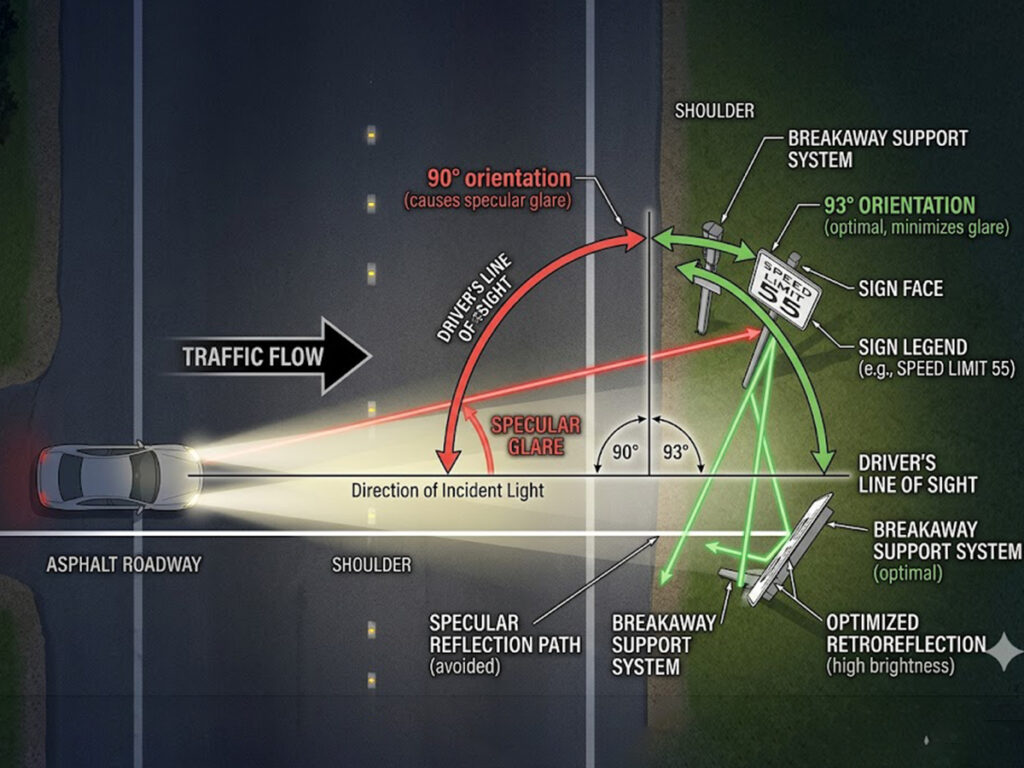
Achieving the perfect sign orientation for retroreflectivity requires more than just facing the sign toward traffic. If a sign sits exactly perpendicular to the travel lane, it can create “specular glare.” This mirror-like reflection occurs when headlights hit a flat surface and bounce directly back, washing out the sign’s legend.
To prevent this, MUTCD Section 2A.21 suggests angling signs slightly away from the road. On straight sections, installers should turn the sign face approximately 93 degrees from the direction of traffic. This 3-degree offset directs the “hot spot” of the reflection away from the driver while maintaining high retroreflective returns. Even a small 5-degree error in orientation can reduce night-time legibility by over 40%. Proper sign orientation for retroreflectivity ensures that the message remains crisp and readable under all lighting conditions.
Post-Installation Inspections and QA/QC
Final verification ensures the assembly meets all MUTCD sign installation standards and engineering blueprints. Site supervisors must conduct a physical audit of the installation site before project handover. This quality control process includes measuring the vertical clearance from the pavement to the sign’s lowest edge.
A critical component of QA/QC involves the “night-time visual inspection” method. An inspector drives past the installation at posted speeds to verify that no glare or obstructions exist. They must also confirm that all fasteners meet vibration-resistance specs and that breakaway stubs sit at the correct height. This rigorous check confirms full compliance with sign retroreflectivity requirements and structural mandates. Successful inspections protect the agency from liability and guarantee long-term performance for the infrastructure.
Ensuring Long-Term Integrity in Highway Signage Projects
Maintenance Schedules and Replacement Cycles
Professional installation represents only the initial phase of a sign’s service life. Environmental exposure and UV radiation constantly degrade the chemical properties of reflective sheeting. To maintain compliance with highway sign installation requirements, agencies must implement a proactive maintenance program. MUTCD Section 2A.08 establishes that organizations must use one of five approved methods to track sign health.
Site supervisors should schedule physical inspections at least once every two years. These audits focus on structural integrity, checking for loose fasteners or tilted posts. Monitoring for retroreflectivity degradation is equally vital. Once a sign falls below the minimum required brightness levels, it no longer meets federal safety mandates. Timely replacement cycles prevent the infrastructure from becoming a liability. Effective maintenance ensures that MUTCD sign installation standards are satisfied throughout the sign’s entire operational lifespan.
Final Inspection Checklist for Site Supervisors
Before project sign-off, a comprehensive technical audit must verify every installation parameter. Site supervisors should utilize a rigorous checklist to confirm that the project meets all engineering benchmarks. This final review serves as the last defense against regulatory non-compliance and future litigation.
The verification process must prioritize the following critical metrics:
- Positional Accuracy: Confirming the sign lateral offset requirements match the specific road type and shoulder width.
- Vertical Clearance: Measuring the highway sign mounting height for urban vs rural zones to ensure pedestrian and vehicle safety.
- Safety Hardware: Verifying that all breakaway sign support requirements are met, particularly the maximum 4-inch stub height rule.
- Structural Stability: Checking that the sign foundation depth requirements align with the soil reports and wind load calculations.
- State Compliance: Ensuring every detail adheres to the unique state DOT sign installation requirements for that specific jurisdiction.
Achieving Excellence in Highway Sign Installation and Compliance
Precision in highway sign installation is the cornerstone of modern roadway safety. Adhering to the rigorous standards of the Federal Highway Administration ensures that every sign performs its intended function. Professional site supervisors must treat MUTCD sign installation standards as the absolute minimum requirement for success.
Ultimately, maintaining strict alignment with highway sign installation requirements and engineering specifications protects both the public and project stakeholders. Consistent oversight during the installation phase guarantees a durable, visible, and legally sound signage system. By prioritizing these technical details, supervisors ensure that highway infrastructure serves the community reliably for years to come.
Frequently Asked Questions (FAQ) Regarding Highway Sign Installation Compliance
Q1: How do site supervisors verify if sign lateral offset requirements meet both MUTCD and State DOT standards?
Site supervisors must measure the horizontal distance from the edge of the traveled way to the nearest edge of the sign. MUTCD sign installation standards generally require a 12-foot offset for rural highways to maintain an adequate clear zone. However, state DOT sign installation requirements may vary; for instance, Caltrans may mandate specific offsets based on shoulder type or slope. Always cross-reference the federal MUTCD with state-specific supplements to ensure the “recovery zone” is sufficient for errant vehicles while maintaining maximum sign visibility.
Q2: Why is the distinction for highway sign mounting height for urban vs rural environments so critical for liability?
The height difference addresses distinct environmental hazards. In rural areas, a 5-foot mounting height optimizes the angle for headlight beams in dark, low-pedestrian corridors. Conversely, urban environments require a 7-foot minimum to prevent pedestrian head injuries and ensure the sign remains visible above parked vehicles. Failing to meet these highway sign installation requirements can lead to “tort liability” if an accident occurs because a sign was obscured or became a physical obstruction on a sidewalk.
Q3: What are the mandatory breakaway sign support requirements for high-speed roadway segments?
For any road with speeds exceeding 35 mph, the FHWA requires crashworthy supports that shear or breakaway upon impact. These breakaway sign support requirements stipulate that the remaining “stub” after a collision must not exceed 4 inches in height. This prevents the support from snagging a vehicle’s undercarriage and causing a rollover. Site supervisors must verify that slip-bases or frangible couplings are installed exactly at grade level to ensure the safety mechanism triggers correctly.
Q4: How do wind load requirements for traffic signs influence sign foundation depth requirements?
Sign panels act as high-drag surfaces. Wind load requirements for traffic signs determine the “overturning moment” or the force trying to topple the post. To counter this, the sign foundation depth requirements are calculated based on the Effective Projected Area (EPA) and local soil class. In high-wind coastal regions, foundations must be deeper—often exceeding standard 4-foot depths—and may require concrete encasement to resist the lateral pressure and vibration (vortex shedding) caused by gusts up to 150 mph.
Q5: Can improper sign orientation for retroreflectivity lead to a failed safety inspection?
Yes. Even if a sign uses premium sheeting, improper orientation can cause “specular glare,” making the legend unreadable at night. Sign orientation for retroreflectivity standards suggests turning the sign face approximately 3 degrees away from the perpendicular (a 93-degree angle) on straight road sections. This directs the mirror-like glare away from the driver’s eyes. Inspectors utilizing the “night-time visual inspection” method will fail any installation that exhibits significant glare or fails to meet sign retroreflectivity requirements under standard headlight illumination.
References:
- FHWA — MUTCD 11th Edition, Section 2A.08 & Table 2A-3: Maintaining Minimum Retroreflectivity (Minimum retroreflection coefficients for 2026 compliance): https://mutcd.fhwa.dot.gov/pdfs/11th_Edition/part2a.pdf
- FHWA — MUTCD 11th Edition, Sections 2A.16 – 2A.21: Standardized Sign Placement (Standards for mounting height, lateral offset, and orientation): https://mutcd.fhwa.dot.gov/pdfs/11th_Edition/part2a.pdf
- FHWA — Manual for Assessing Safety Hardware (MASH): Performance criteria for breakaway sign support requirements and crashworthiness: https://highways.dot.gov/safety/rwd/reduce-crash-severity
- ASTM D4956 – 19(2026): Standard Specification for Retroreflective Sheeting for Traffic Control (Material performance and prismatic sheeting grades): https://www.astm.org/d4956-19.html