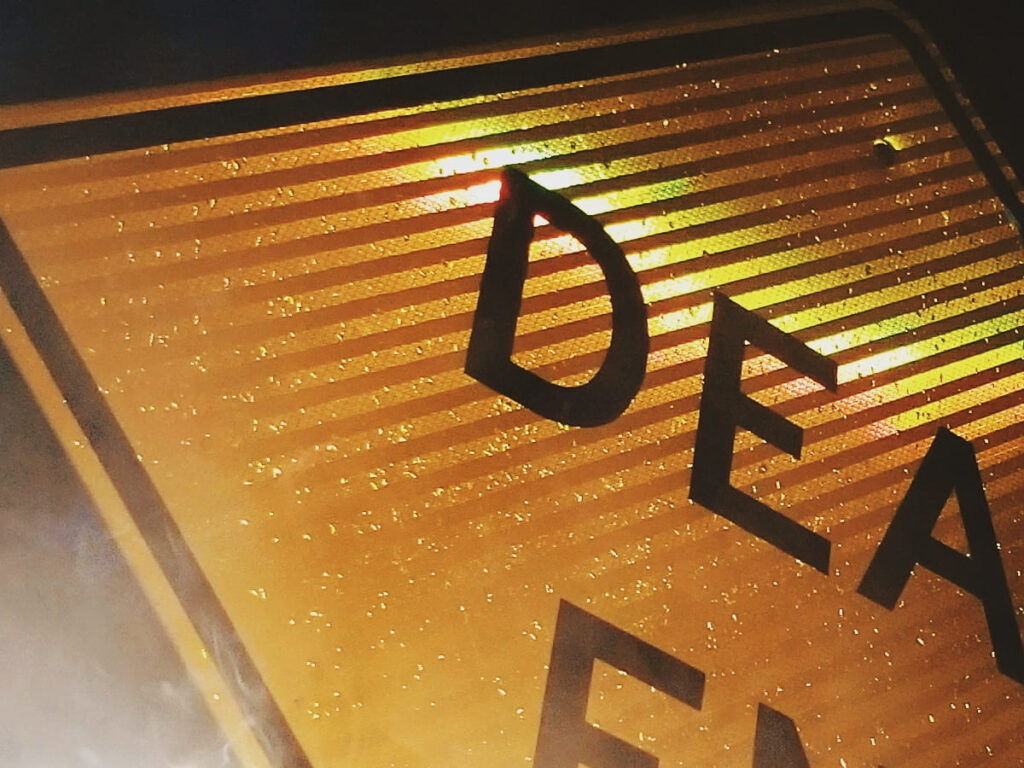
Reflective signage material is the single most important variable in a traffic sign’s nighttime performance. The substrate — aluminum, roll-up fabric, or composite — provides the structure. The reflective sheeting provides the visibility. ASTM D4956 is the standard that classifies and defines the performance requirements for that sheeting, covering Types I through XI across two fundamental technologies: glass-bead and microprismatic.
Choosing the right Type for a given application is not just a performance decision — it is a compliance decision. MUTCD 11th Edition Section 2A.22 requires that signs maintain retroreflectivity at or above the minimum luminance coefficient values in Table 2A-5 throughout their service life. The sheeting Type you specify determines how long a sign can maintain those minimums before replacement.
This guide covers every relevant ASTM D4956 sheeting Type, with performance data, MUTCD compliance context, and application guidance. For a practical guide on applying these grades to rental fleet stocking decisions, see our article on reflective sheeting for rental fleet applications. If you are ready to source compliant inventory now, OPTRAFFIC의 MUTCD-compliant safety signage is available in Type III and higher sheeting grades with ASTM D4956 certification documentation on request.
For a broader look at how to select the right reflective materials across different road environments, 가이드를 참조하세요 how to select the best reflective materials for traffic signs.
ASTM D4956: 분류 시스템의 작동 방식
Types vs. Classes
ASTM D4956 organizes retroreflective sheeting into two dimensions. 유형 (나는 XI를 통해) define performance — specifically the minimum coefficient of retroreflection (라) measured in candelas per lux per square meter (CD/LX/m²), along with color and durability requirements. Classes (1 through 5) define the adhesive backing method, which is a manufacturing and installation detail.
For specifying traffic sign sheeting, the Type is the critical parameter. The Class matters when ordering — Class 1 is pressure-sensitive adhesive (the most common for traffic sign fabrication), while Classes 2 through 5 cover heat-activated, low-tack, low-temperature, and non-adhesive variants.
Two Technology Families
All ASTM D4956 Types fall into one of two optical technology categories:
- 유리구슬 시트 (유형 I 및 II) — retroreflectivity comes from glass microspheres that reflect light back toward its source. Lower cost and lower performance. Degrades faster under UV and physical wear.
- 미세 분산 시트 (유형 III, IV, VIII, ix, xi) — retroreflectivity comes from cube-corner prism elements that return light more efficiently across a wider range of entrance angles. Higher performance, 더 긴 서비스 수명, better wet-weather visibility.
Understanding which family a Type belongs to explains most of the performance differences between grades — and most of the cost differences as well.
| MUTCD compliance framework MUTCD 11th Edition Section 2A.22 requires agencies and operators to maintain a documented assessment or management method to keep signs above the minimum RA values in Table 2A-5.Table 2A-5 sets minimum maintained retroreflectivity levels by sign color and application — for example, 50 cd/lx/m² for black-on-orange TTC signs, 35 cd/lx/m² for white-on-red regulatory signs.The sheeting Type you specify determines how long a sign stays above those minimums before replacement. Higher-grade sheeting = longer compliant service life = wider replacement intervals. 원천: Mutcd 11th Edition, mutcd.fhwa.dot.gov |
Glass-Bead Sheeting: Type I and Type II
Type I — Engineer Grade
Type I is the lowest-performance classification in ASTM D4956. It uses enclosed-lens glass-bead technology and delivers a minimum RA of approximately 70 cd/lx/m² for white sheeting under standard measurement geometry.
Historically, Type I served as the default for a wide range of traffic control applications. 하지만, its combination of lower RA output and faster degradation under UV and physical wear makes it difficult to maintain MUTCD Table 2A-5 compliance across a typical 7–10 year sign lifecycle — particularly for ground-mounted signs in active use. 따라서, most roadway agencies and rental operators are transitioning away from it for work zone and regulatory sign applications.
그 말은, the grade remains appropriate for non-critical, 저속, and temporary applications where signs are replaced frequently and Table 2A-5 minimums are verified before each use.
Type II — Super Engineer Grade
The second glass-bead grade, II 형, uses enclosed-lens technology with approximately double the RA output of Type I. It delivers improved visibility compared to Engineer Grade while remaining in the glass-bead technology family.
실제로, 하지만, this grade occupies a narrow market position. It outperforms Type I but costs more — and for most roadway applications, the step up to Type III microprismatic sheeting delivers meaningfully better performance for a comparable price premium. 결과적으로, new traffic sign procurement rarely specifies Type II, and it is uncommon in rental fleet inventory.
미세 분산 시트: III 형, IV, and the Work Zone Grades
Type III — High Intensity Prismatic (잘 알고 있기)
Type III is the recommended baseline for roadway traffic sign sheeting. It uses encapsulated-lens microprismatic technology, delivering a minimum RA of approximately 250 cd/lx/m² for white — significantly above Type I and comfortably above MUTCD Table 2A-5 minimums for all common sign color/application combinations.
Type III’s performance margin above the MUTCD minimum means signs can sustain compliant retroreflectivity for 7–10 years on aluminum substrates under normal outdoor conditions. That service life, combined with a moderate price point, makes Type III the most cost-effective general-purpose specification for permanent and temporary traffic sign inventory.
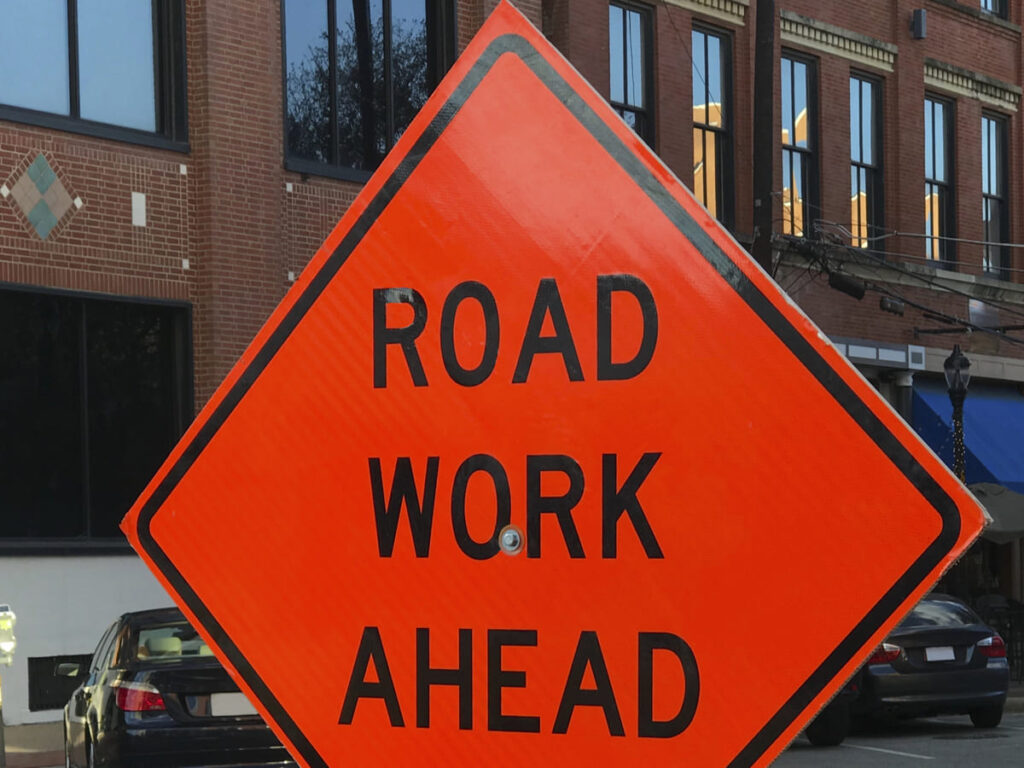
For work zone signs, Type III is specified under fluorescent orange for TTC applications — the orange fluorescent version provides enhanced daytime conspicuity in addition to nighttime retroreflectivity, which is particularly important for ROAD WORK AHEAD and FLAGGER AHEAD signs.
Type IV — High Intensity Prismatic (Alternative Grade)
Type IV is a microprismatic sheeting grade with performance characteristics similar to Type III. Historically, Type IV was specified by some state DOTs and agencies as an alternative to Type III for permanent highway signing in urban environments.
실제로, the distinction between Type III and Type IV is less significant for most procurement decisions than the distinction between glass-bead and microprismatic families. Both deliver adequate performance for ground-mounted signs on roads posted up to 55 MPH. For new inventory procurement, confirm your applicable state DOT’s specification — some states specify Type III, others accept Type III or IV interchangeably.
Type VIII — Extended Performance Prismatic
Type VIII consolidates and replaces the discontinued Types VII and X under the ASTM D4956-19 revision. It uses microprismatic technology with extended durability specifications designed for high-UV and harsh-weather environments.
Type VIII is primarily used for permanent signing in demanding climates. 차량 임대 목적으로, it is an acceptable alternative to Type IX for highway applications where a state DOT specification calls for it specifically.
High-Performance Sheeting: Type IX and Type XI
유형 IX — 초고강도 프리즘형
Type IX는 금속화되지 않은 큐브 코너 마이크로프리즘 기술을 사용합니다., delivering very high retroreflectivity — particularly at the short-to-medium road distances characteristic of overhead and shoulder-mounted sign viewing geometry. Its minimum RA exceeds 1,000 cd/lx/m² for white at standard measurement angles.
Type IX is the specified grade for permanent highway signing in many state DOT standards, 머리 위 안내 표지판, and construction zone devices on high-speed roadways. 그것은 10+ year service life on aluminum under typical conditions makes it a cost-effective long-term choice for any sign that will be deployed repeatedly in demanding environments.
For traffic sign buyers specifying rental fleet inventory for highway applications, Type IX is the correct step up from Type III. It meets the elevated retroreflectivity expectations of contractors on federally funded projects and satisfies state DOT specifications that require higher-than-Type-III performance on roads posted above 55 MPH.
유형 XI — 다이아몬드 등급 (풀큐브 프리즘형, DG³)
Type XI is the highest-performance classification in ASTM D4956. It uses full-cube corner microprismatic technology — meaning the prism geometry is optimized to return light across the widest possible range of entrance angles, not just head-on. This results in approximately 60% 가벼운 복귀, nearly double that of other prismatic grades.
The practical advantage of Type XI over Type IX is wide-angle performance. 급커브에서, complex intersections, and any application where drivers approach a sign at an oblique angle, Type XI maintains retroreflectivity where other grades fall off. 추가적으로, Type XI’s uniform daytime and nighttime appearance — it looks similar in both conditions — reduces driver confusion in mixed-lighting environments.
Type XI carries a 10–12 year service life on aluminum and is specified for overhead highway signs, 중요한 안전 구역, and high-speed work zones. It is the lowest total cost-of-compliance option for the highest-demand applications when lifecycle cost is calculated rather than unit purchase price.
ASTM D4956 Reflective Signage Material: Full Comparison Table
| 유형 | 일반 이름 | 기술 | 최소. RA White (CD/LX/m²) | Typical Service Life | 기본 애플리케이션 | MUTCD Work Zone Use |
| 나 | 엔지니어 성적 | 유리구슬 | ~70 | 3-5년 | Non-critical, 저속 | ⚠️ Compliance burden high |
| II | 슈퍼 엔지니어 등급 | 유리구슬 | ~150 | 4–6 years | Light roadway use | ⚠️ Uncommon — use Type III instead |
| III | 고강도 프리즘 | 미세 분산 | ~250 | 7-10년 | Standard roadway signs | ✅ Recommended baseline |
| IV | 고강도 프리즘 | 미세 분산 | ~250 | 7-10년 | Urban permanent signs | ✅ Acceptable alternative to Type III |
| VIII | Extended Performance | 미세 분산 | ~250+ | 10+ 연령 | High-UV/harsh weather | ✅ Replaces discontinued VII/X |
| ix | 매우 높은 강도 | 금속화되지 않은 마이크로프리즘 | ~1,000+ | 10+ 연령 | 고속도로, 머리 위 표지판 | ✅ 고속 / 간접비 |
| xi | 다이아몬드 등급 (DG³) | 풀큐브 마이크로프리즘 | ~1,000+ (광각) | 10–12 년 | 고속도로, critical zones | ✅ Maximum performance |
| Note on discontinued TypesTypes V, VI, and VII have been discontinued or reclassified in ASTM D4956-19.Type X has been reclassified as Type VIII.If you encounter specifications referencing these discontinued types, consult your state DOT for the current equivalent grade. |
Selecting the Right Reflective Signage Material by Application
Permanent Roadway Signs
For permanent ground-mounted signs on roads posted up to 55 MPH, Type III is the standard specification. It meets MUTCD Table 2A-5 minimums with sufficient margin to sustain compliance through a 7–10 year replacement cycle. For overhead guide signs and permanent signing on roads above 55 MPH, Type IX or XI is the correct specification — check your state DOT’s standard specifications for the exact grade required.
임시 교통 통제 (작업 구역) 손짓
Work zone signs present a specific compliance challenge: they are subject to the same MUTCD Table 2A-5 retroreflectivity minimums as permanent signs, but they endure more physical handling, more frequent repositioning, and sometimes shorter deployment cycles.
For ground-mounted TTC signs, Type III on aluminum is the recommended specification. The fluorescent orange version of Type III is the standard choice for ROAD WORK AHEAD, FLAGGER AHEAD, and similar advance warning signs — it delivers both day and night compliance in a single material, combining retroreflectivity with enhanced daytime conspicuity.
High-speed highway work zones require a step up. Where roads are posted above 55 MPH, or where a state DOT specification calls for a higher grade, Type IX is the correct choice. On roads above 65 MPH, contract specifications may require Type XI — confirm with the applicable state DOT before ordering.
For a field-level guide to deploying compliant temporary traffic control signs, 우리를 보아라 MUTCD temporary traffic control guide.
Overhead and Highway Guide Signs
Overhead signs require Type IX or XI. The viewing geometry for overhead signs — with drivers looking up at an angle — means standard ground-mounted sign sheeting grades do not deliver adequate retroreflectivity at the observation angles actually experienced by drivers. Type IX and XI are both designed to maintain high RA at the short-distance, higher-observation-angle geometry of overhead viewing.
Construction Zone Devices (바리케이드, 묘사자, 드럼)
Construction zone devices are typically specified at Type III for standard work zones and Type IX for high-speed highway construction zones. The fluorescent orange versions of both grades are commonly used for maximum daytime conspicuity alongside nighttime retroreflectivity. Confirm your state DOT’s approved product list for specific device applications.
Environmental Factors That Affect Reflective Signage Material Performance
UV 노출
Prolonged UV exposure is the primary degradation mechanism for both glass-bead and microprismatic sheeting. High-UV climates — southern US states, desert environments, high-altitude installations — accelerate retroreflectivity loss. 이 환경에서, upgrade one grade level relative to standard specifications and shorten replacement intervals by 20–30%.
Ambient Light Competition
Urban environments with significant ambient artificial lighting reduce the apparent retroreflectivity of lower-grade sheeting — drivers cannot distinguish sign retroreflectivity from background light. Type IX and XI perform better in these environments due to their higher RA output and wide-angle performance. For complex urban intersections or areas with high visual clutter, Type XI’s wide-angle capability provides a meaningful safety advantage.
Weather and Road Geometry
안개, 비, and snow reduce retroreflective sign visibility for all sheeting grades. Microprismatic grades (Type III and above) maintain better wet-weather performance than glass-bead grades due to their sealed optical elements. For regions with frequent adverse weather, specify Type III minimum for all traffic signs. For sharp curves and complex geometry where drivers approach signs at oblique angles, Type XI’s wide-angle retroreflectivity is the most appropriate choice.
자주 묻는 질문: ASTM D4956 Reflective Signage Material
1분기: What is the difference between Type III and Type XI reflective sheeting?
Both use microprismatic technology, but they differ significantly in RA output and optical geometry. Type III High Intensity Prismatic delivers approximately 250 cd/lx/m² for white and is designed for standard ground-mounted sign viewing distances. Diamond Grade Type XI, 대조적으로, delivers over 1,000 cd/lx/m² and uses full-cube prismatic technology that maintains high retroreflectivity across a much wider range of entrance angles. 머리 위 표지판, 고속 고속도로, and applications where wide-angle visibility is critical all call for Type XI. For standard roadway signs, 하지만, Type III is sufficient and more cost-effective.
Q2: Is Type I reflective sheeting still MUTCD compliant?
MUTCD 11th Edition does not ban Type I outright. 하지만, it requires a documented management method to keep signs above Table 2A-5 minimums throughout their service life. Type I glass-bead sheeting degrades to below-compliant levels faster than microprismatic grades, particularly under UV exposure and physical wear. 결과적으로, maintaining compliance with Type I requires shorter replacement intervals and more frequent inspection — increasing total compliance cost. For most roadway applications, Type III is the more practical choice.
3분기: What does the ASTM D4956 Class designation mean?
The Class designation (1 through 5) specifies the adhesive backing type, not the performance level. For most traffic sign fabrication, 수업 1 — pressure-sensitive adhesive — is the standard choice. Moving up the scale, 수업 2 requires heat activation, 수업하는 동안 3 uses a low-tack positionable adhesive suited to applications where repositioning is needed. Cold-climate installations may call for Class 4, which uses a low-temperature pressure-sensitive formula. At the top of the scale, 수업 5 has no adhesive backing at all. Unless a specific installation method requires otherwise, 수업 1 covers the vast majority of traffic sign procurement.
4분기: Which ASTM D4956 Type is required for work zone signs?
MUTCD 11th Edition does not mandate a specific Type for work zone signs — it mandates compliance with Table 2A-5 minimum RA values through a documented management method. 실제로, Type III fluorescent orange is the industry standard for ground-mounted TTC work zone signs on roads posted up to 55 MPH. For higher-speed applications or where a state DOT specification requires it, Type IX is the step up. Confirm your state DOT’s approved product list for the specific grade required on your project.
Q5: How long does ASTM D4956 Type III sheeting last on a traffic sign?
~에 .080″ aluminum substrates in standard outdoor installations: 7–정상 조건에서 10년. On roll-up fabric substrates in active use: 3-5년. Both estimates assume proper storage and maintenance. High-UV climates, abrasive cleaning agents, or coastal salt environments reduce these estimates by 20–40%. The MUTCD management method approach means there is no single compliance deadline — signs should be replaced when retroreflectometer readings or expected-life calculations indicate they are approaching Table 2A-5 minimums.
Q6: Can I use Type IX sheeting for all traffic signs to maximize compliance?
Technically yes, but it is not cost-effective for every application. Type IX delivers performance well above what MUTCD Table 2A-5 requires for standard ground-mounted signs — you pay for performance you do not need. The practical recommendation is to match the sheeting grade to the application: Type III for standard ground-mounted signs, Type IX for highway and overhead applications, Type XI for the highest-demand overhead and critical safety zone applications. This approach optimizes total cost of compliance across the fleet lifecycle.
Matching Grade to Application
ASTM D4956 reflective signage material selection comes down to one principle: match the sheeting grade to the retroreflectivity demand of the application, then verify that demand against MUTCD Table 2A-5. Type III covers the majority of roadway applications efficiently. Type IX and XI address the higher-demand scenarios where Type III falls short — not because Type III fails the standard, but because specific applications require a higher performance floor.
The environmental factors — UV exposure, ambient light competition, 날씨, and road geometry — modify this baseline. Hotter, sunnier climates call for a grade step up or shorter replacement intervals. Complex urban environments benefit from the wide-angle performance of Type XI. Wet-weather regions should specify microprismatic grades across the board.
For the practical application of these grades to traffic sign rental fleet procurement and replacement cycle planning, 가이드를 참조하세요 reflective sheeting for rental fleet applications.