>

ブログ

>

高級サインブラケット素材が自治体の維持管理予算を削減する理由: ライフサイクルコスト分析

高級サインブラケット素材が自治体の維持管理予算を削減する理由: ライフサイクルコスト分析

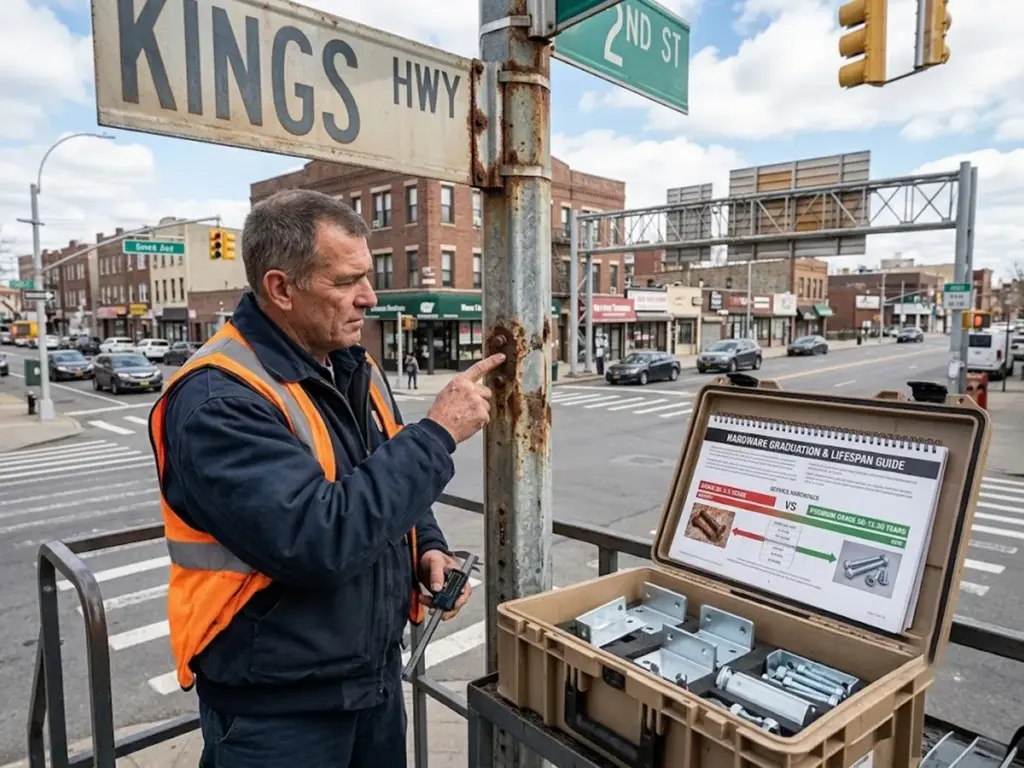
Your crew just spent four hours, a bucket truck, and a lane closure on an arterial to replace a $14 ブラケット. The sign panel was fine. The post was fine. One piece of seized, corroded hardware pulled a two-person crew off a backlog that already stretches past your fiscal year, and it will happen again at the same intersection in six years.

That is the quiet arithmetic draining public works budgets across the country: the cheapest line item on the purchase order dictates when everything else gets paid for a second time. その間, your finance director is asking why maintenance keeps growing, and your auditor is questioning your useful-life estimates.

これ road sign bracket life-cycle cost analysis gives you the formula, the real US labor and traffic control inputs, and the 20-year model you need to defend a specification change with numbers instead of opinions.

The Hidden Math Behind a $14 ブラケット: Why Unit Price Misleads Public Works Budgets

Unit price is the wrong measurement because it captures 3% of the money and none of the timing. a road sign bracket life-cycle cost model captures both.

How Low-Bid Awards Transfer Cost from Capital to Operating Budgets

Procurement is scored on the day of purchase. Maintenance is scored six to eight years later, usually under a different department head. When an agency saves $23 per assembly on hardware, that saving is documented immediately on a supply line. The shortened replacement interval it creates lands in the operating budget as unbudgeted crew hours, and no report in the system connects the two events.

The result is a structural blind spot. The department capturing the saving is not the department absorbing the cost, so the feedback loop that should correct the specification never closes.

The Installed-Cost Ratio Most Agencies Never Calculate

Divide hardware cost by the fully loaded cost of the service event that installs it. For most US municipalities, a bracket and fastener set runs $12 に $40, while the service event, once burdened labor, aerial equipment, 旅行, and traffic control are included, runs $350 に $900 それ以上.

That puts hardware at roughly 2% に 6% of the money. いつ 94% of the cost is the visit, the only rational optimization target is visit frequency. This is the single insight that reframes street sign hardware replacement cost from a purchasing question into an asset management question.

Reading Work Order History as a Procurement Signal

Your CMMS already holds the evidence. Query repeat visits by asset ID and look for three patterns:

  1. Sort work orders by asset ID and flag any assembly touched twice inside 10 年.
  2. Isolate fastener-related and mount-related work orders by purchase year to identify a bad procurement cohort.
  3. Separate knockdowns and vandalism from hardware attrition, since only the latter is a specification problem.

If panel replacements are being triggered by mount failure rather than sheeting degradation, your municipal road sign replacement cycle is being set by your cheapest component.

How Do You Build a Total Cost of Ownership Formula for Sign Mounting Hardware?

Total cost of ownership for sign mounting hardware is the sum of acquisition, インストール, 検査, 交換, and disposal costs across a fixed analysis period, discounted to present value. It differs from unit-price comparison because it prices the frequency of future service events, どこですか 90%+ of the money sits. For asset managers, its practical value is converting a materials debate into a defensible budget forecast.

The Five Cost Buckets Behind Every Mounted Assembly

  • 取得: ハードウェア, ファスナー, 貨物, 受信, and inventory carrying cost.
  • インストール: burdened crew labor, 装置, 旅行, and traffic control for the original install.
  • 検査: routine assessment cycles, including the nighttime and daytime retroreflectivity checks required under the FHWA Manual on Uniform Traffic Control Devices (mutcd).
  • Replacement and rework: every subsequent hardware-driven service event, plus collateral panel and post work.
  • Disposal and administration: 除去, scrap handling, and purchase order processing overhead.

The Working TCO Equation

TCO = A + 私 + (N × C) + P + d, discounted to present value, どこ:

  • A = acquisition cost per assembly
  • I = initial installation cost
  • N = number of replacement events in the analysis period (analysis years ÷ expected hardware service life)
  • C = fully loaded cost per service event
  • P = inspection and condition assessment overhead
  • D = disposal and administrative cost

Note what dominates. Because C is 20 に 60 times larger than A, the variable N controls the outcome. どれでも road sign bracket life-cycle cost model that ignores N is just a price list.

Selecting a Defensible Analysis Period

Tie the window to a real asset cycle, not a fiscal convenience. Retroreflective sheeting on regulatory and warning signs typically delivers 10 に 15 years of compliant service life under MUTCD minimum retroreflectivity requirements, while galvanized posts frequently exceed 25 年.

The alignment principle is straightforward: hardware that survives at least one full sheeting cycle lets you swap a panel without touching the mount. Use a 20-year window for council-facing analysis and a 10-year view to defend next year’s operating request.

What Does a Single Bracket Replacement Actually Cost a US Municipality?

A single bracket replacement typically costs a US municipality $350 に $900 in fully loaded terms, そして $1,200 or more on high-volume corridors requiring night work. The drivers are burdened crew rates, aerial equipment deployment, travel time, and maintenance of traffic, not the hardware itself.

Loaded Crew Rates, Not Base Wage Rates

The posted wage is roughly 62% of the story. According to the Bureau of Labor Statistics Employer Costs for Employee Compensation series, benefits account for approximately 38% of total compensation for state and local government workers, one of the widest wage-to-benefit gaps in the US economy.

Applied to highway maintenance workers, whose BLS median annual wage sits near the high $40,000s nationally, a two-person sign crew realistically carries a fully burdened rate of $95 に $130 per hour once fringe, PPE, トレーニング, and supervisory overhead are loaded in. Contracted work under federal-aid funding adds Davis-Bacon prevailing wage determinations, widening the gap further. Pull your own indirect cost rate from finance before running the model.

Equipment Deployment and Fleet Opportunity Cost

An aerial device carries an internal charge-back rate commonly in the $45 に $85 per hour range once fuel, maintenance reserve, and depreciation allocation are included. The larger cost is opportunity cost: a bucket truck committed to a bracket swap is unavailable for signal, 点灯, or storm response that shift.

This is why overhead-mount, mast-arm, and high-mast assemblies produce the fastest payback on premium hardware. Their cost per service event can run triple that of a ground-level post mount, so heavy duty pole clamp bracket cost-effectiveness improves sharply with mounting height.

Travel Time and Jurisdiction Geometry

Windshield time is real money, particularly for county agencies managing dispersed inventories across hundreds of centerline miles. More importantly, batched replacement campaigns cost dramatically less per asset than reactive single-asset dispatches, and unpredictable hardware failure forces you into the expensive mode. Predictability is itself a budget line.

交通の維持: The Cost Line That Dwarfs the Hardware Itself

Traffic Control Setup, フラグを立てる, and Permitting

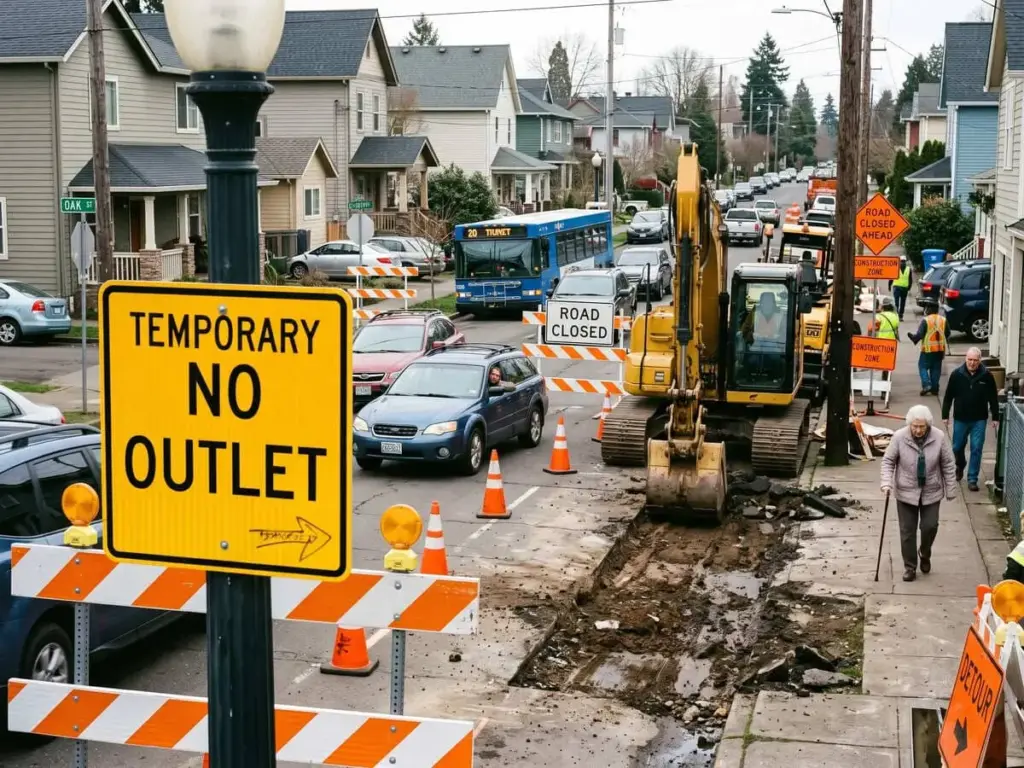
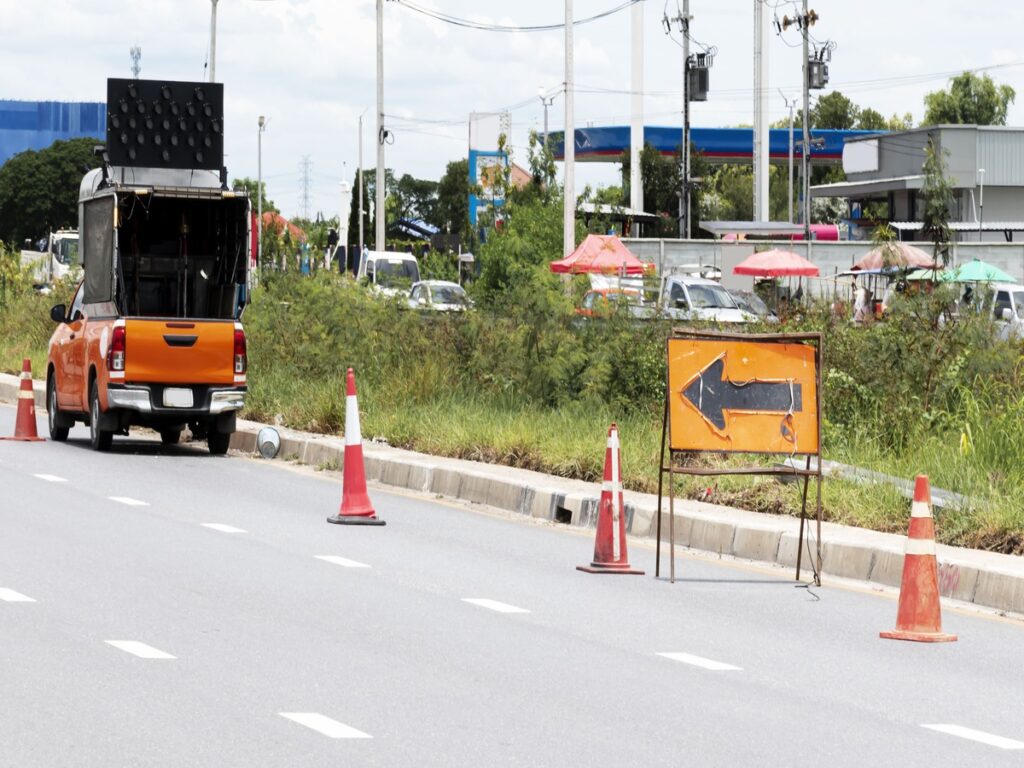
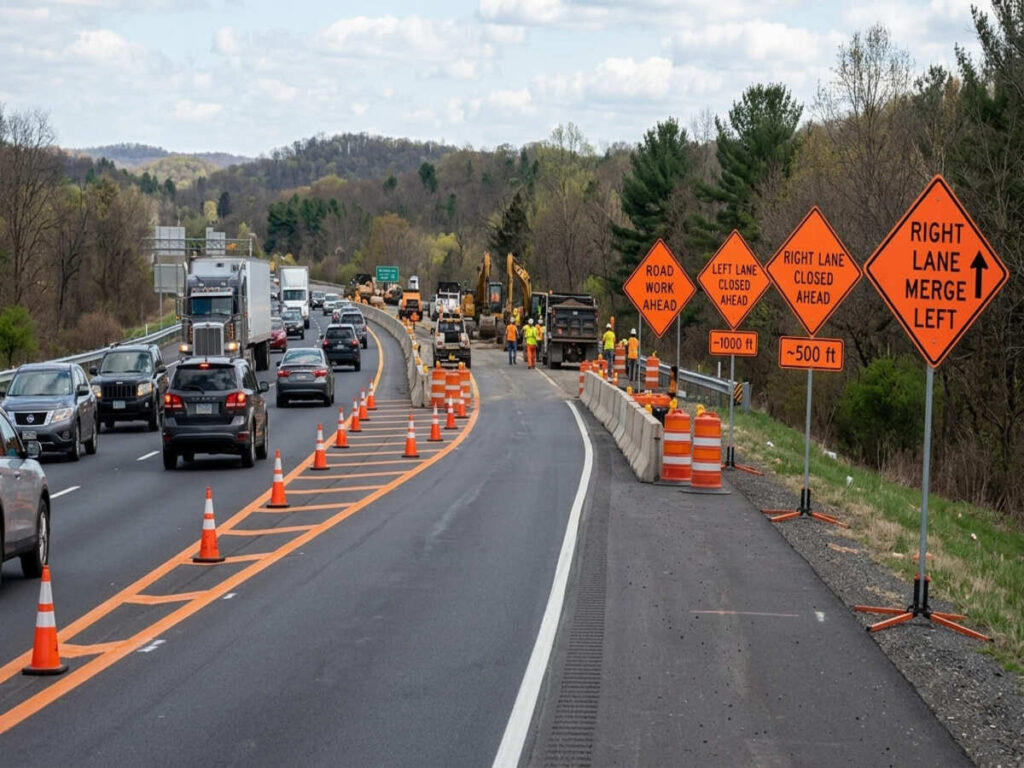
A compliant temporary traffic control setup requires devices, advance signing, コーン, flagging personnel, and the labor to set up and tear down, before a single wrench turns. Work on a state route adds encroachment permitting and lead time that removes scheduling flexibility.

Here is the scaling problem: MOT cost is driven by roadway classification and traffic volume, not by the size of the part being replaced. Replacing a $15 bracket on a four-lane arterial can require the same work zone as a structural repair. Typical MOT cost for a short-duration municipal setup ranges from roughly $250 on a low-volume local street to $1,200+ on an arterial requiring flaggers and a lane closure.

動脈性の, 高速道路, and the Night Work Premium

Peak-hour lane closure restrictions push arterial and highway sign work into night and weekend windows. That adds shift differentials, overtime, reduced productivity under artificial lighting, and additional supervision, commonly a 15% に 30% premium on the labor component.

Many state DOT life-cycle cost methodologies also require road user cost, the monetized delay imposed on the traveling public. Include it. Councils increasingly ask, and it makes every avoided service event look considerably more valuable in your infrastructure life cycle cost analysis.

Risk-Adjusted Cost: Worker Exposure and Tort Liability

Every avoided service event is an avoided exposure event. FHWA work zone data attributes roughly 850 に 900 fatalities per year to work zone crashes nationally, with highway maintenance and construction workers among those struck. Fewer trips to the same asset is a safety outcome, not only a fiscal one.

On the asset side, a sign that has rotated out of position or detached can support a claim regarding inadequate maintenance of traffic control devices. Multiply your cost per service event by a factor reflecting incident probability and self-insured retention exposure, and the risk-weighted road sign bracket life-cycle cost of low-grade hardware climbs again.

Converting Hardware Grade into Replacement Cycles: The Lifespan Variable

OPTSIGNS | Why Premium Sign Bracket Materials Lower Municipal Maintenance Budgets: A Life-Cycle Cost Analysis

Standard Grade Versus Premium Grade as a Service-Life Assumption

For modeling purposes, collapse the entire materials conversation into two variables:

  • Standard/low-grade hardware: shorter assumed field service life
  • Premium/high-grade hardware: substantially longer assumed field service life

Environmental Severity Multipliers by Region

Apply severity as a multiplier on your baseline traffic sign bracket replacement lifespan across three US tiers:

  • Coastal and salt-air jurisdictions: highest attrition, fastest premium payback
  • Snowbelt regions with heavy chloride de-icing programs: high attrition, driven by winter maintenance chemistry
  • Inland and arid regions: lowest attrition, longest baseline life

Agencies in severe-exposure zones reach payback fastest, which means a single nationwide specification standard leaves money on the table in one direction or the other.

Failure Mode Economics and Collateral Cost

Reframe failure modes purely as cost events:

  • Fastener seizure turns a 10-minute panel swap into a full mount replacement.
  • Gradual rotation or loosening generates a complaint-driven, unbatched dispatch.
  • Mount failure takes a serviceable sign panel down with it.

That last one compounds: one hardware failure triggers hardware cost, plus panel cost, plus a full service event, plus MOT. Understanding the durability tradeoffs between common bracket and fastener material pairings protects the assumption your entire model rests on.

A 20-Year Side-by-Side Model Across a 5,000-Sign Inventory

The table below compares standard and premium hardware scenarios in terms of acquisition cost, 交換サイクル, present-value total, and 20-year net position. All figures are illustrative modeling inputs. Substitute your own rates.

Shared assumptions: 5,000 mounted assemblies; 20-year analysis period; $450 average fully loaded cost per service event; 2.0% real discount rate per OMB Circular A-94.

変数標準グレードPremium Grade
Hardware cost per assembly1538
Total acquisition cost75000190000
Assumed service life8 年20+ 年
Replacement events in 20 年2 (年 8, 16)0
Total replacement service events100000
Hardware PV (all cycles)~$194,000~$190,000
交換作業 + MOT PV~$3,560,0000
20-year PV total~$3,754,000~$190,000
PV cost per assembly~$751~$38

The acquisition premium is $115,000. The avoided present-value cost is approximately $3.56 百万, a return of roughly 31:1 over the analysis period.

Two drivers produce that gap:

  • 初め, event elimination.
  • 2番, batching: predictable service life lets remaining work be scheduled into low-cost planned campaigns instead of reactive dispatches.

Sensitivity, stated honestly: the premium option only fails to pay if actual field life gains less than roughly 25% over standard grade, meaning it does not remove even one full replacement cycle inside the window. そのしきい値を超えると, the math is not close.

ガスブ 34 報告, Useful-Life Estimates, and Defensible Capital Planning

The Modified Approach Versus Depreciation for Sign Assets

Under GASB Statement No. 34, governments report infrastructure assets either by depreciating them over estimated useful lives or by using the modified approach, which requires documented condition assessments at least every three years and disclosure of a minimum condition level the agency commits to maintaining.

長い, more predictable hardware life supports both paths. It stabilizes depreciation schedules under the first and makes the preservation commitment sustainable under the second. Reporting treatment is a finance department decision; this section informs that conversation rather than replacing professional accounting judgment.

Setting Useful-Life Estimates You Can Defend to an Auditor

Four things support a useful-life assumption: manufacturer documentation, warranty terms, condition assessment records, and your own historical replacement data. Estimates that field performance repeatedly contradicts produce recurring adjustments, a weaker audit posture, and reduced credibility for future capital requests.

Retain hardware specifications and supplier certifications inside the asset record so the number has a paper trail.

Turning Predictable Cycles into Multi-Year CIP and Grant Requests

A documented replacement cycle converts an erratic operating expense into a forecastable capital program line. That matters for Highway Safety Improvement Program applications and similar federal and state funding narratives, where life-cycle cost justification strengthens the request.

The political argument compresses to one sentence: a council approves a program with a known cost curve far more readily than a municipal sign maintenance budget line that grows every year without explanation. With the ASCE 2025 Report Card for America’s Infrastructure grading US roads a D+ against a multi-trillion-dollar investment gap, defensible life-cycle documentation is now table stakes for competitive funding.

How to Write Procurement Language That Rewards Life-Cycle Value (5 ステップ)

  1. Establish best-value evaluation authority with your purchasing office, confirming where statute permits documented life-cycle cost as an award criterion alongside price.
  2. Specify minimum service life, warranty duration, and remedy terms as performance requirements rather than naming a manufacturer, keeping the solicitation competitive and compliant.
  3. Require hardware and fastener compatibility documentation, since mismatched components shorten assembly life and quietly invalidate your entire road sign bracket life-cycle cost モデル.
  4. Request physical samples for field validation before committing an inventory-wide order.
  5. Consolidate SKUs across a multi-year standardization program to cut inventory carrying cost, reduce wrong-part dispatches, and unlock volume pricing that narrows the acquisition premium.

As a fully integrated traffic sign manufacturer, we control the chain from substrate and hardware sourcing through custom printing and finishing, which is why we can document service life assumptions rather than estimate them. Our municipal specification templates are used by public works teams across 40+ US states.

Every input in this analysis, from severity multipliers to service-life assumptions, ultimately traces back to material selection and finish specification. For the engineering, 耐久性, and compliance factors that determine which hardware grades can actually support these life-cycle assumptions, 私たちの complete technical breakdown of bracket material performance and compliance requirements before finalizing your spec.

よくある質問

How do you calculate the life-cycle cost of a road sign bracket?

Total acquisition, インストール, 検査, 交換, and disposal costs across a defined analysis period, then discount future costs to present value using a rate such as the 2.0% real rate in OMB Circular A-94. The dominant variable is replacement event count, calculated as analysis period divided by expected service life. Because each event carries $350 に $900 in crew, 装置, and traffic control cost, reducing event count saves far more than reducing unit price.

What percentage of a sign replacement actually goes to hardware?

だいたい 2% に 6% in most US municipal settings. The remainder is burdened crew labor, aerial equipment, travel time, and maintenance of traffic. The ratio worsens on arterials and highways, where work zone requirements and night scheduling can add a 15% に 30% labor premium while hardware cost stays flat.

How long should traffic sign brackets last before replacement?

Model it as a range driven by exposure severity and hardware grade rather than a single number. The useful benchmark is whether mounting hardware outlasts one full sheeting cycle, 通常 10 に 15 years under MUTCD minimum retroreflectivity requirements, so panels can be replaced without disturbing the mount. Hardware failing inside that window generates entirely avoidable service events.

Does premium mounting hardware help with GASB 34 asset reporting?

Indirectly, はい. Longer and more consistent service life makes useful-life estimates easier to support with documentation and historical data, strengthening your position under either the depreciation or modified approach. It also converts reactive maintenance into a forecastable replacement program suited to multi-year capital planning. Final reporting treatment remains a decision for your finance department and auditors.

Can a municipality specify higher-grade brackets under low-bid procurement rules?

Generally yes, through performance specifications and best-value evaluation rather than brand naming. Agencies commonly set minimum service life, 保証, and documentation requirements, then award among qualifying suppliers. Some statutes also permit documented life-cycle cost as an evaluation factor. Confirm the approach with your purchasing office and legal counsel before issuing the solicitation, since rules vary by state.

参照

私たち. 労働統計局, Employer Costs for Employee Compensation

私たち. 労働統計局, Occupational Employment and Wage Statistics: Highway Maintenance Workers

連邦高速道路局, Work Zone Facts and Statistics

Governmental Accounting Standards Board, Statement No. 34: Basic Financial Statements for State and Local Governments

Office of Management and Budget, Circular A-94: Guidelines and Discount Rates for Benefit-Cost Analysis

私たち. 労働省, Davis-Bacon and Related Acts

目次

共有: