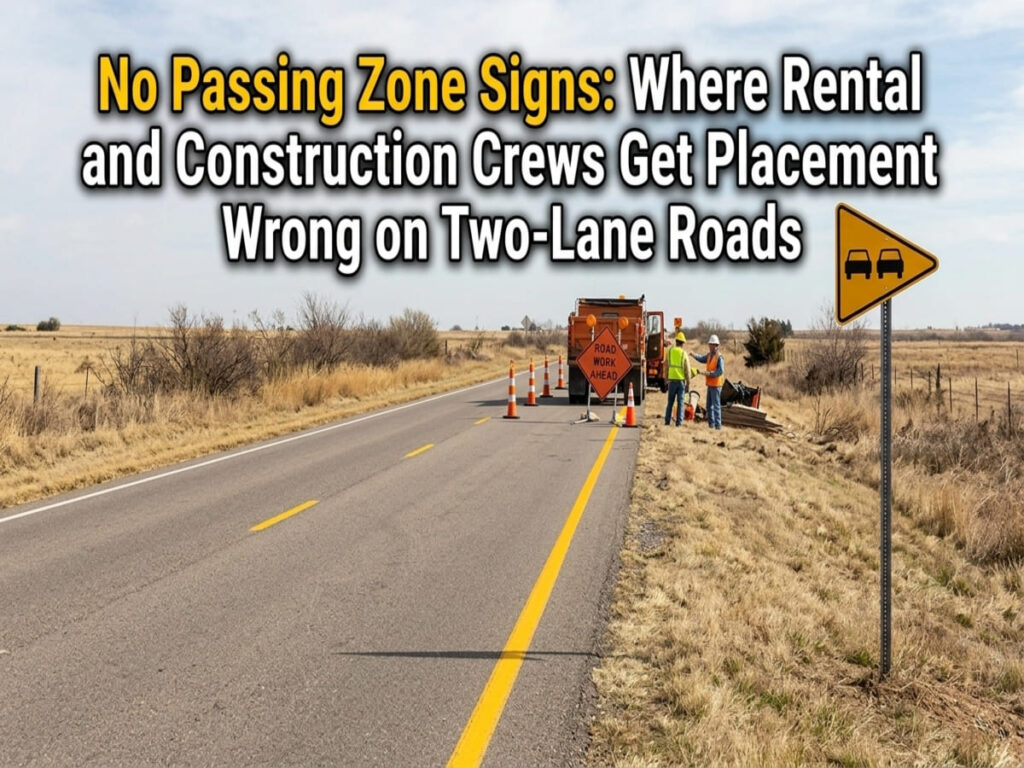
a no passing zone sign looks simple to place. Post it where the road curves or a hill blocks the view, and drivers get the message. 実際に, crews get this placement wrong more often than any other regulatory sign on a two-lane road. The correct spot depends on sight distance, not on where the hazard looks obvious.
Our team has reviewed traffic control plans with this exact problem. a no passing zone sign went up right at the crest of a hill. しかし, the safe zone actually needed to start farther back, at the point where sight distance dropped below the safe threshold. The gap between those two points is exactly where drivers had already committed to a pass before the restriction technically started. That gap is where head-on collisions happen on temporary two-lane work zones.
このガイドでは 3 つのことについて説明します: what a no passing zone sign legally requires, how sight distance actually determines placement, and where crews most often get it wrong on construction and lane-conversion sites.
キーテイクアウト
- Sight Distance Drives Placement: The sign goes where passing sight distance drops below the safe minimum, not where the hazard looks visually obvious.
- Full Coverage Matters: The restricted zone must cover the entire stretch where sight distance is inadequate, including the approach.
- Temporary Work Zones Change the Calculation: 装置, 障壁, and altered alignments can reduce sight distance below what the original road design assumed.
- Markings and Signs Work Together: A double yellow centerline reinforces the sign, but the sign itself is the enforceable regulatory device.
- Re-check After Layout Changes: Any shift in the work zone’s horizontal or vertical alignment requires a fresh sight distance check.
What a No Passing Zone Sign Legally Means
The no passing zone sign is a regulatory sign. It prohibits drivers from crossing the centerline to pass another vehicle for the length of the marked zone. Crews typically pair it with a double yellow centerline, but the sign and the marking serve different legal functions. The sign is the enforceable regulatory device. The marking simply reinforces it visually, which matters most at night or in wet conditions when painted lines are easier to spot than a sign at a distance.
How Sight Distance Actually Determines Placement
The core rule behind every no passing zone is passing sight distance. This is the minimum distance a driver needs to see an oncoming vehicle, complete a pass, and return to the lane safely. Engineers calculate this distance from the posted speed limit, not from how the road looks to a driver.
This is exactly where crews get the mix-up. A curve or hill crest might look like the obvious hazard point. しかし, the actual no-passing zone often needs to start well before that point, because sight distance drops gradually rather than at one sharp line. Ending the zone as soon as the hazard clears is the same mistake, just in reverse.
Where Work Zones Change the Calculation
A permanent road has an established, engineered no-passing zone based on its normal geometry. A temporary work zone changes that geometry. 結果として, the original calculation may no longer apply:
| Work Zone Change | Effect on Sight Distance | Placement Consequence |
|---|---|---|
| Equipment or materials staged near the centerline | Blocks the driver’s line of sight earlier than the road’s natural curve | No passing zone needs to start farther back than the permanent markings show |
| Temporary barriers on a curve | Reduces effective sight distance around the curve | Zone may need to extend further than the original engineered distance |
| Lane shift or taper | Changes the angle drivers view oncoming traffic from | Sight distance calculation needs to be redone for the shifted alignment, not assumed from the original road |
Crews sometimes rely on the road’s existing no-passing markings without checking how the work zone itself has changed what a driver can actually see. That’s the gap worth checking before signage goes out.
Building a Placement Check Into the Traffic Control Plan
The fix isn’t a different sign. その代わり, it’s confirming sight distance against the site as it exists during the work, not as it exists on the base map.
- Walk or drive the site before finalizing sign placement. Check where a driver’s view is actually blocked by equipment, 障壁, or the altered alignment.
- Extend the no passing zone to cover the full reduced-sight-distance stretch. Don’t just cover the section around the most obvious hazard.
- Re-verify placement any time the work zone layout shifts. A taper or lane shift changes the sight distance calculation from what the original road design assumed.
- Pair the sign with matching temporary centerline markings where practical. This lets the visual cue and the regulatory sign reinforce each other.
Stocking the Right Sign for Two-Lane Work
Getting placement right depends on one thing: having the sign available at the exact point the site check identifies. It shouldn’t matter what spare happens to be sitting in the truck. On longer projects, that point can also move as the work progresses. So crews need signage they can reposition quickly, not a fixed installation.
The Optraffic team builds two-lane work zone sign sets around this need. Each set includes no passing zone signage sized and mounted for quick repositioning as a site’s layout shifts. That flexibility matters most on projects where equipment staging changes week to week. It lets a crew match signage to a new sight distance check, instead of leaving outdated placement in place.
関連書籍
- ペナント型標識と通行禁止区域におけるその役割を理解する
- チャネライザーコーンがどのようにして停止視距離を改善し、より安全な道路を実現するのか
- 道路狭窄標識と交通安全におけるその重要な役割を理解する
- 一車線先の標識 vs. ロードナローズ vs. 車線の端: あなたのワークゾーンに実際に必要なものはどれですか?
よくある質問
What does a no passing zone sign mean?
It means drivers may not cross the centerline to pass another vehicle for the length of the marked zone. 通常, this is because sight distance ahead is too short to complete a pass safely.
Is a no passing zone sign the same as a double yellow line?
いいえ. The double yellow line is a pavement marking that reinforces the restriction visually. The no passing zone sign is the regulatory device that actually makes the restriction enforceable.
Why would a temporary work zone need a different no passing zone than the permanent road markings show?
装置, 障壁, or a shifted lane alignment can block a driver’s view earlier than the road’s natural curve does. 結果として, the actual sight distance drops below what the original road design assumed.
What happens if a no passing zone sign is placed too late?
Drivers may already be evaluating a pass before the restriction visually applies. This increases the risk of a pass attempt in a zone where sight distance is genuinely inadequate.
結論
A no passing zone sign only works if it’s placed where sight distance actually drops, not where the hazard happens to look most obvious. Temporary work zones shift that calculation every time equipment, 障壁, or a lane taper changes what a driver can see. That’s why the Optraffic team builds 通過ゾーンサインはありません into two-lane work zone sign sets designed for quick repositioning. こちらです, placement can follow the actual site conditions, instead of the original road plan.