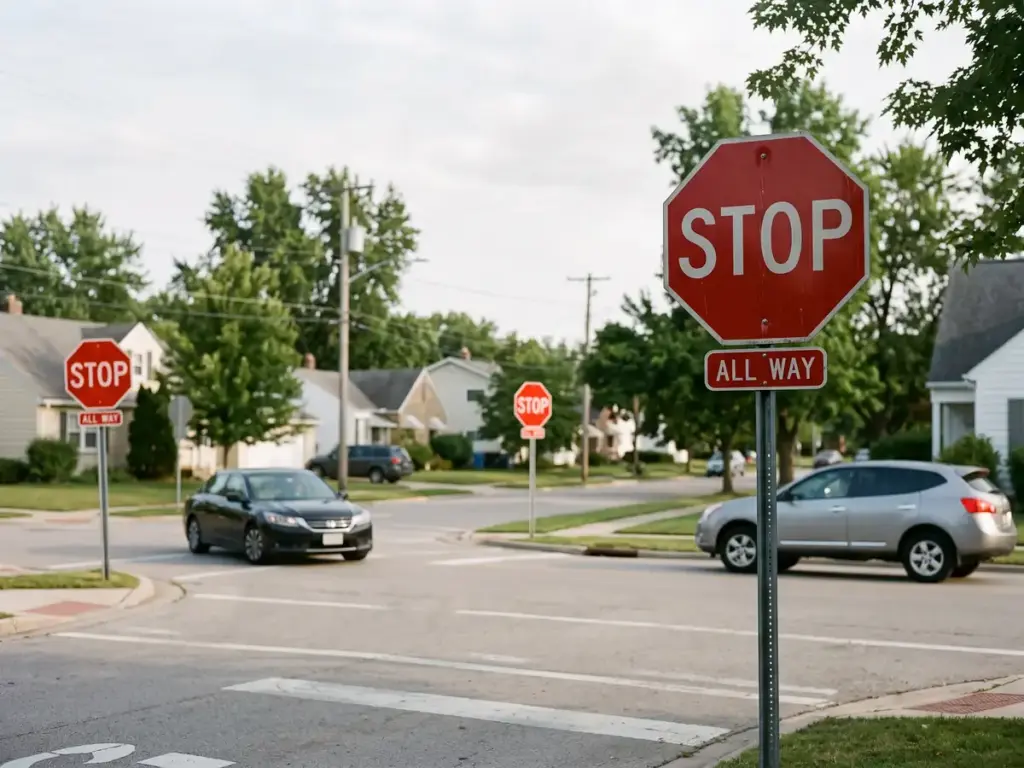
Two cars reach a four-way intersection at the same moment. Both drivers stop. Both wait. One waves, the other hesitates, and then both move at once. Most drivers have lived this scene. It happens because the 4 way stop rules sound simple but leave gaps that drivers fill with guesswork.
The same confusion reaches road agencies and property owners. Our team has reviewed requests from developers who wanted a “4-way stop” at a busy corner. They assumed more stop signs meant more safety. तथापि, the MUTCD sets clear tests for an all way stop sign, and the wrong install can create new crashes. It also no longer approves the “4-रास्ता” plaque most people picture.
इस गाइड में तीन बातें शामिल हैं. पहला, the right-of-way rules at an all-way stop. दूसरा, what the MUTCD requires before an agency installs one. तीसरा, how to sign it correctly.
चाबी छीनना
- First to Stop, First to Go: The first vehicle at the line proceeds first, so drivers can settle ties without guessing.
- Same-Time Arrivals: The driver on the right goes first, so crossing paths stay predictable.
- ALL WAY Plaque (R1-3P): Mount it below every STOP sign, because the MUTCD no longer approves 2-WAY or 4-WAY legends.
- Engineering Study First: Agencies need a study and a warrant, so unwarranted stops do not add crashes.
- गति नियंत्रण: STOP signs should not be used for speed control, so radar speed signs fit that job better.
4 Way Stop Rules: Who Has the Right of Way?
The basic order is easy to remember. NHTSA’s right-of-way guidance summarizes it as “First to Stop = First to Go.” The first vehicle to reach the intersection goes first. Everyone else waits their turn.
Ties and turns add three more rules. The table below shows how they combine.
| परिस्थिति | Who Goes First | क्यों |
|---|---|---|
| Vehicles arrive at different times | The first to stop | Order of arrival sets the queue |
| Two vehicles arrive together at right angles | The driver on the right | The left driver yields |
| Two vehicles face each other, one turns left | The vehicle going straight | The left-turner crosses oncoming traffic |
| Driver is unsure | Let the other go | NHTSA’s rule: when in doubt, bail out |
The New York DMV driver’s manual confirms the right-angle rule. Where two drivers stop at STOP signs at the same time, the driver on the left must yield to the driver on the right. Always check your own state’s manual, since wording varies. The NHTSA right-of-way rules are a good federal reference.
What the MUTCD Requires Before an All-Way Stop
An all-way stop is not a free safety upgrade. The MUTCD 11th Edition treats it as an engineering decision. Meeting a warrant does not require installation, and engineering judgment makes the final call.
The warrants in Sections 2B.12 through 2B.17 are:
| वारंट | यह क्या परीक्षण करता है | Key Threshold |
|---|---|---|
| Crash experience | Crashes a stop could prevent | 5 or more in 12 महीने, या 6 or more in 36 महीने (four-leg) |
| दृष्टि दूरी | Minor-road drivers cannot see far enough | Inadequate sight distance on stop-controlled approaches |
| संक्रमण | Interim control before a signal or roundabout | Temporary use while a signal is arranged |
| 8-hour volume | Combined traffic on both streets | 300 units per hour on the major street, 200 on the minor, for the same 8 घंटे |
| Other factors | Left-turn conflicts, residential collectors | इंजीनियरिंग निर्णय |
If the major-street 85th-percentile speed exceeds 40 मील प्रति घंटा, the volume minimums may drop to 70 प्रतिशत. पूरा पाठ अंदर है FHWA MUTCD 11वां संस्करण, Chapter 2B. The MUTCD also cautions that very different approach volumes can reduce the benefit of an all-way stop.
The ALL WAY Plaque: क्यों “4-रास्ता” Is Out
Most drivers say “four-way stop.” Most signs used to say “4-रास्ता।” The MUTCD has moved on. It uses an ALL WAY supplemental plaque (R1-3P), mounted below each STOP sign where every approach is controlled. The plaque has a white legend and border on a red background.
Numeric legends such as 2-WAY, 3-WAY and 4-WAY are not permitted with STOP signs. A three-leg intersection that says “4-रास्ता” sends a wrong message. ALL WAY works for any number of legs.
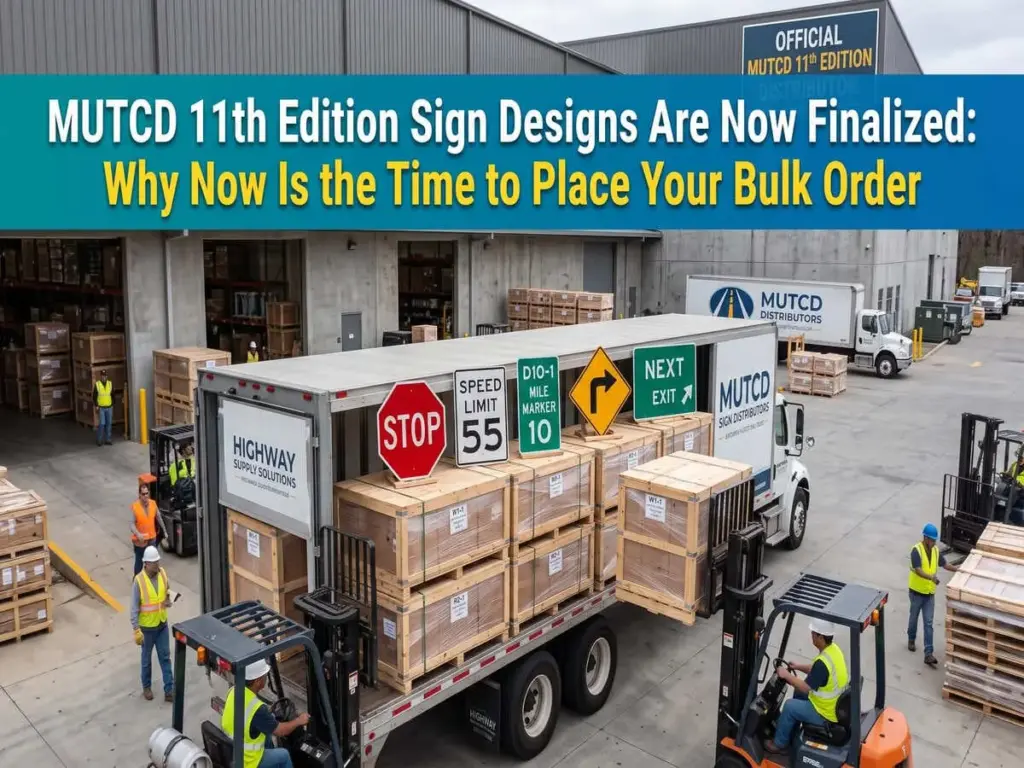
New installs should use the current plaque. Agencies with older “4-रास्ता” plaques should check their state’s replacement schedule. That makes an ALL WAY plaque stock a practical item for any agency or developer with a replacement plan.
When an All-Way Stop Is the Wrong Tool
Agencies often add stops to slow traffic. The MUTCD warns against it. STOP signs should not be used for speed control. Drivers slow near the sign, then speed up between intersections.
Unwarranted stops also cause problems:
- रियर-एंड क्रैश as drivers brake for a stop they do not expect.
- Traffic diverted onto nearby side streets.
- Driver disrespect when stops feel pointless, so compliance drops.
If speed is the real problem, the Optraffic team builds radar speed signs for neighborhood speed control that show drivers their actual speed along the whole street. That treats the cause directly, without adding a stop that drivers learn to ignore.
When the Signal Goes Dark
Power outages turn many signalized intersections into de facto all-way stops. Many state manuals tell drivers to treat a dark signal as an all-way stop. Check your own state’s rules.
The risk comes when the outage lasts. A busy intersection without a signal creates long queues and near-misses. Agencies and contractors can bring portable traffic signal lights for signal outages to restore control while the permanent signal is repaired. That keeps the intersection from relying on driver courtesy alone.
How to Sign an All-Way Stop Correctly
Use this checklist when an engineering study supports an all-way stop:
- Install a STOP sign on every approach, not only the cross street.
- Mount an ALL WAY plaque (R1-3P) below each STOP sign.
- Keep stop lines and sight lines clear so drivers see each other.
- Check sign face condition हर साल, since faded red reduces recognition.
- Document the study and the warrant in case of a later challenge.
संबंधित पढ़ना
- पेरिस स्टॉप साइन्स का उपयोग क्यों नहीं करता है और शहरी यातायात के लिए इसका क्या मतलब है
- यूरोपीय स्टॉप संकेतों को समझना: क्यों “रुकना” पूरे यूरोप में उपयोग किया जाता है
- रास्ता दे।. उपज: ऑस्ट्रेलिया और यूके के बीच रोड साइन लैंग्वेज में अंतर को समझना
- बिक्री के लिए संकेत रोकें: MUTCD आज्ञाकारी स्टॉप साइन मानकों के लिए एक पूर्ण गाइड, प्लेसमेंट, and Warrants
अक्सर पूछे जाने वाले प्रश्न
Who has the right of way at a 4 way stop?
The first vehicle to stop goes first. If two vehicles arrive together, the driver on the right goes first. A vehicle going straight goes before a vehicle turning left across its path.
What does an all way stop sign mean?
It means every approach to the intersection has a STOP sign. Each driver must stop and then proceed in turn. An ALL WAY plaque below the STOP sign shows this.
है “4-रास्ता” still a valid stop sign plaque?
नहीं. The MUTCD uses the ALL WAY plaque (R1-3P). It does not permit numeric legends such as 2-WAY, 3-WAY or 4-WAY with STOP signs.
When can an agency install an all-way stop?
After an engineering study. Warrants include crash history, दृष्टि दूरी, a transition period, and an 8-hour volume of 300 units per hour on the major street and 200 on the minor street.
Can STOP signs be used to slow traffic?
The MUTCD says STOP signs should not be used for speed control. Drivers tend to speed up between intersections, so other measures work better.
निष्कर्ष
The 4 way stop rules come down to order of arrival, the driver on the right, and a straight-through vehicle over a left-turner. Agencies add one more rule: no all-way stop without a study and a warrant. That is why the Optraffic team supplies stop signs and ALL WAY plaque sets that match 4 way stop rules, so every intersection is signed to the current MUTCD from day one.