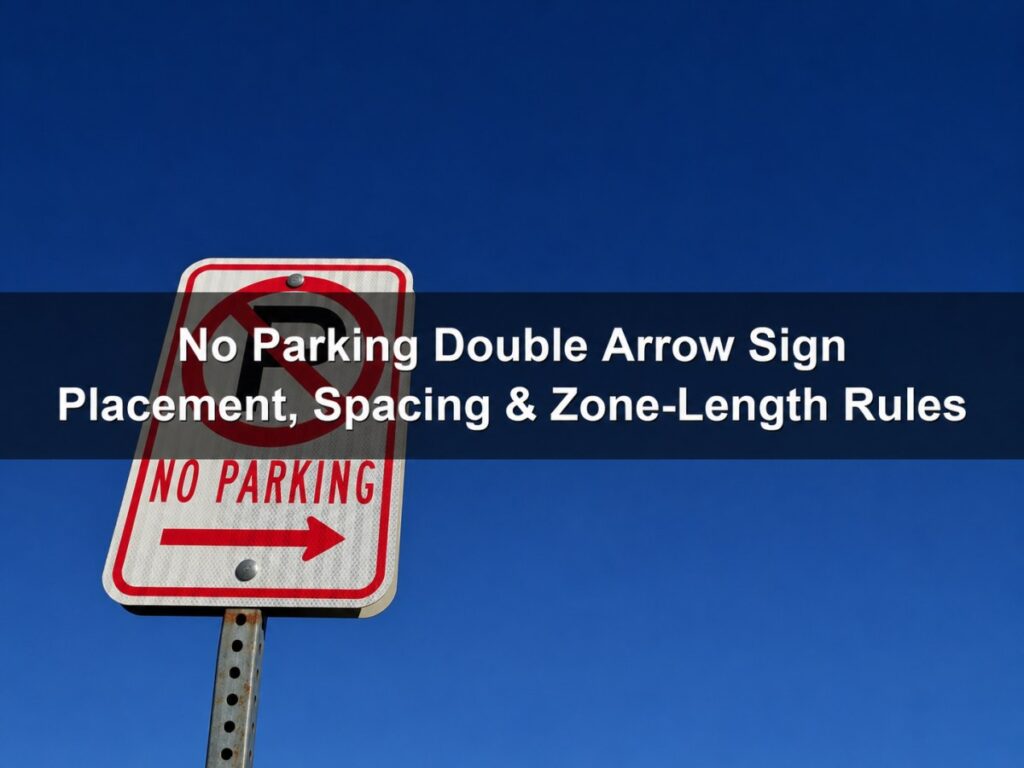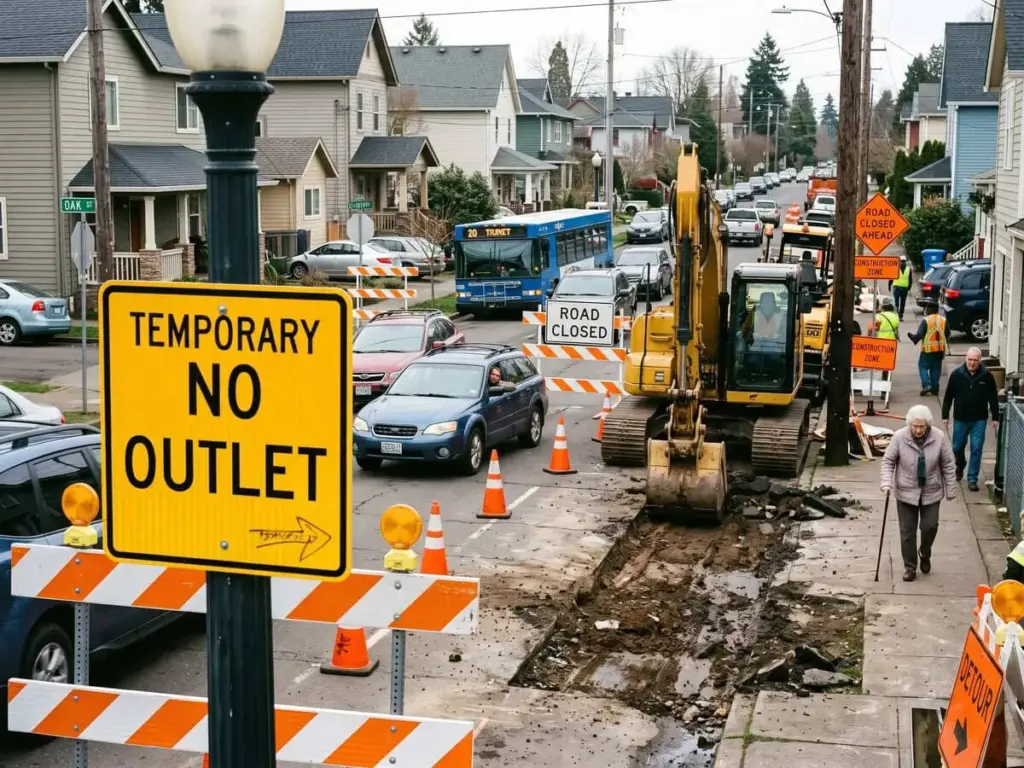
Most parking disputes on a signed block start with the same sentence: “I didn’t know it meant that.” On a curb with a single NO PARKING sign, the double-headed arrow under the legend is usually the reason.
That small graphic carries a large claim: the prohibition runs in both directions from the post. Yet crews routinely mount it at the wrong point in the block, use the wrong spacing, or place it on a street where a completely different rule governs the opposite curb.
This guide focuses on layout. For plain-language definitions of left, सही, and double arrows, के लिए हमारी मार्गदर्शिका देखें the role of arrows on parking signs.
यहाँ, we explain how to place, अंतरिक्ष, and specify a two-sided zone that stands up to review by a driver, an enforcement officer, and an appeals board.
Key takeaways
- A double arrow is a statement about पद: it belongs at an intermediate point in a zone, never at the end of one.
- The restriction it creates runs both ways from the post, to the next parking sign or the nearest intersection — and only along that one curb line.
- Sign count is a legibility decision, not a symmetry decision: drivers need a sign where they make the parking decision.
- Arrow signs should sit at 30° to 45° to the traffic flow, with the bottom of the sign at 7 ft in commercial and residential districts.
The Double Arrow Is a Statement About Position, Not Severity
Arrow logic on parking signs depends on position. MUTCD Section 2B.47, paragraph 6, sets out that logic as guidance rather than a hard standard. Although local practice can drift, the guidance consistently distinguishes three placements:
“If arrows are used and if the sign is at the end of a parking zone, there should be a single-headed arrow pointing in the direction that the regulation is in effect. If the sign is at an intermediate point in a zone, there should be a double-headed arrow pointing both ways. When a single sign is used at the transition point between two parking zones, it should display a right and left arrow pointing in the direction that the respective restrictions apply.”
Match the arrow to the sign position
The table below translates that guidance into the three layout situations you need to identify before choosing an arrow.
| Sign position | Arrow treatment | What the sign claims |
|---|---|---|
| End of the restricted zone | एक सिर वाले, pointing into the zone | The restriction stops at this post |
| Intermediate point inside a long zone | दो सिरों | The restriction continues in both directions |
| Transition between two different zones | Right arrow and left arrow on one sign | Each side carries its own separate rule |
Why an end-of-zone double arrow causes disputes
A double arrow at the end of a zone communicates the wrong boundary. It extends the restriction backward into the block and forward into whatever regulation comes next.
नतीजतन, if the next block permits parking, that placement creates a citation that will not hold up.
This is also why a double arrow so often ends up in a parking appeal. A driver parked past the sign is not arguing about the wording. They are arguing about where the zone ended, and the sign itself is the only evidence on the record.
Where the Double Arrow Belongs on the Block
Mid-zone is the only correct default. That sounds like a narrow rule, but in practice it decides the layout of an entire curb, because everything else on the block is positioned relative to it.
Add intermediate signs on long zones
अगला, consider zone length. Section 2B.48, paragraph 3, addresses it directly: “If the zone is unusually long, signs showing a double arrow should be used at intermediate points within the zone.”
उदाहरण के लिए, a single double arrow at the midpoint of a 500-foot block leaves the outer thirds effectively unmarked. A driver who pulls in 200 feet past the sign never sees it, while a driver already parked there has no reason to walk back and read it.
Clear the corner before you place the sign
Parking restrictions normally terminate short of the crosswalk to keep sight lines and pedestrian movements clear. MUTCD guidance in Section 2A.16, paragraph 12, advises against placing signs within 4 ft in advance of a crosswalk in urban areas where crosswalks exist.
If you place a double arrow inside that band, it tells drivers the zone continues through a space you have already decided is off limits. That contradiction makes the restriction harder to understand.
Conflicts the arrow cannot solve
A double arrow describes a continuous span, so it cannot carve an exception out of the middle. Where a hydrant, bus stop, loading zone, or driveway interrupts the curb, choose one of these three options:
- Split the zone into two zones with single arrows pointing away from the exception.
- Post the exception separately, with its own sign facing the same traffic.
- Use a word message instead of an arrow, so the boundary is stated rather than implied.
उदाहरण के लिए, a double arrow over a stretch that contains a bus stop leaves drivers to infer the exception. बजाय, show the exception explicitly; अन्यथा, the agency must defend a sign that contradicts itself.
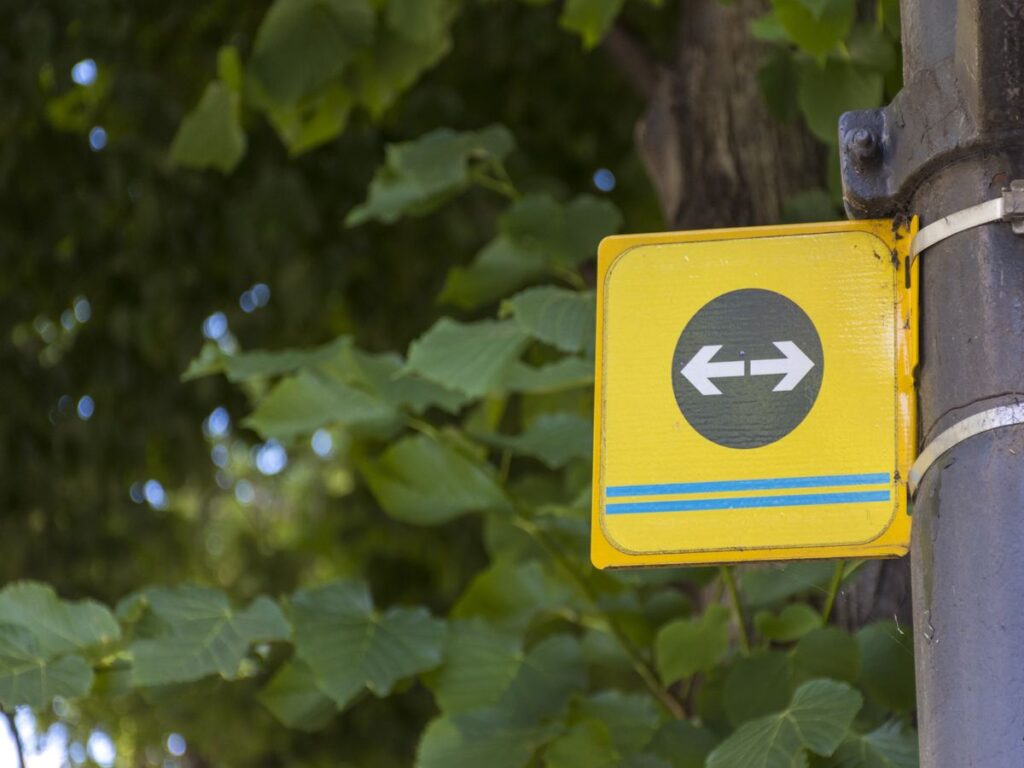
A right arrow and a left arrow on one post mark a transition between two zones. A double arrow in the same position would claim both sides carry the same rule.
How Far the Restriction Actually Reaches
व्यवहार में, a double arrow sign governs both directions from the post until the next parking sign that addresses the same curb, or until the nearest intersection — whichever comes first. That is how most agencies write their ordinances and how most enforcement officers read the block.
The MUTCD guidance calls for arrows or supplemental plaques to show the limits of a restriction, but it does not fix a distance.
बजाय, local ordinance determines whether the zone ends at the next sign or at the corner. फलस्वरूप, two adjacent cities can enforce visually identical signs differently.
Both directions is not both sides
A double arrow describes one curb line, in two directions along that curb. It says nothing about the opposite side of the street.
On a two-way street, the far curb forms a separate zone. Its own signs face the other direction of travel, and signs on your side of the road do not control it.
The confusion is understandable — “both ways” sounds like it covers the whole street — but it matters at the enforcement stage. A citation written for a vehicle across the road, on the strength of a double arrow facing the other way, is a citation with a defect in it.
When a word message beats an arrow
Section 2B.47, paragraph 10, permits word messages instead of arrows to show designated restriction zones. Examples include BEGIN, अंत, यहाँ कोने के लिए, HERE TO ALLEY, THIS SIDE OF SIGN, and BETWEEN SIGNS.
On short or irregular blocks, a word message can remove ambiguity that an arrow leaves unresolved. This applies to layouts with diagonal streets, मृत अंत, or a single mid-block driveway. The table below compares treatments for these boundary conditions.
| Zone condition | Best treatment | क्यों |
|---|---|---|
| Zone runs to the corner | Double arrow mid-block, single arrow at the last post before the crosswalk | States both the continuation and the end |
| Zone ends at a driveway or alley | Word message (HERE TO ALLEY, HERE TO DRIVEWAY) | The boundary is not a sign, so an arrow cannot describe it |
| Two rules meet mid-block | Right arrow plus left arrow on one sign | Each side carries a different restriction |
| Zone under 30 फुट | Single arrow only | A double arrow over-promises the extent |
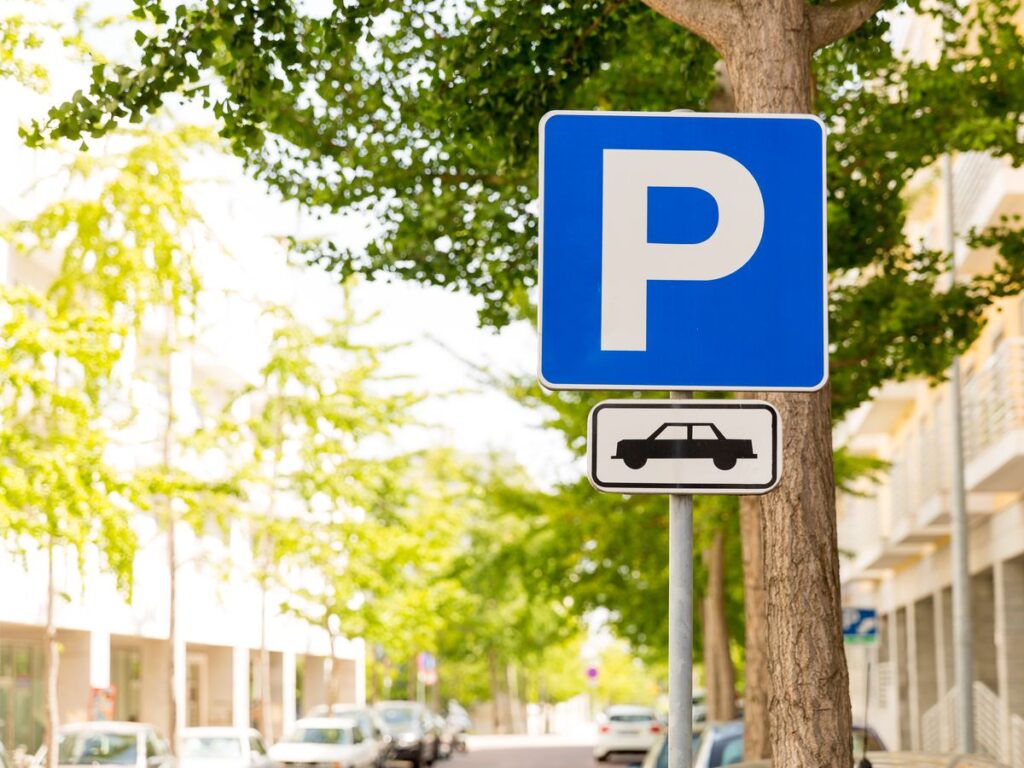
The zone a double arrow claims runs along one curb line only — the opposite side of the street is a separate zone with its own signage.
How Many Signs a Block Actually Needs
Base sign spacing on legibility. Section 2B.48, paragraph 2, puts it in one line: “Spacing of signs should be based on legibility and sign orientation.”
There is no federal number of feet per sign. A table that claims otherwise describes a local standard.
The test that matters is where the parking decision is made. A driver chooses a space while approaching it, गति से, with traffic behind them. If the nearest sign is 300 feet back around a curve, the zone is effectively unmarked at the point of decision — and no amount of signage at the corner fixes that.
Use curb length as an initial layout check
Use the following layouts to begin planning the sign count. Then check visibility along the curb before finalizing the spacing.
| Curb length | लक्षण | लेआउट |
|---|---|---|
| तक 150 फुट | 1-2 | Single arrow at the zone end facing approaching traffic; no double arrow needed |
| 150–350 ft | 2-3 | Double arrow at the mid-point, single arrow at the terminating end |
| 350–600 ft | 3-4 | Double arrows at intervals of roughly 150–200 ft, single arrow at the end |
| ऊपर 600 फुट | 4+ | Double arrows at intervals no greater than the sight distance to the previous sign |
Confirm spacing in the field
Treat the table as a starting point for a field check. Approach speed, curvature, tree canopy, parked trucks, and driveways all shorten the distance at which drivers can read a sign.
इसलिए, adjust the intervals to the site. They can stretch on a slow residential street, but they cannot on an arterial with a 40 mph approach.
Sign spacing follows sight distance along the curb, not an even split of the block.
When a Double Arrow Is the Wrong Choice
Four situations account for most misinstalled double arrows. Each has a correct alternative that is already in the manual.
1. At the end of a zone
Use a single-headed arrow pointing into the zone. If the block ends at a corner, the last sign before the crosswalk is the one that terminates the restriction — not the one in the middle of the block.
2. Where two rules meet
Use a right arrow and a left arrow on a single sign. A double arrow at a transition point tells drivers both sides carry the same rule, so it fails to communicate the different restrictions.
3. Where the sign is mounted at 90 degrees to the curb
Section 2B.48, paragraph 4, sets a standard: if signs are mounted at 90 degrees to the curb line, two signs shall be mounted back to back at the transition point between two parking zones. Each must have an appended THIS SIDE OF SIGN (R7-202P) पट्टिका.
A single double arrow rotated to face the curb is not an acceptable substitute.
4. Where the zone is too short to justify it
On a zone shorter than about 30 feet — roughly one to two parallel spaces — a double arrow over-promises. A single arrow at the end of the restriction is both accurate and easier to defend.
बढ़ती हुई ऊँचाई, कोण, and Post Position
Layout gets the zone right on paper. Mounting decides whether it works on the street, and this is where installation crews most often depart from the standard without noticing.
ऊंचाई
Section 2A.18 sets the minimums. In business, व्यावसायिक, or residential areas where parking or pedestrian movements are likely to occur, चिन्ह का निचला भाग कम से कम होना चाहिए 7 ft above the top of the curb. This condition covers almost every block where crews use a double arrow.
ग्रामीण क्षेत्रों में, the minimum is 5 फुट. Signs above a sidewalk need 7 ft of clearance. A secondary sign below a primary sign may sit 1 ft lower than the applicable minimum.
कोण
Drivers read arrow signs at an angle. Section 2B.48, paragraph 1, recommends setting signs with arrows at an angle of not less than 30 degrees and not more than 45 degrees to the line of traffic flow.
This orientation lets approaching drivers see the face rather than the edge. तुलना करके, a sign parallel to the curb is legible only to someone already stopped beside it.
Post position
Keep the sign face outside the swept path of vehicles and clear of the sidewalk envelope. Most agencies specify a minimum setback behind the curb face rather than a single national figure, so confirm the local number before driving the post.
A sign 6 inches too close to the travel lane creates a strike hazard, while one too far back is invisible from a parked car. In higher-speed environments, also account for breakaway performance when selecting the post.
Specifying the Sign: आकार, दंतकथा, and Sheeting
Once the layout is fixed, the specification is straightforward — and getting it wrong at the procurement stage undoes the placement work.
Choose the sign size
The R7-1 NO PARKING ANY TIME sign is 12 × 18 in for conventional roads. Choose larger formats where approach speeds and reading distances demand them, and follow the road hierarchy when selecting a size. Our contractor’s guide to no parking sign dimensions and reflectivity breaks down the size and sheeting grades by application.
Specify the legend and color
Section 2B.47, paragraph 3, is a standard, not guidance: where parking is prohibited at all times or at specific times, the basic design shall have a red legend and border on a white background. Green legend and border on white is reserved for permissive parking. A double arrow inherits the same color logic as the legend it sits under.
Arrange the message in reading order
Paragraph 5 recommends the following reading order, from top to bottom: the restriction or prohibition, the times of day it applies, and the days of the week. A double arrow belongs at the bottom, beneath the legend, so the arrow is the last thing a driver reads before deciding.
Select the sheeting and substrate
Regulatory signs must be retroreflective or illuminated and must present the same shape and similar color by day and night. For a sign that will spend a decade facing weather on a public curb, aluminum with a correctly graded reflective sheeting is the specification that keeps the arrow legible after the first winter.
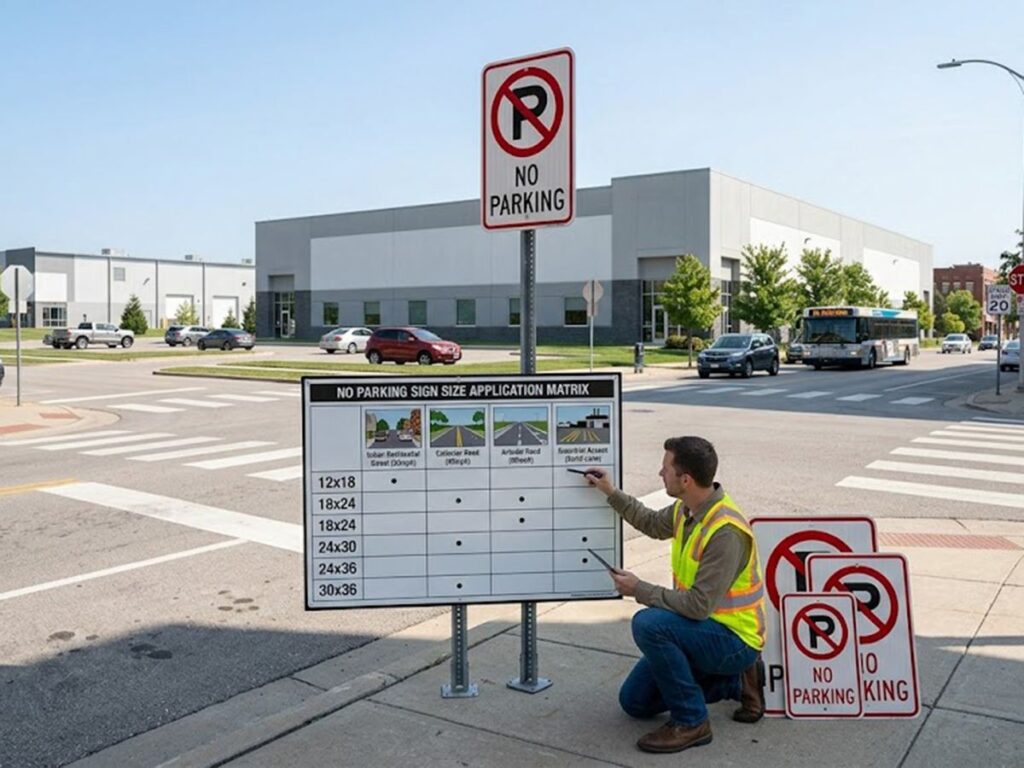
Sign size follows the road hierarchy. ए 12 × 18 in R7-1 is the conventional-road default; higher-speed approaches need larger formats.
If you are specifying a full block or a municipal batch rather than a single sign, हमारा MUTCD compliance guide for no parking signs covers the procurement checklist, और यह public safety sign range lists the standard legends available with double-arrow layouts.
What Makes a Two-Sided Zone Defensible
A zone is defensible when a driver could have known the rule from the street, without prior knowledge of the block. That standard is stricter than “the sign was there,” and it is the one appeals boards apply.
Check the layout against these five points:
- निरंतरता. No gap between signs longer than the sight distance to the previous one.
- Consistent arrow logic. Double arrows mid-zone, single arrows at the ends, and never a double arrow terminating a zone.
- No contradictions. Stacked signs on one post must not tell two stories; where they do, the most restrictive rule generally governs, but the ambiguity itself is a defect.
- Legibility at distance. Faded sheeting, a rotated post, or a branch across the face all convert a valid sign into a contestable one.
- Correct height and angle. A sign at 6 ft instead of 7 फुट, or flat to the curb, is read late or not at all.
Check authority and required notices on private property
For private property, check two additional conditions: local ordinance must provide the authority to restrict parking, and you must post tow-away or penalty information where the ordinance requires it. Without that backing, a double arrow on a commercial lot provides no enforcement authority.
Also consider how time limits and exceptions interact with the arrow on the same sign. Our guide to parking sign times and restrictions explains those relationships.
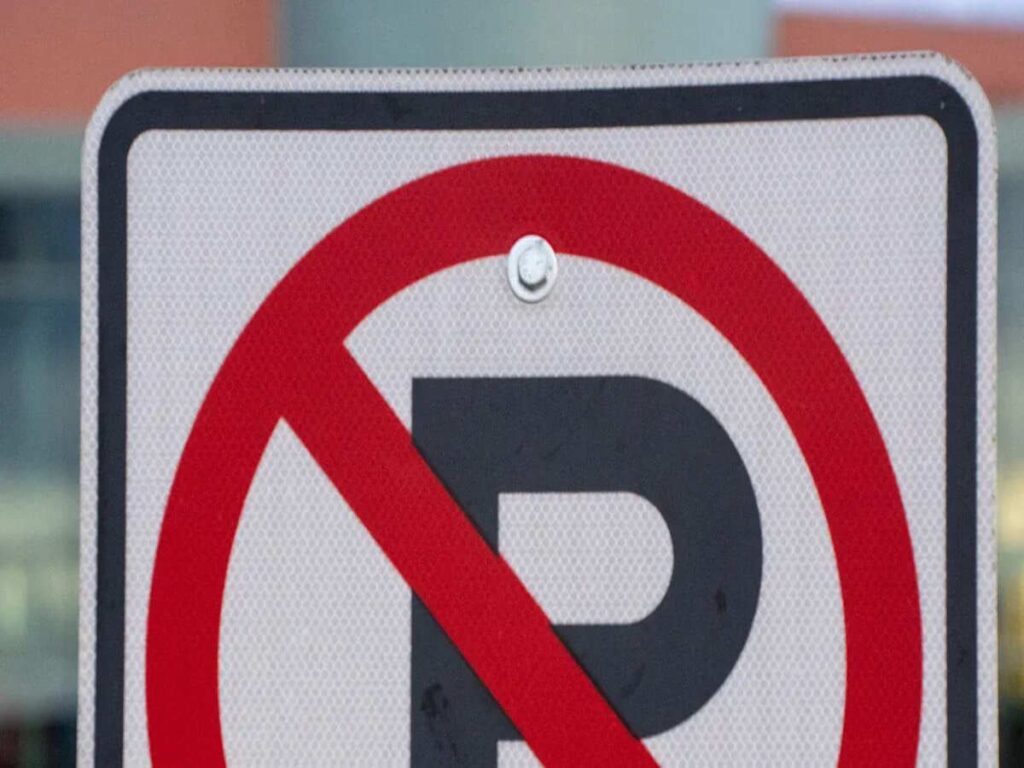
A defensible zone reads the same way from the driver’s seat, the enforcement officer’s notebook, and the appeals file.
अक्सर पूछे जाने वाले प्रश्नों
Does a no parking double arrow sign apply to both sides of the street?
नहीं. It applies in both directions along the curb where the sign stands. The opposite curb is a separate zone governed by its own signs facing the other direction of traffic.
How far past the sign does the restriction extend?
To the next parking sign addressing the same curb, or to the nearest intersection, whichever comes first — subject to local ordinance. Where the boundary is not a sign, a word message such as HERE TO CORNER or BETWEEN SIGNS is more reliable than an arrow.
Can one double arrow cover an entire block?
Only on a short block. Section 2B.48 advises using double-arrow signs at intermediate points where the zone is unusually long, because a driver who parks mid-block never sees a sign at the corner.
What is the difference between a double arrow and two single arrows?
A double arrow on one post claims both directions from that point. Two single arrows pointing away from each other at separate locations define a zone with a gap between them. The first is a mid-zone marker; the second is a pair of boundaries.
Is a double-headed arrow read the same way outside the United States?
The directional logic is widely shared, but the sign formats are not. The UK and Australia use different sign families and different arrow conventions, so a layout cannot be transplanted without checking the local standard. Our comparison of arrow road sign types sets the three systems side by side.
What size should a double arrow no parking sign be?
12 × 18 in is the conventional-road standard for the R7-1 layout. Larger formats are used on higher-speed roads where reading distance increases.
Who can enforce a double arrow zone on private property?
Only where local ordinance grants that authority and the required tow-away or penalty information is posted. The sign alone does not create enforcement power.
Getting the Zone Right Before It Goes in the Ground
Place the double arrow mid-zone, space signs to sight distance, and mount them at the right height and angle. एक साथ, these decisions remove the ambiguity that generates most parking disputes.
इसके विपरीत, placing a double arrow at the end of a block simply because the old post stood there quietly extends a restriction nobody wrote.
If you are signing a block, a campus, or a municipal batch, our team can review the layout against the standard your jurisdiction has adopted. We can also supply the R7-1, R7-202P, and custom double-arrow legends on aluminum with graded reflective sheeting.
Start with the one-stop signage solution, browse the roadworks and traffic control range for temporary and permanent installations, or read more placement guides on the OPTSIGNS blog.
Section numbers cited above follow the MUTCD 2009 edition with 2012 revisions. The 11th edition reorganized Part 2 and renumbered sections, so confirm numbering against the edition your state or agency has adopted before quoting a section in a design memo. Nothing here is legal advice; parking authority and enforcement scope are set by local ordinance.