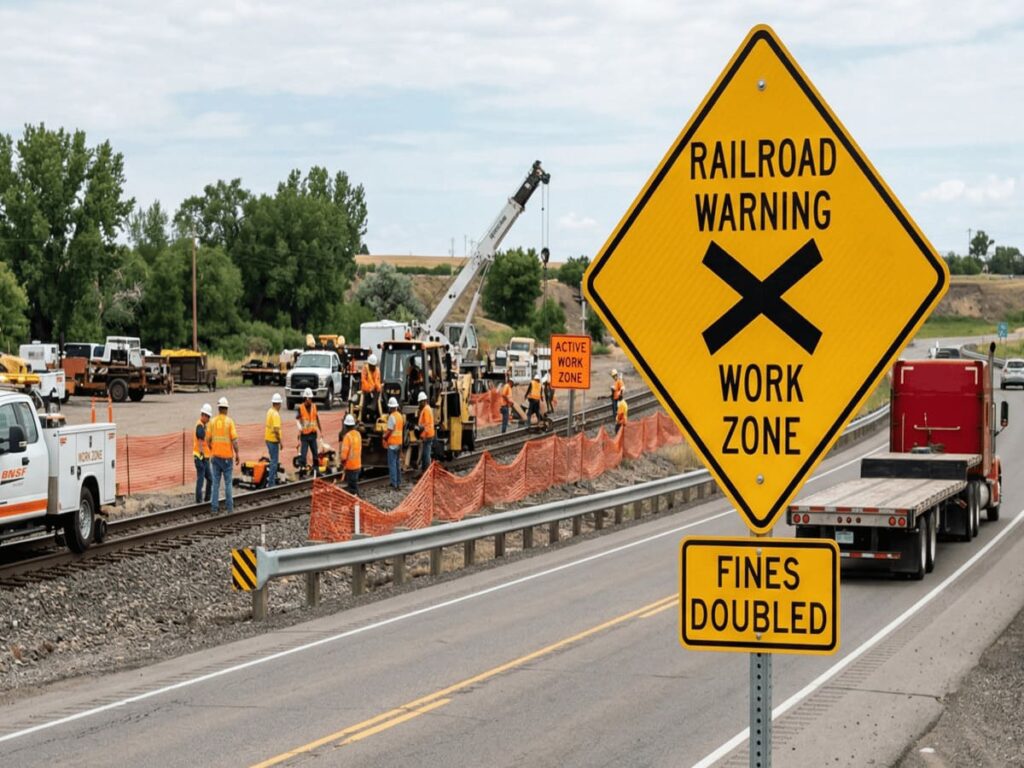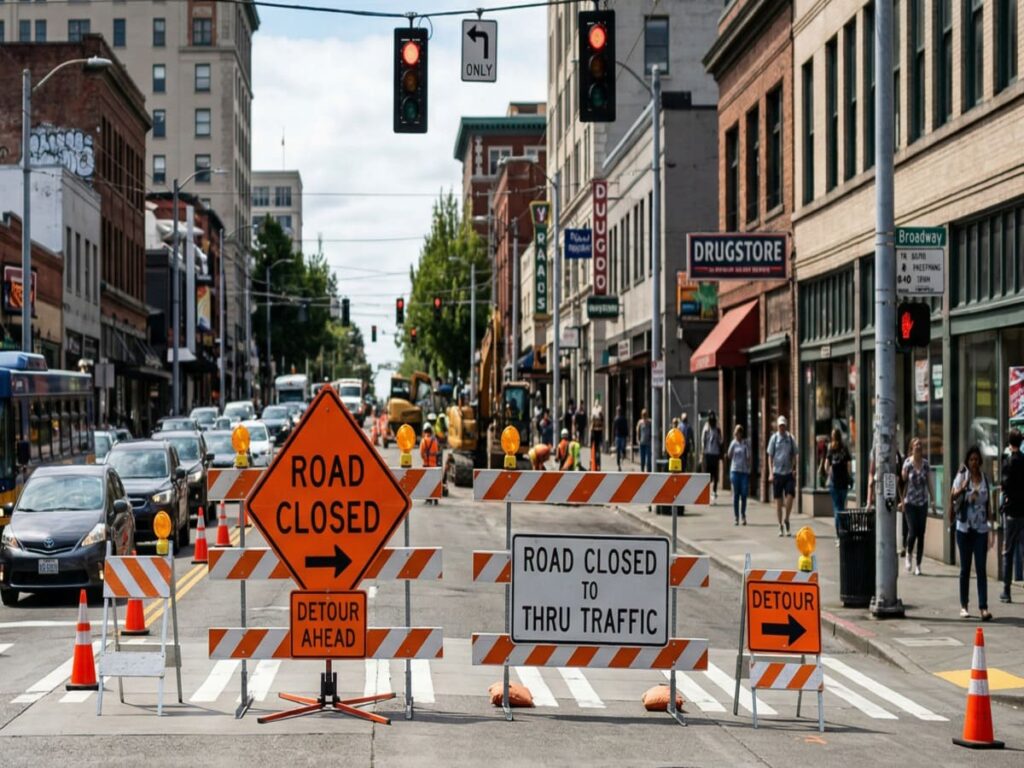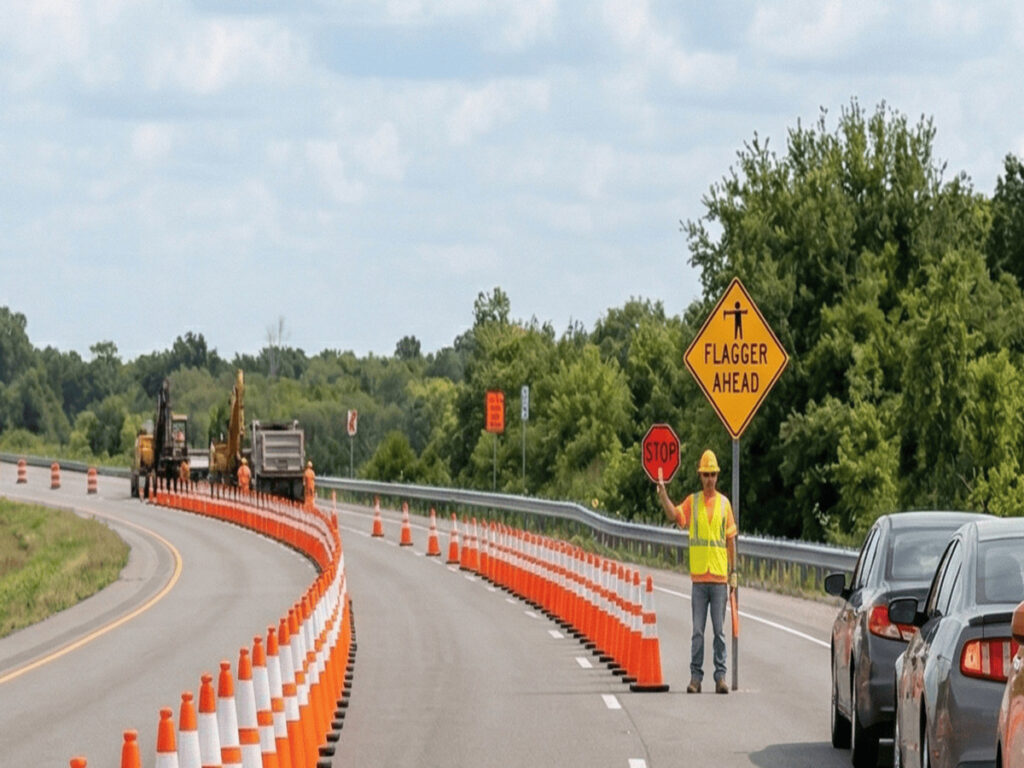
Work zone safety signs do not fail all at once in extreme weather. A road crew working on I-80 through Iowa discovered their standard orange signs were invisible to approaching drivers during a blowing snow event — not because the signs were missing, but because snow-packed sign faces and Engineer Grade retroreflective sheeting had dropped below functional visibility thresholds. The signs were physically present. They simply were not working.
Extreme weather degrades work zone safety signs incrementally. Retroreflectivity drops before anyone on the crew notices. A snow-covered sign face looks like a sign from the cab of a truck. A cone blown 12 inches out of position creates a gap in the taper that drivers interpret as an open lane. Además, by the time an incident occurs, the accumulation of small degradations has been building for hours — and each individual failure was preventable.
This guide covers the three weather categories responsible for the majority of work zone equipment failures across the United States, the specific failure mechanisms for each, and the field protocols that keep the TTC setup functional when conditions deteriorate.
What this guide covers: Heavy rain and fog · Heavy snow, freezing rain, and ice · High wind events including Gulf Coast hurricane season and Midwest severe storms · Retroreflectivity degradation thresholds · LED alternatives when static signs fail · Pre-storm inspection and post-storm recovery SOP
US regions covered: Great Lakes and Northeast (blizzard, lake-effect snow) · Gulf Coast and Southeast (Huracán, tropical storm) · Tornado Alley — Texas, Oklahoma, Kansas (severe thunderstorms, ice storms) · Pacific Northwest (persistent heavy rain, niebla densa)
MUTCD 11th Edition Note: Sección 2A.08 requires that retroreflective devices maintain minimum retroreflectivity levels throughout the operation. Weather contamination does not suspend this requirement — the obligation to maintain compliant work zone safety signs remains in effect regardless of conditions. If weather degrades retroreflectivity below minimum thresholds, the operator must restore compliance or supplement with active lighting.
Parte 1: Heavy Rain and Dense Fog — How Work Zone Safety Signs Lose Visibility
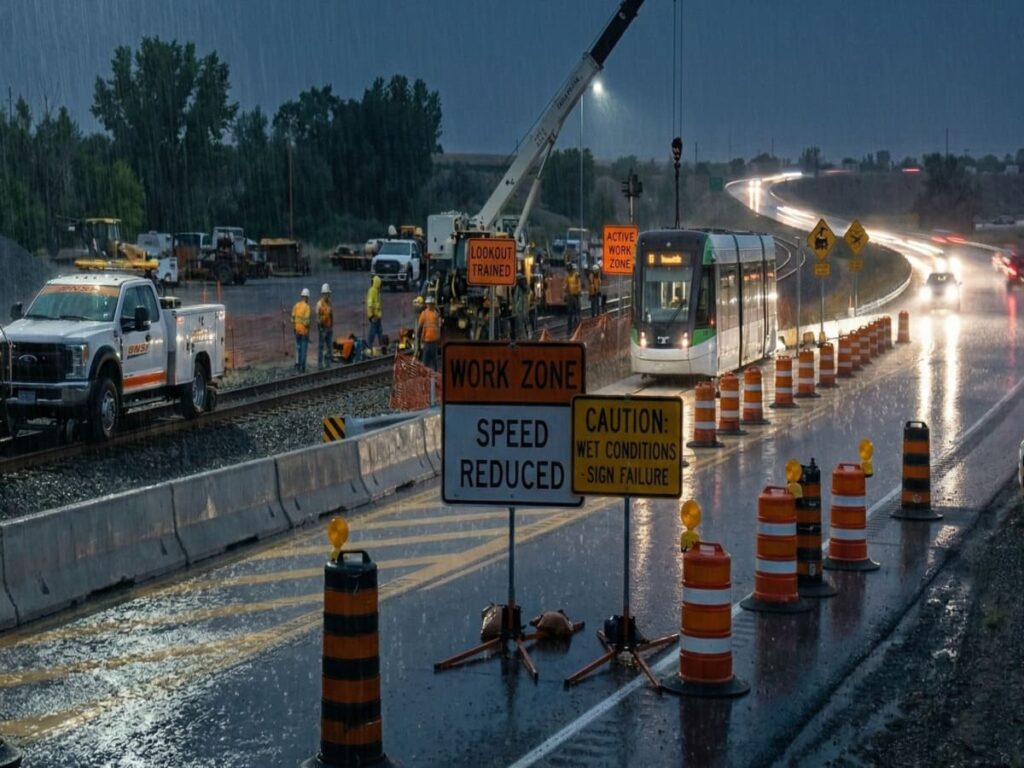
Rain and fog are the most underestimated weather hazards in work zone TTC. Unlike snow or wind — which produce visible equipment failure — rain-degraded work zone safety signs look identical to functional signs. Drivers receive no warning that the retroreflective performance they depend on has dropped to a fraction of its rated value.
1.1 How Rain Degrades Retroreflectivity
Retroreflective sheeting works by returning light from vehicle headlights back toward the driver. This mechanism depends on a dry interface between the sign face and the air. Heavy rain forms a continuous water film across the sign face, changing the angle at which light enters the prismatic or glass-bead layer and scattering the reflected beam away from the driver’s line of sight.
The result is a steep reduction in effective retroreflective distance — the distance at which a driver can read the sign and react. Específicamente, en 60 mph, a driver needs a minimum of 180 meters of warning distance to respond and stop safely. The table below shows how each reflective grade performs under heavy rain conditions versus dry conditions.
| Grado reflectante | Normal Night Distance | Heavy Rain Distance | Drop | MUTCD Min. para 60 mph |
| Grado de ingeniero (Tipo I) | 100–150 m | 20–40 m | ~75% | Insufficient |
| Prismático de alta intensidad (Tipo III) | 200–300 metros | 60–100 m | ~65% | Marginal — use only in dry conditions |
| Grado de diamante (Tipo IX/XI) | 300–400 metros | 120–180 m | ~ 50% | Recommended minimum for wet-weather highway work |
Engineer Grade signs at highway speed in rain: non-compliant by default. En 60 mph in heavy rain, Engineer Grade retroreflective sheeting provides only 20–40 meters of effective visibility — less than 25% of the 180-meter minimum required for adequate driver response time. Using Engineer Grade work zone safety signs on highway-speed roads in wet conditions is a compliance failure and a direct crash risk factor.
1.2 Pacific Northwest and Gulf Coast: Where Rain Is the Default Condition
The Pacific Northwest — Oregon and Washington — receives over 150 inches of annual rainfall in some areas, and construction seasons routinely involve multi-week periods of continuous light to moderate rain. Similarmente, Gulf Coast states from Louisiana to the Florida Panhandle experience persistent warm-season rainfall outside of hurricane events, with June through September averaging 5–8 inches of monthly precipitation in many areas.
For contractors operating in these regions, treating Diamond Grade retroreflective sheeting as an upgrade option is a planning error. En otras palabras, in Pacific Northwest and Gulf Coast wet-season operations, Diamond Grade is the functional minimum — the standard that allows work zone safety signs to maintain adequate visibility across a normal shift that will include multiple rain events.
The practical implication: when budgeting and specifying signs for projects in these regions, specify Diamond Grade (Type IX or XI) as the baseline. The per-sign cost difference between HIP Type III and Diamond Grade typically runs $30–80 per sign — a minor line item compared to the compliance exposure from signs that fail to meet retroreflectivity thresholds during a wet shift.
1.3 Dense Fog: The One Condition Where Retroreflectivity Alone Fails
Dense fog introduces a fundamentally different failure mechanism from rain. En la niebla, light from vehicle headlights is scattered by suspended water droplets before it can reach the sign face — and the retroreflected light is similarly scattered before it can return to the driver’s eye. Como consecuencia, no grade of retroreflective sheeting maintains adequate visibility when fog reduces visibility below approximately 100 medidores. This is the threshold at which passive retroreflective work zone safety signs become functionally non-compliant regardless of their rated grade.
The Pacific Northwest, Appalachian Mountain corridors, and Atlantic coastal areas from Virginia through Maine regularly experience dense fog events during active construction periods. En estas condiciones, the only device that maintains functional visibility is an active light source — a Type B LED barricade light or equivalent flashing beacon mounted at the sign position.
Fog visibility threshold for LED supplement deployment: When forward visibility in the work zone drops below 150 meters — confirmed by the TCS observing that the farthest advance warning sign is no longer clearly readable from the nearest approach lane — deploy Type B LED barricade lights at all advance warning sign positions immediately. Do not wait for visibility to deteriorate further.
OPTRAFFIC — Reflective Traffic Signs: diamond grade reflective signs (Tipo IX/XI) and high intensity prismatic signs for wet-weather operations across the Pacific Northwest, Gulf Coast, and beyond — Browse reflective traffic signs →
Parte 2: Heavy Snow, Freezing Rain, and Extreme Cold — Winter Failure Modes Across the Midwest and Northeast
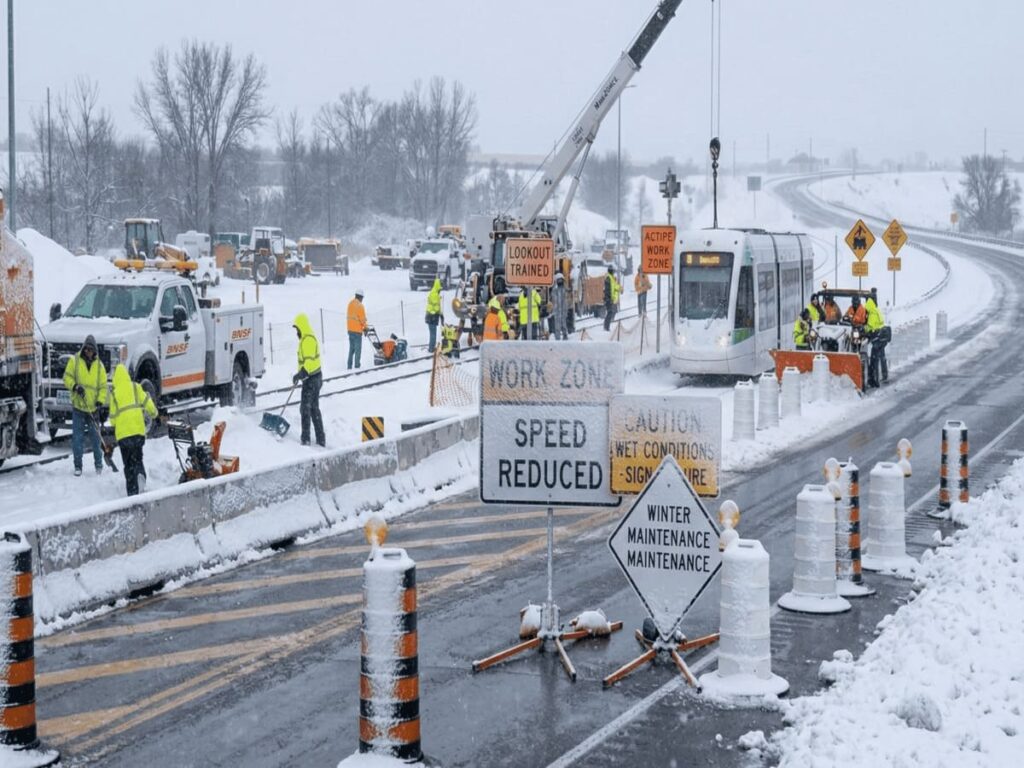
Winter weather presents three distinct failure mechanisms for work zone safety signs — snow accumulation, freezing rain glaze, and material brittleness from extreme cold. Each requires a different field response. Por lo tanto, treating all winter weather as a single category leads to the wrong intervention at the wrong time.
2.1 Snow Accumulation on Sign Faces: The Silent Failure
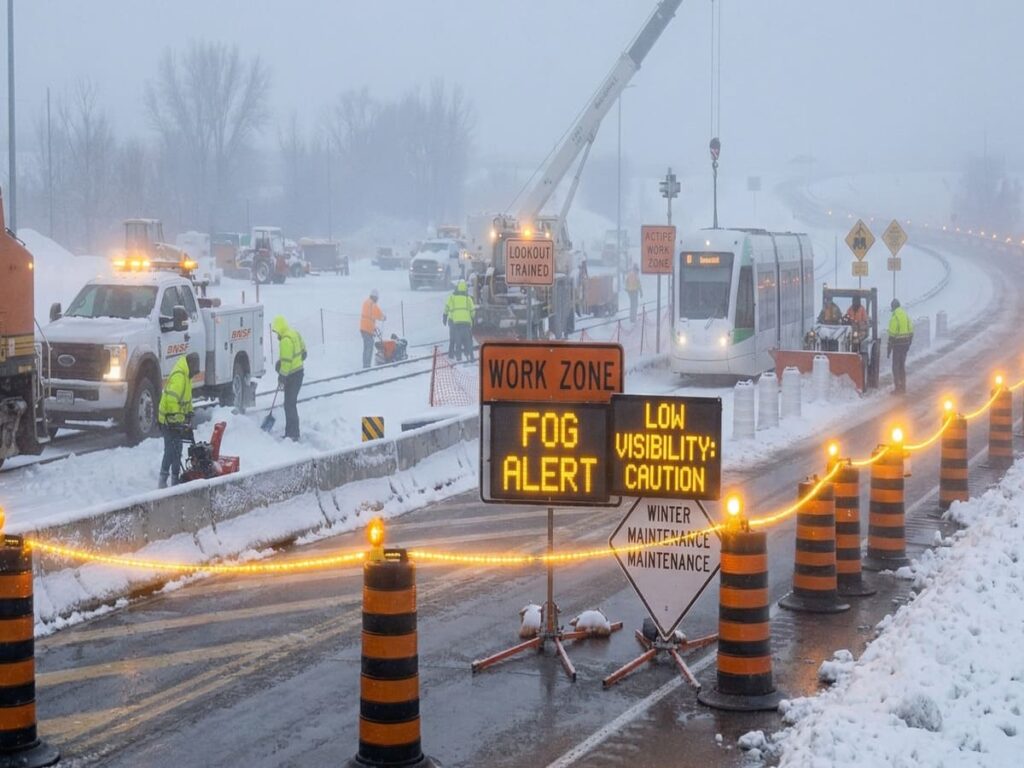
The most common winter work zone failure in the Great Lakes states, New England, and Upper Midwest is not equipment blown over by wind — it is sign faces covered by accumulated snow. A 48-inch work zone safety sign can be completely obscured by 2–3 inches of wet snow across its face, leaving the orange aluminum blank visible to drivers but communicating nothing.
Lake-effect snowfall along the Great Lakes corridor — Buffalo, cleveland, and the eastern shore of Lake Michigan — regularly produces accumulation rates of 2–4 inches per hour in narrow snow bands. In a 4-hour work shift, a sign face can accumulate enough snow to reach full obstruction three or more times. Además, wet snow adheres to sign faces more aggressively than dry powder, and it does not blow off on its own in moderate wind.
The response is straightforward but requires discipline: establish a snow accumulation inspection schedule keyed to observed snowfall rate, and adhere to it regardless of other work pressures. Específicamente, the table below provides standard inspection intervals.
| Snowfall Rate | Intervalo de inspección | Required Action |
| Light snow — less than 1 in/hr | Cada 2 horas | Visual check; wipe sign face if accumulation visible |
| Moderate snow — 1 a 2 in/hr | Cada 1 hora | Actively clear all sign faces and cone reflective collars |
| Heavy snow — more than 2 in/hr | Cada 30 minutos | Evaluate whether to continue; deploy LED supplements immediately |
2.2 Freezing Rain: The Most Dangerous Winter Failure Type
Freezing rain affects a broad swath of the central United States — from north Texas and Oklahoma through Missouri, Kentucky, and Tennessee, and east through the mid-Atlantic states during winter warm fronts. Unlike snow, freezing rain produces a transparent ice layer on sign faces. Como consecuencia, the sign appears intact and the orange color is visible, but the ice layer distorts the retroreflective optics and renders the sign face unreadable beyond very short distances.
Freezing rain creates three simultaneous equipment problems. Primero, the ice layer on sign faces degrades retroreflective performance to near-zero while the sign looks operational from a distance. Segundo, ice accumulates on the sign stand support arms, adding top-heavy weight that causes stands to tip — particularly after a vehicle passes and creates air displacement. Tercero, and most operationally disruptive, traffic cones freeze to road surfaces, bonding their rubber bases to the pavement. Como resultado, crews attempting to clear the work zone in deteriorating conditions discover they cannot lift the cones quickly, extending exposure time for everyone on site.
Three equipment interventions reduce freezing rain impact:
- Apply a thin coat of automotive silicone spray to sign face retroreflective surfaces before the shift — this delays ice adhesion and makes clearing easier when ice does form
- Place rubber mats or cardboard sheeting under traffic cone bases when freezing rain is forecast — this prevents the cone base from bonding directly to pavement
- In forecast freezing rain events, increase sign stand ballast preemptively to the heavy-wind specification (30 lbs minimum) before the ice accumulation begins adding top weight
2.3 Extreme Cold: When Equipment Materials Become Brittle
The Upper Midwest and Northern Plains — Minnesota, Wisconsin, Dakota del Norte, Iowa — regularly experience temperatures below -20°F with wind chill factors pushing apparent temperatures to -40°F or lower. At these temperatures, several standard TTC materials reach their brittleness threshold and fail in ways that do not occur in moderate cold.
Standard HDPE traffic cones become brittle below approximately -15°F. A cone struck by a vehicle or dropped during setup at these temperatures can shatter rather than flex, creating debris on the road surface. Similarmente, roll-up signs using PVC substrate harden in extreme cold and may crack along fold lines when opened. LED barricade light lithium batteries lose 30–50% of their rated capacity at -20°F, potentially reducing a full-shift battery to a half-shift without warning.
In regions with sustained extreme cold, specify equipment with cold-weather ratings. Específicamente, LLDPE (linear low-density polyethylene) traffic cones maintain flexibility at temperatures below -30°F. Roll-up signs with EPDM rubber substrates remain pliable in extreme cold. For LED lights, use models with heated battery compartments or switch to alkaline battery versions, as alkaline chemistry maintains better low-temperature performance than lithium-ion.
OPTRAFFIC — LED Barricade Lights: Tipo B luces LED de barricada rated for sub-zero temperatures — active warning supplement for snow-covered sign conditions — Browse LED warning lights →
Parte 3: High Wind Events — From Gulf Coast Hurricane Season to Tornado Alley Severe Storms
High wind is the only extreme weather type that converts work zone safety signs from safety devices into hazards. An aluminum sign panel struck by 75 mph wind and launched from an inadequately ballasted stand becomes a projectile capable of injuring workers and drivers. Como consecuencia, understanding the wind speed thresholds at which different equipment fails — and the response protocols for different wind regimes — is essential for contractors working in high-wind exposure regions.
3.1 Wind Speed Thresholds and Equipment Failure Points
Different TTC devices fail at predictably different wind speeds. The table below provides working estimates based on standard equipment configurations. These values assume equipment in good condition with full rated ballast; worn equipment, improper assembly, or under-ballasted stands will fail at lower speeds.
| Equipo | Standard Failure Wind Speed | Upgraded Tolerance | Upgrade Method |
| Sign stand — 10 libras base | ~30 mph | ~50 mph | Add sandbag ballast to 30 lbs |
| 18-inch traffic cone | ~25 mph | Not wind-rated | Replace with 28″ heavy base cone |
| 28-cono de pulgada, 10 libras base | ~40 mph | ~55 mph | Add base weight; nest cones in pairs |
| Roll-up sign on stand | ~35 mph | ~50 mph | Add secondary strap; dual-point mount |
| Rigid aluminum sign 36″x36″ | ~50 mph | Projectile risk above 50 mph | Remove before Tropical Storm Warning |
Wind speed failure thresholds are estimates based on ASCE 7 wind load calculations for standard portable sign configurations and product testing data. Gusty conditions — where wind speed fluctuates rather than maintaining a steady value — can cause failure at mean speeds 10–15 mph below the steady-state threshold because repeated flex-and-release cycles fatigue mounting hardware.
3.2 Gulf Coast Hurricane Season: June to November Protocol
Contractors operating in Louisiana, Misisipí, Alabama, and the Florida Panhandle during the June through November hurricane season face a wind exposure regime that has no equivalent in inland operations. The critical distinction from ordinary high-wind events is not just peak speed — it is the combination of sustained high wind, simultaneous heavy rain, and the extended warning period that the National Weather Service provides through the Watch and Warning system.
The most dangerous mistake in Gulf Coast hurricane-season TTC is treating aluminum sign panels as equipment that can remain in the field through a tropical storm. A standard 36-inch by 36-inch aluminum sign panel weighs approximately 3–4 lbs. Sin embargo, en 75 mph wind — the threshold for a Category 1 hurricane — that panel carries kinetic energy equivalent to a baseball thrown at 200 mph if it becomes airborne. Por lo tanto, rigid sign panels must leave the field before sustained tropical storm-force winds arrive.
The Gulf Coast response protocol follows NWS advisory levels:
- Tropical Storm Watch issued (tropical storm-force winds possible within 48 horas): conduct equipment inventory; confirm heavy-ballast stands are available; prepare rollup sign substitution kits for all rigid aluminum panels
- Tropical Storm Warning issued (tropical storm-force winds expected within 36 horas): begin removing all rigid aluminum sign panels from the field; replace with rollup signs on heavy-ballast stands where TTC must remain in service; add ground anchors to all LED barricade lights
- Hurricane Watch or Warning issued: full TTC teardown — all equipment off the road surface before wind arrival. No TTC device should remain in the travel lane during a hurricane event.
3.3 Tornado Alley Severe Thunderstorms: Zero-Warning-Time Protocol
The tornado alley corridor — stretching from west Texas and Oklahoma north through Kansas and Nebraska, and extending east through Missouri and the Mississippi Valley — presents a fundamentally different wind threat than Gulf Coast hurricanes. Severe thunderstorms in this region can escalate from no advisory to 60+ mph winds in under 10 minutos, leaving no time for standard equipment removal procedures.
The response protocol for tornado alley operations shifts the trigger point from reactive to anticipatory. Rather than waiting for a weather event and then attempting teardown, crews in these regions should pre-configure their setups for rapid clearance and monitor NWS products continuously throughout the shift.
- Severe Thunderstorm Watch (conditions favorable for severe storms within 200 millas): designate a crew member to monitor NWS radar during the shift; reduce the number of active sign positions to the minimum compliant set; stage rollup signs as backup for rigid panels
- Severe Thunderstorm Warning (severe storm confirmed within 25 millas): immediately begin clearing the nearest sign positions; do not wait to complete all positions before starting — clear what can be cleared and accept that some equipment may be exposed
- Tornado Warning (tornado confirmed on radar or by spotter): all crew to shelter immediately — equipment is secondary to crew safety at this point
OPTRAFFIC — Traffic Cones: heavy base 28 conos de tráfico de pulgadas y 36 conos de tráfico de pulgadas for high-wind exposure — Gulf Coast, Plains, and Midwest severe weather operations — Browse traffic cones →
OPTRAFFIC — Sign Frames: portable sign stands with heavy base and 30+ lb ballast capacity for hurricane-season and severe storm operations — Browse sign frames →
Parte 4: Work Zone Safety Signs Maintenance SOP — Before, Durante, and After Extreme Weather
Weather does not announce when a sign has degraded below the functional threshold. The inspection SOP is the only mechanism that catches incremental failure before it becomes an incident.
4.1 Pre-Storm Inspection Checklist
When a weather forecast shows extreme conditions approaching within 24 horas, conduct a dedicated equipment inspection before the shift begins — separate from the standard pre-shift check. En particular, this inspection focuses on weather-vulnerability items that normal pre-shift checks do not specifically address.
Sign faces: Clean all sign faces and verify retroreflective sheeting is intact — no delamination, burbujeando, or surface contamination. Sheeting that has lost adhesion at the edges will fail faster in rain and wind.
Sign stand ballast: Verify base weight against the forecast wind speed using the thresholds in Part 3. Add sandbags or additional ballast preemptively — not after the wind starts.
Traffic cone bases: In forecast freezing rain, place rubber mats under cone bases. In forecast high wind, verify base weight and consider nesting pairs of cones to increase combined base mass.
luces LED de barricada: Test all units; replace low-battery units before the shift; stage spare batteries at the site vehicle in accessible position.
Rollup sign inventory: For Gulf Coast and Plains operations during severe weather season, confirm rollup sign substitutes are available for every rigid aluminum sign in the active setup.
4.2 Mid-Storm Inspection Protocol
Once extreme weather is active, reduce inspection intervals and shift from preventive to corrective mode. The following protocols apply by weather type.
Rain and fog operations: Inspect every 60 minutos. Specifically check: sign face water film (wipe or reposition if standing water); LED light operation; visible gap formation in cone lines from vehicle air displacement.
Snow operations: Follow the snowfall-rate table in Part 2. The key check is sign face obstruction — do not rely on visual assessment from the work area, which is typically upwind of the signs. Walk the approach and look at sign faces from the driver’s perspective.
High wind operations: Inspect every 30 minutos. Check sign stand verticality (a stand tilted more than 10 degrees has likely lost effective ballast contact and will fall in the next gust); check cone line continuity; check LED unit orientation (wind can rotate mounted units away from the approaching traffic direction).
Visibility threshold requiring immediate LED supplement deployment: When forward visibility in the work zone drops below 150 meters — observed by the TCS confirming that the farthest advance warning sign is no longer clearly readable from the nearest approach lane — deploy Type B LED barricade lights at all advance warning sign positions immediately. This applies regardless of weather type or time of day. 150 meters is not a guideline; it is the minimum distance at which drivers at 60 mph have adequate reaction time.
4.3 Post-Storm Recovery: Inspect Before You Reopen
After extreme weather passes, the natural impulse is to resume operations immediately. Sin embargo, resisting this impulse and completing a structured post-storm inspection is the most important compliance action available. Work zone safety signs that appeared functional before the storm may have shifted, tilted, accumulated ice or debris, or had their LED units discharged — none of which is visible without a deliberate check.
Complete the following steps before resuming normal operations after any extreme weather event:
- Paso 1: Walk all four approach directions and document the position and condition of every TTC device.
- Paso 2: Clean all sign faces — remove snow, lodo, water film, o escombros. Verify retroreflective sheeting is still attached and undamaged.
- Paso 3: Replace all deformed, agrietado, or blown-over cones. Straighten sign stands to vertical. Re-anchor any LED units that have shifted.
- Paso 4: Test all LED barricade lights. Replace any units that fail to operate.
- Paso 5: Photograph the restored setup from the driver approach perspective on each arm. This creates defensible documentation confirming MUTCD compliance was restored before work resumed.
OPTRAFFIC — Complete Extreme Weather Work Zone Kit: diamond grade reflective signs + luces LED de barricada + heavy base traffic cones — built for year-round operations from the Great Lakes to the Gulf Coast — Browse all products →
Parte 5: When to Upgrade Your Work Zone Safety Signs — Retroreflectivity Decision Framework
The most common upgrade mistake is treating Diamond Grade retroreflective sheeting as a premium option for difficult conditions, when it is more accurately the minimum standard for a large share of real-world TTC operations. Como resultado, the decision framework below maps operating conditions to required and recommended retroreflective grades based on MUTCD requirements and FHWA retroreflectivity research.
5.1 The Three-Level Upgrade Framework
| Condición | Minimum Grade | Grado recomendado | Notas |
| Urban low-speed (<=35 mph), tiempo de día, seco | HIP Type III | HIP Type III | MUTCD minimum; adequate for ideal conditions only |
| Carretera (>=45 mph), any conditions | HIP Type III | Diamond Grade Type IX | Higher approach speed reduces available reaction time |
| Night operations, any road type | HIP Type III | Diamond Grade Type IX | Headlight geometry requires higher retroreflectivity |
| Wet-weather or fog, any road type | Diamond Grade Type IX | Diamond Grade Type XI + CONDUJO | Static signs alone may be insufficient in dense fog |
| Pacific Northwest or Gulf Coast wet season | Diamond Grade Type IX | Diamond Grade Type XI | Assume wet-surface conditions for entire project duration |
| Visibility below 150 metro | Grado de diamante + LED supplement | Grado de diamante + LED supplement | LED is mandatory supplement — no static sign alone qualifies |
5.2 Cost-Benefit: Why the Upgrade Math Always Favors Diamond Grade
The per-sign cost difference between High Intensity Prismatic (Tipo III) y grado de diamante (Tipo IX) retroreflective sheeting is typically $30–80 per sign depending on size. A standard four-approach urban intersection work zone requires approximately 12–16 signs. Upgrading the entire set from HIP to Diamond Grade costs $360–1,280 — a one-time procurement decision.
Para comparar, a single work zone rear-end collision involving a minor injury generates minimum direct costs of $50,000–150,000 in medical bills, honorarios legales, and insurance adjustments, before accounting for regulatory penalties or litigation. The upgrade cost represents less than 1% of the minimum incident cost in most scenarios.
Además, Diamond Grade sheeting carries a 12-year manufacturer warranty, versus 7 years for most HIP products. Over the longer service life, the per-year cost difference between the two grades narrows to a few dollars per sign per year. When this long-term view replaces single-purchase comparison, Diamond Grade is consistently the more economical choice for any sign intended to serve through multiple weather seasons.
OPTRAFFIC — Work Zone Safety Signs: high visibility signs with Diamond Grade and HIP retroreflective sheeting for all weather conditions — Browse safety signage →
Parte 6: Six Weather-Related Work Zone Safety Sign Failures — and How to Prevent Them
The table below consolidates the six most common weather-related equipment failures in US work zones, organized by the specific weather trigger. Each failure is preventable with the inspection protocols and equipment specifications in Parts 1 through 4.
| # | Falla | Weather Trigger | Consecuencia | Prevention |
| 1 | Engineer Grade signs used for night or wet-weather highway work | Lluvia, night, niebla | Effective warning distance drops below 180 m minimum for 60 mph | Upgrade to Diamond Grade for all highway-speed and nighttime operations |
| 2 | Snow accumulation on sign faces not cleared on schedule | Moderate to heavy snow | Sign is physically present but functionally invisible | Follow snowfall-rate inspection table; clear every 30–60 minutes in heavy snow |
| 3 | Standard-weight sign stands deployed during hurricane or severe storm season | Tropical storm, high wind | Sign stands topple; rigid aluminum panels become airborne projectiles | Monitor NWS advisories; prepare heavy-ballast stands or rollup signs before storm season |
| 4 | Only retroreflective signs deployed in dense fog | Dense fog (visibilidad < 100 metro) | All retroreflective signs become non-functional; zero advance warning | Add Type B LED barricade lights to every warning sign position when visibility drops below 150 metro |
| 5 | Cones not checked for ice freeze-down after freezing rain | Freezing rain | Cones freeze to road surface; cannot be moved during teardown — delays and crew exposure | Place rubber mat under cone bases before freezing rain events; inspect for freeze-down before teardown |
| 6 | Work zone restored without post-storm equipment inspection | Any extreme weather | Displaced or damaged devices create gaps in TTC sequence | Complete four-direction post-storm inspection before resuming operations; photograph device positions |
Resumen: Work Zone Safety Signs Don’t Fail All at Once — They Degrade
Work zone safety signs fail incrementally in extreme weather — not catastrophically. Retroreflectivity drops before anyone notices. A snow-covered sign face looks functional from 50 metros de distancia. A cone displaced by wind creates a gap that drivers read as an invitation. By the time an incident occurs, the sequence of small degradations was preventable at multiple points.
The upgrade framework in Part 5 addresses the most consequential single decision: specifying the right retroreflective grade for the operating environment before a project begins. Específicamente, Diamond Grade is not an upgrade for extreme conditions in most of the United States — it is the baseline that allows work zone safety signs to function across the Pacific Northwest wet season, Gulf Coast hurricane season, Great Lakes blizzard conditions, and Plains severe storm events.
The inspection SOP in Part 4 addresses everything the initial specification cannot anticipate. Weather changes mid-shift. Snowfall rates increase. Fog rolls in. The inspection protocol is the mechanism that catches degradation before it reaches the functional failure threshold — before the sign stops working, not after a driver fails to slow down.
OPTRAFFIC — Complete Extreme Weather Work Zone Equipment
- Diamond Grade and HIP señales de tráfico reflectantes for all weather conditions — Safety Signage →
- Type B amber luces LED de barricada — active supplement for fog, fuertes nevadas, and low-visibility operations — LED Warning Lights →
- Heavy base 28 inch and 36 conos de tráfico de pulgadas for high-wind exposure — Traffic Cones →
- Heavy-weight portable sign stands con 30+ lb ballast capacity — Sign Frames →
References and Further Reading
- MUTCD 11th Edition Section 2A.08 — Maintaining Minimum Retroreflectivity: https://mutcd.fhwa.dot.gov/pdfs/11th_Edition/part2.pdf
- FHWA — Maintaining Traffic Sign Retroreflectivity (FHWA-SA-07-020): https://safety.fhwa.dot.gov/roadway_dept/night_visib/retro/
- ASTM D4956 — Standard Specification for Retroreflective Sheeting for Traffic Control
- OSHA Winter Weather Work Zone Safety: https://www.osha.gov/winter-weather
- NOAA National Weather Service — Severe Weather Terminology: https://www.weather.gov/safety/
- Señales de zona de trabajo para autopistas de un solo carril, Two-Way Operations — OPTRAFFIC: optsigns.com/work-zone-signs-highway-one-lane-two-way-flagging-guide/
- Road Closed Signs for Urban Intersections — OPTRAFFIC: optsigns.com/road-closed-signs-urban-intersection-work-zone-guide/
- Railroad Warning Signs for Rail-Adjacent Work Zones — OPTRAFFIC: optsigns.com/railroad-warning-signs-work-zone-ttc-rail-adjacent-guide/
- Aluminum Traffic Signs Thickness and MUTCD Compliance — OPTRAFFIC: optsigns.com/aluminum-traffic-signs-thickness-mutcd-compliance-guide/