Why Unit Price Misleads Commercial Bollard Estimations
Most vendor quotes list a unit price and call it a day. Commercial estimators and procurement managers who accept that number as their project budget regularly find themselves absorbing cost overruns that erode project margins. The true bollard cost factors extend far beyond the sticker price on any product sheet.
This analysis focuses on flexible, plastic, removable, retractable, and collapsible bollard systems — the categories most relevant to parking lot management, pedestrian zone control, loading dock access, and warehouse traffic delineation.
Every bollard project carries five distinct cost layers: (1) unit/material cost, (2) site preparation, (3) installation method, (4) freight and logistics, and (5) maintenance and lifecycle replacement. Vendors typically quote Layer 1 only. Layers 2 through 5 routinely add 60–200% to the initial unit cost on commercial-scale projects.
Flexible and Plastic Bollard Cost Factors: Material, Anchoring, and Replacement Frequency
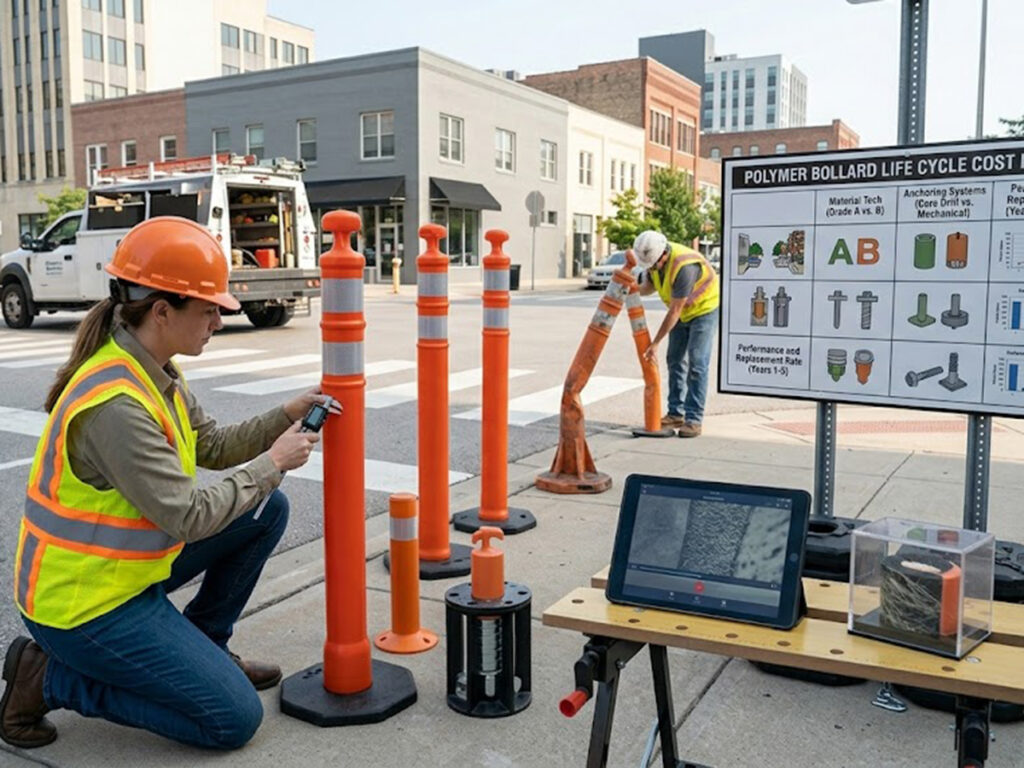
Flexible and plastic bollards dominate high-volume commercial applications: parking lot perimeters, drive-through lane delineation, cart corrals, and warehouse interior traffic control. Their apparent affordability makes them the default specification — and their true cost structure makes them the most frequently underestimated category in commercial bid packages.
Material Composition and Impact-Recovery Ratings
Three primary material tiers drive unit cost and lifecycle performance in flexible bollards. Standard HDPE posts run $35–$90 per unit. Premium TPU and polyurethane formulations reach $75–$180 per unit. Recycled rubber base configurations occupy the $20–$45 range.
The bollard cost factors behind material selection go beyond purchase price. Impact-recovery cycle ratings determine actual service life. Standard HDPE posts are rated for 8,000–15,000 vehicle impact cycles before structural failure. Premium TPU formulations carry ratings of 50,000 or more cycles. In a high-traffic drive-through corridor with 20 bollards, a $40 HDPE unit replaced every 18 months costs more over five years than a $120 TPU unit lasting the full period — a 40% total lifecycle savings for the higher-priced specification.
Material specifications to confirm at procurement: Shore A durometer hardness rating, UV-stabilization additive grade (critical in USDA Zones 9–13 and coastal markets), and ASTM D4101 resin classification.
5-Year TCO Comparison: HDPE vs. TPU Flexible Bollards (20-Unit High-Impact Installation)
| Variable | Standard HDPE ($40/unit) | Premium TPU ($120/unit) |
| Initial unit cost (20 units) | 800 | 2400 |
| Anchor hardware | $400–$700 | $400–$700 |
| Installation labor | $400–$900 | $400–$900 |
| Replacements (5 yr, high-impact) | $2,100–$3,600 (3 cycles) | $0–$800 (0–1 cycle) |
| 5-Year Total Cost | $3,700–$6,000 | $3,200–$4,800 |
Source: ASTM D4101 Material Standards / Industry TCO modeling, 2026
Surface-Mount Anchor Hardware: The Hidden Per-Unit Cost Multiplier
Surface-mount installation eliminates concrete core drilling for flexible bollards — but anchor hardware costs are frequently omitted from vendor quotes. Hardware runs $8–$45 per bollard, varying by substrate and corrosion specification.
Substrate type drives hardware selection. Asphalt installations carry additional risk in freeze-thaw climates (USDA Zones 1–6), where seasonal heave degrades anchor integrity. Concrete substrates demand anchor bolt patterns matching structural load requirements: 2-bolt vs. 4-bolt flange base configurations.
Corrosion resistance specification is a critical procurement decision. Zinc-plated hardware ($8–$15/unit) corrodes within 3–5 years in northern or coastal environments. Hot-dip galvanized hardware (ASTM A123, $18–$30/unit) or 316 stainless steel ($28–$45/unit) adds upfront cost but eliminates hardware replacement cycles.
Retroreflective delineator sleeve grade adds $3–$18 per unit depending on ASTM D4956 classification: Type I for standard applications, Type III for high-visibility compliance requirements.
Estimating a parking lot perimeter or drive-through protection project? Request a volume-tiered quote on flexible and surface-mount bollard packages for your specific substrate and climate zone.
Replacement Frequency Modeling by Installation Environment
Installation environment is one of the most underweighted bollard cost factors in commercial estimating. Four environment classifications carry distinct replacement frequency profiles that directly determine annual maintenance budget allocation.
| Environment Type | Example Application | Expected Service Life | Annual Replacement Rate |
| Low-impact | Pedestrian zones, sidewalk edge | 5–8 years | 5–10% of units |
| Moderate-impact | Parking lot perimeter, cart corrals | 2–4 years | 15–25% of units |
| High-impact | Drive-through lanes, loading docks | 12–24 months | 35–60% of units |
| Extreme-impact | Warehouse forklift corridors | 6–12 months | 60–100% of units |
Source: OSHA 1910.178(n) — Powered Industrial Trucks: Traveling
Removable Bollard Cost Variables: Sleeve Installation, Subsurface Risk, and Access Hardware
Removable bollard systems — post plus ground sleeve — are the standard specification for access-controlled entry points, event perimeter management, and loading zones requiring periodic vehicle access. The dominant bollard cost factors in this category are front-loaded in the sleeve installation phase, not the post unit price.
Ground Sleeve Installation Cost by Substrate Condition
Ground sleeve installation labor varies dramatically based on substrate type and condition. Concrete core drilling cost factors define the labor estimate range.
| Substrate Condition | Core Drill Time (per unit) | Est. Labor Cost | Key Risk Factor |
| Standard asphalt (2–3 inches) | 30–45 min | $45–$85 | Seasonal heave in freeze-thaw climates |
| Standard concrete (4-inch unreinforced) | 45–75 min | $75–$135 | Post-pour age affects drill time |
| Reinforced concrete (6–8 inch, rebar grid) | 90–180 min | $150–$350+ | Rebar interference, bit replacement |
| Concrete over aggregate + membrane | Variable | $150–$400+ contingency | Membrane breach remediation |
Diamond core drill bits for 4–6 inch diameter sleeves cost $80–$400 per bit with a service life of 20–50 linear inches in reinforced concrete. Non-shrink hydraulic grout costs $12–$22 per sleeve; epoxy grout runs $35–$75 per sleeve but delivers superior pull-out resistance for high-frequency post removal.
Subsurface Utility Risk: GPR Scanning and the True Cost of a Line Strike
Subsurface utilities interference is the most chronically underbudgeted risk in commercial bollard installation. Public utility marking (811 Call-Before-You-Dig) is mandatory in all 50 states but covers only publicly registered infrastructure. Private site utilities — data conduit, private electrical distribution, irrigation — fall entirely outside 811 scope.
Ground Penetrating Radar (GPR) scanning costs $350–$1,200 per mobilization for a standard commercial site. Complex multi-zone sites reach $1,500–$4,000. GPR resolves utilities to 18–24 inches depth in concrete and asphalt. A 2024 OSHA enforcement summary identified underground utility strikes during excavation as contributing to 12% of construction site electrical incidents resulting in injury — at an average direct cost of $42,000 per incident, including emergency repair, stop-work delay, and regulatory response. (Source: OSHA Construction Industry Electrical Hazard Statistics, 2024)
The practical clearance requirement is a minimum 6-inch horizontal clearance from any utility centerline to the core drill edge. On dense urban sites, subsurface utilities interference constrains bollard placement grids and may require design revision — a cost that must be priced at bid stage, not discovered as a field change order.
For projects integrating subsurface risk into broader procurement planning, the traffic bollard sourcing & procurement guide covers site qualification checklists in detail.
Locking Mechanisms, Key Systems, and Operational Access Cost
Removable bollard operational cost centers on locking hardware specification and key management. Three hardware tiers carry distinct per-unit and system-level cost implications.
- Pin-lock systems: $15–$40 per unit hardware cost, no keying setup cost, lowest security grade
- Single-key cylinder lock: $35–$90 per unit, master key system setup at $50–$200
- Interchangeable core (IC) lock systems: $90–$250 per unit, integrate with the facility grand master key hierarchy
IC core systems add $60–$150 per bollard versus pin-lock hardware but eliminate re-keying costs on personnel turnover. For facilities with high staff rotation or multiple access tiers, the IC specification delivers measurable total cost of ownership advantages over a 5-year horizon.
Retractable and Collapsible Bollard Cost Factors: Mechanism Engineering and Drainage Variables
Retractable and collapsible bollards carry the highest unit cost and the most complex installation engineering among non-crash-rated bollard systems. The housing and cassette installation — not the post unit itself — drives the primary cost variance. This is precisely where standard benchmark data misrepresents the true bollard cost factors.
Cassette Installation: Excavation Depth, Drainage Design, and Concrete Collar Costs
Retractable bollard systems require a below-grade housing cassette installed in a formed excavation. Excavation depth ranges from 24 to 42 inches for a standard 36-inch above-grade retractable bollard.
| Configuration | Additional Requirements | Material Add-Cost | Labor Add-Cost |
| Standard (no drainage) | Formed excavation, concrete collar (3,000 PSI min) | Baseline | $250–$600/unit |
| Drainage-integrated | Perforated drain sleeve, gravel sump (6–12 in), drain tile | $180–$600/unit | $90–$250/unit additional |
| High water table site | Pump-out, drainage membrane, sealed cassette | $400–$1,200/unit contingency | Variable |
The concrete collar specification — minimum 3,000 PSI, 6-inch collar thickness around the cassette — is a non-negotiable structural requirement. Cold-weather pour timing affects the cure schedule and adds risk in northern markets during Q4 and Q1 installation windows. Cassette outer diameter typically ranges from 8 to 14 inches by the manufacturer.
Collapsible Surface-Mount Variants: Cost Reduction Without Sacrificing Function
Shallow-mount collapsible bollards present a cost-engineered alternative for sites where full cassette excavation is prohibited by substrate conditions, utility density, or structural constraints. Spring-return systems use 4–8 inch depth anchors only, with installation costs at $75–$200 per unit installed — comparable to removable sleeve systems.
The functional constraint demands explicit specification: shallow-mount collapsible systems carry no impact rating. These units apply to pedestrian flow control, parking lane delineation, and vehicle guidance — not access control where vehicle intrusion resistance is a design requirement.
Cycle life rating is a primary bollard cost factor in collapsible mechanism specification. Entry-level spring-return mechanisms are rated for 50,000–100,000 depressions before failure. Premium cast-aluminum flush-profile housings carry 200,000+ cycle ratings at $180–$320 versus $45–$90 for basic configurations.
Motorized Retractable Bollards: Electrical Rough-In and Control System Cost Variables
Automatic and motorized retractable bollards introduce electrical infrastructure cost as a primary project variable — outside the bollard vendor’s quote scope entirely. Estimators must coordinate with the electrical subcontractor at the bid stage.
- Dedicated electrical circuit to each bollard or bollard group controller: $400–$1,800 per group
- GFCI protection and junction box at grade level: $120–$280 per installation point
- Single-button surface-mount control: $150–$400
- Access card reader integration: $500–$2,000 per reader
- Vehicle loop detector (saw-cut and loop wire): $800–$2,500 per loop
- Electrical permitting: $150–$500 plus a 2–6–week inspection scheduling delay in major metros
Bollard Freight Logistics Variables: LTL Classification, Liftgate Requirements, and Volume Consolidation
Freight cost is the most consistently underestimated line item in commercial bollard procurement. Flexible bollards and steel sleeve systems carry entirely different freight profiles — and misclassifying either category produces budget surprises at delivery.
LTL vs. FTL Classification and NMFC Freight Density Pricing
Freight classification under the National Motor Freight Classification (NMFC) system determines carrier rate calculation. Flexible bollards are high-cube, low-density freight at NMFC Class 125–150. Steel sleeve systems and retractable cassettes are dense, heavy freight at NMFC Class 70–85.
| Order Scenario | Mode | Estimated Freight Cost | Notes |
| 10 flexible bollards, regional | LTL | $85–$180 | High cube, Class 125–150 |
| 50 flexible bollards, regional | LTL | $220–$480 | Palletization efficiency critical |
| 20 steel sleeve systems, regional | LTL | $380–$750 | Dense freight, Class 70–85 |
| 100+ steel cassette systems | FTL | $1,200–$2,800 | vs. $3,500–$6,000+ LTL equivalent |
Source: NMFC freight classification benchmarks, NMFTA 2025/2026
LTL-to-FTL break-even occurs at approximately 10,000–12,000 lbs of total shipment weight, or when pallets fill more than 50% of a standard 48-foot trailer.
Liftgate and Jobsite Delivery: Last-Mile Cost Variables
Standard LTL freight quotes assume dock-height receiving at 48–52 inches. Most commercial construction job sites do not have dock facilities. Failure to specify delivery requirements produces avoidable accessorial charges — a preventable bollard cost factor.
- Liftgate delivery surcharge: $75–$200 per shipment — specify proactively
- Inside delivery (curb to staging area): $100–$350 additional
- Retractable cassette systems (oversized/heavy): 25–60% premium over standard LTL
- Carrier detention fees: $75–$150 per hour after 2-hour free time
For projects consolidating bollard procurement across multiple phases, direct factory vs. local distributor sourcing carries direct freight optimization implications that provides detailed analysis.
Order Consolidation and Volume Threshold Strategy
A project requiring 80 removable bollard systems across three phases (30/30/20 units) generates three LTL shipments at $380–$750 each, totaling $1,140–$2,250 in freight. A consolidated FTL shipment with on-site storage costs $1,200–$1,800 total — plus $200–$600/month storage if needed. The break-even favors consolidation at almost any phase separation exceeding 60 days.
Manufacturer freight-free thresholds — commonly $2,500–$5,000 order minimums — provide an additional cost lever. Blanket purchase orders for 12-month anticipated volume lock in freight-free tiers while allowing phased releases aligned with the project schedule.
Traffic Bollard Maintenance Cost Drivers: Degradation, Mechanism Servicing, and Lifecycle Modeling
Maintenance cost modeling is the most neglected element of bollard TCO in commercial estimating. Traffic bollard maintenance cost drivers can represent 40–120% of initial project cost over a 5-year horizon, depending on bollard type and installation environment.
Flexible Bollard Degradation: UV, Chemical, and Impact Replacement Modeling
UV degradation is a primary bollard cost factor in warm and coastal climates. Standard HDPE loses structural integrity within 3–7 years without UV stabilization additives. UV-stabilized formulations add 20–35% to unit cost but extend service life to 8–12 years in high-UV environments.
Deicing chemical exposure — calcium chloride and magnesium chloride — accelerates base-plate corrosion and post-surface chalking in northern markets. Specifying marine-grade hardware and UV/chemical-stabilized posts for any installation in USDA Zones 4–7 is a direct TCO decision.
Retroreflective tape degradation creates a separate replacement cycle. ASTM D4956 Type I tape carries a 3–7 year rating at standard luminance coefficient levels. Type III tape lasts 7–10 years. Re-taping at 30% luminance loss is more cost-effective than full post replacement when the structural post remains intact.
Removable Bollard Maintenance: Lock Servicing, Sleeve Corrosion, and Refinishing
Lock cylinder servicing costs aggregate meaningfully across large installations. Annual lubrication runs $5–$15 per unit in materials. Cylinder replacement on wear or key loss costs $35–$120 per cylinder. Facilities without IC core systems pay $25–$75 per cylinder in re-keying costs on each personnel change.
Ground sleeve corrosion is the highest-cost maintenance event in removable bollard systems. Sleeve replacement costs $205–$580 per unit all-in — material, core-drill removal, and reinstallation combined. Specifying hot-dip galvanized sleeves to ASTM A123 (a $15–$35 per unit premium) eliminates sleeve replacement in most climates for a 15–25 year service life.
Retractable Bollard Mechanism Servicing: Spring, Drain, and Actuator Cost Cycles
Spring-return mechanism servicing is the primary recurring maintenance cost for non-motorized retractable bollards. Spring replacement intervals average 3–7 years at standard commercial use frequencies. Spring kit cost runs $45–$180 per unit with 30–60 minutes of labor.
Drainage sump maintenance in retractable cassette systems requires annual inspection and periodic cleanout at $30–$80 per unit annually. Motorized actuator overhaul becomes necessary at 250,000–500,000 cycles. Overhaul kit costs $180–$450 per unit plus $150–$300 labor. Full actuator replacement runs $400–$1,200 per unit.
Parts availability is itself a bollard cost factor: proprietary mechanisms from offshore manufacturers may carry 4–12 week lead times for replacement components. Specifying brands with domestic parts inventory or domestic stocking distributors is a direct procurement risk mitigation decision.
From Cost Variables to Defensible Budget Line Items: The Commercial Estimator’s Framework
Every bollard cost factor covered in this analysis feeds into a single practical output: a defensible project budget that survives bid review, absorbs field conditions, and protects project margin.
The 12-Variable Pre-Bid Bollard Cost Qualification Checklist
Confirm each variable before submitting a bollard installation estimate:
- Bollard type confirmed: flexible/removable/retractable/collapsible
- Substrate type and reinforcement depth verified: asphalt/unreinforced concrete/reinforced concrete
- GPR scan completed or 811 call-before-you-dig confirmation obtained
- Installation method confirmed: surface mount/sleeve/cassette excavation
- Freight delivery access confirmed: dock height vs. liftgate vs. flatbed crane
- Volume quantity break tier confirmed with supplier
- Locking/access hardware specification confirmed: pin-lock/keyed cylinder/IC core
- Drainage requirement assessed for all retractable cassette system locations
- Electrical rough-in scope confirmed with the electrical subcontractor for motorized bollards
- Maintenance reserve budget allocated: 15–25% of initial unit cost per year
- Parts availability and lead time confirmed for retractable and collapsible mechanisms
- Multi-phase freight consolidation opportunity assessed against storage cost trade-off
Total Cost of Ownership Modeling: Building the 5-Year Bollard Budget Line Item
TCO modeling provides the only budget framework that accurately represents the full financial commitment of a commercial bollard program.
| Bollard Type (20 units, high-impact) | Year 0 All-In | Year 1–5 Annual | 5-Year TCO |
| Flexible HDPE (high-impact zone) | $1,800–$3,400 | $700–$1,500 | $5,300–$10,900 |
| Premium TPU Flexible | $3,200–$5,000 | $200–$600 | $4,200–$8,000 |
| Removable Steel Sleeve System | $8,000–$18,000 | $400–$900 | $10,000–$22,500 |
Note: Removable system Year 0 cost reflects sleeve installation in standard concrete. Reinforced concrete adds $75–$215 per unit to installation labor.
Frequently Asked Questions: Bollard Cost Factors for Commercial Projects
How much does it cost to install a removable bollard in reinforced concrete vs. standard concrete?
Standard 4-inch concrete installation runs $75–$135 per unit in labor. Reinforced concrete at 6–8 inches requires specialty diamond-core drilling at $150–$350+ per unit. Diamond core bits ($80–$400 each) last 20–50 linear inches in reinforced concrete and must be budgeted as a consumable. Total installed cost for a removable bollard in reinforced concrete — sleeve, grout, hardware, and labor combined — commonly reaches $500–$900 per unit.
What is the total cost of ownership for flexible plastic bollards in a high-traffic commercial parking lot?
A 20-unit high-impact installation carries a 5-year TCO of $3,700–$6,000 for standard HDPE specification. Premium TPU specification reduces 5-year TCO to $3,200–$4,800 through elimination of most replacement cycles — a meaningful TCO advantage despite 3x the initial unit cost.
Do retractable bollards require drainage, and how much does it add to the installation cost?
Drainage requirement depends on site conditions. Flat grade, high water table proximity, and freeze-thaw cycle risk all trigger drainage integration. Drainage adds $180–$600 per unit in materials plus $90–$250 per unit in additional labor. Sealed cassette alternatives eliminate drainage need but add $200–$500 to cassette unit cost.
How do I reduce freight costs when ordering bollards for a multi-phase commercial project?
Three strategies deliver measurable freight cost reduction: (1) consolidate phases into a single FTL load — break-even occurs at approximately 60 days of phase separation; (2) structure POs to hit manufacturer freight-free thresholds ($2,500–$5,000 minimums are standard); (3) coordinate delivery precisely to eliminate carrier detention at $75–$150 per hour. FTL consolidation for orders exceeding 10,000 lbs saves $1,500–$3,500 versus equivalent LTL pricing.
What subsurface risks should I budget for when installing bollards on an urban commercial site?
Three risk categories require explicit budget allocation: (1) Utility interference — GPR scan at $350–$1,200 per mobilization; emergency repair exposure $800–$3,500+ per incident; (2) Unknown substrate — reinforced concrete discovered post-mobilization adds $75–$215 per unit as a field change order; (3) Drainage conditions — high water table adds $400–$1,200 per unit in contingency for retractable systems. A 10–15% contingency line item on all urban bollard installation bids reflects documented industry practice.
References
- ASTM D4101: Standard Specification for Polypropylene Injection and Extrusion Materials.
- ASTM D4956: Standard Specification for Retroreflective Sheeting for Traffic Control
- ASTM A123: Standard Specification for Zinc (Hot-Dip Galvanized) Coatings on Iron and Steel Products.
- OSHA 29 CFR 1910.178(n): Powered Industrial Trucks — Traveling.
- OSHA Construction Industry Electrical Hazard Statistics and Enforcement Summary, 2024.
- NMFTA National Motor Freight Classification (NMFC), 2025/2026 Edition