_1795571035_WNo_1600d900.png)
Paris stop signs are part of France's traffic-control system, where intersection priority is managed through road signs, إشارات المرور, علامات الطرق, and the general priority-to-the-right rule. When a STOP sign is installed, drivers must recognize its specific instruction and come to a complete stop before entering the intersection.
Understanding the French AB4 STOP sign, the AB5 advance-warning arrangement, associated road markings, and the differences between stopping and yielding helps drivers navigate Paris intersections safely. This information is also useful for road authorities, المقاولون, and traffic-sign suppliers selecting or maintaining regulatory signage for urban streets.
Quick Navigation
- What Are Paris Stop Signs?
- What Does the French AB4 STOP Sign Look Like?
- When Are STOP Signs Used in Paris?
- STOP Signs vs. Yield Signs vs. علامات الأولوية
- STOP Lines and Intersection Markings
- Where Should a STOP Sign Be Installed?
- مواد, الرؤية, والصيانة
- How to Select STOP Signs for Urban Roads
- الأسئلة المتداولة
1. What Are Paris Stop Signs?
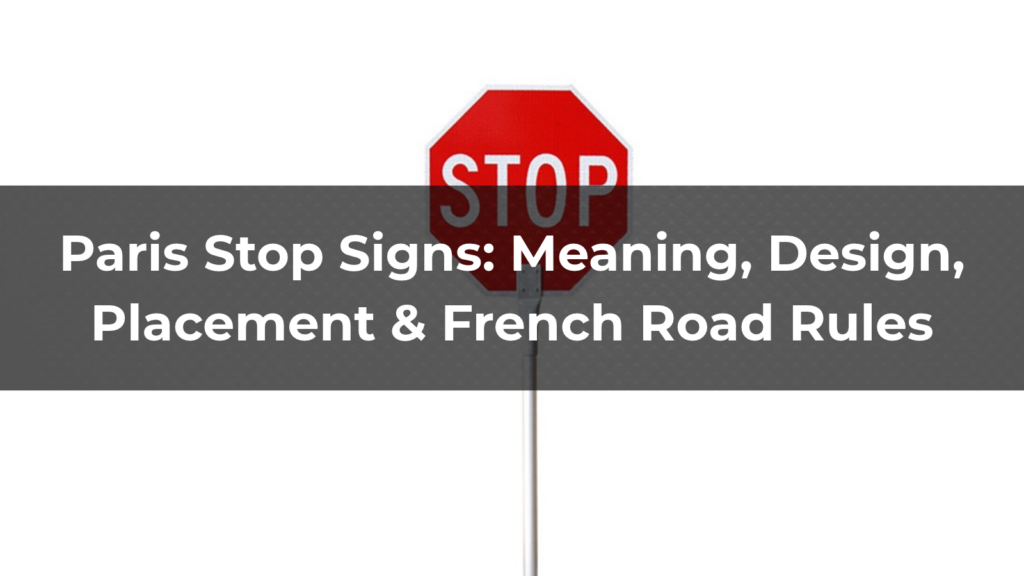
Paris stop signs are regulatory traffic signs used to require vehicles to stop before entering a designated intersection. في فرنسا, the standard STOP position sign is officially identified as AB4. It has a red octagonal shape, a white border, and the word STOP in white capital letters.
Paris does not use STOP signs as the default control at every intersection. The city's traffic-management approach generally applies priorité à droite, or priority to traffic approaching from the right, unless another priority arrangement is established through signs, علامات الطرق, or traffic signals.
This means drivers should not assume that every intersection in Paris requires a full stop. They must identify the signs, إشارات, and road markings that apply to each junction and follow the corresponding right-of-way rules.
The main functions of a STOP sign include:
- Requiring a complete stop: Drivers must bring their vehicles to a full stop rather than simply slowing down.
- Clarifying right-of-way: The sign establishes a specific stopping obligation for the controlled approach.
- Reducing intersection conflicts: A complete stop gives drivers an opportunity to assess approaching vehicles, راكبي الدراجات, والمشاة.
- Supporting traffic management: STOP signs provide a clear instruction where a road authority determines that a mandatory stop is appropriate.
2. What Does the French AB4 STOP Sign Look Like?
The AB4 is the official French position sign requiring drivers to stop at an intersection. Its distinctive octagonal shape and contrasting colors make it recognizable from the road approach.
شرط 3-1 of the French decree of November 24, 1967, defines the AB4 as an octagonal sign with a red background, a white border, and the word STOP in white letters. The same article identifies AB5 as the advance-warning sign associated with a STOP-controlled intersection.
Read Article 3-1 of the French road-sign regulations on Légifrance.
Key visual features of an AB4 sign
| ميزة | French AB4 specification | غاية |
|---|---|---|
| شكل | مثمن | Provides a distinctive shape for quick recognition |
| خلفية | أحمر | Creates strong visual contrast |
| حدود | أبيض | Defines the sign face clearly |
| نص | STOP in white capital letters | Communicates the mandatory stopping instruction |
| Sign category | AB4 | Identifies the French STOP position sign |
The AB4's octagonal shape is an important recognition feature. It distinguishes the STOP sign from triangular warning and yield signs, as well as circular regulatory signs used for other traffic instructions.
AB4 vs. AB5: Position sign and advance warning sign
French regulations distinguish between the sign requiring a stop at the intersection and the advance-warning arrangement that alerts drivers to an upcoming STOP requirement.
| لافتة | Configuration and function | استجابة السائق |
|---|---|---|
| AB4 | Octagonal STOP position sign | Come to a complete stop at the intersection |
| AB5 | Advance warning formed by an AB3a yield sign with an M5 STOP supplementary panel | Prepare to stop at the upcoming intersection |
مهم: AB5 is not a separate red octagonal STOP sign. Under the French sign regulations, it consists of an AB3a yield sign supplemented by an M5 STOP panel. Its purpose is to warn drivers in advance of the STOP requirement at the intersection.
3. When Are STOP Signs Used in Paris?
STOP signs are not the default solution for every intersection in Paris. The city's traffic-management approach generally applies priority to the right, while other priority arrangements may be introduced where the road layout and traffic conditions require them.
The City of Paris's October 2026 guide to vertical and horizontal road signage explains that priority to the right is widely applied. It states that changes to this arrangement require a specific assessment and coordination between the relevant services. The guide also describes exceptional situations in which AB3a yield signs or AB4 STOP signs may replace traffic signals, including certain very-low-traffic accesses and movements with limited conflict.
Consult the City of Paris traffic-signing guide (جزء 2 – Circulation).
Situations where a STOP sign may be considered
The use of a STOP sign depends on the intersection assessment and the applicable regulations. Situations that may warrant a closer review include:
- Restricted visibility: Buildings, الجدران, المركبات المتوقفة, الغطاء النباتي, or road geometry may limit a driver's view of cross traffic.
- Low-volume access roads: A minor access connecting to another road may require a clearly defined priority arrangement.
- Unusual traffic movements: Certain turning movements or access configurations may need a specific stopping or yielding instruction.
- Documented safety concerns: Repeated conflicts or crashes may lead road authorities to reassess the existing intersection controls.
- Special access arrangements: طرق الوصول الخاصة, مداخل الخدمة, or restricted approaches may require specific traffic-control measures.
These are assessment considerations rather than automatic installation rules. A STOP sign should be selected only when the responsible road authority determines that it is suitable for the intersection's geometry, ظروف المرور, الرؤية, والمتطلبات القانونية.
Why priority to the right remains important
Priorité à droite requires drivers to give way to vehicles approaching from the right when no other priority arrangement applies. The City of Paris guide explains that this approach can help moderate vehicle speeds and encourage greater attention at intersections. It can also reduce unnecessary stop-and-go movements where traffic volumes are relatively low.
For drivers unfamiliar with French road rules, the key point is that the absence of a STOP sign does not mean an intersection has no priority rule. Drivers must still assess the road layout and comply with the applicable right-of-way requirements.
4. STOP Signs vs. Yield Signs vs. علامات الأولوية
Several French road signs control how drivers approach intersections. Although they may appear in similar locations, their instructions are different. Recognizing these differences helps prevent incorrect stopping, unsafe entry, and right-of-way conflicts.
| French sign | معنى | Driver obligation |
|---|---|---|
| AB4 – قف | Mandatory stop at the intersection | Come to a complete stop, give way to traffic on the other road, and proceed only when safe |
| AB3a – Cédez le passage | Yield at the intersection | Give way to traffic on the priority road; a complete stop is not automatically required if the way is clear |
| AB1 – Priorité à droite | Intersection where traffic from the right has priority | Give way to vehicles approaching from the right |
| AB6 – Route prioritaire | Indicates that a road has priority status | Follow the priority arrangement indicated by the sign and applicable rules |
| AB7 – Fin de route prioritaire | End of a priority road | Recognize that the priority-road indication has ended and follow the rules applying beyond the sign |
The distinction between STOP and yield is especially important. A STOP sign requires a complete stop, even if the driver cannot see any approaching traffic. A yield sign requires the driver to give way but does not automatically require stopping when the road is clear and it is safe to proceed.
شرط 3-1 of the French road-sign regulations identifies AB1 as a right-priority intersection sign, AB3a as a yield position sign, AB4 as a STOP position sign, and AB6 as an indication of priority-road status. These signs have different functions and should not be treated as interchangeable.
Roundabouts and priority rules
Drivers should also distinguish between a French carrefour giratoire و rond-point. At a conventional signposted roundabout, entering traffic generally gives way to vehicles already circulating on the ring. A rond-point without that specific priority arrangement may follow the priority-to-the-right rule. The signs and markings at the actual junction determine the applicable rule.
The City of Paris guide specifically notes that priority to the right applies at a rond-point, unlike a carrefour giratoire where priority is given to circulating traffic. Drivers should therefore check the actual signs and intersection layout rather than assuming that all circular junctions follow the same rule.
5. STOP Lines and Intersection Markings
A STOP sign is part of an intersection-control arrangement. Road markings can reinforce the stopping position by showing drivers where to stop before entering the junction.
The French road-marking instruction identifies STOP lines as continuous transverse markings. The City of Paris's October 2026 guide lists the STOP line under Article 117-4 as a continuous line with a width of 50 سم. The guide distinguishes this marking from the broken line used for yield arrangements.
What a STOP line communicates
- It identifies the stopping boundary for approaching traffic.
- It helps drivers stop before entering the conflicting traffic area.
- It supports consistent stopping behavior across different vehicle types.
- It reinforces the intersection-control instruction when used with the appropriate sign.
Under Article R415-6 of the French Highway Code, drivers approaching an intersection indicated by a STOP sign must stop at the limit of the roadway being entered. They must then give way to vehicles traveling on the other road or roads and proceed only after ensuring that it is safe to do so.
Drivers should stop before the applicable stopping boundary and avoid blocking pedestrian crossings or entering the intersection while waiting for a safe opportunity to proceed. Where markings are faded, مفتقد, or difficult to interpret, the legal stopping requirement indicated by the STOP sign still applies.
For road authorities and contractors, the sign and its associated markings should be reviewed as one traffic-control arrangement. Installing a sign without checking the visibility and condition of the road markings may leave drivers uncertain about the intended stopping position.
6. Where Should a STOP Sign Be Installed?
The placement of a STOP sign affects how early drivers recognize the stopping requirement and whether they can stop safely before entering an intersection. The exact location must follow the applicable French regulations and the road authority's approved traffic-management plan.
Position the sign where approaching drivers can see it
The AB4 is a position sign. It should be installed where drivers approaching the controlled road can recognize the instruction and stop at the intersection. Placement should account for the approach direction, road alignment, surrounding buildings, street furniture, الأشجار, المركبات المتوقفة, and other potential obstructions.
Consider the stopping position and road layout
The sign's position should correspond to the intended stopping boundary. Road authorities and installation teams should review the relationship between the sign, the intersection edge, the STOP line, معابر المشاة, cycle facilities, and nearby access points.
Check visibility for different road users
Urban intersections often involve cars, مركبات التسليم, حافلات, motorcycles, الدراجات, والمشاة. A STOP sign should remain visible from the relevant approach without being hidden by parked vehicles, temporary construction equipment, الغطاء النباتي, أو علامات أخرى. Its installation should also avoid creating unnecessary obstructions for pedestrians and cyclists.
Use advance warning where appropriate
Where drivers may not have enough time to recognize an upcoming stopping requirement, the road authority may assess whether advance warning is needed. The French AB5 arrangement provides this warning function through an AB3a sign supplemented by an M5 STOP panel. Its use and position should follow the applicable sign regulations and approved intersection design.
7. مواد, الرؤية, والصيانة
A STOP sign must remain recognizable in different lighting and weather conditions. For urban roads, the sign face, أداء عاكس, structural condition, and installation stability all contribute to its long-term effectiveness.
Reflective sign face
Retroreflective materials return light toward its source, helping drivers see signs illuminated by vehicle headlights at night. When specifying a sign, road authorities and buyers should check the reflective material required by the applicable French or project specification rather than assuming that a generic reflective grade is automatically compliant.
Durable sign substrate
The sign substrate should be suitable for the installation environment and expected service life. Aluminum is commonly used for permanent road signs because it offers a practical balance of weight, صلابة, ومقاومة التآكل. The selected material, سماكة, and supporting structure should meet the project requirements.
Stable mounting hardware
دعامات, قوسين, المثبتات, and foundations should support the sign under the expected outdoor conditions. The installation should resist movement, اهتزاز, and wind loading while maintaining the required sign orientation and visibility.
Routine inspection and replacement
STOP signs should be inspected periodically to identify damage, يتلاشى, تآكل, loose fixings, الكتابة على الجدران, ومشاكل الرؤية. Road authorities should also check whether nearby construction, vegetation growth, street furniture, or changes to the road layout have affected the sign's effectiveness.
- Check that the red background and white STOP lettering remain clear.
- Inspect the reflective face for fading, تقشير, الخدوش, or delamination.
- Confirm that the sign is securely mounted and correctly oriented.
- Remove obstructions that reduce visibility from the approach direction.
- Review the condition and legibility of the associated STOP line.
- Replace signs that are damaged or no longer meet the applicable requirements.
8. How to Select STOP Signs for Urban Roads
Choosing a STOP sign for a road project involves more than selecting an octagonal red sign. المشترين, المقاولون, and road authorities should confirm that the sign design, مواد, أبعاد, خصائص عاكسة, and mounting arrangement match the project's location and regulatory requirements.
Confirm the applicable sign standard
Start by identifying the country, road authority, and technical specification governing the project. A French AB4 sign follows the French road-sign system. It should not be assumed to be interchangeable with a STOP sign designed for the U.S. Mutcd, المعايير الأسترالية, or another national system. الشكل, أبعاد, حروف, مواد عاكسة, and installation details may differ.
Choose suitable dimensions and reflective materials
The sign size should be selected according to the applicable regulations, road environment, سرعة الاقتراب, and viewing distance. Reflective material should also meet the specified performance requirements for the project. للشوارع الحضرية, visibility must be considered alongside the surrounding visual environment and available installation space.
Evaluate durability and installation requirements
Consider the substrate, edge treatment, فتحات التركيب, قوسين, دعامات, and expected outdoor exposure. A suitable sign should remain stable and legible throughout its intended service life. Buyers should request product specifications and supporting compliance documentation before approving a bulk order.
Review supplier capabilities
For larger road-sign projects, supplier evaluation should cover product consistency, manufacturing quality control, قدرات التخصيص, التعبئة والتغليف, مهلة, and delivery arrangements. It is also important to confirm that the supplier understands the destination market's sign requirements and can provide the requested product configuration.
OPTRAFFIC provides traffic safety equipment and signage solutions for road construction, التحكم في حركة المرور, ومشاريع السلامة العامة. Buyers can explore its منتجات السلامة المرورية to review available product categories and discuss project-specific requirements.
9. الأسئلة المتداولة
1. What is a STOP sign called in France?
The French STOP position sign is called AB4. It is an octagonal red sign with a white border and the word STOP in white capital letters.
2. Are there STOP signs in Paris?
نعم. STOP signs are part of the French road-sign system, but they are not the default control at every Paris intersection. The city generally applies priority to the right in many locations, with STOP signs and other controls used where the specific traffic arrangement requires them.
3. What is the difference between AB4 and AB5?
AB4 is the octagonal STOP sign placed at the intersection to require a complete stop. AB5 is the advance-warning arrangement formed by an AB3a yield sign with an M5 STOP supplementary panel.
4. Do drivers have to stop completely at an AB4 sign?
نعم. Under Article R415-6 of the French Highway Code, drivers must stop at the limit of the roadway being entered, give way to vehicles on the other road or roads, and proceed only after ensuring that it is safe to do so.
5. What does priorité à droite mean in Paris?
Priorité à droite means priority to the right. At an intersection where no other priority arrangement applies, drivers must give way to vehicles approaching from their right. It is an important general rule on many Paris streets.
6. Is a STOP sign the same as a yield sign in France?
لا. An AB4 STOP sign requires a complete stop. An AB3a yield sign requires drivers to give way to traffic on the priority road, but they do not have to stop if the way is clear and it is safe to proceed.
7. What does the STOP road marking mean?
A STOP line is a continuous transverse road marking that identifies the stopping boundary. The City of Paris's October 2026 guide lists this marking as a continuous line 50 cm wide under Article 117-4 of the French road-marking instruction.
8. Who is responsible for installing road signs in Paris?
The City of Paris's road-signing guide states that the road manager is responsible for implementing vertical and horizontal signage. The guide also explains that the allocation of traffic-police powers varies according to the road and its administrative classification.
9. Can a standard international STOP sign be used in a French road project?
ليس تلقائيا. The sign must meet the applicable French regulations and project specifications. Buyers should confirm the required AB4 design, أبعاد, أداء عاكس, مواد, and mounting details with the relevant road authority before ordering.
خاتمة
Paris stop signs are best understood within the wider French system of intersection priority and road signage. The AB4 sign requires drivers to stop, while AB5 provides advance warning through an AB3a sign with an M5 STOP panel. AB3a itself indicates a yield requirement, and priority-to-the-right rules apply at intersections where no different priority arrangement has been established. These signs have distinct functions and must be selected and installed according to the applicable regulations and the specific conditions of each intersection.
For road authorities, المقاولون, and traffic-sign buyers, clear sign design, suitable reflective materials, reliable mounting hardware, and regular maintenance all contribute to effective traffic control. أوبترافيك supports traffic safety projects with a range of signage and road-safety equipment. يزور أوبترافيك to learn more about its traffic safety solutions and product capabilities.