_1795569770_WNo_1600d900.png)
MUTCD delineators are retroreflective traffic guidance devices that help road users recognize roadway alignment, منحنيات, lane reductions, منحدرات التبادل, and other changes in the travel path. Under the current MUTCD, roadway delineators must meet requirements for أداء عاكس, crashworthy supports, لون, الموضع, والتباعد according to their intended application.
This guide explains the key provisions in the MUTCD 11th Edition with Revision 1, including delineator design, قواعد اللون, ارتفاع التركيب, roadway spacing, and use in temporary traffic control (TTC) المناطق. It also covers practical considerations for selecting, التفتيش, and maintaining delineators for highway, الطريق, and traffic management projects.
Quick Navigation
- What Are MUTCD Delineators?
- Which MUTCD Edition Applies?
- MUTCD Delineator Design Requirements
- MUTCD Delineator Color Requirements
- Where Are Delineators Used?
- MUTCD Delineator Placement and Spacing
- Delineators in Temporary Traffic Control Zones
- How to Choose MUTCD Delineators
- التفتيش والصيانة
- FAQs About MUTCD Delineators
- خاتمة
What Are MUTCD Delineators?
التعريف والغرض
Delineators are retroreflective devices installed in a series along a roadway to help drivers recognize its alignment. They are particularly useful where the road path may be difficult to anticipate, including horizontal curves, lane-reduction transitions, منحدرات التبادل, and locations with roadside barriers.
The MUTCD classifies delineators as guidance devices rather than warning devices. Their purpose is to make the roadway path easier to follow, particularly at night or during adverse weather. Unlike a sign that communicates a specific regulation or warning, a series of delineators provides repeated visual references that trace the road edge or alignment.
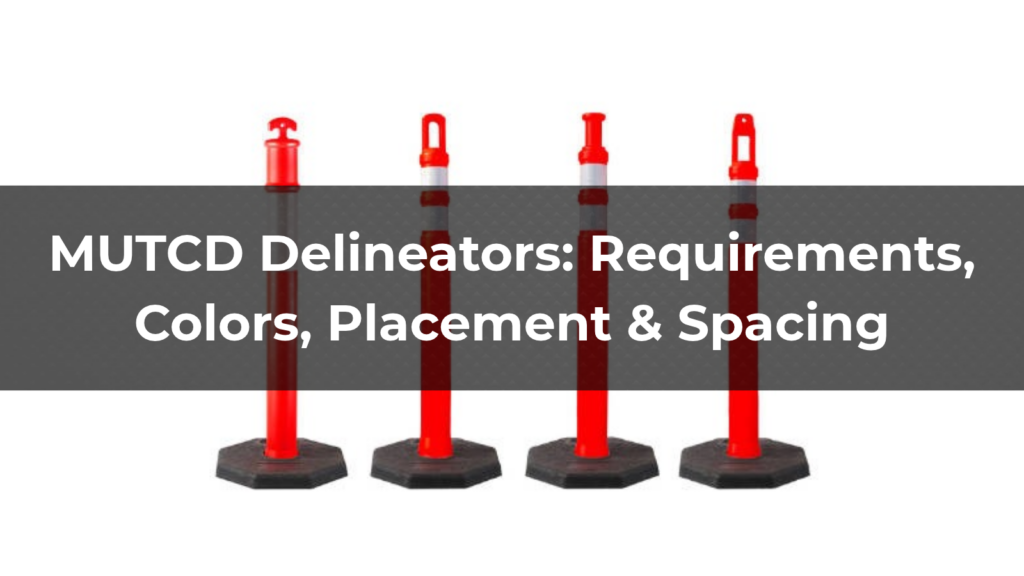
Depending on the application, delineators may be installed on posts, mounted on guardrails, or incorporated into temporary traffic control equipment. Common product formats include:
- محددات ما بعد التركيب: Vertical supports with one or more retroreflective elements, commonly used along road edges and ramps.
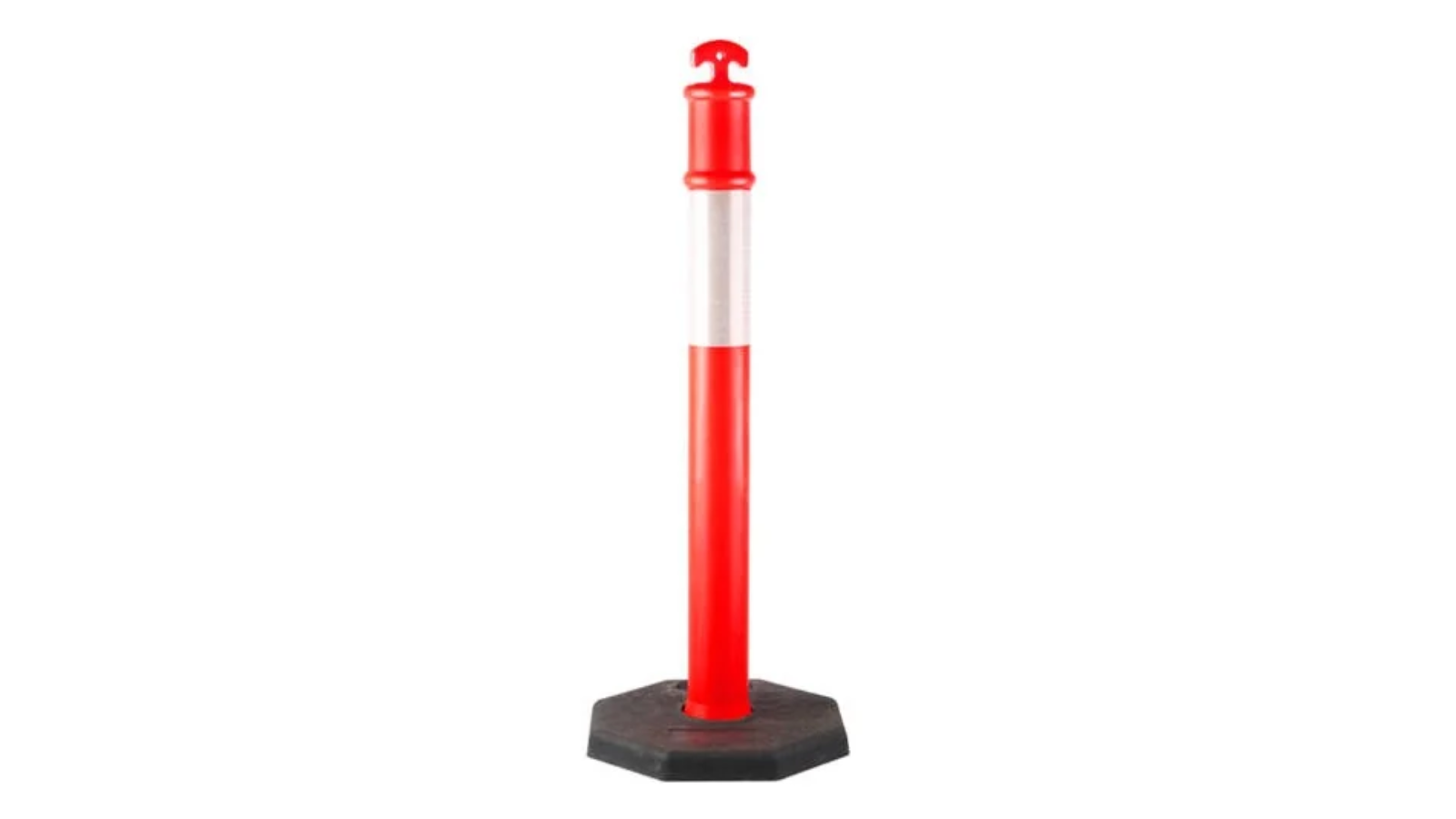
- وظائف تحديد مرنة: Posts designed to flex when contacted, often used to mark lane boundaries, المناطق المقيدة, or traffic paths.
- Guardrail delineators: Reflective units attached to or positioned alongside longitudinal barriers to maintain visual guidance.
- محددات مؤقتة: Portable devices used to show a vehicle path through a work zone, التفاف, or short-term traffic arrangement.
- Chevron delineators: Directional devices with a chevron panel or blade that visually reinforces a required traffic movement.
These product categories are not interchangeable from a standards perspective. A portable flexible post or chevron unit should not automatically be treated as a MUTCD roadway delineator simply because it has reflective material. The intended use, support, أبعاد, لون, and project requirements must all be checked.
المرمى مقابل. أجهزة التحكم في حركة المرور الأخرى
Delineators are often used with pavement markings, علامات, المخاريط, الحواجز, and channelizing devices, but each device has a different function. Understanding these differences helps agencies and contractors select the appropriate equipment for a particular traffic control plan.
| جهاز | الوظيفة الرئيسية | استخدام نموذجي |
|---|---|---|
| المحددات | Provide repeated visual guidance along roadway alignment. | Road edges, منحنيات, سلالم, وانتقالات الحارة. |
| علامات المرور | Communicate regulatory, تحذير, or guidance information. | حدود السرعة, إغلاق حارة, المخاطر, and route directions. |
| علامات الرصيف | Define lanes, حواف الطريق, and permitted or restricted movements. | Center lines, خطوط الحافة, lane lines, and tapers. |
| Traffic Cones and Channelizers | Channelize traffic and mark temporary work areas or paths. | مناطق العمل, short-term lane closures, والالتفاف. |
| Object Markers | Mark obstructions within or adjacent to the roadway. | Bridge ends, fixed objects, and roadway obstructions. |
Delineators do not provide the physical separation of a barrier, and they should not be relied on to stop or redirect an errant vehicle. They are visual guidance devices and should be combined with other traffic control measures when a project requires additional warning, channelization, or positive protection.
Which MUTCD Edition Applies?
إدارة الطرق السريعة الفيدرالية (الهيئة الفيدرالية للطرق السريعة (FHWA).) publishes the دليل على أجهزة مراقبة حركة المرور الموحدة (Mutcd), which establishes national standards and guidance for traffic control devices on streets, الطرق السريعة, pedestrian facilities, مرافق الدراجات, and site roadways open to public travel.
As of November 2026, the current federal publication is the 11th Edition of the MUTCD with Revision 1, بتاريخ ديسمبر 2025. المراجعة 1 became effective on March 5, 2026. State and local agencies may also have adoption procedures, supplements, standard drawings, or additional requirements that apply to a specific project.
The main MUTCD provisions for roadway delineators are found in Part 3, Chapter 3G:
- Section 3G.01 – عام: Explains the purpose and typical use of delineators.
- Section 3G.02 – تصميم: Covers retroreflective performance, support requirements, and reflector dimensions.
- Section 3G.03 – طلب: Addresses delineator colors and where series of delineators are used.
- Section 3G.04 – التنسيب والتباعد: Provides mounting height, lateral placement, and spacing guidance.
للتحكم المؤقت في حركة المرور, Section 6J.04 مهم أيضًا. It allows delineators to indicate roadway alignment and the required vehicle path through a TTC zone. عند استخدامها, they must supplement or combine with other TTC devices, be mounted on crashworthy supports, and follow Chapter 3G.
Always check the current official MUTCD and the version adopted by the authority having jurisdiction before specifying or installing delineators. The federal manual provides the national framework, while project plans and state or local requirements may determine the details for a particular road.
Official reference: الهيئة الفيدرالية للطرق السريعة (FHWA). – MUTCD 11th Edition with Revision 1, مشتمل جزء 3: العلامات و جزء 6: مراقبة حركة المرور المؤقتة.
MUTCD Delineator Design Requirements
الأداء الانعكاسي
Section 3G.02 requires delineators to consist of retroreflective devices that can clearly return light under normal atmospheric conditions from a distance of 1,000 feet when illuminated by the high beams of standard automobile lights. This performance requirement helps drivers recognize the roadway alignment at night.
Retroreflective performance depends on more than the presence of reflective tape. The material, لون, حالة, توجيه, and viewing angle all affect how well the device returns light toward an approaching driver. الأوساخ, يتلاشى, الخدوش, and incorrect installation can reduce the visibility of an otherwise suitable reflector.
When evaluating a product, request documentation that identifies the reflective material and its performance. Do not assume that a product meets the MUTCD design provisions solely because its product description uses terms such as high visibility, عاكس, or traffic safety grade.
Minimum Reflective Element Dimensions
The MUTCD specifies that retroreflective elements for delineators must have a minimum vertical and horizontal dimension of 3 بوصة, or a minimum diameter of 3 inches when the element is circular.
The Manual also describes single, double, and vertically elongated delineators. A single delineator has one reflective element for the direction of travel being considered. A double delineator has two identical reflective elements mounted together for that direction. A vertically elongated unit may be used instead of a double delineator when its size is appropriate.
| Delineator Format | وصف | مرجع MUTCD |
|---|---|---|
| أعزب | One retroreflective element for the direction of travel. | Section 3G.02 |
| Double | Two identical retroreflective elements mounted together for the same direction. | Section 3G.02 |
| ممدود عموديا | One elongated reflective element that approximates the vertical dimension of two separate single elements. | Section 3G.02 |
Crashworthy Supports
Delineators must be mounted on crashworthy supports as required by Section 3G.02. The support is part of the installation, not a secondary purchasing detail. A reflector with suitable dimensions and retroreflectivity does not make the complete assembly compliant if the post, قاعدة, أجهزة التركيب, or installation does not satisfy the applicable crashworthiness requirements.
للتحكم المؤقت في حركة المرور, Section 6J.04 repeats the requirement that delineators be mounted on crashworthy supports. Buyers should confirm the intended application and ask for relevant test reports or compliance documentation for the complete device and support configuration where required by the agency.
MUTCD Delineator Color Requirements
Delineator color is not selected only for product appearance. Under Section 3G.03, the color of delineators must correspond to the color of the applicable roadway edge-line markings under Sections 3A.03 and 3B.09. The color therefore communicates the same directional information as the related pavement marking.
| لون | MUTCD Context | Important Note |
|---|---|---|
| أبيض | Corresponds to white edge-line applications; delineators on the left-hand side of a two-way roadway shall be white. | Check the roadway direction and edge-line arrangement. |
| أصفر | Corresponds to yellow edge-line applications, including the left edge of divided highways and one-way roadways where applicable. | Do not select yellow solely because it is a common product color. |
| أحمر | Used on truck escape ramps; may also be used on the reverse side of a delineator where it would be viewed by wrong-way traffic. | Red has a specific directional or escape-ramp meaning. |
Section 3A.03 identifies yellow markings with the separation of opposing traffic and certain left-edge applications, while white markings are used for same-direction traffic separation and the right-hand roadway edge. Red delineators are required when used on truck escape ramps and may be used on the reverse side of a delineator where they would be seen by a road user traveling in the wrong direction.
Do not confuse delineator colors with the colors of object markers or temporary channelizing devices. Those devices have their own MUTCD provisions. The correct color depends on the device type, direction of travel, roadway marking, and intended application. Always verify the relevant section and agency standard before ordering.
Where Are Delineators Used?
Highway Curves and Roadway Edges
Delineators are useful on horizontal curves and long roadway sections where drivers need repeated visual references to understand the road alignment. They can help make the outside and inside edges of a curve easier to follow, particularly at night or when rain, ثلج, or other conditions reduce the visibility of pavement markings.
On long continuous sections of highway, agencies may use delineators to maintain a consistent visual reference. Their placement should follow the applicable MUTCD provisions and account for roadside obstructions, shoulders, الحواجز, and sight lines.
Interchange Ramps and Acceleration Lanes
Interchange ramps often include tight curves, changing alignment, and merging or diverging traffic. The MUTCD requires a series of single delineators on at least one side of interchange ramps, subject to the stated exceptions. It also provides guidance for delineators on the outside of ramp curves and for double or vertically elongated delineators along acceleration and deceleration lanes.
These devices help drivers follow the ramp path and recognize where the roadway curves or connects with another traffic lane. The spacing should be adjusted so that several delineators remain visible to approaching drivers.
Lane-Reduction Transitions
When a lane ends or merges into an adjacent lane, delineators can help show the reduction and guide vehicles through the transition. Section 3B.12 recommends delineators adjacent to the lane or lanes being reduced for the full length of the transition, positioned and spaced to make the lane reduction clear, subject to the exceptions in that section.
On low-speed urban roads where curbs clearly define the roadway edge, or where a through lane becomes a parking lane, the MUTCD provides an option for delineators to be omitted based on engineering judgment. The complete transition must still follow the applicable traffic control and pavement marking requirements.
الدرابزين, Bridge Rails, and Roadside Barriers
Delineators may be installed where guardrails or other longitudinal barriers are present along a roadway or ramp. They can be mounted directly above, immediately behind, or on the innermost edge of a barrier, as appropriate to the installation. Where a barrier changes the normal offset from the roadway edge, the delineator line should transition smoothly around the obstruction.
Truck Escape Ramps
The MUTCD requires delineators used on truck escape ramps to be أحمر. It recommends placing red delineators on both sides of the ramp. At the entrance, يجب ألا يتجاوز التباعد 50 feet for a distance sufficient to identify the ramp entrance. Beyond the entrance, spacing should provide adequate guidance based on the length and design of the escape ramp.
MUTCD Delineator Placement and Spacing
Correct placement is essential because a delineator series must form a clear and consistent visual line. Section 3G.04 provides guidance for mounting height, إزاحة جانبية, and spacing on tangent sections and curves. These values are not a substitute for an engineering review of site conditions or any stricter agency requirements.
ارتفاع ارتفاع
Unless the delineators are mounted on a guardrail or another longitudinal barrier, they should be installed at a height of approximately 4 قدم. The height is measured vertically from the bottom of the lowest retroreflective device to the elevation of the near edge of the roadway.
When delineators are mounted on the face of or on top of guardrails or other longitudinal barriers, they may be installed lower than the normal recommended height. The objective is to keep the reflective elements visible to road users while accommodating the barrier configuration.
التنسيب الجانبي
The MUTCD recommends placing delineators 2 ل 8 feet outside the outer edge of the shoulder, or in line with a roadside barrier that is 8 feet or less outside the shoulder edge when appropriate. They should generally remain at a constant distance from the roadway edge.
If an obstruction enters the space between the pavement edge and the projected delineator line, the delineators should transition to a position in line with or inside the innermost edge of the obstruction. For a guardrail or other longitudinal barrier, they should be positioned just behind, directly above, or on the innermost edge of the barrier.
Placement must also avoid creating a vertical or horizontal clearance obstacle for pedestrians. This is particularly important near sidewalks, shared-use paths, المعابر, and other locations where people may travel outside the vehicle lanes.
Spacing on Tangent Roadway Sections
For straight or tangent sections, Section 3G.04 recommends the following spacing:
| Roadway Section | التباعد الموصى به | Application Note |
|---|---|---|
| Mainline tangent sections | 200–530 قدم | Use the spacing appropriate for roadway conditions and visibility. |
| Ramp tangent sections | 100 قدم | Provides closer visual guidance along interchange ramps. |
| Truck escape ramp entrance | Not more than 50 قدم | Applies to red delineators on both sides for enough distance to identify the entrance. |
On highways with continuous delineation, closer spacing may be used. Where driveways or intersections interrupt uniform spacing, a delineator that would otherwise fall within the feature may be relocated in either direction by no more than one-quarter of the uniform spacing. Units still falling within the feature may be omitted.
Spacing on Horizontal Curves
On horizontal curves, spacing should be adjusted so that several delineators are visible to the road user at the same time. Table 3G-1 gives approximate spacing based on the curve radius. The values below reproduce the entries in the MUTCD table; the complete table and its notes should be consulted when designing a specific installation.
| منحنى دائرة نصف قطرها (ر) | Approximate Spacing (س) |
|---|---|
| 50 قدم | 20 قدم |
| 115 قدم | 25 قدم |
| 180 قدم | 35 قدم |
| 250 قدم | 40 قدم |
| 300 قدم | 50 قدم |
| 400 قدم | 55 قدم |
| 500 قدم | 65 قدم |
| 600 قدم | 70 قدم |
| 700 قدم | 75 قدم |
| 800 قدم | 80 قدم |
| 900 قدم | 85 قدم |
| 1,000 قدم | 90 قدم |
The MUTCD notes that spacing for other curve radii may be interpolated from the table. The minimum spacing should be 20 قدم, and spacing on curves should not exceed 300 قدم. Before and after a curve, the first, ثانية, and third delineators may be spaced at 2S, 3س, and 6S respectively, with spacing not exceeding 300 قدم. These values should be applied with the curve geometry and actual visibility in mind.
Delineators in Temporary Traffic Control Zones
Temporary traffic control zones are created for road construction, صيانة, عمل فائدة, الاستجابة للحادث, والأحداث المخطط لها. في هذه المناطق, the normal roadway path may be changed, and drivers need clear guidance through the work area.
Section 6J.04 allows delineators to be used in TTC zones to indicate roadway alignment and outline the required vehicle path. عند استخدامها, they must combine with or supplement other TTC devices, be mounted on crashworthy supports, and comply with Chapter 3G. They are not intended to replace the complete traffic control plan.
Common Temporary Applications
- Lane shifts and reductions: Help drivers follow a temporary alignment when lanes move or merge.
- Roadwork and maintenance: Mark the required vehicle path around work areas and temporary obstructions.
- Detours and temporary roadways: Provide a repeated visual reference where the usual road alignment has changed.
- Incident management: Help define a temporary route around an incident scene when included in the approved TTC arrangement.
Spacing along curves in TTC zones should follow Section 3G.04 and should allow several delineators to remain visible to an approaching driver. The spacing requirements for cones, علامات أنبوبي, لوحات عمودية, الطبول, and other channelizing devices are addressed separately in Chapter 6K; those rules should not be automatically applied to every delineator installation.
For more complex projects, the agency or responsible traffic control professional should determine the device type, support, التباعد, and layout based on the work zone plan, هندسة الطريق, سرعة حركة المرور, and pedestrian access needs.
How to Choose MUTCD Delineators
Choosing delineators for a road project involves more than selecting a bright color or a flexible post. The device must suit the intended traffic control function and satisfy the applicable design, تثبيت, and agency requirements. Consider the following factors before purchasing.
Confirm the Intended Application
أولاً, identify whether the product will be used for permanent roadway delineation, مراقبة حركة المرور المؤقتة, lane channelization, إدارة مواقف السيارات, or pedestrian-area separation. These applications may use products that look similar but are governed by different MUTCD provisions or local standards.
For a permanent highway installation, review Chapter 3G and the agency's standard drawings. For a temporary TTC zone, also review Section 6J.04 and the approved traffic control plan. For a flexible post used in a parking lot or private site, confirm which standards apply to that facility rather than assuming that every MUTCD roadway requirement applies in the same way.
Check Reflective Material and Dimensions
Request details about the reflective sheeting or retroreflective element, including its material grade, أبعاد, لون, and performance documentation. For a MUTCD roadway delineator, verify the minimum 3-inch reflective element dimension and the required retroreflective performance in Section 3G.02.
Also consider the reflective surface's orientation and visibility from the intended direction of travel. A reflective panel facing away from approaching traffic will not provide the intended guidance, even if the material itself is suitable.
Evaluate the Post, قاعدة, and Support
The support should be appropriate for the installation environment and meet the crashworthiness requirements that apply to the device. اعتمادا على المنتج, the construction may include a flexible post, a rigid support, a detachable rubber base, or a mounting arrangement for a guardrail.
For portable products, check base weight, استقرار, طريقة التثبيت, storage requirements, and whether the post can be replaced separately. للتركيبات الثابتة, confirm the mounting hardware and substrate requirements before ordering.
Review Color and Configuration
Confirm the required color based on roadway direction and the corresponding edge-line marking. Ask whether single, double, or vertically elongated reflective elements are required. For a truck escape ramp, red delineators are required by the MUTCD. For other locations, use the color specified by the applicable section and agency plan.
Ask for Compliance Documentation
قبل وضع طلب بالجملة, request product drawings, مواصفات المواد, reflective performance information, support details, and any applicable test reports or certificates. Confirm that the documentation covers the complete assembly and the intended application, not only an individual reflective film or post material.
A supplier's general statement that products meet MUTCD or FHWA requirements should be checked against the exact model, configuration, and project specification. The final selection and installation should be reviewed by the agency or qualified traffic control professional responsible for the roadway.
Compare Product Types and Practical Features
Different delineator formats serve different purposes. Flexible posts can be useful where devices may be contacted by vehicles, while weighted-base units can be easier to deploy and relocate for temporary layouts. Chevron-style panels can add a directional visual cue where the selected traffic control plan calls for that type of device.
OPTRAFFIC's product range includes flexible warning posts, poly flex posts, حواجز على شكل حرف T, cone delineators, and chevron delineators. Its chevron delineator product page describes a flexible PC blade, heavy-duty rubber base, Class 1W reflective film, and UV inhibitors. These are product features to compare; they do not by themselves establish that a particular configuration is approved for every MUTCD application.
استكشف OPTRAFFIC delineators and bollards range or review the Chevron Delineator specifications for product-specific information.
التفتيش والصيانة
Delineators need to remain visible, وضعه بشكل صحيح, and in serviceable condition throughout their use. Routine inspection is especially important on highways, منحنيات, سلالم, and work zones where a missing or damaged device can interrupt the visual guidance line.
Inspect Reflective Elements
- تحقق من وجود الأوساخ, الطين, تراب, and other buildup that can reduce reflectivity.
- ابحث عن التلاشي, تقشير, تكسير, الخدوش, or missing reflective material.
- Confirm that the reflective face is oriented toward the intended direction of travel.
- Replace units that no longer provide clear visual guidance.
Check Supports and Mounting
- Inspect posts, قواعد, قوسين, السحابات, and mounting points for damage or loosening.
- Check that the device remains upright and at the intended mounting height.
- Look for movement, displacement, or changes in the lateral offset.
- Remove or replace damaged supports that may affect crashworthiness or stability.
Verify the Alignment and Spacing
Walk or drive the installation from the road user's approach direction and check whether the delineators form a consistent visual line. Confirm that curve spacing still allows several devices to be seen at once and that no new obstruction blocks the reflective elements.
في مناطق التحكم المروري المؤقتة, inspect the setup when work conditions change and remove devices that are no longer needed. The TTC arrangement should remain consistent with the approved plan and provide a clear route for motorists, راكبي الدراجات, والمشاة.
FAQs About MUTCD Delineators
1. What does MUTCD say about delineators?
The MUTCD addresses roadway delineators in Part 3, Chapter 3G. It covers their purpose, retroreflective design, support requirements, لون, طلب, ارتفاع التركيب, الموضع, والتباعد. Section 6J.04 also explains how delineators may be used in temporary traffic control zones.
2. What is the minimum reflective size for a MUTCD delineator?
Section 3G.02 specifies a minimum vertical and horizontal dimension of 3 inches for retroreflective elements, or a minimum diameter of 3 inches for circular elements.
3. How high should MUTCD delineators be mounted?
Section 3G.04 recommends a mounting height of approximately 4 قدم, measured from the bottom of the lowest retroreflective device to the elevation of the near edge of the roadway. Delineators mounted on guardrails or other longitudinal barriers may be installed lower.
4. How far apart should roadway delineators be?
For tangent sections, the MUTCD recommends 200 ل 530 feet on mainline roadways and 100 feet on ramp tangent sections. Curve spacing should be adjusted so several delineators are visible at the same time, using Table 3G-1 as a reference. Truck escape ramp entrance delineators should be spaced no more than 50 feet apart for enough distance to identify the entrance.
5. What color should MUTCD delineators be?
The color should correspond to the applicable edge-line marking under Sections 3A.03 and 3B.09. Delineators on the left-hand side of a two-way roadway shall be white. Red delineators are required on truck escape ramps and may be used on the reverse side of a delineator where wrong-way traffic would see it.
6. Are delineators required on every highway?
لا. The MUTCD specifies locations where delineators shall be provided, such as the right-hand side of freeways and expressways and at least one side of interchange ramps, subject to stated exceptions. Delineators may also be used on other classes of roads. The need for a specific installation depends on roadway conditions, agency standards, and engineering judgment.
7. Can delineators be used in temporary traffic control zones?
نعم. Section 6J.04 allows delineators in TTC zones to show roadway alignment and the required vehicle path. عند استخدامها, they must supplement or combine with other TTC devices, be mounted on crashworthy supports, and comply with Chapter 3G.
8. Are flexible delineator posts automatically MUTCD compliant?
لا. Flexibility alone does not establish compliance. The reflective element, أبعاد, أداء عاكس, support, لون, intended use, and installation must meet the provisions that apply to the project. Always review model-specific documentation and the requirements of the authority having jurisdiction.
9. What is the difference between a delineator and a channelizing device?
A delineator is primarily a guidance device that helps drivers follow roadway alignment. Channelizing devices are used in temporary traffic control to warn road users of work-related conditions and guide them through or around a work area. Some product designs may look similar, but their MUTCD classifications and requirements are not necessarily the same.
خاتمة
MUTCD delineator requirements cover retroreflective performance, minimum reflector dimensions, crashworthy supports, لون, ارتفاع التركيب, الموضع, والتباعد. The 11th Edition with Revision 1 provides the current federal framework, with key roadway provisions in Chapter 3G and temporary traffic control provisions in Section 6J.04. Correct application depends on roadway geometry, direction of travel, project conditions, and the standards adopted by the responsible agency.
عند اختيار المروحات, verify the reflective material, support configuration, لون, أبعاد, and documentation for the exact product and intended use. اوبتسيغنز offers traffic safety equipment for roadwork and traffic management, مشتمل traffic delineators and bollards, flexible warning posts, و chevron delineators. Review the product specifications and applicable project requirements to identify a suitable solution for your traffic guidance needs.