In the Australian traffic control industry, fleet management is a game of kilograms. Every ute and truck has a strict Gross Vehicle Mass (GVM) limit. Exceeding this limit not only risks heavy fines from the National Heavy Vehicle Regulator (NHVR) but also voids insurance and accelerates vehicle wear.
Traditional steel or aluminium road signs are heavy, cumbersome, and inefficient. The modern solution lies in the modular . By adopting a “frame plus insert” strategy, contractors can significantly reduce payload weight, improve fuel economy, and protect workers from injury.
This guide analyses the operational benefits of switching to Optraffic MMS frames and lightweight Corflute inserts.
Multi-message frames offer superior efficiency for mobile works. To compare how these modular systems stack up against traditional static signage or boxed edge signs, explore our Definitive Guide to Corflute Sign Types.
The Multi-Message Sign System: How It Works
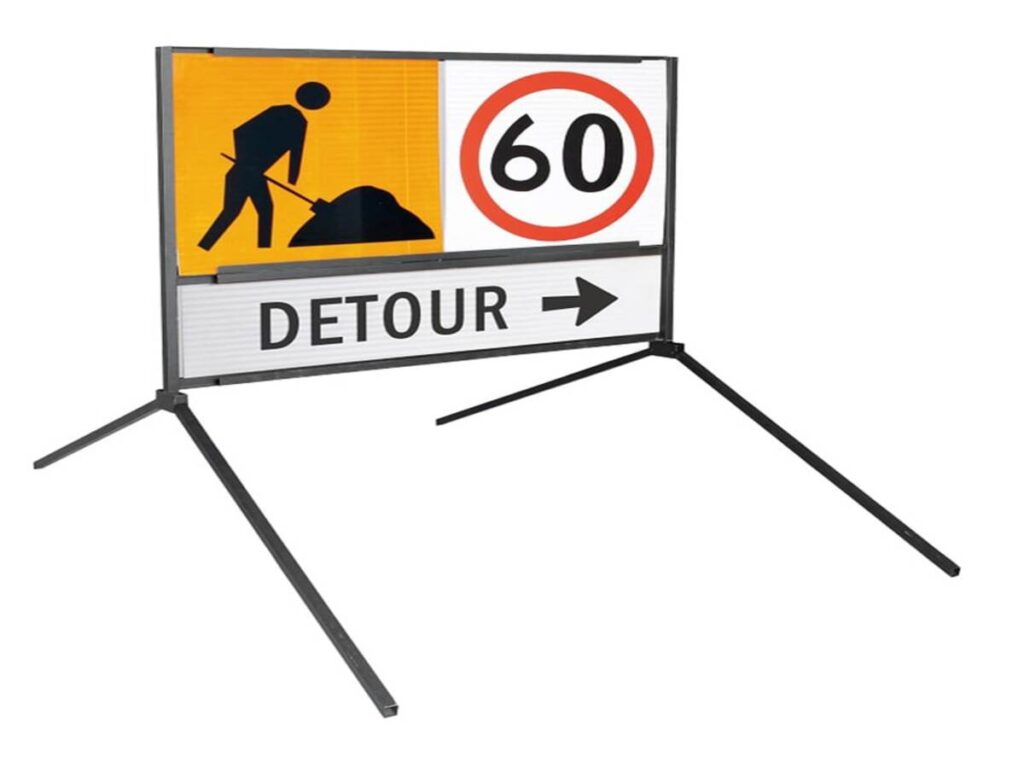
The Multi-Message Sign System is the standard for temporary traffic management in Queensland, New South Wales, and Victoria. Unlike fixed-message metal signs, this modular system separates the “message” from the “structure.”
A Modular Framework
The system consists of a lightweight, galvanised steel frame designed to hold removable panels.
- The Frame: A generic skeleton that remains on the truck.
- The Inserts: Lightweight Corflute panels (600x600mm or 1200x300mm) that slide into the frame.
This interchangeability means a traffic control crew does not need to carry 50 different metal signs. They simply carry 10 frames and a stack of 50 flat, featherweight Corflute inserts.
Weight Comparison: Steel Signs vs. Corflute Inserts
The weight difference between traditional metal substrates and professional-grade Corflute is staggering. In a direct head-to-head comparison, a high-density Corflute insert typically weighs only 15% to 20% of a standard 1.6mm steel or aluminium sign of the same dimensions.
The “Ute Load” Calculation
Consider a standard site setup requiring 40 different hazard warnings.
- All Steel Scenario: Using traditional metal signs adds approximately 100kg of dead weight to the vehicle.
- MMS Corflute Scenario: Utilising the Multi-Message Sign System with Corflute inserts reduces that weight to approximately 20kg.
Result: By converting to a modular system, contractors reclaim nearly 80kg of payload capacity per vehicle. This weight saving directly translates into lower fuel consumption and a significant reduction in the cumulative strain on traffic control personnel.
Reducing GVM (Gross Vehicle Mass) for Traffic Control Fleets
Popular workhorses like the Toyota Hilux or Isuzu D-Max have a typical payload capacity of around 900kg to 1000kg. However, once you account for the tray body, bull bar, toolbox, arrow board, and two crew members, the actual available payload for equipment often shrinks to under 400kg.
Carrying heavy steel signs eats into this critical buffer. By converting to a Multi-Message Sign system with lightweight Corflute, fleet managers reclaim valuable payload capacity. This ensures the vehicle remains legal (under GVM) even when fully loaded with cones and bollards.
Why Material Density Matters for Operational Safety
While the primary goal is to reduce weight, the signage must maintain structural integrity. Optraffic ensures its Corflute inserts utilise high-density polypropylene sheets. This increased material density ensures the inserts remain flat in high-velocity drafts and offer superior impact resistance on active roadworks sites, unlike cheaper, lower-density plastic sheets that buckle or crack under stress.
For high-wind highway zones where MMS frames might not be suitable, consider using Box Edge Signs for maximum stability.
Cost Benefits of Interchangeable Signage
Beyond weight, the economic logic of interchangeable signage is compelling.
Lower Inventory Costs
Purchasing a dedicated metal sign for every possible hazard (e.g., “Mowing”, “Tree Work”, “Line Marking”) is capital intensive. With the MMS system, contractors invest in durable frames once. The specific messages are printed on inexpensive Corflute inserts.
- Capital Expense: A Corflute insert costs a fraction of a riveted metal sign.
- Replacement Cost: If a message is scratched or damaged, replacing the plastic insert is cheap and instant. The expensive metal frame remains intact.
OH&S: Reducing Manual Handling with Lightweight Signs
Manual handling injuries are the single largest cause of workers’ compensation claims in the Australian construction industry. Safe Work Australia statistics consistently highlight “lifting and carrying” as a primary risk factor.
The Cumulative Strain
A traffic controller may deploy and retrieve signs 50 times a shift.
- Steel Signs: Repetitive lifting of metal plates puts significant strain on the lower back and shoulders.
- Lightweight Signs: Optraffic Corflute inserts are virtually weightless in the hand by comparison.
Transitioning to lightweight signs reduces the biomechanical load on workers. It minimises fatigue and significantly lowers the risk of musculoskeletal injuries, protecting both the workforce and the company’s insurance premiums.
Conclusion: Upgrade to Optraffic Multi-Message Signs
Efficiency is not just about speed; it is about weight, cost, and safety. Carrying heavy steel signage in 2026 is an operational liability. It wastes fuel, risks GVM non-compliance, and fatigues your crew.
Optraffic provides the complete Multi-Message Sign System—from robust galvanised frames to high-visibility, high-density Corflute inserts.
Frequently Asked Questions about MMS Efficiency
Yes. Optraffic applies the exact same Class 1W (Class 400) retroreflective sheeting to our Corflute inserts as we do to metal signs. They provide identical night-time visibility and are fully compliant with AS 1742.3.
Yes. The Multi-Message Sign System uses industry-standard dimensions. Our inserts are designed to fit any standard galvanised MMS frame used in Australia.
While they are lightweight for transport, the Multi-Message Sign System secures the inserts within a galvanised steel frame. Furthermore, because Optraffic specifies a higher-density grade of polypropylene, these signs possess the necessary rigidity to stay flat and secure within the frame channels even when subjected to the draft of passing heavy vehicles.
Hundreds. Because Corflute inserts are flat and only 5mm thick, they take up minimal vertical space. You can stack 50 inserts in the same space that would hold only 5 or 6 bulky metal signs, drastically improving your logistics capacity.