Introduction: The Universal “Start Button” for Safety
Every road construction project begins with a single, critical decision: the placement of the first advance warning sign. Before a driver sees a traffic cone, a flagger, or an excavator, they must see the diamond.
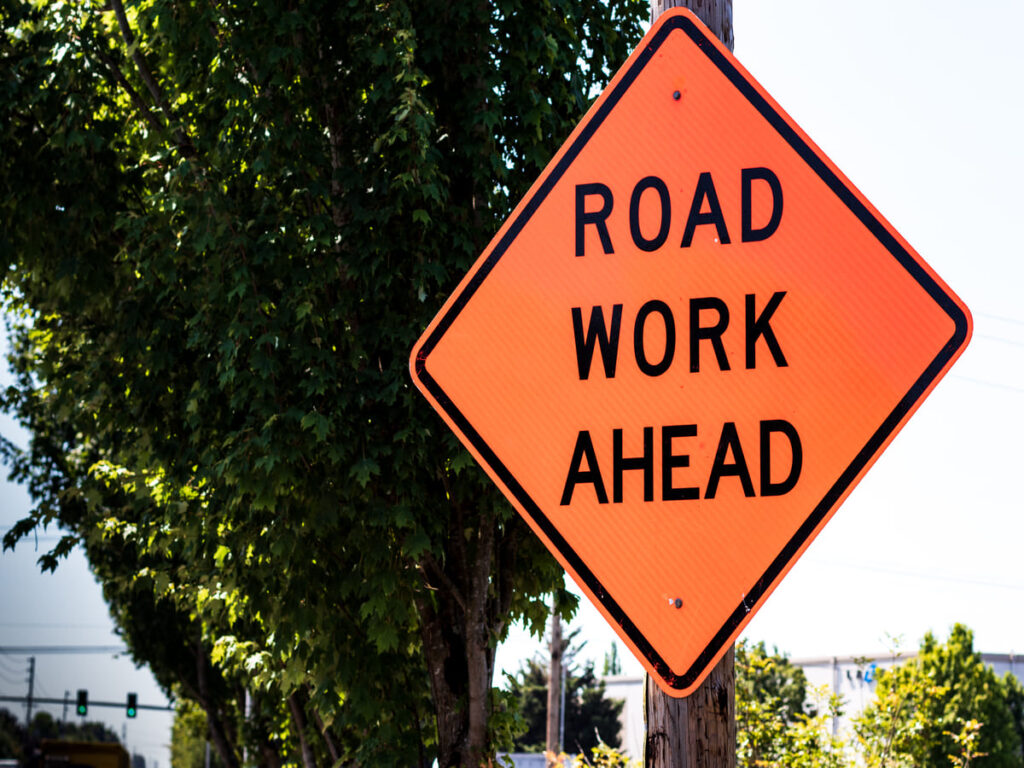
The Road Work Ahead sign (MUTCD Code W20-1) is the universal “start button” for temporary traffic control (TTC). It serves a specific legal and psychological function. It shifts the driver’s mental state from “open road cruising” to “alert caution.”
If you place this sign incorrectly, or if it lacks the proper retroreflectivity, your entire work zone is non-compliant. A missing Road Work Ahead sign is the first thing a lawyer looks for after a work zone accident. Liability often hinges on this single piece of orange aluminum.
This guide provides a comprehensive breakdown of the W20-1 standard. We will cover the shift from the legacy Men at Work sign, the specific placement distances for urban vs. rural roads, and how to choose the right road work ahead sign with stand for your crew.
Related Resource: The placement of your W20-1 defines the “A-Dimension” for your entire zone. For a complete spacing chart, reference our Construction Road Signs Placement Guide.
The Evolution: “Men at Work” vs. “Road Work Ahead”
For decades, the industry standard was the text-based Men at Work sign. You will still see this term used in casual conversation and older contract specifications. However, federal standards and best practices have evolved significantly.
1. Why “Men at Work” is Outdated
The shift away from Men at Work signs is not just about political correctness; it is about accuracy and safety.
- Inclusivity: The modern construction workforce is diverse. Using gender-specific language is unprofessional in today’s compliance environment.
- Scope of Hazard: The term “Men at Work” implies that the only hazard is a human being. This is dangerous. A work zone often presents hazards even when no workers are present, such as:
- Uneven lanes or steel plates.
- Narrowed widths due to concrete barriers.
- Mud or gravel on the roadway.
- The Solution: The Road Work Ahead sign covers all conditions. It warns drivers that the road itself is modified, regardless of whether a human is standing on it.
2. The Modern MUTCD Standard (W20-1 & W21-1)
The Manual on Uniform Traffic Control Devices (MUTCD) Section 6F.18 establishes the W20-1 Road Work Ahead sign as the primary general warning sign.
For scenarios where you specifically need to warn about human presence (e.g., a short-duration spot repair), the MUTCD recommends the Symbol Sign (W21-1). This sign features a graphic of a worker holding a shovel.
- Why Symbols Win: A driver moving at 65 MPH processes a graphic symbol 2x faster than reading text like “Men at Work.”
- Legibility: Text signs require literacy and language proficiency. Symbols are universal.
Key Takeaway: If your contract specifies a Men at Work sign, clarify with the engineer. In 99% of cases, they actually require a W20-1 Road Work Ahead sign or a W21-1 Symbol sign.
The Physics of Visibility: Why Orange Matters
You cannot just use any orange sign. The effectiveness of a construction ahead road sign depends on two factors: Fluorescence and Retroreflectivity.
1. Fluorescent Orange (The Daytime Hero)
Standard orange paint fades. Modern construction work ahead signs use Fluorescent Orange sheeting.
- The Science: Fluorescence absorbs UV light from the sun (which is invisible) and re-emits it as visible orange light.
- The Result: The sign appears to “glow” during the day, especially at dawn and dusk. This increases the detection distance by up to 40%.
2. Retroreflectivity (The Nighttime Hero)
At night, the sign must bounce headlights back to the driver.
- Engineering Grade (Type I): Do not use this. It is obsolete for road construction ahead signs. It reflects only a fraction of light.
- High Intensity Prismatic (Type IV): The minimum standard for most temporary signs.
- Diamond Grade (Type XI): The gold standard. For high-speed highways (55+ MPH), you need Type XI sheeting. It reflects light even at wide entrance angles (e.g., if the sign is twisted or the car is in the far lane).
Pro Tip: A road work ahead sign with Type XI sheeting is visible from 1,500 feet away at night. This gives a driver 15 extra seconds to react compared to cheaper materials.
The “A-Dimension”: Precision Placement Rules
The single most common violation in work zone inspections is improper spacing. You cannot simply place a Road Work Ahead sign “somewhere before the cones.”
The MUTCD defines this distance as the “A-Dimension.” It is calculated based on the speed limit and the complexity of the road environment. This distance buys the driver Perception-Reaction Time (PRT).
1. Urban Low Speed (≤ 35 MPH)
- The Rule: Place the sign 100 feet (30 meters) before the transition area.
- The Logic: In city environments, blocks are short (often 300-400 feet). If you place the sign too far back (e.g., 500 feet), it might end up:
- Before the previous intersection (causing turning traffic to miss it).
- Hidden behind a parked delivery truck.
- Confusing drivers who turn off the road before reaching your work zone.
- Scenario: A pothole repair crew on a residential street.
2. Urban High Speed (≥ 40 MPH)
- The Rule: Place the sign 350 feet (100 meters) in advance.
- The Logic: At 40 MPH, a vehicle travels roughly 60 feet per second. A 350-foot gap gives the driver about 6 seconds to see the construction ahead sign, read it, and lift their foot off the gas before they encounter the taper.
- Scenario: Utility work on a 4-lane arterial boulevard.
3. Rural & Highway (≥ 50 MPH)
- The Rule: Place the sign 500 feet to 1,000 feet (150-300 meters) in advance.
- The Logic: On highways, speed is the enemy. Drivers are often in “highway hypnosis.” You need a massive buffer zone. On 70 MPH interstates, this sign is often the first of a 3-sign series (Road Work Ahead -> Left Lane Closed Ahead -> Flagger Ahead), spaced 1,000 feet apart.
- Scenario: Interstate bridge deck repair or lane resurfacing.
Critical Warning: Never place a road construction ahead sign where it contradicts existing permanent signs. For example, do not place it immediately after a “Speed Limit 65” sign. Cover the permanent sign if necessary.
Choosing the Text: Variants & Legal Nuances
While W20-1 “Road Work Ahead” is the default, specific projects demand specific language. Using the wrong text can confuse drivers about the nature of the hazard or limit your legal protection.
Here is how to choose between the common variants:
1. The “Heavy Civil” Standard: Road Construction Ahead Sign
For major infrastructure projects involving excavation, paving, or bridge repair, engineers often specify the road construction ahead sign (W20-1 Variant).
- The Implication: The word “Construction” implies a long-term project (lasting more than 3 days) involving heavy machinery, lane shifts, and potential stoppages.
- Usage: This is the preferred construction ahead road sign for capital improvement projects. It signals to truckers and locals that this is not just a pothole fix—it is a major site.
- Distance: Because “Construction” implies complexity, these signs are typically placed further back (1,500+ feet) on highways to allow heavy trucks time to merge early.
2. The Legal Shield: Work Zone Ahead Sign
Some states and municipalities mandate the text work zone ahead sign (G20-5aP) or combine it with a “Fines Double” plaque.
- The Legal Trap: In many jurisdictions, the legal definition of a “Work Zone” triggers enhanced penalties for speeding or reckless driving.
- Why Use It? If your primary concern is protecting workers from speeding cars, using specific “Work Zone” nomenclature establishes the legal boundary for double fines. It carries more authority than a generic warning.
3. The Utility Specialist: Utility Work Ahead
If your crew is working on power lines, gas mains, or telecommunications, do not use a generic construction work ahead sign.
- The Rule: Use “Utility Work Ahead” (W21-7).
- The Driver Expectation: When a driver sees “Utility,” they expect a shoulder closure or a bucket truck blocking a single lane. They do not expect a dug-out road surface.
- Accuracy: Using “Construction” for a cable installation is misleading. Using “Utility” tells the driver exactly what to look for (overhead lines or shoulder work).
4. The “Men at Work” Legacy
As mentioned in the introduction, the text Men at Work sign is being phased out. However, if you are working in a private facility (like a factory complex or private parking lot) where older standards persist, you might still see requests for this.
- Recommendation: Always upgrade to the Symbol Sign (W21-1). It communicates “Human Presence” instantly without language barriers.
Choosing the Right Road Work Ahead Sign with Stand: Rigid vs. Roll-Up
A sign is useless if it is lying flat in the dirt. For temporary traffic control, the mounting system is just as important as the retroreflective face. You generally have two material choices when buying a road work ahead sign with stand.
1. Rigid Construction Ahead Signs (Aluminum/Dibond)
- Best For: Long-term projects (lasting more than 3 days) or semi-permanent installations.
- Pros: Extremely durable, wind-resistant, and maintains retroreflectivity longer.
- Cons: Heavy, difficult to store in a pickup truck, and dangerous if they become a projectile in a crash.
- Mounting: Usually requires heavy-duty square steel posts or large A-frame barricades.
2. Roll-Up Road Work Ahead Signs (Vinyl/Mesh)
- Best For: Daily operations, maintenance crews, and utility trucks.
- Pros: Lightweight, deploys in under 60 seconds, and takes up minimal storage space.
- Cons: Can “flutter” in high winds if not tensioned correctly.
- The Industry Standard: For most mobile crews, a roll-up road work ahead sign with stand is the go-to kit. It allows a single worker to set up a compliant advance warning area in minutes.
To avoid buying the wrong setup for your crew’s daily reality, see the full comparison here: Roll-Up vs. Rigid Aluminum Construction Ahead Signs: Which is Right for Your Construction Project?
Safety Standards for Road Work Ahead Sign Stands (MASH & NCHRP-350)
You cannot prop a construction ahead road sign against a tree or mount it on a homemade wooden frame. The stand itself is a regulated safety device.
1. Crashworthiness: Why Your Stand Needs to Collapse
If a distracted driver hits your sign at 60 MPH, what happens?
- Non-Compliant: A heavy, rigid stand might crash through the windshield, injuring or killing the driver.
- Compliant: A MASH-compliant stand is designed to collapse flat or fracture upon impact, passing underneath the vehicle.
- Liability: Using a non-compliant stand opens your company to massive liability lawsuits in the event of a crash.
2. Wind Resistance for Portable Signs
For highway use or open rural roads, wind is the enemy. A standard tripod will blow over when a semi-truck passes at 70 MPH.
- The Solution: Look for a road work ahead sign with stand that features heavy-duty dual springs.
- Mechanism: The springs allow the sign face to flex and bow with the wind gust, then snap back to an upright position, rather than tipping the entire base over.
Mounting Height Rules for Construction Ahead Signs
How high should the bottom of the sign be from the ground? The MUTCD has two distinct rules based on the environment.
1. Rural & Highway (The “1-Foot Rule”)
- Height: The bottom of the road work ahead sign must be at least 1 foot (12 inches) above the roadway.
- Why? On open roads, the main concern is stability. A lower center of gravity prevents the sign from blowing over. Since there are no parked cars or pedestrians to block the view, 1 foot is sufficient for headlight illumination.
2. Urban & Business Districts (The “7-Foot Rule”)
- Height: The bottom of the sign must be at least 7 feet above the ground.
- Why?
- Visibility: In cities, cars are often parked on the shoulder. A 1-foot sign would be invisible behind a parked sedan.
- Pedestrians: A low sign is a head-injury hazard for pedestrians walking on the sidewalk.
- Hardware Implication: You need a stand with adjustable legs or a mast extension to reach this 7-foot requirement.
Pro Tip: If you are working on a sidewalk, you might also need a “Sidewalk Closed” sign. Check our Sidewalk Closed Sign Guide for ADA specifics.
Closing the Loop: The End Road Work Sign (G20-2)
The road work ahead sign starts the legal liability zone, but what ends it?
Leaving a work zone “open-ended” is a major safety risk. If drivers pass the last cone but do not see a termination sign, they remain unsure if the speed limit has returned to normal. Over time, this causes “sign blindness,” where drivers ignore future warning signs because they assume the zone is inactive.
1. The 500-Foot Rule for End Road Work Signs
- The Standard: According to MUTCD Section 6F.59, the End Road Work sign (G20-2) should be placed 500 feet past the end of the work space (the last cone or barrel).
- The Function: This sign legally terminates the temporary traffic control zone. It restores the original speed limit and tells the driver, “You can relax now.”
2. Why “End Road Work” is Crucial for Construction Ahead Signs
If you use a construction ahead road sign at the beginning, you owe it to the driver to tell them when the construction is over.
- Trust: By strictly defining the end of the zone, you build trust. Drivers are more likely to obey your work zone ahead sign next time because they know your signage is accurate and updated.
Conclusion: Sourcing Compliant Road Work Ahead Signs
The Road Work Ahead sign (W20-1) is the single most important diamond on the road. It defines the “A-Dimension,” sets the legal boundary for the work zone, and serves as the first line of defense for your crew.
Whether you call it a men at work sign, a construction work ahead sign, or simply W20-1, the requirement is the same: it must be retroreflective, it must be mounted at the correct height, and it must be stable.
Optraffic manufactures the complete range of MUTCD-compliant advance warning devices:
- High-Intensity Prismatic & Diamond Grade Sheeting: Ensuring your road work ahead sign is visible from 1,500 feet at night.
- MASH-Compliant Stands: Heavy-duty, dual-spring stands that resist highway winds.
- Custom Legends: Need “Utility Work Ahead” or “Survey Crew”? We print to spec.
Do not risk your project’s timeline on non-compliant gear. Contact Optraffic today to equip your fleet with the industry standard in advance warning protection.
FAQ: Common Questions About Road Work Ahead Signs
Is a “Men at Work Sign” still legal?
Technically, yes, but it is outdated. The MUTCD prefers the Road Work Ahead sign (W20-1) or the Worker Symbol sign (W21-1) because they are gender-neutral and more quickly recognized by drivers. Most state DOT contracts now strictly require W20-1.
How far apart should construction ahead signs be placed?
It depends on the speed limit.
- Urban Low Speed: 100 feet.
- Urban High Speed: 350 feet.
- Highways: 500 to 1,000 feet.
Can I use a “Work Zone Ahead Sign” instead?
Yes. The work zone ahead sign is often used when double fines are in effect. It carries significant legal weight and is often paired with a speed limit reduction sign.