Every time a procurement manager, traffic control contractor, or municipal engineer orders road signs in the United States, the specification sheet asks the same question: what aluminum gauge do you need? If you choose the wrong thickness, you face three immediate problems. First, your signs may fail a DOT inspection for non-compliance. Second, panels can warp or blow down under high-wind conditions. Third, you end up paying replacement costs that erase any savings you gained from buying lighter material.
In this guide, we cover every standard aluminum sign thickness used in the U.S. market — from .063″ light-duty all the way to .125″ extra heavy-duty. Specifically, we explain MUTCD compliance thresholds, sign-size selection tables, alloy grade requirements, and a practical RFQ checklist. Whether you source aluminum sign blanks for a construction work zone, manage a municipal sign replacement program, or run an equipment rental fleet, this reference gives you what you need before placing an order.
Why Aluminum Thickness Is a Compliance Issue, Not Just a Durability Choice
Many buyers treat gauge selection as a cost-optimization decision. In reality, it is also a federal compliance issue — and confusing the two leads to expensive mistakes. The Manual on Uniform Traffic Control Devices (MUTCD), published by the FHWA, governs all traffic control devices on U.S. public roads. It references ASTM B-209 as the material standard for aluminum sign blanks and sets minimum structural requirements that translate directly into minimum thickness thresholds.
Specifically, MUTCD Section 2A.11 states that traffic signs must be fabricated from materials that are “retroreflective, durable, and capable of withstanding environmental conditions at the installation site.” Furthermore, the supporting Standard Highway Signs and Markings (SHSM) book, Section 7, specifies that permanent roadway signs use aluminum blanks conforming to ASTM B-209, with thickness and alloy appropriate for sign size and location. State DOTs then layer their own specifications on top — and those state specs can be stricter than the federal floor.
Beyond compliance, there is also a tort liability concern. If a sign fails structurally — for example, a panel warps and becomes unreadable, or a post-mounted sign blows into traffic — and investigators find that the aluminum gauge did not meet applicable specifications, the installing contractor or responsible agency faces direct legal exposure. Therefore, specifying the correct thickness upfront is not just good engineering. It is professional risk management.
The 5 Standard Aluminum Thicknesses for Road Signs — Full Specifications
The U.S. sign industry uses five standard thicknesses, measured in decimal inches. Below, we break down each option, explain where it applies, and note where you should not use it.
| Thickness | Industry Name | Primary Use | Typical Applications | MUTCD Status |
| .040″ | Economy | Indoor / private property | Temporary event signs, private signs | Not for public roads |
| .063″ | Light Duty | Work zone TTC signs | Construction temp signs, rental fleet | Permitted for temp TTC |
| .080″ | Standard Duty | Permanent roadway signs | Stop, speed limit, warning (up to 36″) | Federal minimum — permanent signs |
| .100″ | Heavy Duty | Large or high-wind signs | 48″+ signs, coastal/mountain zones | Required for oversized panels |
| .125″ | Extra Heavy Duty | Freeway / extreme sites | Overhead guide signs, hurricane zones | DOT-spec for high-exposure sites |
.040″ Aluminum — Economy Grade
At four hundredths of an inch, .040″ aluminum meets no MUTCD structural standard for traffic control on public roads. As a result, its legitimate uses are strictly private-property indoor signs, real estate yard signs, and decorative signage that drivers will never encounter at road speed. If you are sourcing DOT-compliant signage for any public road, remove this gauge from your consideration.
.063″ Aluminum — Light Duty (Temporary Traffic Control)
The .063″ gauge is the accepted minimum for temporary traffic control (TTC) signs in construction work zones under MUTCD Part 6. Contractors and equipment rental companies choose it primarily because it is lighter and cheaper per panel — two real advantages when workers stage, move, and re-stage signs across a multi-phase project. For comparison, a standard 36″x36″ .063″ aluminum sign blank weighs approximately 4.4 lbs, while the same size in .080″ weighs 5.6 lbs. On a 500-sign project, that difference adds up quickly.
However, .063″ has a critical limitation: you cannot use it for permanent installation. In addition, some state DOTs prohibit .063″ on high-speed work zones — specifically, corridors with posted speeds at or above 55 mph — even for temporary use. Always verify your state’s TTC plan requirements before ordering this gauge.
.080″ Aluminum — Standard Duty (The Federal Permanent Sign Floor)
Without question, .080″ gauge, 5052-H38 aluminum is the workhorse of the U.S. road sign industry. It represents the federal minimum thickness for all permanent traffic control signs under MUTCD and SHSM Section 7. Consequently, when a state DOT issues a bid package for sign blanks without a more specific call-out, .080″ 5052-H38 is the implied standard.
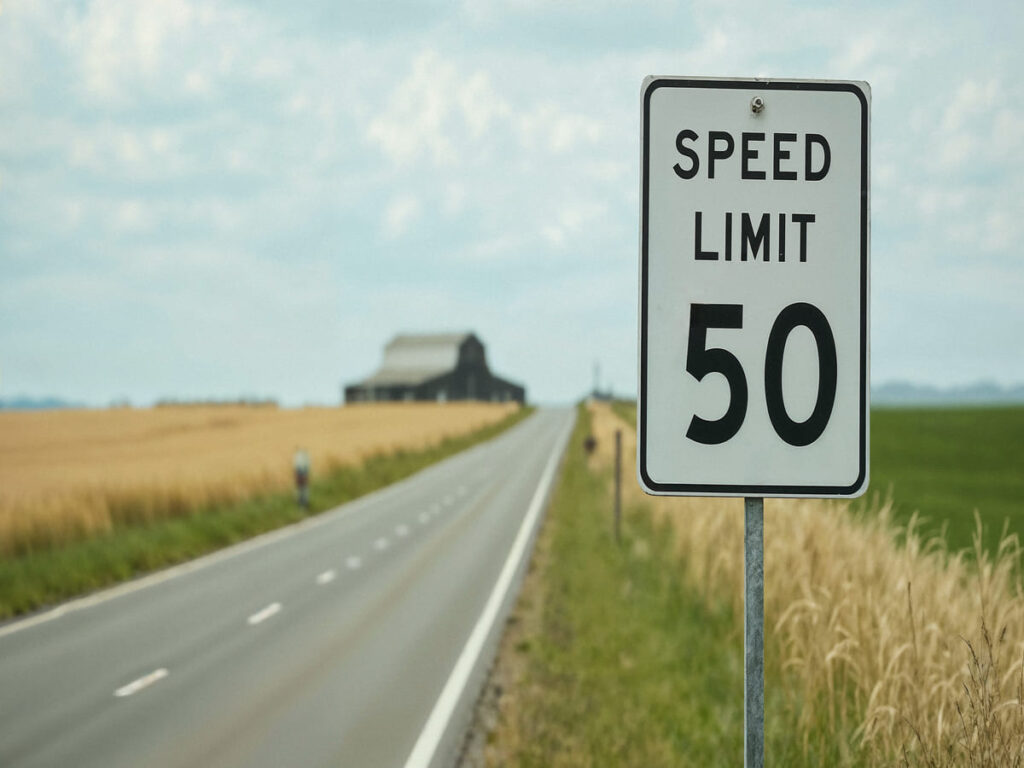
This gauge handles standard regulatory signs — stop, yield, speed limit — along with warning signs and guide signs up to roughly 36″x36″ without supplemental bracing. At this size, a .080″ panel delivers adequate stiffness to resist flutter and vibration on post-mounted installations under standard wind loads. Therefore, for street name signs, parking signs, and most intersection control devices, .080″ is both the correct and compliant choice.
.100″ Aluminum — Heavy Duty (Large Panels and High-Wind Zones)
.100″ aluminum steps in whenever sign size or environmental exposure pushes past what .080″ reliably handles. Two primary triggers drive the upgrade:
- Panel size: Signs larger than 36″x36″ — including 48″x48″ construction warning signs and large guide signs — routinely call for .100″ to prevent panel bow and vibration flutter under wind pressure.
- High-wind geography: Coastal states, mountain corridors, and regions with regular high-wind events frequently require .100″ or .125″ for all permanent sign installations, regardless of panel size.
- DOT contract requirements: Many state DOT standard specifications explicitly call for .100″ on certain sign categories — particularly 48″+ warning signs and large overhead-mounted panels.
To give you a practical sense of the weight impact: a 48″x48″ aluminum sign blank at .100″ gauge weighs approximately 13.8 lbs, compared to 11.0 lbs for the same size in .080″. The difference is manageable with standard two-person installation, but you should budget for heavier mounting hardware to handle the added load.
.125″ Aluminum — Extra Heavy Duty (Freeway and Extreme Environments)
Reserve .125″ gauge (sometimes specified as 1/8″) for the most demanding installations: large freeway guide signs, overhead sign structures, and locations in ASCE 7 high-wind design zones where design wind speeds exceed 90 mph. Many state DOTs require .125″ for any panel exceeding 48″x48″. At this thickness, the panel delivers enough structural rigidity to function as a self-supporting element in multi-post or overhead bridge-mounted configurations.
On the other hand, do not over-specify .125″ for standard roadside applications. You will pay for structural capability your installation does not require. Use it only where project specifications or engineering analysis specifically demand it.
Alloy Grade: Why 5052-H38 Is the DOT Standard — and Why It Matters for Procurement
Thickness alone does not determine a sign blank’s real-world performance. The aluminum alloy and temper designation matter just as much — and this is where many lower-cost suppliers cut corners. A vendor quoting .080″ aluminum could supply 3003-H14 instead of 5052-H38. Both panels measure the same thickness. They look identical. Nevertheless, they perform very differently in the field.
| Alloy | Tensile Strength | Yield Strength | Corrosion Resistance | DOT Spec Status |
| 5052-H38 | 42,000 psi | 35,000 psi | Excellent (marine-grade) | DOT Standard per ASTM B-209 |
| 3003-H14 | 22,000 psi | 21,000 psi | Good | NOT DOT spec |
| 6061-T6 | 45,000 psi | 40,000 psi | Good | Extruded panels only |
5052-H38 belongs to the non-heat-treatable 5xxx aluminum-magnesium series. The H38 temper designation means the alloy reaches its maximum strain-hardened state — the stiffest available without heat treatment. Its high magnesium content (2.2–2.8%) delivers superior corrosion resistance in coastal, saltwater, and industrial environments. As a result, federal procurement specifications for aluminum sign blanks under ASTM B-209 call out 5052-H38 as the required alloy.
By contrast, 3003-H14 is commercially pure aluminum with manganese added for a modest strength boost. It works well for building panels, HVAC ducting, and kitchen equipment — but not for roadway signs. In fact, a 3003-H14 .080″ panel bends more easily by hand than a 5052-H38 .063″ panel. In other words, alloy grade outweighs thickness when it comes to rigidity.
Meanwhile, 6061-T6 is a heat-treatable, high-strength alloy. However, you typically see it only in extruded aluminum sign panels — the interlocking extrusion type for large freeway signs — and structural applications. For standard flat sign blanks in the .063″–.125″ range, 5052-H38 remains the correct specification.
Bottom line for procurement: Always specify alloy by designation in your RFQ. The phrase “.080″ aluminum” alone does not guarantee 5052-H38. Moreover, require mill test reports or a certificate of compliance with ASTM B-209 on any DOT-bid project. Without that documentation, you have no way to verify what you actually received.
Aluminum Thickness by Sign Size — MUTCD-Referenced Selection Table
The relationship between panel size and required thickness is the most practical daily reference for procurement decisions. The table below reflects SHSM Section 7 guidance and standard U.S. industry practice. Note that “high-wind zone” means sites subject to design wind speeds at or above 90 mph per ASCE 7, or as your state DOT defines the threshold.
| Sign Size (longest dimension) | Standard Permanent | High-Wind Zone | Temp. Work Zone (TTC) | Notes |
| Up to 24″ | .080″ | .080″ | .063″ | Street name, parking signs |
| 24″ to 36″ | .080″ | .080″ | .063″ to .080″ | Most regulatory and warning signs |
| 36″ to 48″ | .080″ | .100″ | .080″ | Large warning, construction signs |
| 48″ to 60″ | .100″ | .100″ to .125″ | .080″ to .100″ | DOT-spec construction warning signs |
| Over 60″ | .125″ | .125″ | .100″ | Freeway guide signs; verify state DOT |
Important: These values represent federal floor requirements. Before you finalize a purchase order for any public-works project, cross-reference your specific state DOT standard specifications. California (Caltrans), Texas (TxDOT), and Florida (FDOT) each publish sign material standards that may require heavier gauge or specific alloy certifications beyond federal minimums.
Thickness Requirements by Application — What Each Buyer Segment Needs to Know
Traffic Control Contractors and Construction Companies
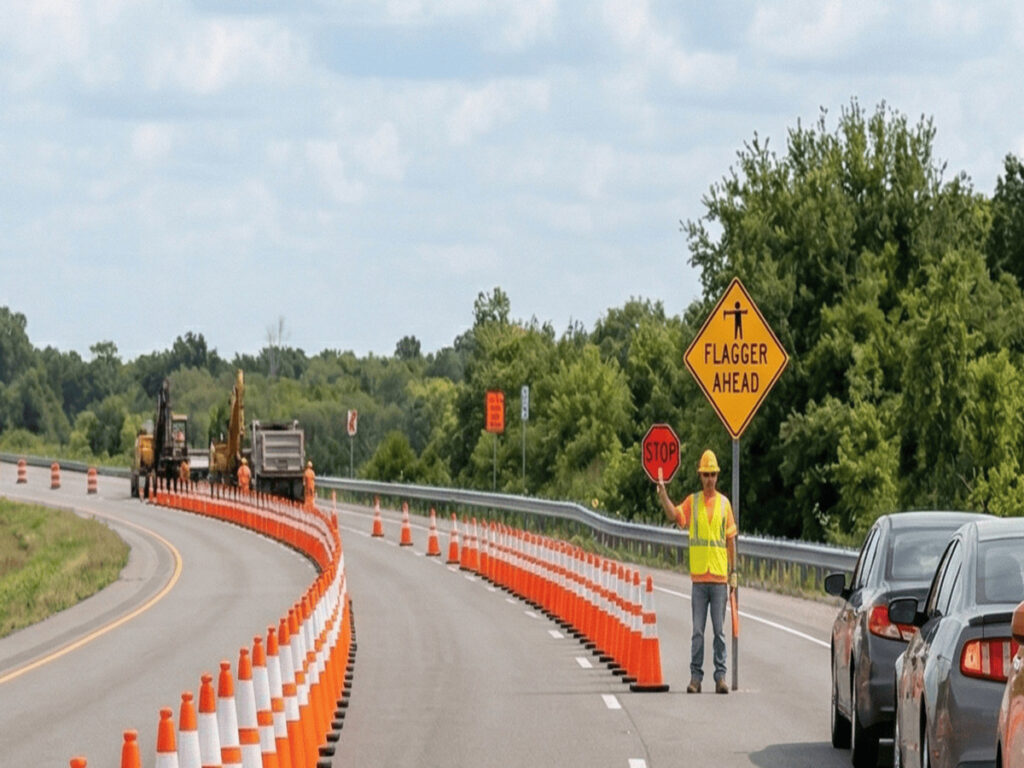
Work-zone sign fleets represent the largest single buyer category for aluminum sign blanks in the U.S. For most temporary traffic control applications, .063″ 5052-H38 offers the best cost-to-compliance balance. It satisfies MUTCD Part 6 temporary traffic control requirements for work-zone signs, weighs less for workers to handle, and stacks efficiently on trucks.
That said, two situations push you to .080″ gauge even in a temporary context. First, if your Traffic Control Plan (TCP) requires signs to remain in place through storm events or in a high-wind corridor, the extra stiffness of .080″ reduces the risk of blown-down panels and the liability that comes with them. Second, some state DOTs require .080″ for all work-zone signs regardless of size — so always verify before you order. For the standard 48″x48″ MUTCD advance warning sign on high-speed roads, .080″ is the industry norm even for temporary use.
Equipment Rental Companies
Rental fleet signs absorb more physical abuse than any other sign category. Workers repeatedly install, remove, stack, and transport them in open truck beds. As a result, the material wears faster than it weathers. For most rental fleets, .080″ 5052-H38 is the right specification. It is durable enough to survive rough handling, compliant for both temporary and permanent applications, and thin enough that unit replacement cost stays manageable when panels do take damage.
Some rental operators do use .063″ for smaller signs at or below 24″ to lower per-unit cost and reduce handling weight. However, for anything larger, stick with .080″ to avoid compliance issues when customers deploy signs on DOT-regulated roads.
Municipal and DOT Procurement Teams
Government agencies procuring permanent road signs for public roads must meet both federal MUTCD minimums and their state DOT standard specifications. For the vast majority of sign types — stop signs, speed limit signs, warning diamonds, guide signs up to 36″ — the specification is .080″ 5052-H38 per ASTM B-209. Your bid packages should include: alloy designation, temper, thickness tolerance (plus or minus .005″ is standard), conversion coating per ASTM B-921, and retroreflective sheeting grade per ASTM D4956.
Furthermore, for sign replacement programs in coastal counties, high-elevation mountain districts, or areas with documented high-wind events, engineering review may justify a blanket upgrade to .100″ or .125″ gauge across your standard sign inventory. The higher upfront unit cost typically pays back through fewer emergency replacements after storm events.
Parking Lot and Facility Operators
Parking signs and ADA compliance signs on private property do not fall under MUTCD unless the facility serves public traffic (per MUTCD Section 1A.09). Even so, .080″ aluminum remains the industry standard for outdoor parking signage. Thinner gauges tend to warp and fade after several years of UV exposure and temperature cycling — a maintenance headache you can avoid by specifying .080″ from the start. For indoor parking structures, .063″ is generally acceptable.
Conversion Coating and Reflective Sheeting — The Rest of the Sign Blank Specification
Aluminum thickness and alloy grade define the substrate. However, a fully compliant road sign also requires two additional specifications that procurement teams must address at the same time.
Chemical Conversion Coating
Federal procurement specs require aluminum sign blanks to undergo conversion coating — per ASTM B-921 or ASTM B-449 — before suppliers apply retroreflective sheeting. The coating creates a chemically bonded transition layer that ensures long-term adhesion of the sheeting to the panel. It also provides a corrosion barrier at cut edges and mounting holes. In practice, signs where manufacturers skip or under-apply the coating show sheeting delamination — typically visible as edge lifting within two to three years of installation.
Retroreflective Sheeting Grade
The MUTCD and ASTM D4956 define three sheeting performance grades. Your aluminum gauge decision and your sheeting grade decision should go hand in hand, because both affect lifecycle cost and compliance. For UK and European projects, see also RA1 vs RA2 reflective sheeting standards:
- Engineer Grade (Type I): The minimum specification, with a 5- to 7-year lifespan. Appropriate for parking signs and low-priority applications.
- High Intensity Prismatic (Type III/IV): The current MUTCD minimum for most permanent road signs, with a 10-year lifespan. Most state DOTs require it for all regulatory and warning signs.
- Diamond Grade (Type IX/XI): Premium sheeting for high-speed roads, school zones, and highway guide signs. Lifespan exceeds 12 years. Some state DOT specifications mandate it.
Here is a common mismatch to avoid: pairing a .100″ heavy-duty blank with Engineer Grade sheeting. You pay for a structurally durable substrate, but the visible surface fails well before the aluminum does. Instead, match your aluminum gauge expected service life to your sheeting grade expected service life. For long-term permanent installations, that typically means .080″+ aluminum paired with High Intensity or Diamond Grade sheeting.
How to Write a Compliant Aluminum Sign Specification for Your RFQ
This section separates procurement teams that consistently receive compliant, project-ready product from those that deal with rejected deliveries, DOT inspection failures, and reorder costs. A complete aluminum sign blank specification for a public-works RFQ must include all of the following elements:
| Specification Element | Example Language | Reference Standard |
| Alloy and Temper | 5052-H38 virgin aluminum alloy | ASTM B-209 |
| Thickness | .080″ (plus or minus .005″ tolerance) | SHSM Section 7 |
| Conversion Coating | Chemical conversion coat per ASTM B-921 or B-449 | ASTM B-921 / B-449 |
| Corner Radius | 1″ corner radius unless project drawings specify otherwise | SHSM / state DOT spec |
| Hole Punching | 3/8″ diameter, 1″ from edge, centered top and bottom | SHSM / state DOT spec |
| Reflective Sheeting | 3M High Intensity Prismatic Type III or approved equal | ASTM D4956 / MUTCD |
| Certification | Mill cert or certificate of compliance with ASTM B-209 | DOT bid requirement |
| Recycled Alloy | State whether virgin alloy is required or recycled is acceptable | Per project bid tabulation |
Pro tip: If your project falls under a state with published standard specifications — and California, Texas, Florida, and New York all do — download the state DOT sign materials section and attach it to your RFQ by reference. This approach eliminates ambiguity and gives your supplier clear acceptance criteria so both sides know exactly what a compliant delivery looks like.
Weight and Shipping Considerations for Large Sign Orders
For procurement teams ordering large quantities, aluminum thickness directly affects freight cost and handling logistics. The table below shows approximate weights for the most common sign sizes across gauge options. For a deeper breakdown of weight calculations, see our aluminum sheet metal weight guide for traffic signage.
| Sign Size | .063″ Weight | .080″ Weight | .100″ Weight | .125″ Weight |
|---|---|---|---|---|
| 24″×24″ | 3.5 lbs | 4.5 lbs | 5.6 lbs | 7.0 lbs |
| 30″×30″ | 5.5 lbs | 7.0 lbs | 8.7 lbs | 10.9 lbs |
| 36″×36″ | 7.9 lbs | 10.0 lbs | 12.5 lbs | 15.7 lbs |
| 48″×48″ | 14.1 lbs | 17.8 lbs | 22.3 lbs | 27.9 lbs |
| 60″×60″ | 22.0 lbs | 27.9 lbs | 34.8 lbs | 43.6 lbs |
To illustrate the freight impact: for a 500-sign order of 36″×36″ panels, stepping from .063″ to .080″ adds approximately 1,050 lbs of total shipment weight (from 3,950 lbs to 5,000 lbs). On an LTL freight quote, that differential can meaningfully affect your landed unit cost. Consequently, discuss your volume and delivery requirements with your supplier before finalizing gauge selection — especially on large construction project orders where multiple deliveries are likely.
Six Common Procurement Mistakes — and How to Avoid Them
- Specifying thickness without alloy grade. The phrase “.080″ aluminum” alone does not guarantee 5052-H38. Always include alloy plus temper plus thickness in every order to prevent non-compliant substitution.
- Using .063″ for permanent installation. This is the most common compliance failure in the field. If the sign stays up after your project ends, it needs .080″ minimum.
- Over-specifying .125″ for standard roadside signs. For signs under 48″, this adds cost and weight with no compliance benefit. Match the gauge to the actual application.
- Skipping the state DOT spec check. Federal MUTCD sets the national floor. However, your state may require a heavier gauge or specific sheeting grades on top of that. Always verify before you finalize the order.
- Mismatching sheeting grade and panel lifetime. Engineer Grade sheeting on a .100″ blank means the sheeting fails while the substrate still has years of life left. Match lifespan specifications across the full sign assembly.
- Failing to require conversion coating documentation. Without a documented conversion coat, long-term sheeting adhesion is not guaranteed. Require certification at order time, not after delivery.
Frequently Asked Questions
Q: What is the minimum aluminum thickness for a permanent road sign in the United States?
A: The federal minimum for permanent traffic control signs on U.S. public roads is .080″ (approximately 2mm) 5052-H38 aluminum per MUTCD and SHSM Section 7. This standard applies to regulatory signs (stop, speed limit, yield), warning signs, and guide signs up to roughly 36″ in their longest dimension. For larger signs, you typically need .100″ or .125″. Also note that individual state DOTs may impose stricter requirements, so always verify your project’s governing specification.
Q: Can I use .063″ aluminum for work zone signs?
A: Yes. .063″ 5052-H38 is acceptable for temporary traffic control signs in construction work zones under MUTCD Part 6. However, it is not compliant for permanent sign installation. Additionally, some state DOTs require .080″ even for temporary signs on high-speed roads at or above 55 mph. Confirm your state’s TTC plan requirements before placing your order.
Q: What is 5052-H38 and why do DOT specs require it instead of regular aluminum?
A: 5052-H38 is a specific aluminum alloy and temper that delivers significantly higher tensile strength (42,000 psi versus 22,000 psi for common 3003-H14) and superior corrosion resistance. Federal procurement specifications under ASTM B-209 call out 5052-H38 as the required alloy for aluminum sign blanks. When suppliers use a lower-grade alloy at the same thickness, they produce a weaker, less rigid panel that bends more easily and corrodes faster. To avoid this, always specify alloy and temper — not just thickness — in your purchase order.
Q: When does a project require .100″ or .125″ aluminum instead of .080″?
A: Two primary triggers justify upgrading from .080″ to heavier gauge. First, panel size: signs larger than 36″x36″ generally require .100″, and panels exceeding 48″x48″ may require .125″. Second, wind load: installations in ASCE 7 high-wind zones or coastal and mountain corridors where design wind speeds exceed 90 mph often demand .100″ or .125″. Individual state DOT specifications may also mandate heavier gauge for specific sign categories regardless of size.
Q: Do aluminum sign blanks require a chemical conversion coating?
A: Yes. Federal specifications and retroreflective sheeting manufacturer guidelines require conversion coating per ASTM B-921 or ASTM B-449 before sheeting application. The coating creates a chemically bonded surface that ensures long-term adhesion between the aluminum substrate and the retroreflective film. Without it, signs frequently show edge delamination within two to three years of installation — a warranty and compliance headache you can avoid by requiring documented conversion coating at the order stage.
Q: How do I write a compliant aluminum sign specification for a government RFQ?
A: A compliant RFQ specification should include: alloy and temper (5052-H38), thickness with tolerance (.080″ plus or minus .005″), conversion coating reference (ASTM B-921 or B-449), corner radius, hole punching pattern, retroreflective sheeting grade (ASTM D4956 type), and certification requirements (mill cert or ASTM B-209 certificate of compliance). For DOT-funded projects, also attach your state’s standard sign material specification section by reference. This step eliminates ambiguity and protects you from receiving non-compliant material.
Q: What is the real-world difference between .080″ and .100″ for a 48″ construction sign?
A: For a 48″x48″ aluminum sign blank, the difference is structural rigidity and wind resistance. At .080″, the panel meets the federal minimum and works in most standard locations. At .100″, the panel is roughly 25% stiffer, weighs about 2.4 lbs more, and satisfies the stricter requirements that many state DOTs set for 48″+ signs or high-wind zones. For construction projects in coastal or mountainous regions, or anywhere state DOT specs apply to a 48″ panel, default to .100″ to stay compliant.
Q: Can aluminum sign blanks be recycled or re-sheeted at the end of their service life?
A: Yes — and this is one of aluminum’s practical advantages for procurement programs. First, 5052-H38 blanks are 100% recyclable at end of service, with significant scrap value. Second, sign blanks that are structurally sound but carry failing retroreflective sheeting can often undergo stripping and re-sheeting. This approach extends service life at a fraction of full replacement cost. Re-sheeting works only when the conversion coating remains intact; if a blank shows severe corrosion or physical damage, replace it rather than re-sheet it.
Summary: Choosing the Right Aluminum Gauge for Your Road Sign Project
To summarize the full decision framework: for most U.S. road sign procurement — whether you equip a construction work zone, build out a traffic management fleet, or run a municipal sign replacement program — the selection logic is straightforward.
- Permanent signs on public roads: Start with .080″ 5052-H38. It is the federal minimum and the correct default for signs up to 36″.
- Temporary work zone signs: .063″ 5052-H38 is acceptable under MUTCD Part 6, with exceptions for high-speed corridors and certain state DOT requirements.
- Signs larger than 36″ or in high-wind locations: Step up to .100″, or consult your state DOT specification.
- Freeway overhead signs: .125″ is the standard for these high-exposure applications.
- Always specify the alloy: Thickness without alloy designation exposes you to non-compliant substitution. Require 5052-H38 and ASTM B-209 certification on every order.
OPTRAFFIC manufactures aluminum sign blanks and road signs across the full standard gauge range — .063″, .080″, .100″, and .125″ — using certified 5052-H38 alloy with conversion coating for retroreflective sheeting adhesion. Our products meet MUTCD, ASTM B-209, and SHSM Section 7 requirements. Contact our team to discuss your project specifications and request a quote.