Por que a sinalização de segurança no local de trabalho específica do setor é mais importante do que você imagina
Os EUA. gravado 5,070 acidentes de trabalho fatais em 2024. Um trabalhador morre a cada 104 minutos de um incidente relacionado ao trabalho, de acordo com o Bureau of Labor Statistics (Fonte: https://www.bls.gov/news.release/cfoi.nr0.htm). Esses números moldam o caso para soluções mais inteligentes sinalização de segurança no local de trabalho. Sinais genéricos falham em ambientes especializados. Armazéns, refinarias de petróleo, salas de aula, e canteiros de obras apresentam riscos distintos. Cada um exige uma abordagem de sinalização personalizada.
Este guia detalha sinalização de segurança no local de trabalho requisitos por indústria. Baseia-se nos EUA. regulamentos, especificações técnicas, e 2024 dados de incidente. Gerentes de segurança, Oficiais de EHS, e os planejadores de instalações encontrarão referências práticas para cada setor coberto.
O custo real da sinalização inadequada em ambientes industriais
O Conselho Nacional de Segurança colocou a 2024 custo de acidentes de trabalho em $181.4 bilhão. Os custos médios de lesões consultadas por um médico $48,000. Um único custo de morte no local de trabalho $1.54 milhão. (Fonte: https://lesionfacts.nsc.org/work/costs/work-injury-costs/)
As penalidades da OSHA se acumulam sobre esses custos. O 2026 máximo fica em $16,550 por violação grave e $165,514 por citação intencional ou repetida. (Fonte: https://www.osha.gov/memos/2025-01-07/2025-annual-adjustments-osha-civil-penalties) Trabalhadores perdidos 102 milhões de dias até lesão em 2024. Pobre sinalização de segurança no local de trabalho frequentemente aparece na cadeia de citações.
A linguagem universal dos sinais de segurança: Padrões, Cores & Categorias
Eficaz sinalização de segurança no local de trabalho baseia-se em regras visuais compartilhadas. Três padrões dominam os EUA. e prática internacional.
| Padrão | Jurisdição | Foco principal |
| OSHA 29 Cfr 1910.145 | Estados Unidos | Categorias de sinais, cores, redação |
| ANSI Z535.2 | Estados Unidos | Palavras de sinalização, layout, legibilidade |
| ISO 7010 | Internacional | Pictogramas padronizados |
| EU 92/58/EEC | União Europeia | Sinais de segurança no trabalho |
Fonte: https://www.osha.gov/laws-regs/regulations/standardnumber/1910/1910.145
ANSI Z535.2 classifica palavras de sinalização por gravidade. PERIGO sinaliza um risco imediato de morte. AVISO sinaliza risco de ferimentos graves. CUIDADO marca perigos moderados. AVISO transmite informações gerais.
As quatro categorias funcionais de sinais de segurança
Moderno sinalização de segurança no local de trabalho se enquadra em quatro grupos funcionais:
- Sinais de proibição (círculo vermelho, barra diagonal): proibir ações perigosas
- Sinais de aviso (triângulo amarelo): sinalizar perigos à frente
- Sinais obrigatórios (círculo azul): exigem ações específicas como uso de EPI
- Sinais de condição segura (quadrado verde): marcar saídas, Primeiros socorros, e equipamento de segurança
Sinais de equipamentos de incêndio (vermelho com pictograma branco) formam uma quinta categoria.
Especificações de sinalização industrial vs comercial
A sinalização de segurança industrial e comercial diverge quanto à durabilidade do material, gravidade do perigo, e carga regulatória. Os sinais industriais devem sobreviver aos produtos químicos, vibração, e atmosferas explosivas. A sinalização comercial aborda principalmente códigos de construção e acessibilidade. Para uma análise detalhada dos aplicativos, os leitores podem revisar o diferença crítica entre sinalização de segurança comercial e industrial.
Sinalização de segurança de armazém: Tráfego, Pedestres & Zonas de armazenamento
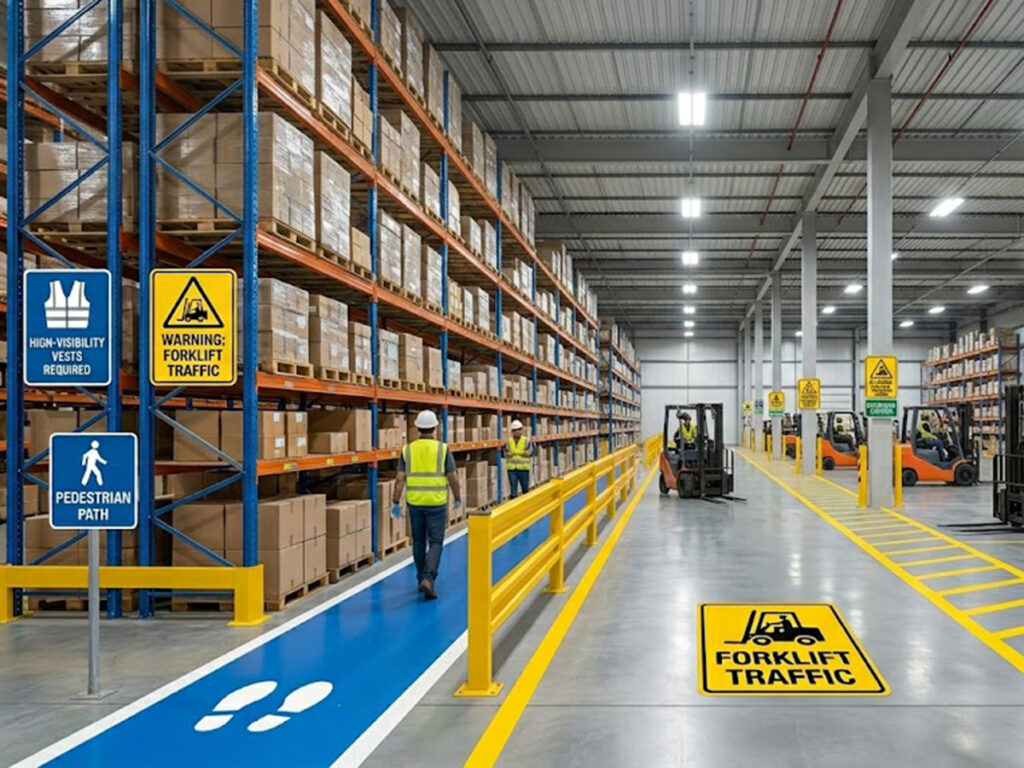
Os armazéns ficam no coração dos EUA. estatísticas de lesões. Ocupações de transporte e movimentação de materiais registradas 1,391 ferimentos fatais em 2024 - o mais alto de qualquer grupo ocupacional. As empilhadeiras movimentaram grande parte desse pedágio (Fonte: https://www.bls.gov/news.release/pdf/cfoi.pdf). Eles causaram 84 mortes relacionadas ao trabalho em 2024 e 25,110 lesões não fatais em 2023–24. (Fonte: https://lesionfacts.nsc.org/work/safety-topics/forklifts/) Impactos sobre pedestres estão no topo da lista de causas. A forte sinalização de segurança do armazém evita esses incidentes.
Otimizando o fluxo de tráfego e a segregação de pedestres
As passarelas para pedestres devem ser claramente definidas e, sempre que possível, fisicamente separados das pistas de empilhadeiras. OSHA aborda isso em 29 Cfr 1910.178(n)(1), o que exige que “todas as regras de trânsito devem ser observadas…[e] uma distância segura deve ser mantida.” Embora não exija tipos de barreiras específicos, isto implica um requisito regulamentar para uma gestão eficaz do tráfego, muitas vezes alcançado através de forte segregação visual e marcação de piso.
A fabricação sozinha enfrentou 937 citações relacionadas a empilhadeiras e $2.7 milhões em multas naquele ano. Operadoras do Reino Unido enfrentam pressão semelhante sob HSG136. O mergulho profundo na sinalização de segurança de armazéns no Reino Unido e na otimização do fluxo de pedestres cobre a camada regulatória em detalhes.
Colocação estratégica de sinalização de segurança em corredores, Docas de carregamento & Zonas de estantes
A colocação de sinais de segurança determina se os trabalhadores veem os perigos a tempo. Embora a OSHA não especifique uma largura numérica da linha de piso em 29 Cfr 1910.178, melhores práticas atuais do setor (referenciando interpretações anteriores da OSHA e padrões ANSI) sugere que as larguras das marcações no piso devem ser de pelo menos 4 polegadas (101.6milímetros) para garantir o domínio visual. Os sinais ao nível dos olhos ficam a 1,5 m – 1,8 m do chão. Sinais de folga suspensos são montados a no mínimo 2,1 m.
A sinalização de segurança do centro logístico também deve levar em conta os ângulos da linha de visão e as variações de iluminação.
| Categoria de sinal | Orientação de montagem/colocação (Referência. ANSI Z535.2 / Fatores Humanos) | Intenção de visibilidade/linha de visão |
| Nível dos olhos do pedestre | Montagem consistente com visualização ideal ao nível natural dos olhos (aprox.. 1.5–1,8m); não deve ser obstruído. | Evita pontos cegos; crucial para a separação entre pedestres e empilhadeiras. |
| Liberação aérea | Monte no ou próximo ao menor risco aéreo. Fazendo referência à visibilidade clara da altura para PITs (Caminhões Industriais Motorizados). | Evita colisões de mastros com mezaninos, luzes, ou aspersores. |
| Marcações de piso | Aplicado ao nível do chão. Uso de contraste de cores (vermelho para perigo, amarelo para cautela) é crítico. | Define faixas de tráfego seguras; estabelece limites claros para os trabalhadores em movimento. |
| Avisos de borda de doca | Aplicado na face da doca ou no piso imediatamente à borda. Referenciando OSHA 1910.28(b)(1) requisitos para proteção contra quedas. | Crucial para a prevenção de quedas tanto para trabalhadores como para PITs. |
Fonte: https://www.osha.gov/laws-regs/regulations/standardnumber/1910/1910.178
Para uma análise mais aprofundada da análise da linha de visão e das marcações de intersecção, veja a chave dicas de colocação de sinalização de segurança para armazéns e centros logísticos.
Armazenamento Frio & Ambientes Logísticos Especializados
O armazenamento refrigerado acrescenta questões de durabilidade do material. Sinais adesivos padrão falham abaixo de 0°C. Os operadores devem especificar substratos de vinil ou alumínio rígido com classificação fria. A exposição aos raios UV também degrada a sinalização externa do cais de carga dentro de 3 a 5 anos.
Industrial & Sinalização Ambiental de Alto Risco: Óleo, Gás, Químico & Fabricação
A sinalização de segurança ambiental de alto risco enfrenta as especificações mais rigorosas em qualquer setor. Eles devem sobreviver ao calor, produtos químicos, vibração, e atmosferas explosivas. O fracasso traz consequências graves.
Óleo, Gás & Requisitos de sinalização de instalações petroquímicas
A sinalização de segurança de petróleo e gás deve atender à API RP 1109 padrões de marcação e NFPA 704 classificações de diamante. O sistema da NFPA usa uma escala de 0 a 4 em quatro categorias: saúde, inflamabilidade, instabilidade, e perigos especiais.
A mineração, pedreira, e o setor de extração de petróleo e gás registraram uma taxa de lesões fatais excepcionalmente alta em 2024. Esses ambientes exigem o mais forte sinalização de segurança no local de trabalho hierarquias na indústria.
Camadas de Múltiplos Sinais em Zonas de Risco Complexas
Um único sinal raramente cobre perigos complexos. As áreas de processo precisam de hierarquias de sinalização em camadas. O guia em usar vários sinais de segurança em áreas de alto risco de forma eficaz explica o espaçamento, hierarquia, e princípios de carga cognitiva.
Armazenamento Químico, Espaços confinados & Riscos de arco elétrico
A sinalização de armazenamento de produtos químicos segue a OSHA 29 Cfr 1910.1200 (Comunicação de perigo) — o segundo padrão OSHA mais citado no ano fiscal 2024. (6) Os pictogramas do GHS identificam perigos químicos específicos. Nfpa 704 áreas de armazenamento com marca de diamante externamente.
Sinais de espaço confinado seguem OSHA 29 Cfr 1910.146. A norma diferencia espaços com autorização obrigatória de espaços sem autorização. Etiquetas de arco elétrico seguem NFPA 70E. Eles devem divulgar a energia incidente e a categoria do EPI.
Canteiro de obras & Sinalização de segurança de linha elétrica
De acordo com o último Bureau of Labor Statistics (BLS) dados, trabalhadores de construção e extração registrados 1,032 fatalidades em 2024. Cai, incidentes atingidos, eletrocussões, e eventos capturados/entre os eventos constituem a OSHA “Quatro Fatais.” Robusto sinalização de segurança no local de trabalho aborda diretamente cada um desses perigos.
Riscos elétricos e sinalização de linhas elétricas aéreas
Riscos elétricos exigem distâncias de aproximação rigorosas. Para trabalhos utilitários e de construção envolvendo guindastes, OSHA 29 Cfr 1926.1408 geralmente exige uma autorização mínima de 20 pés para linhas de energia até 350kV, enquanto outras subpartes, como 1926.959(um), exigir uma condição limite de 10 pés para trabalhadores e equipamentos operando perto de linhas energizadas até 50kV. A sinalização da linha de energia deve marcar estas distâncias mínimas de aproximação (LOUCO) claramente baseado no uso de equipamentos específicos do local. Tensões mais altas precisam de buffers mais amplos. A sinalização da linha de energia deve marcar claramente essas zonas.
Fatalidades recentes chamaram nova atenção para trabalhos de serviços públicos. A análise de sinais de perigo elétrico e proteções para trabalhadores da construção de linhas de energia examina o que mudou após esses incidentes.
Sinais de construção temporários vs permanentes
Os canteiros de obras mudam diariamente. Os sinais devem acompanhar o ritmo. Sinais temporários seguem parte MUTCD 6 padrões. Folhas refletivas se enquadram na ASTM D4956 (Tipos I – XI). Coberturas de maior qualidade são adequadas para projetos de maior duração.
EPI, Escavação & Sinalização de Trabalho em Altura
A proteção contra quedas liderou a lista dos mais citados da OSHA novamente no ano fiscal 2025 com 5914 citações (Fonte: https://workcare.com/resources/article/osha-top-10-violations-2025/). Sinais de escavação marcam trincheiras 5 pés de profundidade de acordo com OSHA 1926.651. Segue sinalização de acesso aos andaimes 29 Cfr 1926.451.
Escola & Sinalização de segurança para instalações educacionais
A sinalização de segurança escolar enfrenta diferentes desafios. As crianças processam informações visuais de maneira diferente dos trabalhadores adultos. Os designers devem equilibrar a conformidade com a acessibilidade. Eficaz sinalização de segurança no local de trabalho nas escolas protege os alunos, funcionários, e visitantes.
Sinalização de Evacuação de Incêndio e Saída de Emergência
Nfpa 101 (Código de Segurança de Vida) rege os sinais de saída em ocupações educacionais. Os sinais de saída devem permanecer visíveis durante a perda de energia. Sinais fotoluminescentes atendendo à UL 924 os padrões oferecem uma opção sem bateria. Acertos de distância de visualização recomendados 100 pés para letras padrão de 6 polegadas.
Lições das atualizações de sinalização escolar do mundo real
As revisões de sinalização lideradas pelo conselho oferecem estudos de caso claros. O Programa de atualização de sinalização escolar de West Dunbartonshire mostra como as auditorias sistemáticas se traduzem em ganhos mensuráveis de segurança. (Observação: este recurso oferece conteúdo em árabe.)
Parques infantis, Laboratórios e Espaços Educacionais Especializados
A sinalização do laboratório segue ANSI Z358.1 para chuveiros de emergência e lava-olhos. As estações precisam de acesso de 10 segundos contra qualquer perigo. Os parques infantis precisam de sinais resistentes ao desgaste que resistam aos raios UV e ao impacto.
| Altura da letra | Visualizando distância | Caso de uso |
| 1 polegada | 25 ft | Geral interno |
| 2 polegadas | 50 ft | Corredores de armazém |
| 3 polegadas | 75 ft | Docas de carregamento |
| 4 polegadas | 100 ft | Locais ao ar livre |
Fonte: https://webstore.ansi.org/
Camadas de sinais sem criar ruído visual
Muitos sinais reduzem a atenção para todos eles. Os gerentes de EHS devem agrupar sinais relacionados. Eles não devem manter mais do que três mensagens em uma única linha de visão. A pesquisa de carga cognitiva apoia esta regra.
Cronogramas de auditoria e gerenciamento do ciclo de vida de assinaturas
Inspeções visuais trimestrais detectam desbotamento e danos. Documento anual de auditorias formais sinalização de segurança no local de trabalho conformidade com as regras de manutenção de registros da OSHA. Os gatilhos de substituição incluem perda de cor, substratos quebrados, mudanças regulatórias, e modificações de processo.
Construindo um Compatível, Programa de sinalização sob medida para a indústria
Eficaz sinalização de segurança no local de trabalho protege os trabalhadores e reduz a responsabilidade.
A correção começa com uma auditoria específica do setor. Os líderes de segurança devem mapear os perigos por zona. Eles devem combinar cada perigo com a categoria de sinal correta. Eles devem verificar as alturas de montagem, Materiais, e visualizar distâncias.
Sua lista de verificação de sinalização específica do setor
- Armazéns: segregação de empilhadeira, limites de estantes, bordas de encaixe
- Industrial: Nfpa 704 diamantes, Pictogramas GHS, rótulos de arco elétrico
- Construção: proteção contra quedas, escavação, linhas aéreas
- Escolas: caminhos de saída, segurança do laboratório, perigos do parque infantil
- Alto risco: hierarquias em camadas, Zoneamento ATEX, espaço confinado
Quando contratar um especialista em sinalização
Sites complexos se beneficiam de auditorias profissionais. Provedores especializados podem certificar a conformidade, recomendar materiais, e documentar todo sinalização de segurança no local de trabalho sistema. Programas de sinalização personalizados proporcionam ROI de segurança mensurável.
Perguntas frequentes sobre sinalização de segurança no local de trabalho
Quais são as quatro categorias principais de sinalização de segurança no local de trabalho?
As quatro categorias principais são proibição (vermelho), aviso (amarelo), obrigatório (azul), e condição segura (verde). Sinais de equipamentos de incêndio (vermelho com pictograma branco) formam uma quinta categoria funcional. ISO 7010 e ANSI Z535.2 organizam sinalização de segurança no local de trabalho em torno desses códigos visuais.
Como os requisitos de sinalização de segurança industrial diferem da sinalização comercial?
A sinalização de segurança industrial e comercial difere na durabilidade do material, gravidade do perigo, e carga regulatória. Sinais industriais enfrentam produtos químicos, vibração, e atmosferas explosivas. Eles seguem padrões mais rígidos como o NFPA 704, ATEX, e API RP 1109. A sinalização comercial cobre apenas códigos de construção e acessibilidade.
Qual a altura correta de montagem da sinalização de segurança em um armazém?
Sinais ao nível dos olhos dos pedestres são montados a 1,5 m – 1,8 m do chão. Os sinais de folga suspensos ficam a uma distância mínima de 2,1 m. As marcações do piso usam larguras de 2 a 4 polegadas de acordo com as recomendações da OSHA. Os avisos de borda da doca são montados na própria face da doca.
São ISO 7010 sinais de segurança obrigatórios nos Estados Unidos?
ISO 7010 não é obrigatório nos EUA. OSHA aceita projetos ANSI Z535.2 como o principal projeto dos EUA. padrão. No entanto, empresas multinacionais frequentemente adotam ISO 7010 para consistência. Ambos os padrões compartilham a maioria das convenções de pictogramas, facilitando sinalização de segurança no local de trabalho conformidade além-fronteiras.
Com que frequência os sinais de segurança no local de trabalho devem ser inspecionados e substituídos?
As melhores práticas exigem inspeções visuais trimestrais e auditorias formais anuais. Os gatilhos de substituição incluem desbotamento da cor, dano ao substrato, atualizações regulatórias, e mudanças de processo. Sinais externos expostos a UV normalmente duram de 3 a 7 anos. Sinais fotoluminescentes precisam de ciclos de recarga a cada 30 minutos.
Que sinalização é necessária para ambientes de alto risco, como locais de petróleo e gás?
Sinais de segurança de petróleo e gás devem cobrir a NFPA 704 diamantes, Pictogramas GHS, Marcadores de zona ATEX, sinais de espaço confinado, e rótulos de arco elétrico de acordo com NFPA 70E. APIRP 1109 rege a marcação de instalações de dutos. Em camadas sinalização de segurança no local de trabalho hierarquias lidam com zonas de perigo complexas de forma eficaz.
Referências
OSHA- 29 Cfr 1910.145, Especificações para sinais e etiquetas de prevenção de acidentes.
OSHA- 29 Cfr 1910.146, Controles Ambientais Gerais
OSHA- 29 Cfr 1910.178, Manuseio e armazenamento de materiais
OSHA- 29 Cfr 1910.1200, Comunicação de perigo.
ANSI Z535.2-2023: Sinais de segurança de instalações/ambiente