Por que a seleção do poste de amarração de tráfego é uma decisão de responsabilidade das instalações, Não é uma compra de hardware
Veículos batem nos EUA. edifícios comerciais mais de 100 vezes todos os dias. O Storefront Safety Council estima que essas colisões matam até 2,600 pessoas e ferir tantas 16,000 anualmente (Fonte: https://www.storefrontsafety.org/post/our-statistics). Por trás dessa estatística está uma decisão de aquisição que a maioria dos diretores de instalações subestima: escolhendo o certo tipos de postes de trânsito para cada site em seu portfólio.
Este guia trata a seleção do poste de amarração como uma decisão de responsabilidade, não é uma compra de hardware. Os três principais tipos de postes de trânsito - fixo, removível, e retrátil – cada um carrega perfis de custo distintos, encargos de manutenção, e acessar compensações. Escolher a categoria errada cria uma lacuna no perímetro ou uma conta de manutenção que aumenta por uma década.
As três pressões concorrentes: Acesso, Proteção de ativos, e Custo Operacional
Cada especificação de poste de amarração fica dentro de um triângulo de compensação. O ativo atrás da linha exige proteção. Cada local precisa de acesso ocasional ou frequente de veículos. Orçamentos de manutenção e custos de mão de obra limitam o que a equipe de operações pode sustentar. Nenhum produto vence em todos os três eixos. A seleção sólida do poste de amarração significa decidir quais duas pressões são mais importantes para cada local, em seguida, especificando o poste de amarração que os protege.
Como esta matriz de decisão difere de uma comparação de especificações padrão
Uma folha de produto padrão lista os recursos. Esta matriz avalia os três núcleos tipos de postes de trânsito contra cinco lentes operacionais: custo de instalação, frequência de acesso, logística de armazenamento, cadência de manutenção, e exposição a responsabilidades. Cada lente é mapeada para um item de linha real no orçamento operacional ou registro de risco.
Definindo os três principais tipos de postes de tráfego em ambientes comerciais
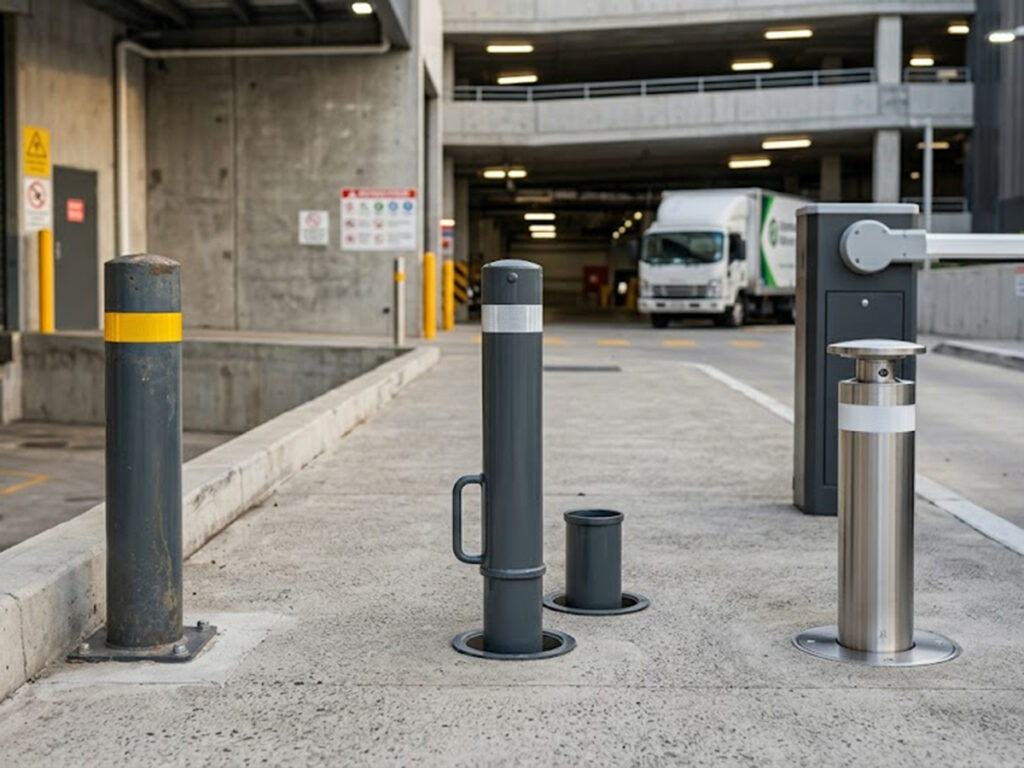
Bollards de tráfego fixo – Âncoras de perímetro permanente
Os cabeços de tráfego fixos ancoram permanentemente em uma base de concreto. O instalador perfura o pavimento e rejunta o poste, ou aparafusa uma placa de base sobre uma laje projetada. Esses postes de amarração não têm partes móveis. Eles nunca mudam o estado de acesso, não requer armazenamento, e exigem manutenção contínua mínima. Os postes de tráfego fixos tornam-se o padrão sempre que uma linha de perímetro não é negociável – cantos de docas de carga, fachadas de edifícios, e zonas pedonais adjacentes ao tráfego.
Bollards de tráfego removíveis e desmontáveis — Acesso manual sob demanda
Postes de amarração removíveis para controle de tráfego são retirados de uma tomada receptora no solo. Operadores desbloqueiam o posto, levante-o claro, e guarde-o em outro lugar. Uma vez separado, uma tampa de descarga ou placa de base visível permanece no pavimento. O mesmo produto aparece nas especificações da Austrália e do Reino Unido como postes de amarração desmontáveis. Cada poste de amarração removível depende de uma fechadura com chave ou com chave para resistir à violação. Um soquete desbloqueado reduz o perímetro a uma sugestão visual.
Bollards de tráfego retráteis — Conveniência telescópica para locais de alta frequência
Postes de amarração retráteis são telescópicos para baixo em um invólucro de subleito. Três subtipos dividem a categoria por mecanismo operacional:
- Unidades manuais assistidas por mola dependem da força do operador.
- Os modelos assistidos por gás reduzem significativamente essa força.
- Dissuasores de tráfego retráteis hidráulicos ou eletromecânicos totalmente automáticos abaixam e sobem sob comando, frequentemente integrado com sistemas de controle de acesso.
Todos os três ficam nivelados com o chão quando retraídos, o que elimina totalmente o armazenamento.
A matriz de decisão lado a lado: Custo, Acesso, Armazenar, e manutenção
A tabela abaixo condensa o perfil operacional de cada categoria. Use-o como documento base para qualquer conversa sobre compras que envolva vários tipos de postes de trânsito.
| Critério | Fixo | Removível | Retrátil |
| Método de instalação | Perfurado ou revestido com base em concreto | Tomada receptora subterrânea | Invólucro escavado com drenagem & escavação de valas |
| Mecanismo | Estacionário, zero peças móveis | Levantamento manual | Manual, assistido por gás, ou hidráulico automático |
| Frequência de acesso adequada | Nunca | Ocasional (semanalmente ou menos) | Alto (várias vezes ao dia) |
| Requisito de armazenamento | Nenhum | Armazenamento seco alto e seguro necessário | Nenhum – nivelado com o chão |
| Custo de instalação (CapEx) | Baixo a moderado | Baixo a moderado | Alto (escavação, drenagem) |
| Aparência do solo | Presença permanente | Placa de base visível quando removida | Nivele quando retraído |
| Carga de manutenção | Mínimo | Moderado (manutenção de fechadura, limpeza de tomadas) | Alto (limpeza de detritos, hidráulica) |
Fonte: Sintetizado a partir da metodologia de teste ASTM F2656/F3016, BSI NÃO 68 especificações, e dados operacionais do Storefront Safety Council
Método de instalação e pegada no solo comparados
Os postes de tráfego fixo são instalados em horas. Uma placa de base montada na superfície funciona onde a escavação é restrita. Os cabeços de tráfego fixos perfurados exigem uma base mais profunda, mas oferecem maior desempenho em caso de colisão. Os cabeços removíveis precisam de um soquete receptor fundido em uma laje – obra civil moderada, mas não há necessidade de drenagem. Unidades retráteis exigem as obras civis mais pesadas. Seu invólucro sozinho pode ficar 1.0 para 1.5 metros abaixo do nível. A drenagem é importante na instalação. Locais que economizam na drenagem pagam por isso todo inverno em falhas mecânicas.
Bollards fixos versus removíveis – a compensação entre orçamento e acesso
A decisão entre postes de amarração fixos e removíveis geralmente se resume a uma única pergunta: Este ponto de acesso precisa abrir? Ambas as categorias estão na faixa de CapEx baixa a moderada. A divergência operacional é grave. Os postes de amarração fixos oferecem flexibilidade de acesso zero, mas custo contínuo quase zero. Postes de amarração removíveis abrem o perímetro sob demanda, mas introduzem logística de armazenamento, cronogramas de manutenção de bloqueio, e risco de manuseio manual.
Bollards retráteis versus removíveis – quando a automação se paga
A comparação entre cabeços retráteis e removíveis é fundamentalmente um cálculo de ponto de equilíbrio. Unidades retráteis geram CapEx mais altos, mas comprimem a mão de obra operacional até zero. Unidades removíveis têm menor CapEx, mas cobram da equipe de operações o tempo da equipe e o aumento do risco a cada ciclo. Como regra geral, sites que precisam de acesso mais de uma vez por dia normalmente recuperam o prêmio retrátil dentro 24 para 36 meses. O acesso semanal ou mensal continua melhor atendido por unidades removíveis.
Correspondência do tipo de poste de amarração com o caso de uso do site e frequência de acesso
As especificações técnicas são importantes, mas o raciocínio baseado em cenários encerra a maioria das decisões de aquisição. A tradução da matriz de trade-off em casos de uso dá aos Diretores de Instalações uma resposta defensável para cada local.
Quando os postes de amarração fixos são a única escolha defensável
Escolha postes de tráfego fixos para serem inflexíveis, proteção permanente de ativos. O princípio aplica-se sempre que a vulnerabilidade dos ativos for elevada, e o requisito de acesso é genuinamente zero. As aplicações comuns incluem fachadas de edifícios voltadas para estradas movimentadas, Proteção de caixas eletrônicos e lojas, ilhas de bomba de combustível, e pátios somente para pedestres. As lojas de conveniência estão entre os tipos de edifícios mais atingidos no banco de dados do Storefront Safety Council, e postes de tráfego fixos continuam sendo a contramedida padrão.
Quando os postes de amarração removíveis resolvem o problema de acesso ocasional
Escolha postes de tráfego removíveis para economia, acesso ocasional ao site. Locais de eventos, pontos de acesso da pista de incêndio, zonas de carga semanais, e corredores de manutenção fechados se enquadram nesse perfil. Uma advertência domina todas as especificações removíveis: o custo não é o poste de amarração, é o trabalho. O pessoal que manuseia postes de aço diariamente expõe o empregador ao risco de lesões por esforço excessivo – a principal causa de lesões graves no local de trabalho nos Estados Unidos para 25 anos consecutivos. Locais que exigem remoção diária devem especificar núcleos leves de alumínio ou compostos, ou atualize para retrátil.
Quando os cabeços retráteis valem o prêmio CapEx
Escolha postes de tráfego retráteis para controle de acesso de alta frequência, estética aprimorada, e conveniência. Pátios de hotéis, vielas restritas do CBD, entregas de manobrista, parques de estacionamento com acesso controlado, e ruas comerciais para pedestres que admitem veículos de entrega cronometrada, todas se beneficiam. As propriedades premium também ganham uma vantagem estética – a linha nivelada do piso preserva a apresentação da fachada de uma forma que nenhuma outra categoria pode igualar.
| Tipo de poste de amarração | Princípio Operacional Básico | Frequência de acesso ideal | Aplicações comerciais mais adequadas | Risco Operacional Primário / Troca |
| Bollards de tráfego fixo | Inflexível, proteção permanente de ativos onde a vulnerabilidade é alta e o acesso de veículos é zero. | Nunca muda | Fachadas de lojas & fachadas de edifíciosATM & caixas de utilidadesIlhas de bombas de combustívelPátios somente para pedestres | Flexibilidade Zero: Restringe todo o acesso futuro de veículos; requer demolição dispendiosa se o layout do local mudar. |
| (Fechado permanentemente) | ||||
| Bollards de tráfego removíveis | Amigável ao orçamento, controle de perímetro flexível para locais que exigem acesso ocasional ou sazonal. | Baixa frequência | Pistas de incêndio & saídas de emergênciaCorredores de manutenção fechadosLocais de eventos & zonas de food truck Docas de carregamento semanais | Despesas trabalhistas & Responsabilidade: Levantar manualmente postes de aço pesados aumenta os riscos de lesões por esforço excessivo da equipe. Requer armazenamento seguro. |
| (Semanalmente, mensal, ou sazonal) | ||||
| Bollards de tráfego retráteis | Controle de acesso de alta frequência equilibrando estética premium com conveniência perfeita. | Alta freqüência | Pátios de hotéis & valet dropsRestricted CBD & vias urbanasEstacionamentos corporativos com acesso controladoCentros de trânsito & praças universitárias | CapEx Premium: Hardware inicial superior, escavação profunda, e custos de instalação de drenagem; requer manutenção preventiva regular. |
| Pátios de hotéis & gotas de manobrista, CDB restrito & vielas urbanas, Estacionamentos corporativos com acesso controlado, Centros de trânsito & praças universitárias |
Mapeando esses cenários em relação ao seu próprio portfólio de sites? Optsigns prepara folhas de especificações personalizadas site por site para operadoras de múltiplas propriedades, formatado como documentação de apoio para submissões de despesas de capital. Solicite uma chamada de escopo gratuita para padronizar especificações em todo o seu portfólio.
Avaliações de falhas, Espaçamento, e conformidade regulatória para cada tipo de poste de amarração
Padrões de teste de colisão: ASTM F2656, ASTM F3016, e pas 68 Explicado
Três padrões dominam a certificação global de postes de amarração. ASTM F2656 avalia cabeços contra impactos de veículos hostis em alta velocidade, classificando o desempenho por peso do veículo (M30 para caminhões médios em 30 km/h, M50 e 50 km/h) e profundidade de penetração. ASTM F3016 visa a proteção da vitrine em velocidades abaixo 30 mph – o alcance que a maioria dos sites comerciais realmente enfrenta. NÃO 68 é a especificação britânica amplamente adotada internacionalmente para mitigação de veículos hostis. Os fabricantes certificam todos os três tipos de postes de trânsito sob esses padrões, embora as unidades fixas dominem as classificações de impacto mais altas devido à sua conexão estrutural contínua com a fundação.
Espaçamento do poste de amarração: O 1.2 para 1.5 Medidor Padrão
Espaçamento centro a centro de 1.2 para 1.5 medidores estão alinhados com os padrões australianos e orientações de perímetro internacionais. Esta gama para veículos de passageiros e a maioria dos veículos comerciais ligeiros, preservando ao mesmo tempo o fluxo de cadeiras de rodas e peões. Espaçamento mais apertado impede a acessibilidade; espaçamento maior admite veículos estreitos. O padrão de espaçamento se aplica a todos tipos de postes de trânsito - fixo, removível, e retrátil.
Mecanismos de bloqueio e anti-adulteração para postes removíveis
Os postes de amarração removíveis introduzem uma lacuna de segurança que fixa, unidades retráteis não. Mecanismos de travamento com chave ou com chave são itens de especificação obrigatórios. Os modos de falha comuns incluem corrosão do soquete devido à entrada de água, chaves perdidas ou duplicadas, e adulteração fora do expediente. Cada instalação de poste de amarração removível de controle de tráfego deve incluir um protocolo de gerenciamento de chaves documentado e uma inspeção anual de fechadura.
Custo Total de Propriedade – Manutenção, Trabalho, e OpEx oculto
O custo de capital raramente conta toda a história da aquisição. A modelagem do custo total de propriedade em um horizonte de sete a dez anos — a típica janela de planejamento de instalações comerciais — revela onde cada categoria realmente ganha ou perde.
Cada um dos três tipos de postes de trânsito carrega uma assinatura de manutenção distinta:
- Fixo: Inspeção visual, pequenos reparos cosméticos, re-revestimento ocasional. O custo recorrente permanece mínimo.
- Removível: Limpeza trimestral de tomadas, manutenção anual de fechadura, e substituição periódica de juntas e vedações.
- Retrátil: Limpeza mensal de detritos do revestimento e do caminho de drenagem, manutenção anual hidráulica ou do atuador, e substituição programada do selo e do sensor.
Falhas retráteis agrupam-se em torno da entrada de detritos e falhas de drenagem. Areia, folhas, areia, e água gelada são os principais culpados. O maior preditor do custo de vida útil retrátil é se a instalação original especificou drenagem adequada.
O custo de mão de obra oculto dos postes de amarração removíveis
Um poste removível de aço geralmente pesa 25 para 40 quilogramas. Levantar um por dia – ou uma fileira de seis duas vezes por dia – produz exatamente o perfil de manuseio manual que impulsiona a categoria líder de veículos sérios dos EUA.. lesão no local de trabalho. O Bureau of Labor Statistics registrou 568,150 casos de dias longe do trabalho envolvendo entorses, cepas, e lágrimas em 2024, com apenas lesões nas costas sendo responsáveis por 248,180 casos (Fonte: https://laclinicasc.com/work-injury-pt/). Liberty Mutual's 2025 O Índice de Segurança no Trabalho precificou o esforço excessivo envolvendo fontes externas em $13.7 bilhões anualmente – o fator de custo número um para 25 anos consecutivos (Fonte: https://Riskandinsurance.com/understanding-the-58-billion-problem-how-the-top-10-workplace-injuries-impact-american-business/). Qualquer site que remove postagens diariamente especifica núcleos leves ou atualiza as especificações.
Modelagem do TCO de 10 anos em todos os três tipos de postes de tráfego
Os cabeços fixos transferem antecipadamente quase todos os custos para CapEx. Unidades removíveis distribuem custos entre CapEx e mão de obra contínua. As unidades retráteis apresentam o maior CapEx, mas reduzem o trabalho operacional a quase zero – desde que a drenagem tenha sido especificada corretamente na instalação. A drenagem subespecificada continua sendo a causa mais comum de ruptura do TCO em toda a categoria retrátil.
Construindo um caso de aquisição defensável para sua próxima revisão de capital
A conversa sobre aquisições geralmente termina não na doca de carga, mas no comitê financeiro. Estruturar a recomendação para sobreviver a essa revisão separa as especificações competentes das defensáveis.
As cinco perguntas a serem respondidas antes de especificar
Cinco questões resolvem mais tipos de postes de trânsito decisões:
- Qual é a frequência de acesso realista neste ponto - medida, não estimado?
- Qual é a vulnerabilidade dos ativos por trás da linha?
- Qual é a ameaça máxima credível do veículo (massa e velocidade de aproximação)?
- Qual é a realidade de armazenamento e manuseio manual deste site?
- Qual o padrão estético e de marca da fachada?
Cada resposta restringe o campo. Alta frequência de acesso mais capacidade de armazenamento zero apontam para retrátil. Vulnerabilidade grave de ativos mais necessidade de acesso zero apontam para um. Acesso ocasional mais um ponto de orçamento apertado para removível.
Documentação que sua diretoria espera
Uma submissão de capital de segurança de perímetro defensável inclui cinco artefatos: uma avaliação de ameaças específica do local, certificação de classificação de acidentes (ASTM F2656, F3016, ou NÃO 68), um desenho de conformidade de espaçamento, uma projeção do cronograma de manutenção, e um modelo de TCO de 10 anos. Os conselhos aprovam submissões apoiadas por este conjunto de documentação de forma muito mais confiável do que aquelas baseadas apenas em cotações de fornecedores.
Onde esta decisão se encaixa em uma estratégia mais ampla de Bollard
A decisão fixa versus removível versus retrátil é uma camada de um processo de especificação maior. Seleção de materiais, padrões de acabamento, integração de iluminação, e benchmarking de fornecedores acompanham a decisão da categoria de acesso. As equipes de instalações que se preparam para revisões de perímetro em nível de diretoria devem consultar nosso comparação completa do comprador do poste de amarração de tráfego, que percorre a estrutura de especificações mais ampla de todos os principais fabricantes e níveis de classificação de falhas.
Preparando uma revisão de perímetro para seu próximo ciclo de despesas de capital? Solicite uma avaliação de perímetro gratuita no local agora! Optsigns fornece recomendações de especificações escritas, documentação de classificação de falhas, e uma projeção de TCO de 10 anos formatada para revisão pelo conselho.
Perguntas frequentes sobre fixo, Removível, e postes de tráfego retráteis
Qual é a principal diferença entre fixo, removível, e tipos de postes de tráfego retráteis?
Os postes de amarração fixos ancoram permanentemente sem nenhuma peça móvel. Postes de amarração removíveis são retirados de uma tomada enterrada para acesso ocasional. Os postes de amarração retráteis são telescópicos até um invólucro de solo para uso frequente, acesso frequentemente automatizado. A escolha depende da frequência de acesso, requisito de proteção de ativos, e carga de manutenção tolerada.
Com que frequência os postes de tráfego retráteis realmente emperram em condições do mundo real?
O bloqueio é esmagadoramente um problema de instalação, não é uma falha do produto. Drenagem inadequada, faltando selos de detritos, ou carcaças subdimensionadas causam a maioria das falhas. Dissuasores de tráfego retráteis adequadamente especificados operam de forma confiável para 10+ anos. A remoção mensal de detritos e a manutenção hidráulica anual mantêm os mecanismos dentro da tolerância.
Os postes de amarração removíveis são fortes o suficiente para parar um veículo?
Sim — quando certificado pela ASTM F2656 ou PAS 68 e instalado com um soquete receptor projetado. A segurança depende inteiramente da trava estar acionada. Um soquete desbloqueado ou desgastado reduz um poste de amarração removível a uma indicação visual, não é uma barreira física.
Qual é o espaçamento correto entre os postes de trânsito?
O padrão aceito nas orientações australianas e internacionais é 1.2 para 1.5 metros centro a centro. Esta gama pára veículos de passageiros normais e a maioria dos veículos comerciais ligeiros, preservando ao mesmo tempo o acesso de peões e cadeiras de rodas.. Sites com perfis de ameaça mais elevados podem especificar espaçamentos mais restritos juntamente com classificações de falhas atualizadas.
Os cabeços fixos e removíveis podem ser misturados no mesmo perímetro?
Sim – muitos sites comerciais de alto funcionamento fazem exatamente isso. Um padrão comum coloca postes de amarração fixos ao longo da linha contínua protegida e reserva unidades removíveis ou retráteis apenas para pontos de acesso definidos (cais de carga, rotas de emergência, entradas de serviço). A abordagem híbrida equilibra integridade perimetral com flexibilidade operacional.
Qual tipo de poste de amarração oferece o menor custo total de propriedade em 10 anos?
Para sites com necessidades de acesso zero ou quase nulas, postes de amarração fixos oferecem o menor TCO por uma margem significativa. Onde o acesso diário é necessário, postes de amarração retráteis normalmente oferecem menor TCO do que unidades removíveis, uma vez que o trabalho, armazenar, e o risco de manuseio manual são custeados - desde que a instalação tenha especificado drenagem adequada.
Referências
- ASTM International, “Método de teste padrão F2656 para testes de colisão de barreiras de segurança de veículos” e “Método de teste padrão F3016 para testes substitutos de dispositivos de proteção contra impacto de veículos em baixas velocidades.”
- Grupo BSI, “NÃO 68:2013 Especificações de teste de impacto para sistemas de barreiras de segurança de veículos.”
- Liberdade Mútua, “2025 Índice de Segurança no Trabalho,” Grupo Mútuo Liberdade, Julho 2025.